

Cvengros Leaves Lasting Impact
By
Geoff Kimmerly
MHSAA.com senior editor
April 1, 2014
Retired Associate Director Jerry Cvengros, who served at the Michigan High School Athletic Association for more than 13 years after three decades at Escanaba High School, died Monday evening in Lansing. He was 80.
As lead assistant to Executive Director John E. “Jack” Roberts from August 1988 until retiring in January 2002, Cvengros served as director of football and briefly hockey in addition to coordinating the Program of Athletic Coaches Education (PACE), presenting annual in-service training for administrators and serving as MHSAA liaison to statewide principals, athletic directors and coaches associations.
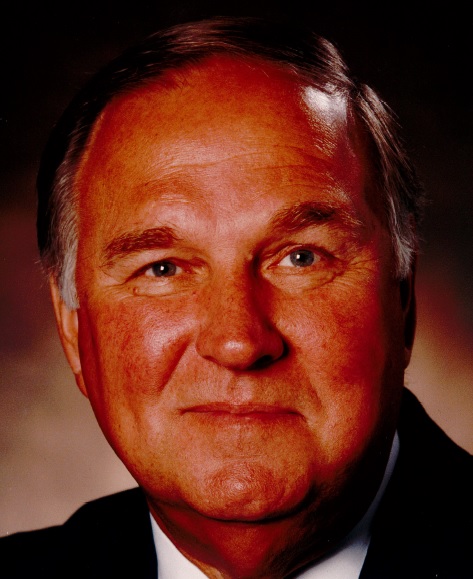 He came to the MHSAA after 30 years at Escanaba, where he taught, coached, served as athletic director and later principal during a tenure stretching from August 1958 through July 1988. While at Escanaba, Cvengros also represented Upper Peninsula Class A and B schools on the MHSAA Representative Council from 1983-88 and served as the Council’s president from 1986-88.
Cvengros received the MHSAA’s Charles E. Forsythe Award in 2000 in recognition of his many and significant contributions to interscholastic athletics.
“During his lifetime, Jerry Cvengros impacted every area of interscholastic athletics as a coach, athletic director, principal and then associate director of the MHSAA," Roberts said. “He was the perfect combination of fairness, toughness and diplomacy, able to draw on a vast knowledge of MHSAA rules and an understanding of educational athletics fostered by his various experiences.
“Jerry was known and respected statewide for his dedication, and his contributions have had a lasting impact.”
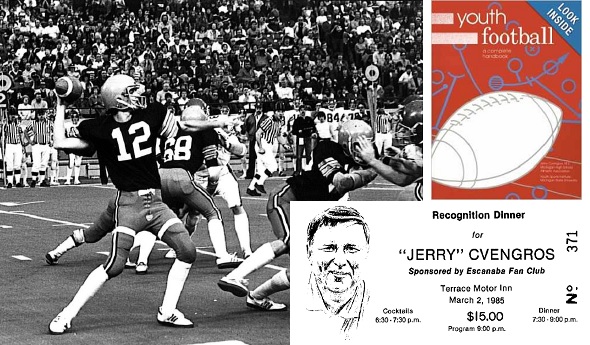
Cvengros built an elite football program at Escanaba as varsity head coach from 1962-84, leading the Eskymos to a 161-42-3 record, a Class A runner-up finish in 1979 and the MHSAA championship in 1981. That team remains the only Class A/Division 1 team from the Upper Peninsula to win an MHSAA football title. Cvengros was inducted into the Michigan High School Football Coaches Association Hall of Fame and served on its original Board of Directors.
His 1979 team fell to Detroit Catholic Central 32-7, but he brought the Eskymos back to the Finals for a 16-6 win over Fraser two seasons later. Cvengros' championship lineup included quarterback Kevin Tapani, who would go on to pitch for the Minnesota Twins among five major league clubs, and tailback Dean Altobelli, who later played at Michigan State University. The title run included a 15-14 Semifinal win over Dearborn Fordson that included a savvy two-point conversion call by Cvengros, who wanted to avoid overtime after a late score drew Escanaba to within a point of tying the score.
As the MHSAA’s director of football, Cvengros was instrumental in creating the current playoff format that expanded the field from 128 to 256 teams beginning with the 1999 season. He also co-authored “Youth Football: A Complete Handbook,” a guide to coaching at that level.
Among many additional honors, Cvengros was inducted into the Upper Peninsula Sports Hall of Fame and Michigan High School Coaches Association Hall of Fame and received the Distinguished Service Award from the Michigan Interscholastic Athletic Administrators Association. The National Federation of State High School Associations twice awarded Cvengros with a Citation – the NFHS’ highest honor – for his service as a coach and then as a member of the MHSAA staff.
Since his retirement, Cvengros and his wife Shelley have continued to reside in Okemos. A visitation will take place beginning at 10 a.m. Monday, April 7, at St. Martha Parish in Okemos, with a funeral Mass to follow at 11 a.m.
Cvengros was a 1951 graduate of Ironwood High School and went on to study and play football at the University of Wisconsin in Madison. He earned his bachelor’s degree in secondary education and teaching from the University of Wisconsin-Superior and a master’s from Northern Michigan University.
He taught English, history and physical education at Escanaba High School and also coached basketball and track and field. He became the school’s athletic director in 1970, added the duties of activities director in 1975 and became principal in 1983.
Cvengros is survived by his wife and children Michael, Steven and David, and seven grandchildren. He was preceded in death by his daughter Lee Ann (Cvengros) Swasey in May 2013.
PHOTOS: (Clockwise from left) Escanaba quarterback Mike Beveridge fires a pass during the 1979 Class A Final; Cvengros co-authored a book on coaching youth football; Cvengros was celebrated once more in Escanaba following his final season as football coach.
'All Together' Onekama Seeks 1st Football Title
November 16, 2018
By Chris Dobrowolski
Special for Second Half
ONEKAMA — The Upper Peninsula is soon to be invaded by Portagers.
 The village of Onekama, meanwhile, might resemble a ghost town.
A large and loyal following for the Onekama football team is geared up for a trip to the Superior Dome in Marquette, site of Saturday’s 8-Player Division 2 Football Final, where the Portagers (10-2) are taking on Rapid River (9-3) in their quest for the school’s first MHSAA football championship.
“It’s really energized the community,” said Onekama head coach John Neph. “I’m so happy that our local community has responded so well. It means so much to have this special event going on.”
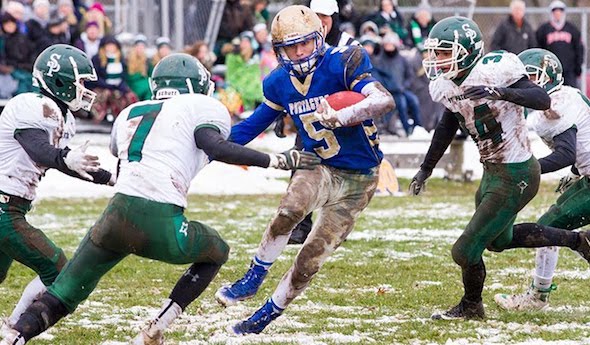
Yard signs and window decorations have sprung up all over town. Residents have stepped forward to find out how they can aid the team during its journey to the championship game, while fans have shown up to games in droves as the team has advanced farther in the postseason, past the likes of Marion (22-6), Brethren (52-0) and Portland St. Patrick (28-14).
“Everyone’s supporting us. The community here is amazing, especially for the football program,” said running back/linebacker Ben Acton. “We had the most people we’ve ever had for our games in the playoffs this year. It’s awesome seeing everybody out there in the stands and after the games.”
The Portagers have given their fans plenty to cheer about. The program had four playoff wins all-time entering this season, and they have nearly doubled that total with this playoff run.
Getting to the championship game wasn’t at the forefront of Onekama’s goals this season, but it hasn’t come as a complete shock, either. The Portagers had five seniors and three top juniors returning to a squad that went 9-2 in 2017.
“We thought we could be pretty good,” said Neph. “Then we had a really good preseason camp, and we got better. We were very pleasantly surprised with the overall development of our players. Our guys have gotten better and better as the season has gone on.”
It’s a squad that has embraced the team aspect of the game. Sure, there are standouts — Acton and junior running back/linebacker Aaron Powers have been playmakers on both sides of the ball, senior Rylan Clarke has led from his tight end position, and senior Wyatt Lawson and junior Wade Sedlar anchor the offensive and defensive lines, respectively — but the Portagers relish functioning as one cohesive unit.
“This isn’t one person’s team. Or the coaches’ team. It’s our team,” said Neph. “It’s all of us together. That has made a huge difference with the morale, and the long run we’ve had. Sometimes at the end of a season you can get tired of going to practice, and I don’t think we’ve ever experienced that. It’s a group of guys that like coming out here, enjoy working with each other. We have some fun, and we’ve been winning, which helps.”
 Onekama has proven it can score points, having topped the 50-point plateau four times. The Portagers like to be known as a stout defensive team, though. They’ve backed that up by shutting out four teams this year, not counting two forfeit victories.
“We really take pride in our defense,” said senior defensive back Ben Johnson, one of four defensive players to receive accolades on the all-Midwest Central Michigan Conference West teams. “We’re a defensive team but our offense — when it clicks, it clicks too.”
The Portagers finished third in the West after they had tough losses to league champion Wyoming Tri-unity Christian (28-26) and runner-up Suttons Bay (13-8). Neph felt like the loss to Suttons Bay, which came two weeks before the start of the postseason, ignited Onekama’s push through the playoffs.
“We lost it late in the game on a long pass,” said Neph. “It felt like we were about to win the game, and to have it taken away from us like that, that was tough. I’m extremely proud of our guys. That’s where the upperclassmen stepped forward and said, ‘We lost today, but we’re going to bounce back and keep going.’ I would say that was a significant turning point for us. We got back to work and moved forward from there.”
The Portagers have reeled off four straight wins and whipped the entire school and community into a frenzy.
“It’s great,” Clarke said of the atmosphere at school. “Our math teacher looked at us today and said, ‘I still can’t believe you guys are going to the Finals.’ Our student support is tremendous. For a small community like us, this is great.”
Advancing this deep into the postseason has created a lot of additional planning and extra responsibilities for Neph and his staff, including making arrangements for hotel accommodations, transportation and meals for the team. He wouldn’t want to have it any other way, with the opportunity to win a Finals championship.
“It would just be an unbelievable, historical moment for our school to win the state championship,” he said. “It would be the crowning event of a lot of people putting hours and hours and hours of work into the football program. For the players, it would be the ultimate experience for them. Something that will last the rest of their lives.”
Win or lose, this season and this playoff performance already has created a deep bond among the 18 players on this year’s Onekama squad.
“We’re brothers,” said Clarke. “We’ll probably be brothers for the rest of our lives. We’ll probably all be coaching our kids together when we’re 30 and 40.”
 Chris Dobrowolski has covered northern Lower Peninsula sports since 1999 at the Ogemaw County Herald, Alpena News, Traverse City Record-Eagle and currently as sports editor at the Antrim Kalkaska Review since 2016. He can be reached at [email protected] with story ideas for Manistee, Wexford, Missaukee, Roscommon, Ogemaw, Iosco, Alcona, Oscoda, Crawford, Kalkaska, Grand Traverse, Benzie, Leelanau, Antrim, Otsego, Montmorency, Alpena, Presque Isle, Cheboygan, Charlevoix and Emmet counties.
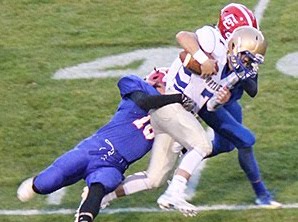
PHOTOS: (Top) Onekama’s Ben Acton (5) finds an opening among four Portland St. Patrick defenders during last week’s Semifinal win. (Middle) Luke Mauntler (7) drags along two Manistee Catholic Central defenders during a Week 6 victory. (Photos courtesy of the Onekama athletic department.)