

Dedication Continues to Make Difference as Pittman Elevates Game, Shores' Offense
By
Tom Kendra
Special for MHSAA.com
September 11, 2024
Jonathan Pittman lives by the acronym “PGF.”
 “My mom gave me that life motto; it stands for 'Put God First,'” explained Pittman, the senior quarterback for Muskegon Mona Shores, which is off to a 2-0 start.
“That is the core of who I am.”
Those aren’t just words for Pittman, who starts every day – Monday through Friday, from 6 a.m. to 7, when much of the world and most 17-year-olds are still sleeping – by going to church to study his Mormon faith at the Spring Lake Ward of the Church of Jesus Christ of Latter-day Saints.
He heads directly from there to school, where he either practices throwing the football or shooting the basketball (Pittman is also a standout on the Sailors’ hoops team). Then it’s off to the classroom – where, by the way, he is a straight-A student in honors classes.
Only when all of that is completed does he switch his focus solely to football. The 6-foot-2, 205-pound senior is a three-year starter with a rocket arm and the power to run over linebackers like a fullback.
“Pitt is the hardest-working kid I have ever coached,” said 14th-year Mona Shores coach Matt Koziak, who has led the Sailors to four Division 2 championship games and won two, in 2019 and 2020.
“He is very critical of his own game. He identifies where he needs to get better, and he just keeps working at it.”
Koziak can track how much film his players are watching. One day, he checked and noticed that senior linebacker and film study devotee Solomon Robertson had logged two hours on that day. The only player with more was Pittman – with six hours.
Pittman’s work ethic appears to be paying dividends, as he’s led the Sailors to impressive road wins over Grand Blanc (28-26) and River Rouge (21-6) to open the season and heading into yet another road game this week at undefeated Flint Hamady.
He did it with his feet against Grand Blanc, running 25 times for 192 yards and throwing for only 43. Against River Rouge, it was just the opposite – he completed 9-of-13 passes for 127 yards, while rushing for just 30.
Pittman comes from good pedigree. His father, also Jonathan Pittman, is a California native and former standout receiver at Brigham Young University who went on to play three years in the NFL for Buffalo, Tampa Bay and the New York Jets. His mother, Quintina, was a three-sport high school star whose college sports dreams were cut short by a knee injury.
 The Pittmans moved to Muskegon in 2014 when his father was hired as the general manager at The Lakes Mall, a position he held for five years. (The younger Pittman, who is the second oldest of four children, said his family is not related to any of the many Pittmans in the Muskegon area.)
Pittman has always had a big arm, which allowed him to earn the varsity starting role as a sophomore. Last fall, he completed 87-of-134 passes for 1,391 yards and 15 TDs. His main targets this fall are wideouts Jaeger Johnson and Micah Carafelle and tight end George Duggins.
Pittman is equally well-known for his power running, forming a tough-to-tackle 1-2 duo with junior running back Tomarion “Ike” Steward (5-11, 205).
The biggest improvement for Pittman so far this season has been his increased speed and agility, as he has slimmed down from 218 pounds to 205.
“I wasn’t as fast as I needed to be and couldn’t execute some of the things we like to run,” said Pittman. “I needed to work on that. Our offense is much more diverse this year. We have a ton of weapons, and we can hit teams from all angles.”
Koziak hopes his quicker quarterback will give his team the extra edge it needs in huge Ottawa-Kent Conference Green games at home against Byron Center (Sept. 20) and at Muskegon (Sept. 27) – both against likely Division 2 playoff opponents.
Shores made it to the Division 2 Final four times in eight years, losing to Warren De La Salle Collegiate in 2014 and 2018, then defeating Detroit Martin Luther King in 2019 and De La Salle in 2020. The Sailors have not advanced out of their District the past three years.
Right now, Shores is just waiting to play a game in West Michigan, and will have traveled 1,030 miles round-trip for their first three this season.
The most puzzling aspect of Pittman’s football career thus far is his surprisingly small number of college scholarship offers. Wayne State, Lawrence Tech and Siena Heights have made offers, while Eastern Michigan and Northern Illinois have made the trip to Muskegon to watch him throw.
Pittman, who plans to major in accounting, is not doing any lobbying – preferring to let his play on Friday nights speak for itself.
One thing is for certain: He has made a believer out of Koziak, who has been coaching football for more than 20 years, with prior stops as offensive coordinator at Muskegon Heights and head coach at Muskegon High in 2009.
“I will say this: Wherever he goes, by his junior year, he will be a team captain,” said Koziak. “You combine his athletic ability and his work ethic, and it’s magic. He’s a special kid; a generational kid.”
 Tom Kendra worked 23 years at The Muskegon Chronicle, including five as assistant sports editor and the final six as sports editor through 2011. E-mail him at [email protected] with story ideas for Muskegon, Oceana, Mason, Lake, Oceola, Mecosta and Newaygo counties.
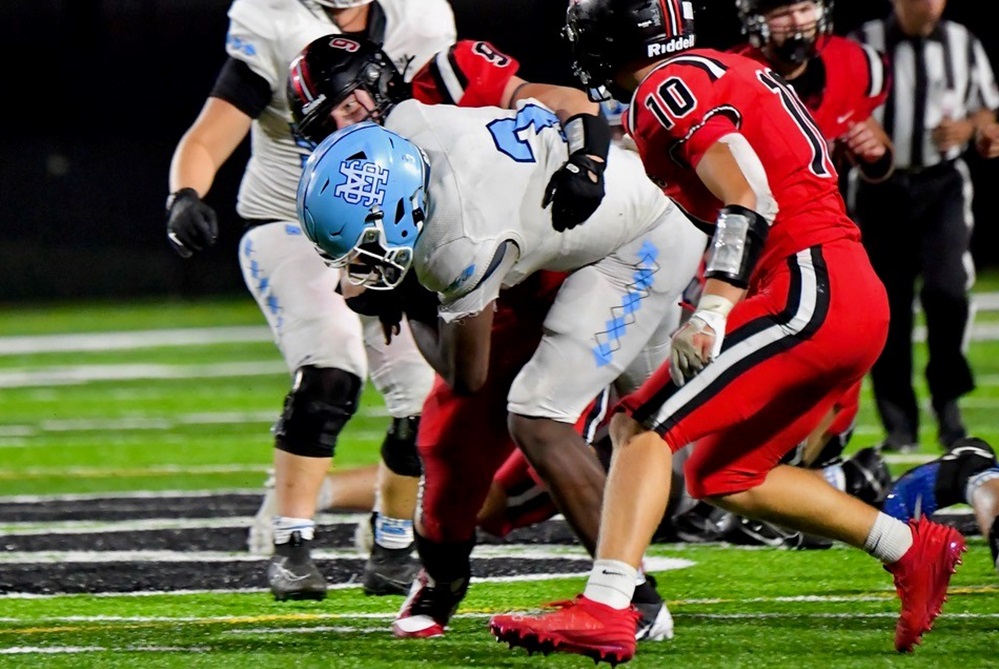
PHOTOS (Top) Muskegon Mona Shores' Jonathan Pittman powers into the Grand Blanc defense during his team's season-opening win. (Middle) Pittman watches as a teammate carries the ball upfield. (Photos by Terry Lyons.)
MHSAA Vault: Shooks a Legend as Freshman Coach
By
Geoff Kimmerly
MHSAA.com senior editor
September 4, 2026
The following originally appeared in the Lansing State Journal on Oct. 28, 2004, and was reprinted by the MHSAA that winter.
Wayne Shooks retired from coaching entirely in 2008 and died Tuesday at the age of 84.
Wayne Shooks tried the varsity football thing once. Some time during the late 1980s, longtime DeWitt coach Gail Thornton asked Shooks to be his offensive coordinator.
“I didn't sleep a night. My wife, after three weeks, said, ‘You're going back to freshmen,’” Shooks remembered.
And those three weeks were in the month of June.
But Shooks' wife must have been on to something. Because few, if any, freshman football coaches have accomplished what Shooks finished with one last win last fall.
He ended his 16th and final season as freshman coach with a 135-2-1 record.
Amazing.
“You can't lose a game for him, or you'll feel bad,” DeWitt senior Mat Brynick recalled from his days as a freshman. “Coach never says it, but it's what everyone expects.
“He taught us how to win.”
 Guys like Shooks, 62, usually go unappreciated.
They get the kids fresh to high school, fresh to high school sports, and still learning things like not spiking the ball after a touchdown.
But few freshman football coaches are as legendary as Shooks is in DeWitt. They are so unappreciated that it's impossible to find out if anyone has accomplished what he's done.
Shook is not big on numbers. Never has been during his 41 years teaching in the district, or more than 20 coaching everything from football to basketball to wrestling to tennis. Oh, and track since 1980.
He also coached 8th-grade football for a few years, junior varsity for one season and was a varsity assistant. But he'll be remembered for what he did with the freshmen.
The losses came in 1993 to Mason during a terrible wind storm, and in 2002 to Greenville. That same year, the Panthers tied Haslett, meaning it was the only year during his tenure that DeWitt wasn't sure if it finished first in its league, since league titles aren't handed out at the freshmen level.
“The kids felt bad. They did their best,” Shooks remembered.
But the losses, however few, were more of a relief for Shooks than a letdown.
Don't take that to mean Shooks doesn't like to win.
Sure, he embraced the role of teacher as much as any freshman coach. But as DeWitt varsity coach Rob Zimmerman said, “If he was a 5th-grade coach, he'd be the most competitive 5th-grade coach you've ever seen.”
“I never pointed (our record) out, it was not our goal,” Shooks said. “Our goal was to win the next week. Although the kids knew it. They just assumed we were going to go 9-0, I guess.”
Guess so.
Shooks had more easily-attainable goals:
- Have fun
- Learn fundamentals
- Emphasize the logical stuff, like the importance of bringing equipment to school every day
“He does a really good job teaching expectations about being young men and being great students,” Zimmerman said. “It's gigantic.”
And it kept kids coming back to junior varsity and varsity. You could hear the fun coming out in Brynick's voice.
He was remembering his freshman football experience, remembering his time with perhaps Michigan's most successful coach at that level.
“I remember a few games, we'd find one play that works, and we ran it to death, pounding it and pounding it,” Brynick recalled. “He loves running the same play over and over. If you can do that, march 80 yards down the field, you're doing something right. No one could stop us.”
That was not all Brynick remembered, or didn't.
Shooks almost never yelled. If he did, it meant a kid messed something up over and over and over again.
He has a doctorate in zoology. Education is obviously a big deal. He loves to win, but he loves to teach. And he's hesitant to go looking for any attention for what he's done.
All made him a perfect freshmen football coach.
“Sometimes I don't think people understand about coaches. You think college level, they are coaches first, that's their job, but not at the high school level,” Shooks said.
“It's not what I've done, it's what they've done. I've always believed the focus should be on the kids. My job is a teacher. I coach because I love to coach.”
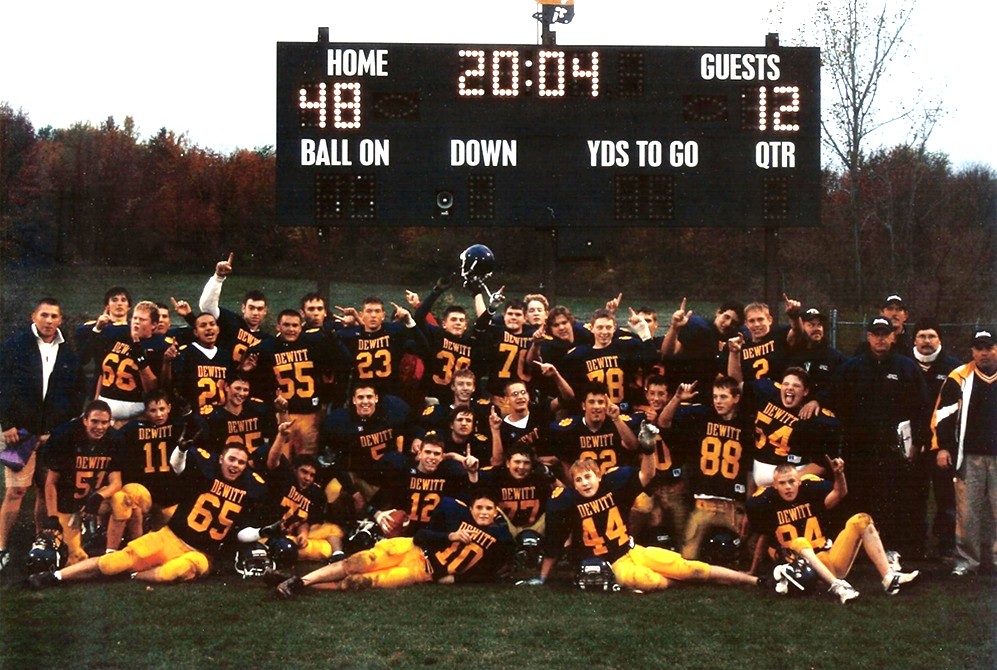
PHOTO DeWitt freshman coach Wayne Shooks, fourth from right, stands for a photo with this final football team in 2004. (Photos courtesy of the DeWitt football program.)