

DeLaSalle Hammers Home 1st Title
November 28, 2014
By Geoff Kimmerly
Second Half editor
DETROIT – When his team fell to 3-3 to start October, Warren DeLaSalle football coach Paul Verska said he was the only one who believed the Pilots could still finish this fall at Ford Field.
And he realized again before last week’s Semifinal against Southfield that his “loosey-goosey goofball group” was more than prepared for championship game pressure as his four captains danced to M.C. Hammer’s “Can’t Touch This” in the snow.
The final 30 seconds of the fourth quarter were not always kind to DeLaSalle this season; all three losses, over three straight weeks, came by seven or fewer points as their opponents took the lead during the final half-minute.
“That kinda strengthened us as a team. We said we’ve pretty much got to go out and get it and not leave it behind the last 30 seconds or a minute,” Pilots senior quarterback Joey Garbarino said. “Me and the captains, pretty much the whole team, pretty much everyone knew. We knew what we could do.”
Over the last five weeks, DeLaSalle showed everyone else – and finished by earning the school’s first MHSAA football championship with a 44-8 win over Muskegon Mona Shores that probably still surprised plenty despite the Pilots’ recent body of work.
DeLaSalle (10-3) gave up only 9.9 points per game during its closing eight-game winning streak and avenged one of those losses by eliminating reigning three-time champion Birmingham Brother Rice in the Regional Final.
Mona Shores (12-2) averaged 39.5 points per game entering Friday and had run for more than 3,000 yards. But the Sailors managed only 99 on the ground and 201 total and didn’t score until the final four minutes of the third quarter.
“I told our kids when we got here that it isn’t how many Ws you have, but who you play,” Verska said. “I said we have a tough schedule, and I know we’re physical. And I knew deep down in my heart we could be more physical than them. I knew they had some great athletes, but I thought if we pounded on them, pounded on them, pounded on them, they wouldn’t go four quarters with us toe to toe.”
The quarterback conversation this week focused on Mona Shores senior Tyree Jackson. The four-year starter carried the Sailors to their first playoff game last season and through most of this school-record postseason run, but watched the end of the team’s 25-24 Semifinal win over Farmington Hills Harrison from the sideline on crutches after sustaining an injury. A University of Buffalo recruit, Jackson threw 24 touchdown passes and ran for 14 scores this season.
Garbarino hasn’t had nearly that buzz although he’s been plenty solid in succeeding a pair of quarterbacks now playing in the Big 10 – University of Michigan’s Shane Morris and Rutgers University’s Giovanni Rescigno.
Garbarino’s numbers this season were solid – 11 touchdowns passing, 10 rushing and just under 1,700 yards combined – but he saved the spectacular for Friday rushing 18 times for 85 yards and two scores and completing all seven of his passes for 89 yards and another score.
“We call the plays in the huddle, and he tells them to man up and let’s go; we’re going to get the three, four, five, six yards, whatever it is,” Verska said. “If I wanted an H-back or a fullback or tight end, this would be my guy. If I wanted a linebacker, this would be my guy. But he sacrificed for the team and played quarterback, and it’s like another fullback running with the ball when he gets it.”
DeLaSalle’s primary back was excellent Friday as well. Sophomore Allen Stritzinger ran for 175 yards on 18 carries, including a 56-yard scoring burst just more than four minutes into the second quarter that helped the Pilots build a 20-0 lead.
 Senior Jake Townsley – also a standout goalkeeper on the District finalist soccer team – set an MHSAA Finals record with three field goals, from 41, 23 and 29 yards. Senior Alex Spicuzzi caught only one pass – but it was for a score. Junior linebacker Eric Rogers and senior defensive back Cooper Gammon had nine and eight tackles, respectively, as Mona Shores didn’t get past the Pilots’ 44-yard line until that scoring drive midway through the third quarter.
Jackson wouldn't say how much his injury limited him in the Final, but he battled on despite not being at 100 percent. He did complete 17 of 27 passes for 102 yards but ran for just 14. Senior running back DeOntay Moffett ran for 85 yards, but the Sailors didn’t hold onto the ball for more than 2½ minutes during a possession until, again, that scoring drive when they trailed 30-0.
They also played without junior Hunter Broersma, a starter at receiver and defensive back who was ill and unable to suit up. Junior Tyler Trovinger, the back-up quarterback and a starting defensive back, did play despite also being injured last week and caught the lone scoring pass and made 10 tackles. Junior linebacker Dominique Shermeta had 12 tackles.
“The coaching staff got here four years ago, and we had 66 kids in the program (grades) 9-12,” said Mona Shores coach Matt Koziak, who previously coached multiple levels at Muskegon High. “We go 1-8 the first year, and the kids easily could have been, ‘This is the same old thing.’ But they saw something and were able to work for something.
“I’ve been part of three state championships at Muskegon in one way or another … and this has been my favorite season. I’ll never forget these guys, ever.”
DeLaSalle had made the Finals twice before, finishing runner-up in 2006 and 2008.
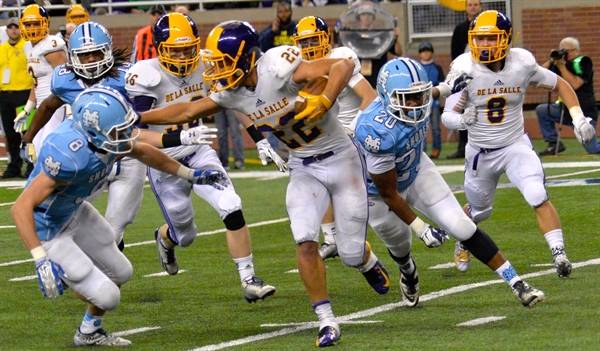
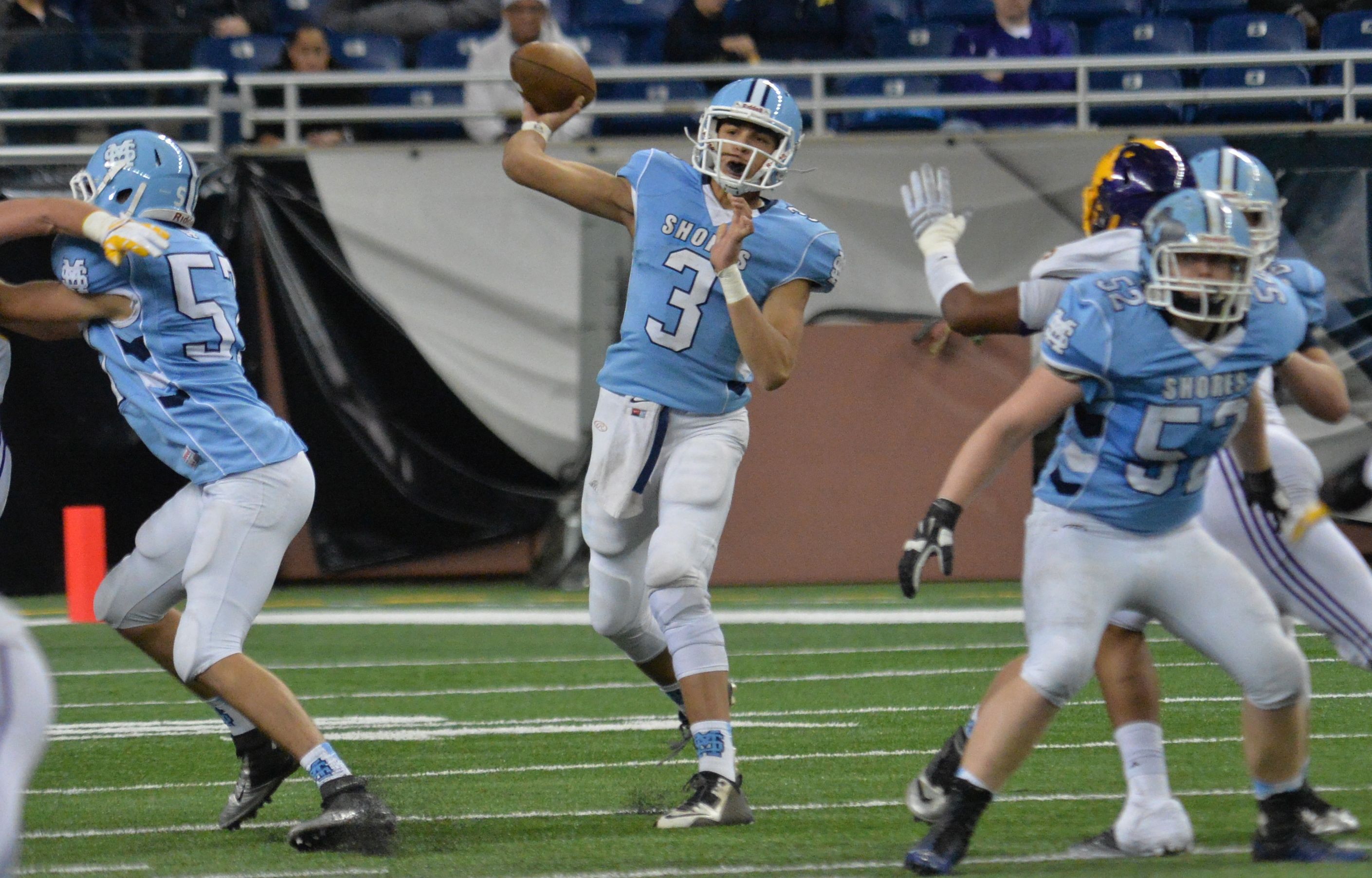
PHOTOS: (Top) DeLaSalle running back Allen Stritzinger pushes ahead for yards as Mona Shores’ Austin Wingett (8) and Kentrell Eason (20) pursue. (Middle) Sailors quarterback Tyree Jackson prepares to unload a pass Friday. (Click for action photos and team photos from Hockey Weekly Action Photos.)
VIDEO HIGHLIGHTS:
STRITZING GOES THE DISTANCE - Allen Stritzing rushed for 175 yards for Warren DeLaSalle in the Division 2 Final, 56 of it coming on this second quarter TD run.
MONA SHORES TOUCHDOWN - Muskegon Mona Shores got on the scoreboard in the third quarter on this 12-yard pass from Tyree Jackson to Tyler Trovinger.
Watch the entire game and order DVDs by Clicking Here.
Behind Scenes, St Mary's Goes to Goddard
September 27, 2016
By Keith Dunlap
Special for Second Half
As a coach and athletic director at Orchard Lake St. Mary’s over nearly three decades, George Porritt has been asked plenty of times to recall details from his football program’s storied past.
 That comes with coaching a program that annually has a roster full of highly-touted high school players coveted by college recruiters and has seen the best not only shine for prominent college programs but also NFL organizations (see Allen Robinson of Jacksonville).
“When was the last time a player did that?”
“What is the school record in this category?”
“How often has your team done this in a season?”
“When was the last time you lost to this opponent?”
Porritt’s answer is usually quick and consistent.
“Ask Robin Goddard,” Porritt typically says.
For the past 40 years, turning to Goddard has been a frequent option for anyone around St. Mary’s, and for that matter, other schools around the state.
It is why there will be lots of people in the prep sports community thinking of him when he has surgery on Thursday to break up kidney stones that have been bothering him during recent weeks.
Goddard each year puts together media guides with records and teams at St. Mary’s that go all the way back to the early 1900s. (See "Michigan's Football Past: A Must Read")
He can easily point out the fact that St. Mary’s won a state basketball championship in 1933, lost in the state basketball semifinals in 1919 and won its first state baseball championship in 1913. (Note: The MHSAA was not formed until Dec. 1924; previous championship tournaments were hosted by various entities around the state.)
“If he doesn’t have it in something, he finds it right away,” Porritt said. “He goes to the library and he tries to dig it up. He calls the other school and has done it for years. He keeps a great history of our school.”
Surely though, there have to be times when people raise their eyebrows at Goddard and wonder how he can possibly get accurate information from a century ago, right?
Actually, not really.
Not around St. Mary’s, anyway, even if it is hard to fathom for many others that high school sports in Michigan actually did exist before the start of World War I.
“I won’t even challenge him,” Porritt said. “I know he found it somewhere. He’ll tell other schools what their records are historically, and they don’t even know what theirs is. He has fun doing it and will go anywhere and find any way to find out the history of whatever he is looking into.”
Goddard’s importance to the school isn’t limited to being arguably the Encyclopedia Britannica of prep sports in the state of Michigan.
Also a facilities coordinator and valuable fundraiser, Goddard has spearheaded projects to put a track and lights at the football field, and was the architect of one of the most ambitious and out-of-box ideas ever seen at the school – the red artificial playing surface now on the football field.
 During Labor Day weekend in 2011, Goddard flew to Cheney, Wash., to meet with officials at Eastern Washington University, which at the time had the only red-colored artificial football field in the country.
Goddard picked the brains of the folks at Eastern Washington, came home and started a fundraising effort to try and secure $600,000 to bring a red-colored artificial surface to St. Mary’s.
By the following spring, the funds were raised and construction began on the field that was ready by the start of the 2012 season.
At the time, it was the third red-colored field in the country in addition to Eastern Washington and a high school field at Canyon High School in Texas.
Goddard also helped start the annual Polish Country Fair that takes place on the St. Mary’s campus every Memorial Day weekend, which is one of the most regularly-attended festivals in the Detroit area.
Len Karschnia, an administrator and assistant coach for the both the football and basketball teams at St. Mary’s, said when Goddard gets in touch with alums who have the means to donate back to the school, there usually is no hesitation because of their respect for Goddard.
“They always trust Robin to do that,” Karschnia said. “Everything he does (is) for the kids and the school, and that is why nobody is really reticent to give back to any projects that he runs because if he tells you on Tuesday he wants $500 to put up a banner in the gym, on Thursday the banner is up and done and there is a plaque on the wall saying thanks to whoever gave it to him.”
A staple at the school since he arrived in 1976, there obviously will be a lot of prayers and well-wishes around the state for a speedy recovery from surgery.
“He is a guy that whatever St. Mary’s needs, he’ll do it and he doesn’t need any fanfare for his good deeds,” Karschnia said. “It’s all for the kids, for George and for the school. That is really his value.”
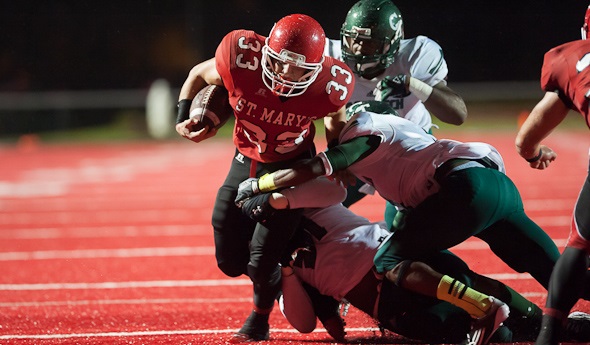
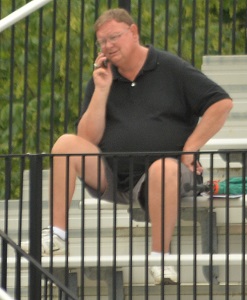
PHOTOS: (Top) Orchard Lake St. Mary's takes on Detroit Cass Tech on its home red turf in 2012. (Middle) Tucked away in the McLane Stadium bleachers, Robin Goddard watches the Eaglets' run to the 2015 Division 2 baseball championship. (Top photo by Terry McNamara.)