

Detroit Embarks on Historical Weekend
By
Tom Markowski
Special for Second Half
November 27, 2015
DETROIT – Basketball used to be king in Detroit. Detroit Public School League teams like Detroit Cooley, Detroit Pershing, Detroit Southwestern and others won MHSAA championships and sent numerous players on to college to play at major universities like Michigan, Michigan State and others.
 Recently the quality of basketball has taken a step back, and football has taken center stage.
This past March, Detroit Western International was the first PSL team to win the Class A boys basketball title since Pershing in 2009 and just the second since Detroit Central won the Class A title in 1998. This is a far cry from what is considered one of the glory eras in PSL history. From 1987-94, teams from the PSL won eight consecutive Class A titles.
(It should be noted that Detroit Renaissance did win Class B titles in 2004 and 2006, and Detroit Crockett also won the Class B title in 2001.)
In 2007 Detroit King was the first PSL team to win a football state title. For those outside of the city, it might not have meant that much other than a simple statistic. But for the PSL coaches who longed for respect statewide, King’s victory over Midland in the Division 2 Final was vindication.
When Detroit Cass Tech won back-to-back Division 1 titles (2011, 2012) a few years later, football fans across the state began to realize that what King accomplished in 2007 was not a fluke. Teams from Detroit were relevant statewide.
This weekend another first will take place. King will play for the Division 2 title (against Lowell) on Friday and Cass Tech will play for the Division 1 title (against Romeo) on Saturday. It’s the first time two PSL teams will play for MHSAA championships in the same season. Both games kick off at 1 p.m. at Ford Field.
The milestone is not lost on the coaches, Dale Harvel of King and Thomas Wilcher of Cass Tech.
Wilcher pointed to King and then-coach James Reynolds for taking the lead. King was the first PSL team to reach an MHSAA Final (1989 and 1990), and by doing so created instant credibility.
“King established what we could accomplish,” Wilcher said. “By winning the first state title, by winning both the PSL and then the state the same year.
“I don’t prepare my kids the same way. From day one I’m preparing for a state championship, Thanksgiving Day weekend, not for nine weeks. You have to condition a different way. You have to have a long-haul focus. The kids you started with might not be the ones you finish with. King High set that bar.”
Step aside for moment and realize what Wilcher said. Cass Tech and King is the most intense rivalry in the city. Emotions run high, and sometimes they boil over. But here is the coach from one team praising the other. In addition to the rivalry, there is mutual respect.
“It’s great,” Wilcher said of the two city powers playing for a title. “It’s great for the city.”
Regardless of what takes place Friday, Harvel said he, his staff and players will be at Ford Field in support of Cass Tech.
And Harvel said it’s not just about King and Cass Tech. What will take place this weekend will affect all PSL schools: their players, coaches, student body and alumni.
“It’s a factor with our school system,” he said. “It’s a pride factor even if you don’t play for Cass or King. The alumni for all public schools are represented.”
Harvel said even though most point to the 2007 championship season as a turning point, it was the teams that lost in the Class A Final in 1989 and 1990 that started it all. Some forget that back in 1989 there were just four MHSAA Finals champions, not eight, making King’s run all the more noteworthy. The next season the playoffs were expanded from four classifications to eight.
Coincidentally, each team has had two difficult playoff games and two one-sided affairs on their way to Ford Field. King (13-0) trailed Detroit U-D Jesuit, 24-21, in a Pre-District before winning, 35-24, and King led Detroit East English 7-0 after three quarters before pulling away for a 26-12 victory in a Regional Final.
Cass Tech (11-2) blew past its first two opponents by the combined score of 84-20. In the Regional Final it trailed Macomb Dakota 10-0 before coming back for a 16-10 victory. Last week, the Technicians held on to defeat Canton 48-41 on a snow-covered field at Troy Athens. Canton had possession on Cass Tech’s 40 for the last play of the game.
 Tom Markowski is a columnist and directs website coverage for the State Champs! Sports Network. He previously covered primarily high school sports for the The Detroit News from 1984-2014, focusing on the Detroit area and contributing to statewide coverage of football and basketball. Contact him at [email protected] with story ideas for Oakland, Macomb and Wayne counties.
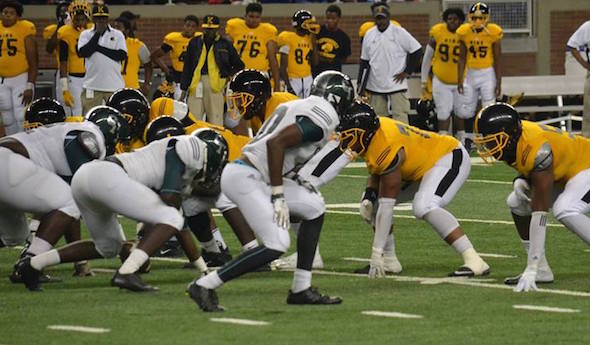
PHOTO: Detroit Cass Tech (green helmets) and Detroit Martin Luther King, here in the Detroit PSL Final, give the league two MHSAA finalists for the first time. (Photo courtesy of the Detroit Public School League.)
Zeeland West Puts 'T' in 3rd MHSAA Title
November 30, 2013
By Bill Khan
Special to Second Half
DETROIT — Danny Bauder would rather trade touches for trophies.
In most other offenses, a player of Bauder's ability would be a featured running back. What team wouldn't want to keep feeding the rock to a kid who ran for 1,796 yards and 28 touchdowns this season?
Bauder did all of that damage, despite the fact he shares the load in the shell game that is Zeeland West's run-oriented Wing-T offense.
He once again had maximum impact on minimal carries, running eight times for 144 yards and a touchdown in West's 34-27 victory over DeWitt in the MHSAA Division 3 championship game Saturday at Ford Field.
Two teammates had more carries than Bauder, as the Dux rolled up 441 rushing yards on 66 carries. Cole Hession had 26 carries for 122 yards, quarterback Casey Brinks had 11 carries for 66 yards and Grant Postma had six carries for 71 yards and two touchdowns.
They all shared in the same accomplishment with their teammates — West's third MHSAA title in the nine-year history of the school. The Dux (13-1) were Division 4 champions in 2006 and 2011.
"I love (our offense), because everyone has a chance to get the ball," said Bauder, who got things rolling with an 80-yard touchdown run on the second play from scrimmage. "We have three backs. We rotate them like every other drive. It's a good team offense. It's a team. I don't mind, just as long as we win."
 Led by its ground attack, West appeared to be on the verge of running away with this one, building a 28-7 halftime lead.
The Panthers wouldn't allow the Dux to coast to the championship that easily, however.
A 56-yard touchdown run by Chris Ruby and a 29-yard scoring strike from Jake Johnson to Josh Borta in a 72-second span got DeWitt within 28-20 with 6:50 left in the third quarter.
West responded with a 25-yard touchdown run by Brinks with 2:57 to go in the third, but an offense that averaged 48.9 points per game coming into the contest wouldn't score again. Junior defensive back Ben Zamiara led DeWitt's defensive charge with a game-high 20 tackles, 11 more than anyone else on either team. The Panthers held West to 1-for-4 on fourth-down conversions.
"I'm pretty sore right now," Hession said. "This is one of the games I've come out of the most sore. I can feel it right now, and my adrenaline is still rushing. Props to them, because they came out and they had three or four series where they stopped us on fourth down. Not many teams can do that. They're just good."
DeWitt closed the deficit to seven points when Johnson rolled left and hit a wide-open Borta for a 75-yard touchdown with 4:25 left in the game.
The Panthers' offense would watch the rest of the game on the sidelines. The Dux milked some clock by getting two first downs before dropping back to punt from its own 48 for the only time in the game. Postma barely got off the punt, but was knocked to the ground when a DeWitt defender caught him on the leg while going for a block. West retained the ball, running out the remaining 32 seconds by taking a knee one time.
"Our punter was already hurt," West coach John Shillito said. "He was on one leg. So, it was a great effort by Grant to get the ball off and it was a break for us. We knew the game was over. You knew that all you had to do was take a knee."
DeWitt coach Rob Zimmerman said going for the block was a risk the Panthers had to take, given the time on the clock and the potential field position.
"If they punt and pin us down at the 10, that's a long way to go," Zimmerman said. "We went for it. Obviously, it didn't turn out in our favor. You have to take chances when you're in that situation."
DeWitt tried in vain to play catch-up all night after falling behind 8-0 when Bauder took the ball around the left side of the Dux line and broke into the clear for an 80-yard touchdown just 45 seconds into the game. West, which attempted (and missed) only one extra-point kick all year, got two points on a pass from Brinks to Zach Poppema.
West scored on four of its five possessions in the first half, failing only on its second series when a fourth-and-five run from the DeWitt 13 came up a yard short.
The Dux shook off that temporary setback and scored on a 7-yard pass from Brinks to Hession on the first play of the second quarter. Hession ran for the 2-point conversion to make it 16-0.
Following a fumble at the West 49, the Dux took a 22-0 lead on an 18-yard run up the middle by Postma with 6:45 left in the first half. Brinks' conversion run failed.
DeWitt (13-1) finally put a drive together and got back in the game on a 4-yard touchdown pass from Johnson to Justice Shankel with 3:15 left in the first half. Cameron West's extra point made it a 22-7 game.
The Dux didn't get away from their ground game with time winding down in the first half, throwing only one pass on a seven-play, 80-yard drive that yielded a 12-yard touchdown run by Postma with 1:04 to go in the half. Postma's 2-point run failed, resulting in a 28-7 halftime lead for West.
"We dug ourselves too deep a hole," Zimmerman said. "I felt if we got one more possession, we had a shot."
Johnson, a junior, was 15 for 24 passing for 289 yards, three touchdowns and two interceptions for DeWitt. Brinks was 3 for 5 for 35 yards and a touchdown for West.
Borta grabbed five passes for 183 yards and two touchdowns.
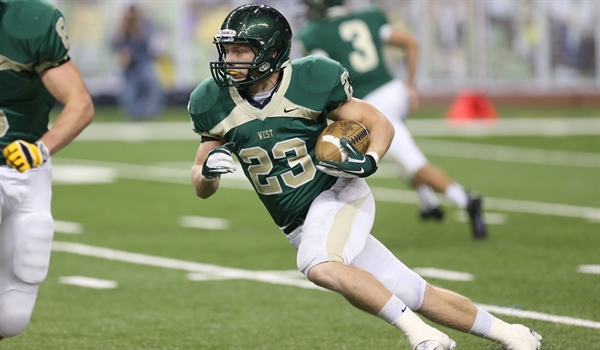
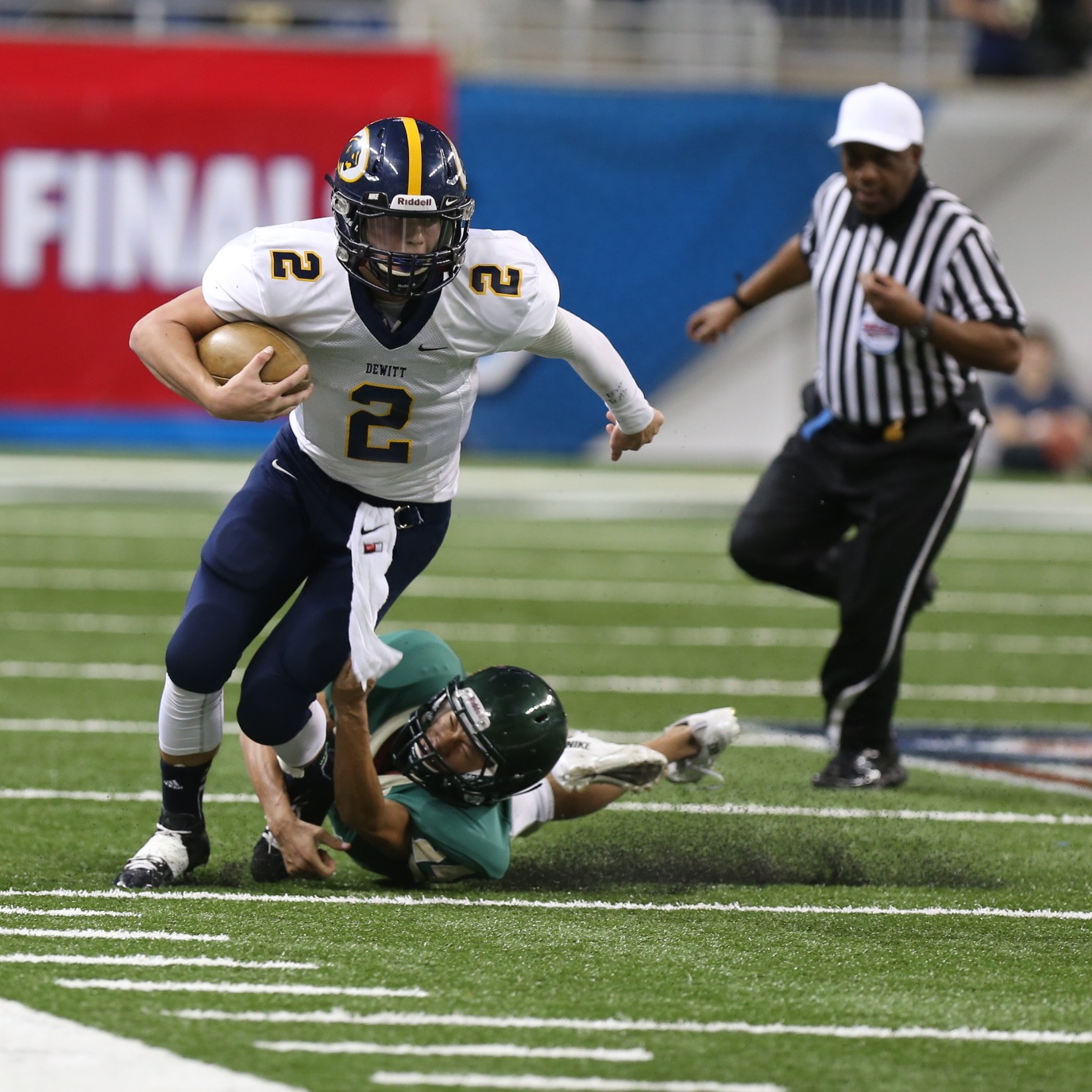
PHOTOS: (Top) Zeeland West running back Danny Bauder scampers ahead during Saturday's Division 3 Final. (Middle) DeWitt quarterback Jake Johnson tries to pull away from a Dux defender's grasp. (Photos by Hockey Weekly Action Photos).