

Detroit Embarks on Historical Weekend
By
Tom Markowski
Special for Second Half
November 27, 2015
DETROIT – Basketball used to be king in Detroit. Detroit Public School League teams like Detroit Cooley, Detroit Pershing, Detroit Southwestern and others won MHSAA championships and sent numerous players on to college to play at major universities like Michigan, Michigan State and others.
 Recently the quality of basketball has taken a step back, and football has taken center stage.
This past March, Detroit Western International was the first PSL team to win the Class A boys basketball title since Pershing in 2009 and just the second since Detroit Central won the Class A title in 1998. This is a far cry from what is considered one of the glory eras in PSL history. From 1987-94, teams from the PSL won eight consecutive Class A titles.
(It should be noted that Detroit Renaissance did win Class B titles in 2004 and 2006, and Detroit Crockett also won the Class B title in 2001.)
In 2007 Detroit King was the first PSL team to win a football state title. For those outside of the city, it might not have meant that much other than a simple statistic. But for the PSL coaches who longed for respect statewide, King’s victory over Midland in the Division 2 Final was vindication.
When Detroit Cass Tech won back-to-back Division 1 titles (2011, 2012) a few years later, football fans across the state began to realize that what King accomplished in 2007 was not a fluke. Teams from Detroit were relevant statewide.
This weekend another first will take place. King will play for the Division 2 title (against Lowell) on Friday and Cass Tech will play for the Division 1 title (against Romeo) on Saturday. It’s the first time two PSL teams will play for MHSAA championships in the same season. Both games kick off at 1 p.m. at Ford Field.
The milestone is not lost on the coaches, Dale Harvel of King and Thomas Wilcher of Cass Tech.
Wilcher pointed to King and then-coach James Reynolds for taking the lead. King was the first PSL team to reach an MHSAA Final (1989 and 1990), and by doing so created instant credibility.
“King established what we could accomplish,” Wilcher said. “By winning the first state title, by winning both the PSL and then the state the same year.
“I don’t prepare my kids the same way. From day one I’m preparing for a state championship, Thanksgiving Day weekend, not for nine weeks. You have to condition a different way. You have to have a long-haul focus. The kids you started with might not be the ones you finish with. King High set that bar.”
Step aside for moment and realize what Wilcher said. Cass Tech and King is the most intense rivalry in the city. Emotions run high, and sometimes they boil over. But here is the coach from one team praising the other. In addition to the rivalry, there is mutual respect.
“It’s great,” Wilcher said of the two city powers playing for a title. “It’s great for the city.”
Regardless of what takes place Friday, Harvel said he, his staff and players will be at Ford Field in support of Cass Tech.
And Harvel said it’s not just about King and Cass Tech. What will take place this weekend will affect all PSL schools: their players, coaches, student body and alumni.
“It’s a factor with our school system,” he said. “It’s a pride factor even if you don’t play for Cass or King. The alumni for all public schools are represented.”
Harvel said even though most point to the 2007 championship season as a turning point, it was the teams that lost in the Class A Final in 1989 and 1990 that started it all. Some forget that back in 1989 there were just four MHSAA Finals champions, not eight, making King’s run all the more noteworthy. The next season the playoffs were expanded from four classifications to eight.
Coincidentally, each team has had two difficult playoff games and two one-sided affairs on their way to Ford Field. King (13-0) trailed Detroit U-D Jesuit, 24-21, in a Pre-District before winning, 35-24, and King led Detroit East English 7-0 after three quarters before pulling away for a 26-12 victory in a Regional Final.
Cass Tech (11-2) blew past its first two opponents by the combined score of 84-20. In the Regional Final it trailed Macomb Dakota 10-0 before coming back for a 16-10 victory. Last week, the Technicians held on to defeat Canton 48-41 on a snow-covered field at Troy Athens. Canton had possession on Cass Tech’s 40 for the last play of the game.
 Tom Markowski is a columnist and directs website coverage for the State Champs! Sports Network. He previously covered primarily high school sports for the The Detroit News from 1984-2014, focusing on the Detroit area and contributing to statewide coverage of football and basketball. Contact him at [email protected] with story ideas for Oakland, Macomb and Wayne counties.
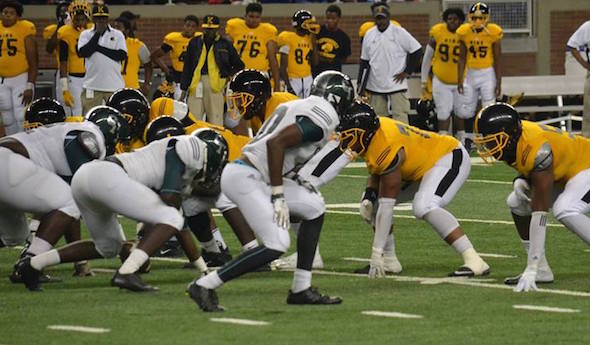
PHOTO: Detroit Cass Tech (green helmets) and Detroit Martin Luther King, here in the Detroit PSL Final, give the league two MHSAA finalists for the first time. (Photo courtesy of the Detroit Public School League.)
Drive for Detroit: Week 2 Preview
August 29, 2018
By Geoff Kimmerly
Second Half editor
Opening week of this high school football season predictably fulfilled anticipation and expectation.
 The encore should be pretty good, too.
Up this week is a rematch of last season’s Division 1 championship game, which also is among a number of league openers matching conference title favorites all over Michigan. Reigning Division 3 champ Muskegon won’t be starting league play for a few more weeks, but again might be hosting the most intriguing game statewide as another Detroit-area powerhouse comes to town.
Nearly all of this week’s games will be played Thursday night in advance of the Labor Day holiday. Check out the MHSAA Score Center for the full schedule and results as games are completed, and if you’re not watching in person check out one of eight games live on MHSAA.tv.
“Drive for Detroit” previews are powered by MI Student Aid. Games below are Thursday unless noted.
Bay & Thumb
Frankenmuth (1-0) at Saginaw Swan Valley (1-0)
Big-time rivals during the 1980s (when they shared a league), Swan Valley and Frankenmuth will meet again for the first time since 2010 and this time as statewide contenders. Swan Valley is the reigning Division 5 runner-up and Frankenmuth was a Division 5 semifinalist a year ago as both fell to champion Grand Rapids West Catholic during the playoff’s final rounds. Both are coming off big wins over bigger competition last week; the Vikings downed Cedar Springs by nine, and the Eagles defeated Bay City Central by 23.
Others that caught my eye: THURSDAY Elkton-Pigeon-Bay Port Laker (1-0) at Reese (1-0), Goodrich (1-0) at Ortonville Brandon (1-0), Flint Carman-Ainsworth (1-0) vs. Midland (0-1) at Northwood, St. Clair Shores South Lake (1-0) at Marine City (1-0).
Greater Detroit
West Bloomfield (1-0) at Clarkston (1-0), Friday
This is a rematch of last season’s Division 1 championship game, when these two combined for the second-lowest scoring Final in MHSAA football history – Clarkston winning 3-2. Not telling by the score, West Bloomfield’s offense was loaded with future Division I college players – but the retooled Lakers scored 39 in a win last week over Birmingham Groves, while Clarkston’s defense looked stingy again in downing Grandville 12-9. And don’t forget: These two also both play in the Oakland Activities Association Red, and West Bloomfield won that matchup last season 37-16.
Others that caught my eye: THURSDAY Waterford Our Lady (1-0) at Sterling Heights Parkway Christian (1-0), Oak Park (1-0) at Birmingham Groves (0-1), Livonia Churchill (1-0) at Belleville (1-0), Warren Fitzgerald (1-0) at Auburn Hills Avondale (1-0).
Mid-Michigan
Haslett (1-0) at Lansing Sexton (0-1)
In finishing 8-3 a year ago, Haslett posted its best record since 2006. The Vikings picked up on the same foot last week, opening with a 28-7 win over Coldwater – and they’ll now try to make it two in a row over 2017 playoff teams. Sexton just missed giving new coach Johnel Davis his first win, falling to Gaylord by 23-19. But the Big Reds would love to pick up some steam heading into a new league, the Capital Area Activities Conference White, and it’s already possible to forecast this as a key game if Sexton is to qualify for the playoffs in two months.
Others that caught my eye: THURSDAY Lincoln Alcona (0-1) at Breckenridge (1-0), Brooklyn Columbia Central (1-0) at Leslie (1-0), Walled Lake Northern (0-1) at DeWitt (1-0), Ann Arbor Huron (0-1) at Williamston (1-0).
Northern Lower Peninsula
Traverse City St. Francis (1-0) at Maple City Glen Lake (0-1)
St. Francis had a lot to enjoy about a 42-3 opening-night win over Marquette last week, while Glen Lake ran into a regular-season superpower in falling to New Lothrop. But a win over the Gladiators would certainly heal the grief of that 32-point defeat. These teams have met in both the regular season and playoffs two of the last three seasons, with St. Francis claiming last year’s regular-season meeting 35-9 – but then the District Final rematch only 13-0.
Others that caught my eye: THURSDAY Tawas (1-0) at Rogers City (1-0), Lakeview (1-0) at Lake City (1-0), Gladstone (1-0) at Gaylord (1-0), Marquette (0-1) at Traverse City Central (1-0).
Southeast & Border
Napoleon (0-1) at Addison (1-0)
Last season’s Cascades Conference race saw Addison beat Napoleon by two, Napoleon beat Michigan Center by three and Michigan Center beat Addison by 12 – and all three share the league title. It wouldn’t be shocking if this matchup played a big part in the chase again. Addison opened last week with a big win over Dearborn Heights Star International and Napoleon fell to Brooklyn Columbia Central – both repeats of 2017 results and not necessarily telling of what to expect.
Others that caught my eye: THURSDAY Jackson Lumen Christi (1-0) at Parma Western (1-0), Hudson (0-1) at Morenci (0-1), Lake Fenton (1-0) at Ida (1-0) FRIDAY Grand Rapids Catholic Central (1-0) at Saline (0-1).
Southwest Corridor
Saugatuck (1-0) at Watervliet (1-0)
Both saw their 2017 seasons end against eventual MHSAA champions, Watervliet in a Division 6 Regional Final to Jackson Lumen Christi and Saugatuck at Ford Field where it fell to Pewamo-Westphalia in the Division 7 Final. Watervliet scored at least 50 points in its first seven games last season, and opened this one with another 50-pointer last week against Lawton. Saugatuck actually was more of a defensive force a year ago – but started this one with a 55-pointer that’s been the expectation most other seasons this decade.
Others that caught my eye: THURSDAY Dowagiac (1-0) at Three Rivers (1-0), Portage Northern (1-0) at Stevensville Lakeshore (0-1), St. Joseph (0-1) at Niles (1-0), Kalamazoo United (1-0) at Lawton (0-1).
Upper Peninsula
Iron Mountain (1-0) at Ishpeming Westwood (1-0), Friday
Iron Mountain’s one-win finish in 2017 was quite a rarity – the Mountaineers had made the playoffs 16 of the previous 18 years and not had a one-win season on the field since 1990. So it made sense that they equaled last fall’s win total last week with a 12-9 victory over Negaunee. Westwood, meanwhile, is coming off its winningest season ever at 9-2 – and started its campaign last week to show that wasn’t a one-hit wonder with a 42-0 shutout of Houghton.
Others that caught my eye: THURSDAY Negaunee (0-1) at Calumet (1-0) FRIDAY Lake Linden-Hubbell (0-1) at Ishpeming (1-0), Petoskey (0-1) at Escanaba (0-1), Iron River West Iron County (1-0) at Bark River-Harris (0-1).
West Michigan
Detroit Martin Luther King (1-0) at Muskegon (1-0), Friday
When Muskegon opens with back-to-back home games against Warren DeLaSalle and now Martin Luther King, it’s hard to not tout them as the biggest games of many exciting matchups from the west side of the Lower Peninsula. Quarterback Cameron Martinez showed what he’s capable of in last week’s 36-21 win over the reigning Division 2 champion, and expectations will only continue to grow. But King – which fell to DeLaSalle by a point in their Division 2 Semifinal in November – could be an even tougher test coming off a 52-38 win over Illinois powerhouse East St. Louis.
Others that caught my eye: THURSDAY Rockford (0-1) at Lowell (0-1), Lansing Catholic (1-0) at Grand Rapids West Catholic (0-1), Benton Harbor (1-0) at Grand Rapids South Christian (1-0), Holland West Ottawa (1-0) at Grand Rapids Forest Hills Central (1-0).
8-Player
Eben Junction Superior Central (1-0) at Cedarville (0-1)
Superior Central stunned the 8-player community with a 46-24 win over reigning Division 2 champion Crystal Falls Forest Park last week, and the Cougars can start 2-0 for the first time since 2012 by following up against another perennial power. But Cedarville surely is eager to get back on the field as well after putting up 40 in a six-point loss to Stephenson. Don’t be surprised if this turns into an offensive display.
Others that caught my eye: THURSDAY Central Lake (0-1) at Onekama (1-0), Engadine (1-0) at Pickford (1-0), Powers North Central (0-1) at Rapid River (1-0), Bellaire (1-0) at Suttons Bay (1-0).
Second Half’s weekly “Drive for Detroit” previews and reviews are powered by MI Student Aid, a part of the Student Financial Services Bureau located within the Michigan Department of Treasury. MI Student Aid encourages students to pursue postsecondary education by providing access to student financial resources and information, including various student financial assistance programs to help make college more affordable for Michigan students. MI Student Aid administers the state’s 529 savings programs (MET/MESP) and eight additional aid programs within its Student Scholarships and Grants division. Click for more information and connect with MI Student Aid on Facebook and Twitter @mistudentaid.
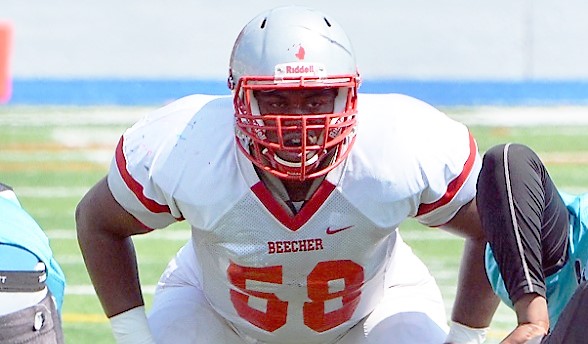
PHOTO: A Flint Beecher linebacker readies for the snap during last week’s win over Flint Southwestern at Atwood Stadium. (Photo by John Johnson.)