


Diversionary Tactics Backfire
September 24, 2013
Placing a stone in your left shoe will take your mind off a blister on your right foot; but it does not solve the problem.
Faced with domestic starvation and civil unrest, many dictators have created external enemies in hopes of distracting their countrymen and women and rallying their support. Think of North Korea as just one of dozens of examples, recent to ancient. It has even ocurred in the US, recently and throughout our nation’s history: strawmen vilified to distract us from other more pressing problems.
Closer to home, it is something like this strategy that may be at work in many school districts as they restructure and rename schools, or resort to closings and charters. And something like this is behind the state and federal emphases on standardized testing and schools of choice.
And really close to home, it was something like this at work in football. Faced with thousands of former players with alleged concussion-related illnesses filing suit against the National Football League, and bad publicity mounting, the NFL focused instead on youth football. We told them this strategy would backfire; but a professional league with more money than many nations was not inclined to listen to little guys like us.
The NFL went state by state to advance concussion legislation which was long on symbolism and low on substance, and totally lacking any enforcement capabilities. In state after state, the NFL paraded young people with sad stories in front of state legislators looking for good headlines.
So today, 49 states have new “concussion” laws; and participation rates in youth football are plummeting. Big surprise. But ironically, it’s plummeting at a time when school-sponsored football is the safest it has been since it was introduced to schools 100 years ago. The equipment is the best ever, the rules the most protective ever, the coaches and officials the best trained and most safety conscious ever.
Take a look at this quick video that tells the true story about school-sponsored football.
Harrison Comes Back to Win Classic
August 23, 2016
By John Johnson
MHSAA Communications Director
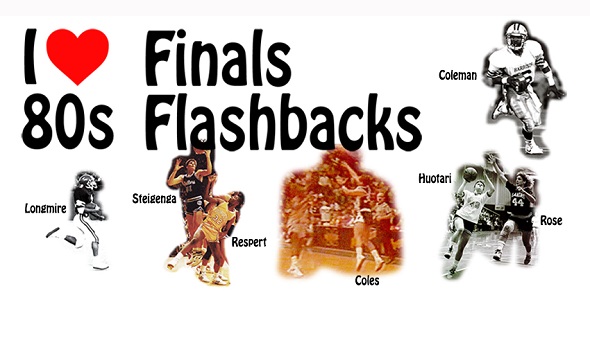
As a new season of events launches this week on MHSAA.tv, this summer’s 80s Finals Flashback series concludes with one of the classic Football Finals of all time.
Our ninth and final game in the Flashback series is the 1989 Class B Final at the Pontiac Silverdome between Farmington Hills Harrison and DeWitt. Here’s a look at this week’s game, and click the score below to watch:
Week of August 22 – Farmington Hills Harrison 28, DeWitt 27 – 1989 Class B Football Final - In Class B, Farmington Hills Harrison scored a 28-27 victory over DeWitt in what many consider the greatest game of Michigan's 25-year playoff history. The defending Class B champions and top-ranked Hawks had their hands full with the Panthers. Tied 7-7 after one quarter, DeWitt grabbed a two-touchdown lead in the second on 32-yard run by John Tellford and a 35-yard pass play from Tellford to John Cowan. Harrison responded with a Matt Conley 1-yard run to cut the margin to 21-14 at the half. Hawks quarterback Mill Coleman knotted the score at 21 with a dazzling 16-yard run early in the fourth quarter, but DeWitt stormed back again, driving 75 yards on 13 plays. The series was highlighted by tight end Dave Riker's 24-yard, one-handed catch to the Hawks’ 3-yard line. Two plays later, quarterback Chris Berkimer slipped over from the 1, and DeWitt again took the lead, 27-21. With 2:12 remaining on the clock and the ball at the Harrison 33, Coleman went to work. Three quick completions moved the ball to the DeWitt 16, then Coleman let his legs do the rest of the work. Following a Hawks timeout, Coleman dashed right for seven more yards to the Panthers’ 9. Facing a 2nd-and-three, Coleman dropped back to pass, escaped the rush at the DeWitt 17, then scampered up the middle and dove into the end zone for the tying points. Steve Hill added his fourth PAT of the game with 1:34 remaining for the final margin, then secured the victory with an interception on the next series. (Watch Coleman’s game-winning touchdown by Clicking Here.)
DVDs may be purchased directly from the MHSAA.tv Website – just click the “Get DVD” button below the player. See the bottom of this screen for the rest of this summer’s “Flashbacks.”
The new season of games produced by members of the School Broadcast Program begins this week with live video of two football games scheduled as of noon Monday. Coming up on Thursday, the SBP at Montrose High School follows its Rams on the road for a game at Byron beginning at 6:40 p.m. At 7 p.m., Marquette High School will cover its home contest against Traverse City St. Francis. Check this release on the MHSAA Website for updates throughout the week as additional games are scheduled.
The NFHS Network has announced new pricing for 2016-17, eliminating the Day Pass and lowering the cost of a Month Pass to $9.95. Subscribers will have access to all live video and streaming statistics across the country. All content becomes available for free, on demand viewing 72 hours after being shown live. Some schools also will be selling Annual Passes at a discounted rate. A portion of every subscription sold by a school goes to benefit its program.
Now in its eighth year, the School Broadcast Program gives members an opportunity to showcase excellence in their schools by creating video programming of athletic and non-athletic events with students gaining skills in announcing, camera operation, directing/producing and graphics. The program also gives schools the opportunity to raise money through advertising and viewing subscriptions.
Schools interested in becoming a part of the School Broadcast Program should contact John Johnson at the MHSAA Office.
Previous Flashbacks
August 15: St. Joseph Lake Michigan Catholic 41, Ontonagon 39 – 1988 Class C Girls Basketball Final - Watch
August 8: Grand Rapids South Christian 69, Redford Bishop Borgess 66 – 1988 Class B Boys Basketball Final - Watch
August 1: Dearborn Divine Child 50, Okemos 45 (OT) – 1986 Class B Girls Basketball Final - Watch
July 25: Muskegon 16, Detroit Martin Luther King 13 – 1988 Class A Football Final - Watch
July 19: Northport 80, Beal City 78 – 1988 Class D Boys Basketball Final - Watch
July 12: Detroit Cass Tech 52, Saginaw 51 – 1987 Class A Girls Basketball Final - Watch
July 5: Traverse City 24, Detroit Catholic Central 14 – 1988 Class A Football Final - Watch
June 28: Saginaw Buena Vista 33, Flint Beecher 32 – 1986 Class B Boys Basketball Final - Watch