

Divine Child Comes Back from Double-Digit Deficit to Complete Repeat
By
Paul Costanzo
Special for MHSAA.com
November 27, 2026
DETROIT – As officials were reviewing the play, and replays were streaming on the big screens at Ford Field, the realization was starting to set in on the Divine Child sideline and up through the stands.
The fumble caused and recovered by senior linebacker Adam Garcia with three minutes to play was going to be upheld, and the Falcons were going to have a chance to run out the clock on a second straight Division 4 football title.
One key fourth-down conversion later, Divine Child was in victory formation, closing out a remarkable 28-21 comeback victory Friday against Grand Rapids Kenowa Hills.
“It was just unreal to be able to have the feeling of going back to back,” Divine Child senior linebacker Joe Muscat said of watching the replay. “It just set in. You couldn’t help but have a smile on your face. It was just insane. Insane.”
The title also was the fourth in program history for Divine Child, and this the first time the Falcons have gone back-to-back during the playoff era – a fitting end for the senior-dominated team, as there were 27 of them in the Class of 2027, including 11 defensive starters.
“Divine Child’s football program has a fantastic tradition behind it,” coach Chris Laney said. “I think everyone knows about Aidan Hutchinson, but there was a lot of great football players that have come through Divine Child, great coaches – Bill McCartney, Tony Versaci, Bob LaPointe – I could go through the list. I couldn’t be happier for where Divine Child football is at today, and that’s kudos to this class of 2027. We have 27 seniors this year, which I’m pretty sure is the biggest senior class Divine Child’s ever had. You win with your seniors, and they certainly led us.”
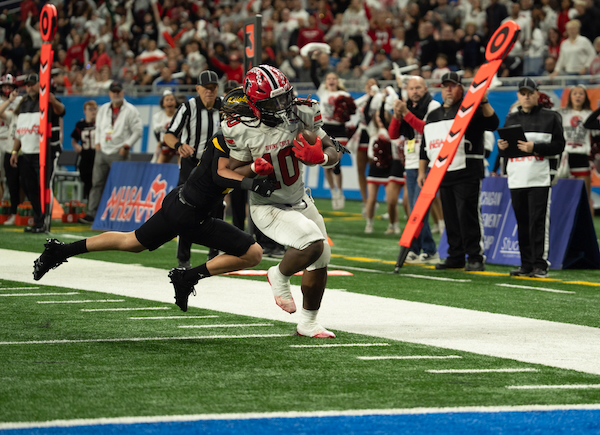
It took 21 unanswered points in the second half to wrap this one up, as well as the big defensive play by Garcia. Senior running back Andre Davis Jr., who rushed for 148 yards and three touchdowns in the game, sealed it with a 26-yard run on 4th-and-1 with less than two minutes to play.
“The tale of two halves,” Laney said. “I thought our kids at halftime were settled in, they weren’t flinching, they weren’t worried.”
Kenowa Hills (12-2) was dominant in the first half, as Lundon Hampton had 127 yards rushing and a TD already during the first 24 minutes, while Grayson Fellows had 118 yards passing and a pair of touchdown passes, both to Macoy Bertollini.
Divine Child’s offense, meanwhile, struggled after a strong opening drive that was capped off by a 38-yard Davis run.
That possession traveled 69 yards, and the Falcons lost seven the rest of the half as quarterback Drew Sheridan was consistently harassed by the Knights’ combination of pressure and tight coverage down field.
Kenowa Hills’ 21-7 lead could have been bigger heading into the half, as it ran three plays inside the Divine Child 5-yard line, and was stopped at the 1 as the second-quarter clock expired.
That defensive stand wound up being much more than a moral victory, as it flipped the momentum fully to the Falcons (13-1).
“That stop right before halftime by our defense was massive,” Laney said. “I think if they score there and go up three scores, I’m not sure our locker room is going to be as eager as they were at halftime. It was a shot of momentum for us.”
Kenowa Hills coach Don Fellows said kicking a field goal rather than going for the touchdown was an option, but he chose to stick with his team’s aggressive identity, which had served the Knights well throughout the season.
“There was a ton of conversation back and forth there,” Fellows said. “But we were here to win it, and we just felt like we’ve got the best running back in the state and we’re really good up front. They called a blitz, and we kind of missed the down scheme there. Listen, if you watch us play, we go for it a lot on fourth down. We were here to win, and there was no way I was getting on that bus not giving our best shots.”
The Falcons dominated the third quarter, tying the game at 21 after a pair of TD runs (16 and three yards) from Davis. Divine Child then took its first lead at 28-21 with 5 minutes, 8 seconds remaining in the game on a four-yard run by Finn Cameron.
Divine Child had the ball for 18:19 of the final 24 minutes and outgained the Knights 223-67 over the final two quarters.
“Kudos to Kenowa Hills,” Laney said. “They’re very well coached, tremendous season, great players, they had a great plan. At halftime, we had to adjust a few things defensively, personnel wise, a little bit schematically to what they were doing. Offensively, we played better in the second half, a lot more clean football.”
Hampton finished with 160 yards on 29 carries, while Grayson Fellows threw for 153 on 13-of-22 passing. William Fussman’s 44 yards on four catches led all Knights receivers.
Sheridan finished with 97 yards passing for Divine Child, completing 8-of-14 attempts, with Rayshawn Thomas catching five of those for 68 yards. Garcia and Giancarlo Vitti each had an interception for the Falcons.
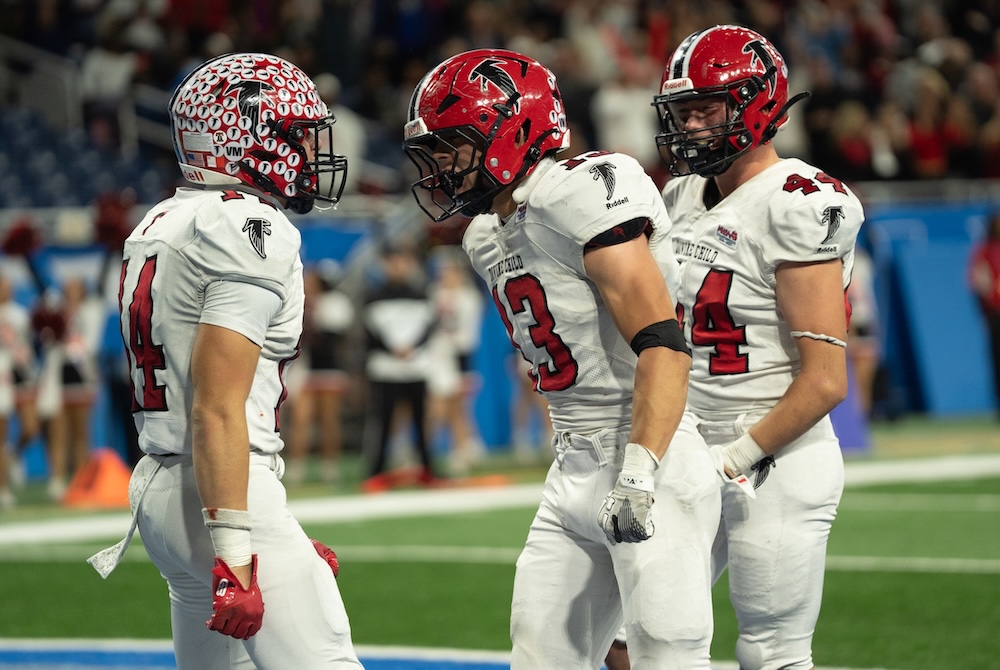
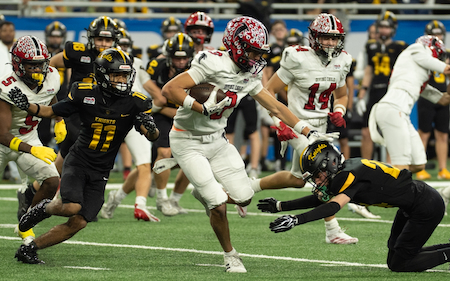
PHOTOS (Top) Dearborn Divine Child’s Finn Cameron (13) and Gianni Joganic (14) enjoy a moment during the Division 4 Final. (Middle) A Kenowa Hills defender attempts to wrap up Andre Davis Jr. (10) as he nears the end zone. (Below) Michael DiSalvo (3) works to elude a pair of Kenowa Hills players in pursuit including Victor Holman (11).
Undefeated, Unscored-Upon Ironwood Journeys Downstate to Complete 1925 Run
By
Ron Pesch
MHSAA historian
November 20, 2025
Port Huron’s bold challenge of Flint Central and Grand Rapids Union for acclaim as “Michigan’s best high school football team” during the fall of 1925 meant an unexpected opportunity in Michigan’s Upper Peninsula.
During the first fall season of school sports under Michigan High School Athletic Association leadership – and half-century before the MHSAA Football Playoffs were introduced – small towns with schools possessing smaller enrollments also cried for recognition and aimed to join in the fun.
For schools, fans, and newspapers, MHSAA classifications conveniently offered a means to subdivide claims on the state title. Acknowledging that they could seldom compete successfully against the larger schools in football, that certainly couldn’t stop them from declaring themselves Class B or Class C gridiron champs.
Undefeated in contests since the middle of the 1923 season, Ironwood High – located in the Upper Peninsula in Michigan’s western-most city – ran through final preparations for the upcoming season with a game against the local alumni. A common practice at many schools, the preseason matchup gave head coaches like Ironwood’s veteran Robert O. ‘Bob’ Black a peek at his squad’s potential against a “friendly” opponent. The preps downed the “Old Timers,” 19-6.
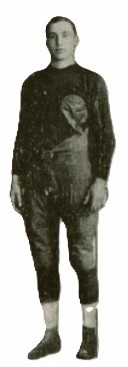
Among Black’s weapons was his team captain, John ‘Cutz’ Cavosie, a 6-foot-1, 190-pound senior with impressive skills in all aspects of the game.
“Capt. Cavosie was true to the form of the last two seasons and gives indications of coming through this season with even greater flying colors than he did a year ago,” noted the Ironwood Daily Globe in coverage of the contest. “He punished the alumni with his driving attack.”
The Red Devils officially opened their 1925 slate with a game at Superior, Wis., on Friday, Sept. 25. Missing from the roster, however, was Cavosie. While the news was, no doubt, gossiped about on the streets of town, there was no explanation in the Globe.
 Meanwhile, seven miles away on the front page of the local newspaper, The Bessemer Herald, readers learned some detail:
“John Cavosie, captain and star fullback of the Ironwood high school football team, left the squad this week after an altercation with the coach and has turned in his uniform.”
His absence from the team was apparent.
According to the hometown Globe, “Neither team showed anything but early season football,” but the Superior Evening Telegram’s coverage told another story:
“A field goal missed by inches cost Superior Central High school victory in the opening game of the season here yesterday and the two teams struggled to a scoreless tie.”
“Superior’s attempt to score … came in the final quarter after the two teams had battled on even terms through 45 minutes of play.”
With the ball on Ironwood’s 20-yard line, the Superior quarterback stepped back for a dropkick, but the ball sailed just left of the left upright.
According to Evening Telegram coverage, late in the second quarter, Ironwood had overlooked a prime chance to dropkick a field goal inside Superior’s 25, opting instead for an end run that failed: “That was Ironwood’s one and only chance to score. … Never again did (they) get within striking distance of the Superior goal.” An earlier attempt at a placement kick had gone wide. Cavosie’s absence was likely the reason for the dismal showing by the Red Devils. His importance to the team would soon be vividly illustrated.
A Legend is Born
While no details of mended fences appeared in print, according to the Globe, “the ‘Red’ Grange of the Upper Peninsula” was back for the team’s second game of the season against Menominee, two weeks later. Cavosie put on a show, notching four touchdowns on the afternoon including on runs of 42, 51, and 67 yards. Late in the game, facing a third-and-25 from just beyond the 50, Cavosie took a pass from center, “stepped back, apparently to punt,” but instead booted a stunning 55-yard dropkick for the game’s final three points in a 41-0 win. The news of the kick, which tied a national record for distance, would travel far beyond the Peninsula.
Next up were shutouts of Hurley, Wis., 47-0, and Hancock, 19-0.
Proud of the local team’s accomplishment, in early November, George Haggerson – president of the University of Michigan Alumni Club of the Gogebic Range – contacted state director of athletics Alden W. “Tommy” Thompson. Seeking broader recognition for Ironwood, he inquired about the possibility of the Red Devils playing a worthy opponent in a season-ending contest. Thompson suggested contact with Detroit, Jackson, Flint, or Grand Rapids high schools.
Ashland, Wis., was defeated 24-0 on Saturday, Nov. 7. Ironwood then squared off with Norway on Armistice Day. Expecting a tight matchup, an outstanding crowd turned out at Oliver Field in Ironwood for the game. Instead, Ironwood trounced the visitors, 34-0.
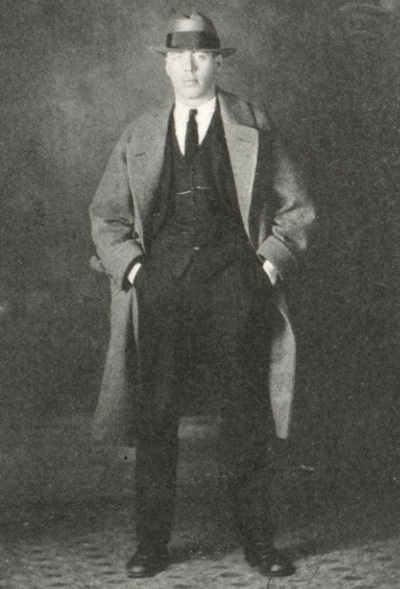 Ironwood was unbeaten and unscored upon, and three days later the Globe announced a firm date for a game downstate. Coach Black’s team would play Redford High School at Northwestern Field in Detroit on Thanksgiving Day.
The choice to travel to the Lower Peninsula to seek out statewide recognition would be an expensive one. Donations to cover the trip – approximately $1,200 – came from local businesses and professional men. They included a donation from a Menominee resident. In a long-distance phone call from the head of a large wholesaling house, Frank St. Peter wanted to relay a specific message to Haggerson, some 200 miles away:
“The Ironwood team will be representing more than Ironwood when it goes to Lower Michigan on Thanksgiving. I consider she will be representing the entire Peninsula. Put me down for $50 to help cover the expenses.”
The trip to Detroit
This was a historic trip – the first for an Ironwood gridiron team to the Lower Peninsula. For locals, train travel would be from Ironwood to Chicago, then after a brief wait, to Ann Arbor, where they stayed Wednesday night. On Thursday morning, the team would head to Detroit by bus.
Among those traveling to Detroit for the game was Haggerson. Many other current residents, as well as former Gogebic Range citizens “living in Detroit, Lansing and Ann Arbor” were expected to make the trip. A crowd of 1,500 was at Ironwood’s Chicago and Northwestern railway station Tuesday night for a rousing sendoff for the 18 members of the team, Coach Black, assistant Max Newcomb, and various school personnel.
According to the Detroit News, Redford had “lost its first game of the season to Detroit Northeastern, 12-6, but since then has been unbeaten in nine games,” with a scoreless tie against Birmingham. Redford had scored 203 points against 24 for its opponents, with Northeastern and Detroit Southwestern “the only schools to score on the suburban eleven.”
“The only record that surpasses that boasted by Redford is the achievement of Ironwood,” stated Thursday morning’s Detroit Free Press, “and the meeting of these two teams should be one of the outstanding high school games in the state.”
The contest was to determine the Class B championship of Michigan.
Back in the U.P.
Those staying in Ironwood could get game detail at the Ironwood Memorial building. A crowd of 1,800 to 2,000 were on hand as returns were relayed by telephone from the Globe office, where Associated Press play-by-play bulletins would arrive quarterly by telegraph, instead of as the game progressed.
“The students gave their cheers the same as they did on the field at games here this season,” stated the Globe, “and the audience was keyed up to high pitch throughout the game.”
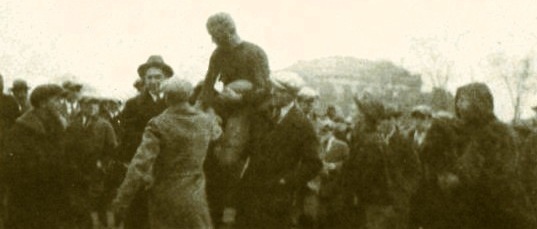 The exploits of Cavosie were on the lips of everyone.
Newspaper reports claimed Ironwood supporters said he was as great as the immortal George Gipp – an All-American on Knute Rockne’s famous undefeated 1920 Notre Dame team – when “The Gipper” played in the Peninsula at Calumet High School.
Quoting Detroit Times reports on the game, the Globe reported the crowd was so large, “that the supply of tickets gave out, and many fans were admitted without the necessary pasteboards, fully 6,000 witnessing the contest.”
Weather conditions were ideal. According to A.P. reports, “overcast sky and southerly wind combined” with “solid underfooting to assure a snappy contest” – with “no alibis for the loser.”
Cavosie lived up to the hype. Pregame, the A.P. stated he wowed the crowd during warm-ups “toeing numerous punts against the wind. Many of them drove 55 yards against the breeze.”
Ironwood scored on its opening drive but was held at bay for the remainder of the first half. The second half was a different story.
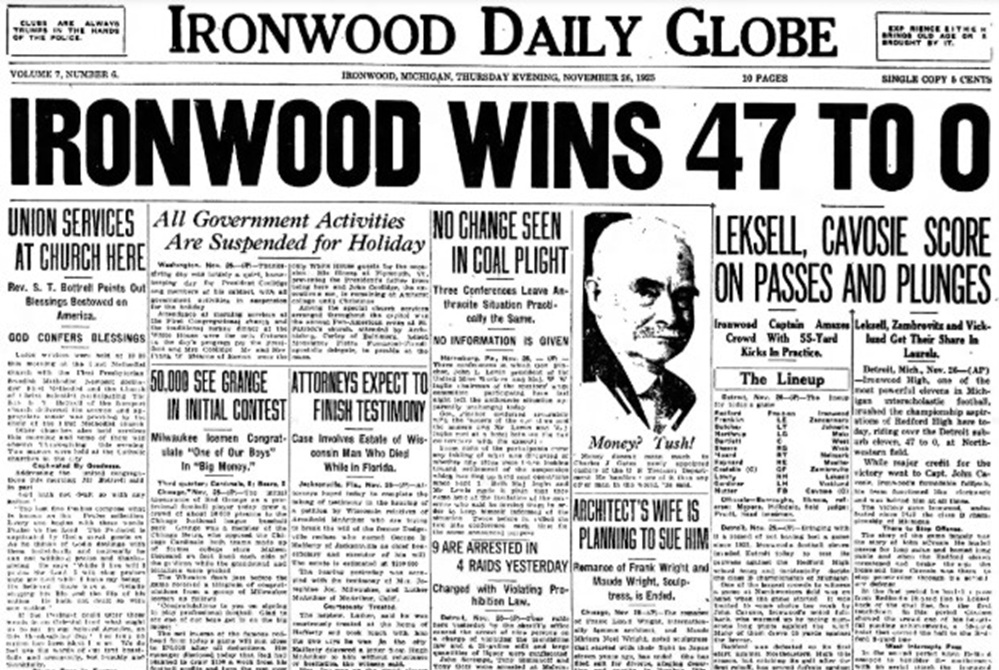
A long touchdown pass from Cavosie started the scoring. The Red Devils scored four times during the fourth quarter, twice the results of intercepted passes. In the end, Ironwood destroyed Detroit Redford, 47-0.
“The story of the game is largely a story of John Cavosie,” stated the Free Press. “He hurled passes from any angle and almost any kind of a formation for long gains and was instrumental in every score credited to his team.”
“Cavosie can run and plunge. He can kick and pass. He can tackle and block,” stated the A.P. reporter, “… his kicking was a revelation to the fans. One time standing on the six-yard line he kicked over the safety man’s head at the 40-yard line and the ball rolled dead on the one-yard strip. His passes were accurate and well timed.
“The team it showed Redford at Northwestern field, Detroit yesterday deserves consideration as one of the best in Michigan in any class.”
At the end, Ironwood claimed the Class B state championship of Michigan with a 6-0-1 mark, outscoring opponents 212-0. A new standard for the school’s athletic teams was set.
 Ironwood’s share of receipts for the game totaled $681.90. “The small quota,” according to the Globe, “was due to the fact that the game was played on municipal property and a charge could not be made on the property itself. A shortage of tickets further accounted for the small gate receipts.”
Upon its return home, the team was honored across multiple receptions. Details not captured in game reports were shared with classmates, former Red Devils athletes, and local fans, as the town celebrated its football heroes. A special focus was shone upon the linemen by A.D. Chishom, a member of the board of education, in his speech honoring the team. Praise for Coach Black and Assistant Newcomb flowed freely.
Come December, George M. Lawton named Cavosie to the Detroit Times first-team all-state squad. The A.P. placed him on its all-state second team, naming Cecil Turner of Port Huron on its first team.
Cavosie’s dropkick, notched against Menominee, was listed among American football historian Parke H. Davis’s “National List of Record Scoring Plays of 1925” - the lone high school entry on the list. “There is not a college team in the country that he could not make as fullback,” raved Davis - the nation’s ‘godfather of sports statistics.’
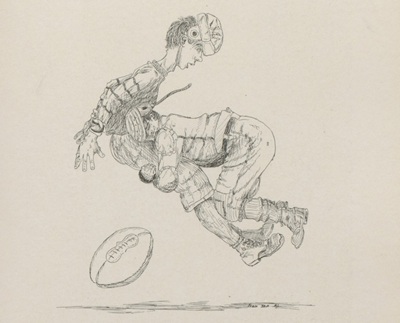
Ironwood students had started the school year on Sept. 6, wandering the halls of a freshly-built school building. Yearbook staff kindly chronicled the happenings of the school year with a fantastic sense of humor.
“September 7: Students learn more about the building. It takes them only fifteen minutes to find right classrooms.”
“September 26: The teachers, like children with new toys, use their new telephones all the time.”
“October 10: Gym students make appearance in the corridor in middies and bloomers. They are kindly presented with a piece of Miss Dougan’s mind.”
“November 30: Students hold assembly to rejoice over victory over Redford.”
Come the end of the school year, the senior members of the team, and their classmates, became the first to graduate from the new Luther L. Wright High School.
“June 14-18: Senior week. Class Play, Class picnic ‘n everything. Commencement. We say goodbye to the school, the students, the faculty.”
The district’s first superintendent, Wright had recently completed a term as Michigan’s State Superintendent of Schools. Ground had broken for the new building on May 1, 1924. Designed by Croft & Boerner of Minneapolis, Minn., it replaced the first building named in Wright’s honor.
Over 100 years later, it is proudly still in use today.
PHOTOS (Top) The Ironwood Daily Globe announces the local team’s win over Detroit Redford as the paper’s lead headline. (2) Ironwood’s John Cavosie. (3) Ironwood football coach R.O. Black, from the school’s 1925 yearbook. (4) Ironwood fans celebrate after the win over Redford. (5) A drawing of two students playing football, from Ironwood’s 1926 yearbook. (Photos gathered by Ron Pesch.)