

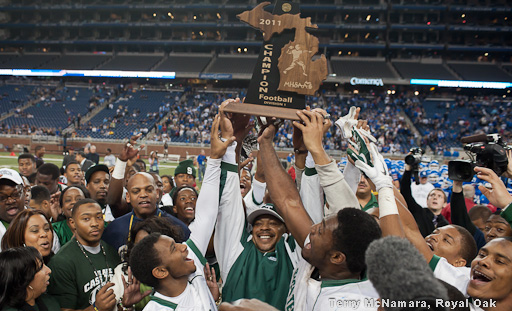
Division 1 Final: Right at Home in Detroit
November 24, 2012
DETROIT – For a year, Royce Jenkins-Stone and his teammates were reminded, if not haunted, by the playoff run that should’ve been a year ago but ended one game short.
On Saturday, the Technicians finished what they didn’t in 2010 – and stunned one of the state’s powerhouse programs to do so.
Cass Tech entered the playoffs 6-3 and unranked in The Associated Press poll. Detroit Catholic Central was 8-1 and No. 2. The Shamrocks have won 10 MHSAA football championships. But the Technicians, in their first Finals appearance, ended this fall No. 1.
Their defense has become known. Their freshman quarterback was not. But the combination of the two turned into a 49-13 win over DCC at Ford Field, just a mile away from Cass Tech’s campus.
“Last year, we took a loss to Lake Orion. And that was that year we were supposed to win. And I still think about it to this day,” said Jenkins-Stone, a senior linebacker and fullback, of the 24-21 Semifinal loss that ended his junior season. “It was a heart breaker. But we stepped it up. The seniors said … we’re going to come back, win the state championship, go further than we did ever before. Make our names in the history books.”
Cass Tech coach Thomas Wilcher said he asked his offense for six points against DCC. He has that much confidence in a defense that gave up just 9.7 points per game this fall.
He ended up needing 14. But that wasn’t a problem. Although it was easy to expect much from the Technicians’ defense – five players have committed to sign with Division I college programs in February – it was tough to predict the performance of freshman quarterback Jayru Campbell.
He tied the MHSAA Finals record of five touchdown passes – hitting five receivers for scores – and threw for 240 yards completing 13 of 20 attempts.
“My team told me if they could have three points we’d win the game,” Campbell said. “Our defense is remarkable. There’s not a word that can describe our defense.”
Fast is an obvious one. Dominating on the line are a few more. Cass Tech allowed the Shamrocks (12-2) just one first down in the second quarter and none in the third.
Junior cornerback Jordan Lewis led the Technicians (11-3) with eight tackles, and the Michigan-bound Jenkins-Stone had seven and returned an interception 36 yards for a score. Jenkins-Stone also ran for a touchdown and caught a pass for a third.
“I told the defense from the beginning that there is no way people should score on us,” Wilcher said. “I told them I think we have the best defense in the country. I said there’s no way I’m going to have 11 Division I players on defense and not win the state title.”
Junior David Houle ran for a score for DCC, and senior Kyle Cooper connected with junior Anthony Darkangelo on a 47-yard pass for the other.
“We’re a pound-it-out type team, and that’s what we like to do. We weren’t able to do that today,” DCC coach Tom Mach said. “They’re very fast, and we didn’t stay with them. … We’ve been great up to this point, and today we just became unraveled.”

Summer Football Safety
July 23, 2018
(This blog first appeared on MHSAA.com on June 23, 2017.)
Across the U.S. this summer, school-age football players are flocking to camps conducted by colleges and commercial interests. They get outfitted in full gear and launch themselves into drills and skills work.
Unlike the start of the interscholastic football season, the players usually do this without several days of acclimatization to avoid heat illness, and without limits on player-to-player contact to reduce head injuries.
Required precautions of the school season are generally ignored at non-school summer camps.
One notable exception to this foolish behavior is found in Michigan where the Michigan High School Athletic Association prohibits member schools’ student-athletes from using full equipment and participating in full-contact activities outside the high school football season. This is not a recent change; it’s been the MHSAA’s explicit policy for more than four decades.
And it’s a policy that has never been more in style and in favor than it is today.