

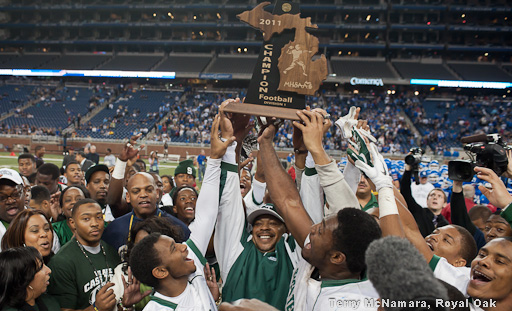
Division 1 Final: Right at Home in Detroit
November 24, 2012
DETROIT – For a year, Royce Jenkins-Stone and his teammates were reminded, if not haunted, by the playoff run that should’ve been a year ago but ended one game short.
On Saturday, the Technicians finished what they didn’t in 2010 – and stunned one of the state’s powerhouse programs to do so.
Cass Tech entered the playoffs 6-3 and unranked in The Associated Press poll. Detroit Catholic Central was 8-1 and No. 2. The Shamrocks have won 10 MHSAA football championships. But the Technicians, in their first Finals appearance, ended this fall No. 1.
Their defense has become known. Their freshman quarterback was not. But the combination of the two turned into a 49-13 win over DCC at Ford Field, just a mile away from Cass Tech’s campus.
“Last year, we took a loss to Lake Orion. And that was that year we were supposed to win. And I still think about it to this day,” said Jenkins-Stone, a senior linebacker and fullback, of the 24-21 Semifinal loss that ended his junior season. “It was a heart breaker. But we stepped it up. The seniors said … we’re going to come back, win the state championship, go further than we did ever before. Make our names in the history books.”
Cass Tech coach Thomas Wilcher said he asked his offense for six points against DCC. He has that much confidence in a defense that gave up just 9.7 points per game this fall.
He ended up needing 14. But that wasn’t a problem. Although it was easy to expect much from the Technicians’ defense – five players have committed to sign with Division I college programs in February – it was tough to predict the performance of freshman quarterback Jayru Campbell.
He tied the MHSAA Finals record of five touchdown passes – hitting five receivers for scores – and threw for 240 yards completing 13 of 20 attempts.
“My team told me if they could have three points we’d win the game,” Campbell said. “Our defense is remarkable. There’s not a word that can describe our defense.”
Fast is an obvious one. Dominating on the line are a few more. Cass Tech allowed the Shamrocks (12-2) just one first down in the second quarter and none in the third.
Junior cornerback Jordan Lewis led the Technicians (11-3) with eight tackles, and the Michigan-bound Jenkins-Stone had seven and returned an interception 36 yards for a score. Jenkins-Stone also ran for a touchdown and caught a pass for a third.
“I told the defense from the beginning that there is no way people should score on us,” Wilcher said. “I told them I think we have the best defense in the country. I said there’s no way I’m going to have 11 Division I players on defense and not win the state title.”
Junior David Houle ran for a score for DCC, and senior Kyle Cooper connected with junior Anthony Darkangelo on a 47-yard pass for the other.
“We’re a pound-it-out type team, and that’s what we like to do. We weren’t able to do that today,” DCC coach Tom Mach said. “They’re very fast, and we didn’t stay with them. … We’ve been great up to this point, and today we just became unraveled.”

Travel Football
July 15, 2016
The University of Michigan will host a high school football game on Sept. 2, 2016. That would not make news, except that the game is between two out-of-state high school teams.
The teams are from New Jersey and Maryland, likely chosen to assist the Wolverines’ recruiting efforts in those states, and to help them make more waves in the college football world. Both high school teams are private schools, and each comes with heavy baggage.
Some public schools in New Jersey have boycotted playing the New Jersey school in football; the Maryland school is not a member of the MHSAA’s counterpart association in that state. One school is flaunting the rules; the other school has no rules to follow.
That major college football has been in an uncontrolled spiral of excess is not news; but its insidious damage to high school sports is finally making headlines.
NCAA rules have recently been robbing schools of winter and spring sports athletes as college coaches entice high school seniors to graduate at the end of their seventh semester and start practicing football with their future college teammates several months early. We are grateful to see Big 12 Commissioner Bob Bowlsby question the practice of enrolling players before their scheduled high school graduation.
Now, NCAA rules appear to invite universities to select high school football teams from anywhere there’s a great prospect or two, and transport the teams across the U.S. to compete in a nearly empty stadium, save for recruiting “gurus,” athletic apparel reps and a few media. We are hoping to see some college sports leaders step up to question this practice.
All of this leads to the rich getting richer – on both the college and school levels. All of which induces another updraft to the spiral of excess in what are supposed to be education-based programs.