

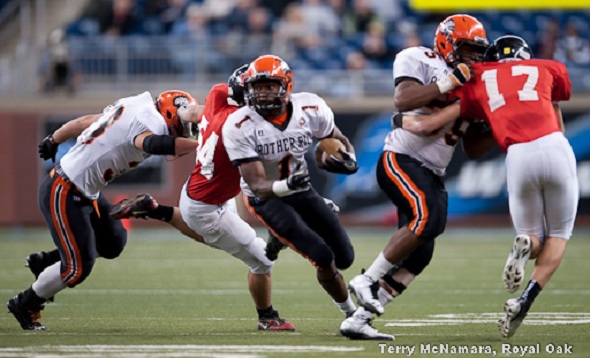
Division 2 Final: 'Anything is Possible'
November 29, 2011
DETROIT – That was the motto of Bloomfield Hills Brother Rice’s football team this season.
And the Warriors had to believe it in order for Friday’s dream finish to become possible.
Brother Rice qualified for the Division 2 playoffs at 5-4 last month and after finishing just fourth in the Detroit Catholic League Central. But riding the legs of senior running back Devin Church, the Warriors finished this season with a 24-14 win over Lowell at Ford Field to earn their seventh MHSAA championship and first since 2005.
Church, who ran for more than 900 yards during the playoffs, piled up 244 and three touchdowns rushing in the Final.
“We did it to make Coach proud,” Church said. “We kept the tradition going.
“That’s everybody’s dream, to win a state title. To walk away with a ring, that’s a blessing.”
“Coach” is Al Fracassa, who finished his 43rd season by winning his 405th high school game. But this run provided a new experience for the longtime leader.
Playing in a conference that also includes Division 1 finalist Detroit Catholic Central, Division 3 finalist Orchard Lake St. Mary and playoff qualifier Warren DeLaSalle, the Warriors lost three league games by a combined four points. Brother Rice (10-4) picked up its fourth loss in Week 8 against Cincinnati LaSalle.
But wins over strong teams – Detroit Martin Luther King and Ann Arbor Pioneer among them – likely gave Brother Rice the playoff points boost it needed to get into the postseason.
“We were worried about making the playoffs again. You get down, but the kids, they taught me a lesson. They came out and they worked their tails off,” Fracassa said. “We had a motto before our season started. … Anything is possible. This motto really personifies this football team. Anything is possible, and they’re going to remember it the rest of their lives.”
Church – who will sign with Northern Illinois in February – ran the ball 33 times. His yards were the sixth-most in an MHSAA Final ever. And they were followed by some flattering comparisons from Lowell coach Noel Dean.
“I don’t want to belittle their team by making it about one player; they have a great team,” Dean said. “(Church) is a fantastic football player. One of the better ones I’ve seen. And I’ve coached against some pretty good running backs in my day. The Grady brothers and the Ducketts, I’ve seen some pretty good ones. He’s fantastic.”
Fracassa added: “He’s done that all year, for the last three years. This is not only his good game he played. He’s played good in every game he’s played.”
And while Church ran wild, the Warriors were able to contain Lowell all-state quarterback Gabe Dean, who was making his third straight appearance in the Division 2 Final. A senior now, he led the Red Arrows to a championship game win in 2009
Dean did throw for 190 yards and two touchdowns, but was able to get free for just 34 yards on the ground as Lowell (12-2) attempted to catch up, and catch Church, most of the afternoon.
“The veer offense, we learned how to shut it down this week in practice. And we did a great job in the game,” Brother Rice junior linebacker Jon Reschke said. “We got them out of the veer and into a shotgun formation, the spread offense, which they didn't want to be in, which helped us.”
Senior linebacker Mark Doman had a team-high 13 tackles for Brother Rice, and Reschke had 10. Junior linebacker Reed Stormzand had 20 to lead Lowell, followed by sophomore linebackers Garrett Stehley and Jake Stehley with 14 and 12, respectively.

Playoffs Coming to MHSAA.tv, Fox
October 29, 2014
A big month of live streaming video from MHSAA Tournaments gets underway this week, with the return of the PrepZone on FoxSportsDetroit.com and MHSAA.tv broadcasts of Finals in two sports, plus its own Football Playoff coverage.
It’s the fourth season for the popular PrepZone on FoxSportsDetroit.com, which will provide free live coverage of four Football Playoff games each week for the first four weekends of the tournament.
Games to be covered Friday are:
- Division 2 – Warren DeLaSalle at Grosse Pointe North
- Division 4 – Grosse Ile at Chelsea
- Division 4 – Kalamazoo United (Hackett, Christian, Heritage Christian) at Eaton Rapids
- Division 6 – Hillsdale at Hanover-Horton
All games will take place Friday at 7 p.m., with short-term archives available on FoxSportsDetroit.com and long-term on-demand viewing on MHSAA.tv.
Boys Soccer coverage on MHSAA.tv begins Wednesday with three live Semifinal games, and wraps up on Saturday with live coverage from Finals sites at Brighton and East Kentwood. Here’s the full schedule (all coverage by subscription):
Semifinals – Wednesday
- Div. 1 – Saline v. Canton at Holt, 5 p.m.
- Div. 4 – Grand Rapids Covenant Christian v. Muskegon Western Michigan Christian at Cedar Springs, 6 p.m.
- Div. 2 – East Lansing v. Mason at Holt, 7 p.m.
- Finals – Saturday
- Noon – 2 Finals games (Sites and Divisions TBA after Semifinals)
- 3 p.m. – 2 Finals games (Sites and Divisions TBA after Semifinals)
Live streaming of the Lower Peninsula Cross Country Finals takes place Saturday at Michigan International Speedway. Planned coverage on MHSAA.tv includes a leader cam, split cams at one and two miles and a camera at the top of the MIS press center covering the finish of race. Commentary will come from a team of reporters around the course.
Here’s the complete schedule (all coverage by subscription unless noted):
- 9:55 a.m. – On Air – Morning Session
- 10 a.m. – Division 4 Boys
- 10:30 a.m. – Division 3 Boys
- 11 a.m. – Division 4 Girls
- 11:30 a.m. – Division 2 Girls
- 12:15 p.m. – Division 3 & 4 Awards (Free video stream)
- 1:25 p.m. – On Air – Afternoon Session
- 1:30 p.m. – Division 2 Boys
- 2 p.m. – Division 1 Boys
- 2:30 p.m. – Division 2 Girls
- 3 p.m. – Division 1 Girls
- 3:45 p.m. – Division 1 & 2 Awards (Free video stream)
MHSAA.tv also will cover two Football Playoff games live each Saturday the first three weeks of the tournament and 12 Semifinal games on Nov. 22. Here’s this week’s schedule (all coverage by subscription):
- Div. 2 – Lansing Everett at Flushing, 1 p.m.
- Div. 2 – Caledonia at Muskegon Mona Shores, 7 p.m.
Coverage of the Girls Volleyball Tournament begins next week, with two District Semifinal Matches each night for four straight nights. Here’s the complete schedule (all coverage by subscription):
Nov. 3 – Class C at Hanover-Horton
- Concord v. Jackson Lumen Christi, 5:30 p.m.
- Napoleon v. Vandercook Lake, 7 p.m.
Nov. 4 – Class C at Calumet
- Ironwood v. L’Anse, 6 p.m.
- Calumet v. Hancock, 7:30 p.m.
Nov. 5 – Class B at Frankenmuth
- Frankenmuth v. Otisville-Lakeville/North Branch winner, 6 p.m.
- Caro v. Flint Northwestern/Mt. Morris winner, 7:30 p.m.
Nov. 6 – Class A at Hudsonville
- Jenison v. Grandville/Holland West Ottawa winner, 5 p.m.
- Hudsonville/Holland winner v. Wyoming/Zeeland East winner, 7 p.m.
A Day Pass subscription to MHSAA.tv is $9.95. A Month Pass subscription is $14.95, enabling purchasers to watch all of this week’s action plus three weeks of coverage of the Girls Volleyball Tournament, weekly Football Playoff coverage and the Preliminaries and Finals of the Lower Peninsula Girls Swimming & Diving Tournament. All events become available for free on demand viewing three days after the date of the contest.
Radio: The MHSAA Internet Broadcast Network – MHSAANetwork.com – kicks off its Fall audio coverage with the Boys Soccer Finals on Saturday. During the month of November, the MHSAA Network will also provide live free audio of the 8-Player and 11-Player Football Finals and the Semifinals and Finals of the Girls Volleyball Tournament.
School Broadcast Program: A number of events broadcast last week are available on-demand on MHSAA.tv:
Soccer Regionals
- Bay City Western vs. East Lansing
- Madison Heights Lamphere vs. Ortonville-Brandon
- Kalamazoo Hackett vs. St. Joseph Lake Michigan Catholic
- Marysville vs. Bloomfield Hills Cranbrook-Kingswood
- Spring Lake vs. Grand Rapids Forest Hills Northern
- Grand Rapids Covenant Christian vs. Kalamazoo Heritage Christian
- Grand Haven vs. Saline
- Elk Rapids vs. Grant
- Ludington vs. Tawas
- Okemos vs. Grand Rapids Forest Hills Central
- Spring Lake vs. East Lansing
Volleyball
- Montrose vs. Genesee
- Central Montcalm vs. Big Rapids
- Calumet vs. Houghton
- Posen vs. Mio
- Montrose vs. Saginaw Arts & Sciences
- Calumet vs. Lake Linden-Hubbell
Football
- Hillman vs. Hale
- Negaunee vs. Ishpeming Westwood
- Whittemore-Prescott vs. Reese
- Stanton Central Montcalm vs. Lakeview
- Rockford vs. Holland West Ottawa
- Pinconning vs. Midland Bullock Creek
- Comstock Park vs. Sparta
- Posen vs. Owendale-Gagetown
- Watervliet vs. Lawton
- Cedar Springs vs. Ada Forest Hills Eastern
MHSAA Highlights: This week's package includes clips from the Spring Lake/East Lansing soccer and the Midland Bullock Creek/Pinconning and Ishpeming Westwood/Negaunee football games.