

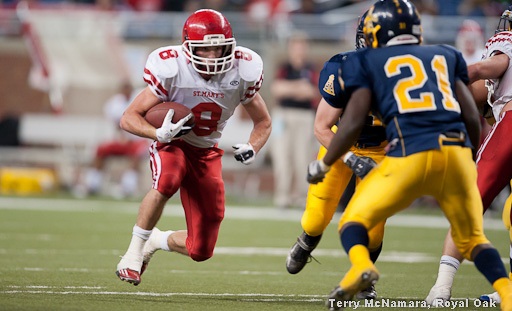
Division 3 Final: Eaglets Fly Again
November 29, 2011
Five times since its most recent MHSAA football championship, Orchard Lake St. Mary returned to the championship game – and lost.
Saturday night there was no stopping the Eaglets – or their running attack – at the Division 3 Final at Ford Field.
St. Mary rushed for 478 yards – and after near-misses the last two seasons won its first championship since 2000 with a 45-7 win over top-ranked Mount Pleasant.
"I knew what it felt like to lose, so it gave me the fire and other teammates the fire to win,” St. Mary senior running back Spencer McInnis said. “It’s unexplainable. It’s awesome. It’s something I’ve wanted since I was a kid. I always knew I was going to go to St. Mary’s. It’s just a great feeling.”
The Eaglets (12-2) had fallen by eight and three to East Grand Rapids in the last two Finals, and in a five-overtime classic in 2007. They entered the playoffs ranked No. 4 by The Associated Press – but as champions of the Detroit Catholic League Central, which sent three teams to Ford Field this fall.
“It was great to win again,” said St. Mary coach George Porritt, who finished his 23rd season leading the program. “It’s a collective effort from these kids, and it’s been all year long.”
McInnis ran for 213 of the team’s 478 rushing yards, and took three of his 23 carries into the end zone. Junior brother Parker McInnis ran for 96 yards and a score, as did junior fullback Grant Niemiec. Senior James Ross added another running touchdown.
“We were in position to make some tackles, and it wasn’t a scheme thing or guys getting blocked. It’s just that their athletes made our guys miss, or we couldn’t tackle them,” Mount Pleasant coach Jason McIntyre said. “I’ve never seen backs that we couldn’t tackle one on one or two on one. A lot of teams will have one great back, and you can focus and rally there. But they had three and four.”
The Oilers’ usually-strong running game finished with just 122 yards, led by senior quarterback Ryan Elliott’s 40. He also had Mount Pleasant’s lone score. It was the team’s first Finals appearance – and only loss this fall as it finished 13-1.
Junior defensive back Cory Williams led the Oilers with nine tackles. Senior lineman Dylan Zerki led the Eaglets with 11, and Ross had 10.

Attending to Football
November 29, 2013
The interscholastic football season comes to an end this weekend with the MHSAA Finals at Ford Field, but the most talked about sport in high schools today will continue to make headlines for many months into the future.
Some of the headlines will introduce topics that are merely footnotes compared to what is really most important, that being the efforts to keep school-sponsored football the safest and sanest brand of football in America.
At the center of these efforts has been a task force appointed by the MHSAA to work throughout 2013 to advance these two objectives: “To promote the value of interscholastic football and to probe for ways to make the sport safer in Michigan.”
The tangible results of the task force’s four meetings are these:
-
- A proposal to the MHSAA Representative Council to revise football practice policies to improve acclimatization of players and to reduce head trauma. The proposal goes to the Representative Council Dec. 6 for discussion, then to the Michigan High School Football Coaches Association and MHSAA Football Committee in January and to the MHSAA League/Conference meeting in February, before returning to the Representative Council for action on March 22.
-
Three proposals to the NFHS Football Rules Committee to modify playing rules to promote player safety.
- A variety of print, online and broadcast promotions on behalf of the value of interscholastic football and its safety record and to encourage healthier out-of-season activities by students in all sports.
MHSAA research informs us that participation in 11- or 8-player football in member high schools this fall was down 3.0 percent compared to 2012, and down 7.63 percent since the 2008 season. The biggest reasons cited by those surveyed are, in declining order, safety issues, declining enrollment, athletes playing other school or non-school sports, cultural changes and pay-to-participate.
It is important to note that participation is not declining everywhere, not even everywhere where enrollments are down and participation fees are up. It is important to note also that some other sports are in much greater decline than football in terms of high school participation.
It is difficult for me to imagine my life without football as a part of it. It’s difficult to imagine schools and communities without football. I very much doubt that the absence of football would have improved my life or the schools and communities I’ve been a part of. It’s a sport that needs our attention, not its extinction.