

Division 3 Final: Eaglets Fly Again
November 29, 2011
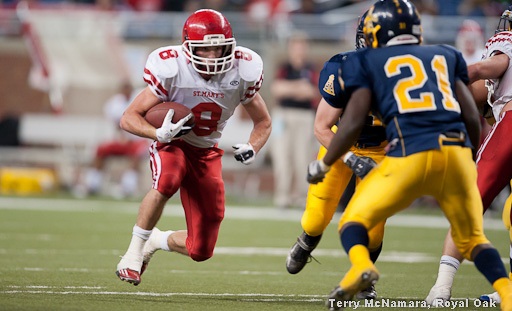
Five times since its most recent MHSAA football championship, Orchard Lake St. Mary returned to the championship game – and lost.
Saturday night there was no stopping the Eaglets – or their running attack – at the Division 3 Final at Ford Field.
St. Mary rushed for 478 yards – and after near-misses the last two seasons won its first championship since 2000 with a 45-7 win over top-ranked Mount Pleasant.
"I knew what it felt like to lose, so it gave me the fire and other teammates the fire to win,” St. Mary senior running back Spencer McInnis said. “It’s unexplainable. It’s awesome. It’s something I’ve wanted since I was a kid. I always knew I was going to go to St. Mary’s. It’s just a great feeling.”
The Eaglets (12-2) had fallen by eight and three to East Grand Rapids in the last two Finals, and in a five-overtime classic in 2007. They entered the playoffs ranked No. 4 by The Associated Press – but as champions of the Detroit Catholic League Central, which sent three teams to Ford Field this fall.
“It was great to win again,” said St. Mary coach George Porritt, who finished his 23rd season leading the program. “It’s a collective effort from these kids, and it’s been all year long.”
McInnis ran for 213 of the team’s 478 rushing yards, and took three of his 23 carries into the end zone. Junior brother Parker McInnis ran for 96 yards and a score, as did junior fullback Grant Niemiec. Senior James Ross added another running touchdown.
“We were in position to make some tackles, and it wasn’t a scheme thing or guys getting blocked. It’s just that their athletes made our guys miss, or we couldn’t tackle them,” Mount Pleasant coach Jason McIntyre said. “I’ve never seen backs that we couldn’t tackle one on one or two on one. A lot of teams will have one great back, and you can focus and rally there. But they had three and four.”
The Oilers’ usually-strong running game finished with just 122 yards, led by senior quarterback Ryan Elliott’s 40. He also had Mount Pleasant’s lone score. It was the team’s first Finals appearance – and only loss this fall as it finished 13-1.
Junior defensive back Cory Williams led the Oilers with nine tackles. Senior lineman Dylan Zerki led the Eaglets with 11, and Ross had 10.

Committees Fail Critical Issues
June 7, 2013
Typically, each sport committee meets once each year for three to five hours, during which time it considers proposals that come from schools, leagues and the state’s coaches association for the sport; and the proposals most often deal with allowing more regular-season events and more qualifiers to the MHSAA postseason tournament.
Occasionally there is a proposal that might improve sportsmanship. But much more often the proposals would increase conflicts between academics and athletics and/or strain overstressed local budgets. And almost never is there a proposal that would address the health and safety of participants (the Wrestling Committee has been an occasional exception and the Competitive Cheer Committee is a routine exception).
While coaches associations must shoulder some of the blame because they’ve brought MHSAA committees “trivial” topics, at least in comparison to the tougher health and safety topics, much of the cause of MHSAA committee ineffectiveness is that the committees don’t meet long enough or often enough to research serious problems and develop well-thought-out solutions. That is forgivable because it is difficult to get commitments from busy people all across Michigan to be absent from their regular jobs and travel dozens or even hundreds of miles, and to do so multiple times each year – which is what it takes to more fully understand complex problems and more carefully construct solutions. Meetings have to be few and they have to be efficient.
However, facing the worst publicity football has seen since the mid-1970s, we knew we had to supplement the football committee process. We did so by appointing a special Football Task Force of optimum size and experienced, representative makeup to meet on however many occasions are necessary during 2013 to accomplish three purposes:
- Review practice policies to improve acclimatization of players and reduce head trauma.
- Review competition rules to reduce head trauma and the frequency of the sport’s most injurious game situations.
- Develop promotions that extol the value of football to students, schools and communities and the safety record of school-based football.
The promotional efforts have begun to be rolled out; game rule modifications are being investigated; and four proposals for changing football practice policies have been prepared. They will be the topic of our next posting.