

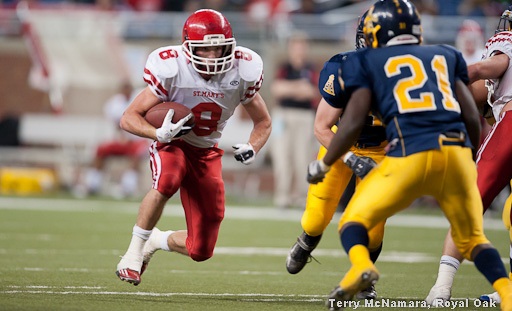
Division 3 Final: Eaglets Fly Again
November 29, 2011
Five times since its most recent MHSAA football championship, Orchard Lake St. Mary returned to the championship game – and lost.
Saturday night there was no stopping the Eaglets – or their running attack – at the Division 3 Final at Ford Field.
St. Mary rushed for 478 yards – and after near-misses the last two seasons won its first championship since 2000 with a 45-7 win over top-ranked Mount Pleasant.
"I knew what it felt like to lose, so it gave me the fire and other teammates the fire to win,” St. Mary senior running back Spencer McInnis said. “It’s unexplainable. It’s awesome. It’s something I’ve wanted since I was a kid. I always knew I was going to go to St. Mary’s. It’s just a great feeling.”
The Eaglets (12-2) had fallen by eight and three to East Grand Rapids in the last two Finals, and in a five-overtime classic in 2007. They entered the playoffs ranked No. 4 by The Associated Press – but as champions of the Detroit Catholic League Central, which sent three teams to Ford Field this fall.
“It was great to win again,” said St. Mary coach George Porritt, who finished his 23rd season leading the program. “It’s a collective effort from these kids, and it’s been all year long.”
McInnis ran for 213 of the team’s 478 rushing yards, and took three of his 23 carries into the end zone. Junior brother Parker McInnis ran for 96 yards and a score, as did junior fullback Grant Niemiec. Senior James Ross added another running touchdown.
“We were in position to make some tackles, and it wasn’t a scheme thing or guys getting blocked. It’s just that their athletes made our guys miss, or we couldn’t tackle them,” Mount Pleasant coach Jason McIntyre said. “I’ve never seen backs that we couldn’t tackle one on one or two on one. A lot of teams will have one great back, and you can focus and rally there. But they had three and four.”
The Oilers’ usually-strong running game finished with just 122 yards, led by senior quarterback Ryan Elliott’s 40. He also had Mount Pleasant’s lone score. It was the team’s first Finals appearance – and only loss this fall as it finished 13-1.
Junior defensive back Cory Williams led the Oilers with nine tackles. Senior lineman Dylan Zerki led the Eaglets with 11, and Ross had 10.

Heads and Heat
August 16, 2012
We are engaged in very serious discussions. They’re not only complicated, with unintended negative consequences possible from what are thought to be positive actions; they’re also a matter of life and death.
The topic is football – the high school sport under most scrutiny today and suffering from the most criticism it’s seen since the 1970s when catastrophic neck injuries spiked, liability awards soared, many insurers balked, and most helmet manufacturers abandoned the business altogether.
During recent years we have learned about the devastating long-term effects of repeated blows to the head; and we’re trying to reduce such hits. We’ve learned that 70 percent of concussions in football result from helmet-to-helmet contact, and we’re trying to have coaches teach blocking and tackling differently and have officials penalize “high hits” consistently and rigorously.
During the past several years we’ve learned that serious heat illness and heat-related deaths are 100 percent preventable, yet nationwide there were 35 heat-related deaths in high school football alone from 1995 to 2010; and we’re promoting practices that acclimatize athletes more gradually than “old school” traditionalists might advocate.
As we simultaneously address issues of heads and heat in football, some coaches may think we’re being overbearing, while many in medical fields say we’re out of date, citing higher standards of the American Academy of Pediatrics, National Athletic Trainers Association and National Federation of State High School Associations, as well as many of our counterpart organizations across the country.
As we consider in-season changes to improve athlete acclimatization and reduce blows to the head, we should be open to making out-of-season changes that work toward rather than in opposition to those objectives. There can be no sacred cows. The topic is too serious.
Ultimately, if we err in the outcome of this year’s discussions about heads and heat in football, it must be on the side of safety, on minimizing risks for student participants. They deserve it and, once again, the sport of football needs it.