

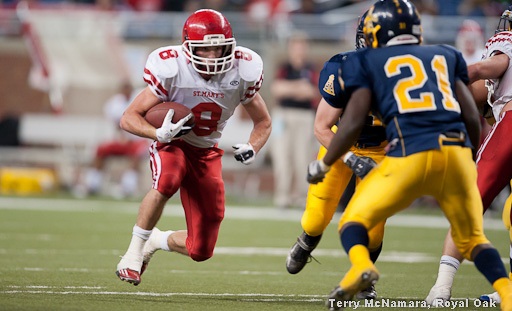
Division 3 Final: Eaglets Fly Again
November 29, 2011
Five times since its most recent MHSAA football championship, Orchard Lake St. Mary returned to the championship game – and lost.
Saturday night there was no stopping the Eaglets – or their running attack – at the Division 3 Final at Ford Field.
St. Mary rushed for 478 yards – and after near-misses the last two seasons won its first championship since 2000 with a 45-7 win over top-ranked Mount Pleasant.
"I knew what it felt like to lose, so it gave me the fire and other teammates the fire to win,” St. Mary senior running back Spencer McInnis said. “It’s unexplainable. It’s awesome. It’s something I’ve wanted since I was a kid. I always knew I was going to go to St. Mary’s. It’s just a great feeling.”
The Eaglets (12-2) had fallen by eight and three to East Grand Rapids in the last two Finals, and in a five-overtime classic in 2007. They entered the playoffs ranked No. 4 by The Associated Press – but as champions of the Detroit Catholic League Central, which sent three teams to Ford Field this fall.
“It was great to win again,” said St. Mary coach George Porritt, who finished his 23rd season leading the program. “It’s a collective effort from these kids, and it’s been all year long.”
McInnis ran for 213 of the team’s 478 rushing yards, and took three of his 23 carries into the end zone. Junior brother Parker McInnis ran for 96 yards and a score, as did junior fullback Grant Niemiec. Senior James Ross added another running touchdown.
“We were in position to make some tackles, and it wasn’t a scheme thing or guys getting blocked. It’s just that their athletes made our guys miss, or we couldn’t tackle them,” Mount Pleasant coach Jason McIntyre said. “I’ve never seen backs that we couldn’t tackle one on one or two on one. A lot of teams will have one great back, and you can focus and rally there. But they had three and four.”
The Oilers’ usually-strong running game finished with just 122 yards, led by senior quarterback Ryan Elliott’s 40. He also had Mount Pleasant’s lone score. It was the team’s first Finals appearance – and only loss this fall as it finished 13-1.
Junior defensive back Cory Williams led the Oilers with nine tackles. Senior lineman Dylan Zerki led the Eaglets with 11, and Ross had 10.

Football’s Future
March 20, 2012
Many folks, including me, will too often focus on the destination more than the trip. More on results than process. The end more than the means.
This is epidemic in sports, on all levels. There’s so much focus on the postseason that it overshadows the regular season.
In contrast, in educational athletics, we are supposed to hold to the principle that opportunities for teaching and learning are as plentiful, maybe more so, in regular season as in tournaments, at subvarsity levels as at varsity, during practices as during games.
This disease affects football as much as any high school sport. There’s been too much focus on the end of the season – playoffs. Postseason tournaments have been the demise of many great Thanksgiving Day high school football classics across the country. Playoffs continue to ruin rivalries and collapse conferences nationwide.
And, disturbingly, the focus on the end of the season misses what is most wrong with football, and may be most threatening to its future. It’s practice. Specifically, what’s allowed during preseason practice and then at practice throughout the season.
We can predict that, in high school football’s future, two-a-day practices will be fewer, practice hours will be shorter and activities will be different. Among proposals we will be presented (and should seriously consider) will be:
If this all sounds silly or radical, remember that the NCAA and NFL are already making such changes. NFL players face contact in practice on only 14 days during a 17-week regular season. Meanwhile, many high school coaches have kids knocking heads and bruising bodies two to four days a week, all season long. Giving critics the impression that interscholastic football for teens is more brutal than the higher levels of football for grown men. Inviting interference from people who think they know better.
Actually, we know better; and we need to do better. Soon.