

Division 4 Final: No. 2 Becomes No. 1
November 29, 2011
DETROIT -- Subtract an injured star linebacker, and what did Zeeland West get?
An inspired performance from his teammates -- and this fall’s MHSAA Division 4 football championship.
Senior Josh Blanton remained on the sideline Friday at Ford Field, unable to contribute because of an injury suffered in last week’s Semifinal.
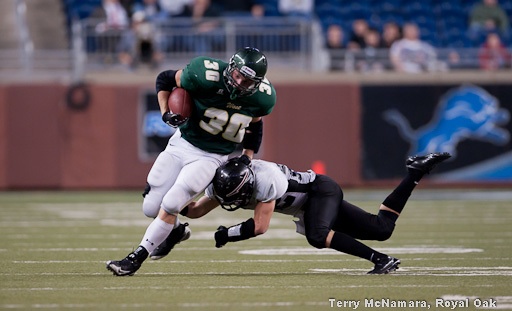
But his No. 2 Dux teammates rallied, and despite falling behind early came back to run over and past top-ranked Marine City 45-7 in perhaps the most highly-anticipated of the day’s four Finals.
“We knew we were going to have a tough time, and as a team we kinda thought about things,” Zeeland West quarterback Clay Coatney said. “We just said to ourselves, we’re going to come out and play as hard as we could, play as physical as we could.”
Zeeland West finished with its second MHSAA championship, but first 14-0 record in seven seasons as a program. Marine City ended 13-1.
The Dux’ physicality was the difference-maker on both sides of the ball. Marine City’s offense came into the Final averaging nearly 37 points per game. But led by senior linebacker Jake McKellar’s eight tackles and lots of contributors all around him, the Dux held the Mariners to just 216 yards of total offense -- while also dominating the line on offense and gaining 410.
Senior Kyle Kujawa ran for 99 of the team’s 288 rushing yards, and scored once. Coatney was 6 for 9 passing for 122 yards and two scores. Senior Brad Mesbergen responded to the Mariners’ early touchdown by returning the ensuing kickoff an MHSAA Finals-record 97 yards to even the score.
Marine City scored the game’s first touchdown just less than two minutes into the game. But the Mariners, despite multiple drives into Dux territory, gave the ball away one each by fumble and interception and three more times on turnovers on downs.
“We’ve got an all-state linebacker not playing. To say we’re playing that type of explosive offense, (and) for those kids to show up and do what they did, you’ve just gotta go, ‘Holy smokes, who are those guys?’” Zeeland West coach John Shillito said.
Marine City senior Adam Kroll threw 36 yards to senior Gunnar Glodich for that lone Mariners touchdown, and finished 8 of 16 passing for 85 yards total. Senior running back Anthony Scarcelli gained just 42 yards on eight carries in his final high school game before signing with Central Michigan, but did lead the team with eight tackles in what also was the final game for his father and coach, Tony Scarcelli.
"When I look at this season, I don't look at one game," Tony Scarcelli said. "I look at this as we're state runners-up. Twenty years from now, we'll all look back on this and say what a great season it was."
A Game for Every Fan: Week 8
October 11, 2012
One team more than half of the 2012 MHSAA football playoff field has been decided, with 129 teams qualified for the 256-team field with two regular-season games to play.
And each of these final weeks includes opportunities for plenty to do something they've never done before.
Over the last two weeks, Swartz Creek, Grand Rapids Northview and Detroit East English have earned their first playoff berths ever (East English in its first year as a school). Detroit Consortium, Mayville, Walled Lake Northern and Saginaw Valley Lutheran all can earn their first berths with wins this weekend.
See below for some of the best games being played in every corner of the state. And visit the MHSAA Score Center all weekend for updated scores and standings.
(All games below are tonight unless noted. Go to Score Center for additional dates and kickoff times.)
Greater Detroit
Clarkston (7-0) at Lake Orion (7-0)
These Oakland Activities Association Red rivals have two of the top three playoff point averages among potential Division 1 teams this fall, and are ranked Nos. 1 and 2, respectively, by The Associated Press' media panel. This is as true a rivalry as they come -- the schools are nearly the same size at more than 2,500 students each, they are located only 11 miles apart, and they've split their last 10 meetings including three in the playoffs.
Others that caught my eye: Detroit Cody (5-2) vs. Detroit East English (6-1) at Detroit Northwestern, Dearborn Heights Robichaud (7-0) at Dearborn Fordson (6-1), Oak Park (7-0) at Oxford (4-3), Detroit Martin Luther King (4-3) vs. Detroit Cass Tech (6-1) at Detroit Northwestern.
Lower Up North
Traverse City St. Francis (4-3) at Maple City Glen Lake (7-0)
At stake this week and potentially next is St. Francis' 22-season playoff berth streak, the state's longest. Its losses are to teams with a combined 19-2 record, but the Gladiators took a significant step last week by beating Saginaw Nouvel. Glen Lake is much like the teams that have beaten St. Francis. The Lakers have given up only 44 points total and own a win over Kingsley, which beat the Gladiators on opening night.
Others that caught my eye: Benzie Central (3-4) at Cheboygan (5-2), Boyne City (7-0) at Elk Rapids (4-3), Lake City (6-1) at Manton (4-3), Kalkaska (5-2) at Frankfort (3-4).
Bay and Thumb
Midland (7-0) at Bay City Western (7-0)
Like some games these teams have won this season, their league race is coming right down to the final minutes. The winner claims a share of the Saginaw Valley Association North championship, with both then facing city rivalry games to finish the regular season. Western has survived three straight eight-point wins, and Midland edged two of those same opponents by seven points apiece. The Chemics have beaten the Warriors in six of their last eight meetings.
Others that caught my eye: Swartz Creek (7-0) at Fenton (6-1), Walled Lake Western (5-2) at Grand Blanc (4-3), Saginaw Valley Lutheran (5-2) at Merrill (4-3), Marine City (6-1) at St. Clair (7-0).
West Michigan
Grand Rapids Catholic Central (7-0) at Hastings (6-1)
The winner of this matchup will claim a share of the O-K Gold championship. Grand Rapids Catholic Central is the reigning champion, but Hastings can claim a league title for the first time since 2001. The Cougars have won three of the four between these two since joining the Gold, but Hastings if off to its best start since that last league championship season.
Others that caught my eye: Lowell (6-1) at Caledonia (6-1), Grand Rapids Forest Hills Central (4-3) at Grand Rapids Christian (6-1), Fruitport (7-0) at Muskegon Catholic Central (5-2), Grandville (4-3) at Rockford (5-2).
Mid-Michigan
Grand Ledge (5-2) at East Lansing (5-2)
This has been one of the best rivalries in mid-Michigan for more two decades. And although this game likely won't decide a league champion this time -- Lansing Everett leads both by a win in the Capital Area Activities Conference Blue standings -- it's remains significant as both the Comets and Trojans' playoff hopes could hinge on which wins tonight. East Lansing might be in better shape, with one-win Okemos coming up in Week 9. But the Comets finish with Holt, 4-3 and another team playing for a postseason berth.
Others that caught my eye: DeWitt (6-1) at Portland (6-1), Walled Lake Northern (5-2) at Hartland (7-0), Williamston (4-3) at Haslett (4-3), Mason (5-2) at Lansing Waverly (4-3).
Southwest and Border
Stevensville Lakeshore (7-0) at Mattawan (7-0)
No region of the state has more big games this week, with titles being decided all over the Kalamazoo area and southwestern corner. But these are the big schools from the biggest league, and the game longest-awaited as both have navigated a tough Southwestern Michigan Athletic Conference West. Mattawan does have to face third-place Portage Northern next week, but the winner tonight will be riding high no matter what opponent is up next. Mattawan did win last season, breaking an eight-game losing streak against the Lancers.
Others that caught my eye: Watervliet (7-0) at Decatur (6-1), Edwardsburg (6-1) at Dowagiac (7-0), Paw Paw (7-0) at Otsego (6-1), Union City (5-2) at Reading (6-1).
Upper Peninsula
L’Anse (6-1) at Eagle River Northland Pines (7-0)
Northland Pines, the only Wisconsin team in the Western Peninsula Athletic Conference, leads both L'Anse and Calumet by a win with this the final weekend of the league schedule. Calumet fell to Northland Pines by two on opening night and defeated L'Anse by 20 last week, which doesn't seem to indicate good things for the latter. But a win tonight would add another huge accomplishment to the Hornets' first winning season since 2007.
Others that caught my eye: Negaunee (7-0) at Marquette (4-3), Pellston (4-3) at St. Ignace (7-0), Crystal Falls Forest Park (5-2) at Bessemer (4-2), Iron Mountain North Dickinson (7-0) at Lake Linden-Hubbell (4-3).
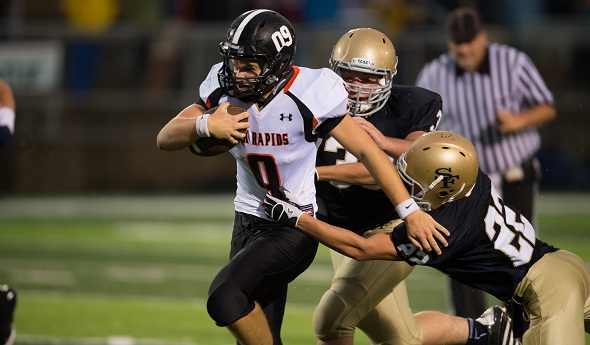
PHOTO: Elk Rapids' Derek Sentieri works to break away from Traverse City St. Francis tacklers during their game earlier this fall. (Click to see more at Terry McNamara Photography.)