

Division 5 Football Final: Powers Up
November 26, 2011
DETROIT – The final night of September was cold, wet and especially disappointing for Flint Powers Catholic.
Chargers coach Bob Buckel sensed that frustration as the bus rolled to to a stop after 6-0 loss and then silent ride home from Davison. Powers already was 2-3 heading into that game and needing to win out to guarantee a playoff spot. Now at 2-4, perfection the rest of the way was absolutely necessary to catch even the slimmest of shots at a postseason berth.
The last eight games became unofficial playoff games for the Chargers. And they won them all.
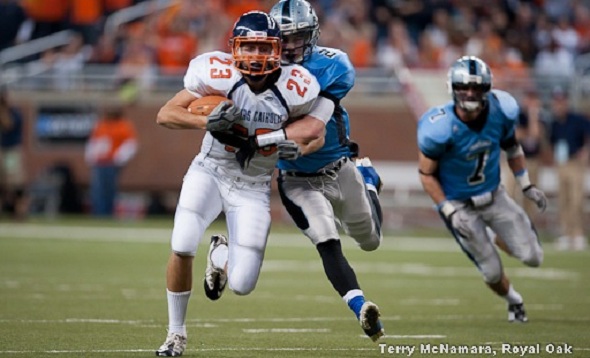
Unranked and the underdog, Powers downed No. 1 Lansing Catholic in record-setting fashion Saturday, 56-26 to claim the MHSAA Division 5 championship at Ford Field.
“We knew that we had to win out. Nobody shied to that competition,” Powers senior lineman Danny O’Brien said. “We really got after it.”
And especially Saturday. The 56 points tied Saginaw Nouvel’s from the Division 7 Final earlier in the day as the new MHSAA Finals record. They also were the most points Powers has ever scored, beginning with its first season in 1970.
Lansing Catholic senior quarterback Cooper Rush was named Division 5-6 Player of the Year earlier this week by The Associated Press, and his name can be found all over the MHSAA record book. He added 291 yards and three touchdowns passing, and another score rushing to his impressive three-year varsity career totals.
But Saturday it was Powers junior quarterback Garrett Pougnet who played his name into history.
Rewind 12 weeks ago. Lansing Catholic (13-1) beat Powers 37-17. Pougnet struggled, completing just 6 of 20 passes and running for 67 yards and a score.
His performance in the Final was one of the many differences in the rematch. This time, Pougnet was 12 of 15 passing for 258 yards and four touchdowns, and also ran 14 times for 159 yards and two scores. His 413 yards of total offense were second in MHSAA Finals history and just 13 off the record.
Buckel listed the other differences this time around: Heading into the teams’ Sept. 2 meeting, Powers (10-4) was coming off a big loss to Saginaw Nouvel and two players were out with concussions. Two more defensive backs were still playing on the junior varsity. And, of course, he used a few different formations in the rematch.
“I just said, when we get the ball, we’re going to be very aggressive,” Buckel said. “We had a play we put in this week called Ford Field. It didn’t work either time. But we just wanted to be aggressive because we really thought we might need to score 50 points to beat them, because nobody has slowed them down.”
Rush finished this season with 4,005 passing yards, good for second in the MHSAA record book for one season, and 48 passing touchdowns, which tops that list. This time, senior Connor Bartlett was the main recipient with 11 catches for 189 yards and two scores. Senior Matt Macksood also caught a touchdown pass, and finished this season with 95 catches (second for one season) for 1,590 yards (fifth) and 22 touchdowns (tied for second).
“We moved the ball pretty good when we had it on offense. We just didn’t have it. I think they scored just about every time they had the ball,” Lansing Catholic coach Jim Ahern said. “The big difference in the games where we came back – we came back from 21 down against Portland, which was a very good football team – was we got some defensive stops. We just didn’t get them tonight.”
Undefeated Cassopolis Continues to Climb
By
Wes Morgan
Special for MHSAA.com
October 5, 2017
By Wes Morgan
Special for Second Half
Getting to the postseason wasn’t the issue for the Cassopolis varsity football program, which is currently ranked No. 6 in the latest Associated Press Division 7 poll and has earned playoff berths 11 times since 2000.
 It was taking that next step.
Now in his fifth year guiding the program, head coach Dan Purlee, a Cassopolis graduate, former athlete and longtime assistant coach, helped push the school past that barrier. And 2016 was the program’s banner year.
The Rangers ripped through all their opponents last season except for a talented Buchanan squad in Week 5. Throughout their 8-1 run during the regular season, the Rangers were on the right side of a 365-130 scoring differential. They went on to outscore their first three playoff foes 141-49.
Cassopolis, which also boasted a 4-0 mark to win the Berrien-Cass-St. Joseph Conference Red championship, finished last year 11-2 with a 54-22 loss to Detroit Loyola in the Division 7 Semifinals.
Just a year earlier, Cassopolis recorded a 9-3 record in 2015, falling to Pewamo-Westphalia in the Regional round. The Rangers’ 48-14 victory against Bridgman that fall earned the program its first District championship.
“We’ve put together a few good years here,” said Purlee, whose team, led by six returning seniors, is 6-0 heading into Friday’s game against Southwest 10 Conference opponent Hartford. “We’re playing pretty good football, but you always feel like there’s room for improvement, and there is. But we like where we’re at this year, and we’re proud of our success and accomplishments over the previous few years.”
Purlee doesn’t easily accept the credit. He promptly shifted the focus to the student-athletes and his astute assistants, including Michigan High School Football Coaches Association Hall of Fame inductee Jim Myers, who has 42 years of coaching under his belt and previously was the head coach at Niles Brandywine. And there’s also Steve Green, who has been coaching alongside Purlee at Cassopolis the last 18 years.
“We’ve done it together,” Purlee said. “Your coaching buddies — it goes beyond coaching. They’re like your brothers.”
Cassopolis athletics director Matt Brawley had high praise for Purlee.
“He’s a professional,” Brawley said. “He’s extremely detailed and has a game plan for every situation. He’s very impressive to watch.”
Brawley also pointed out that, with a current team grade-point average of 3.40, a second consecutive academic all-state award is on the horizon.
Running the full house T formation offense, no one player has had to carry the load. Statistical information was only available through the Rangers’ first five games, but senior Brandon Anderson and junior Tyrese Hunt-Thompson had combined for nearly 500 rushing yards and 14 touchdowns. Senior quarterback Xander Smith had rushed for more than 250 yards with a couple passing touchdowns as well.
Junior Hunter Parsons had rushed for 266 yards through five contests, and quarterback Dylan Green has been responsible for four passing TDs. Keep in mind, most of the starters have watched the second half from the sideline most of the year with games well in hand.
 “We have the ability to run a little shotgun spread,” Purlee said. “We’re pretty diverse offensively. Teams were really loading up the box on us and we’re not traditionally very big up front, so we realized we were going to need to counter that with spreading the field a little bit.
“We’ve just had a stretch here where we’ve had some kids who are extremely athletic and can catch the ball and quarterbacks that can throw the ball. We can pound it up the middle and also spread you out.”
Defensively, freshman outside linebacker Ahsan Hart boasts 33 tackles and a pair of sacks, senior Kyjuan Lanier, a captain at middle linebacker, has 29 tackles, two sacks and two fumble recoveries; and junior defensive end Skyler McKee has recorded 28 tackles with two sacks.
“We’re all comfortable with each other,” Lanier, a three-year varsity player, said. “It’s trust. I feel like if I don’t make a play, I’ve got Hunter Parsons right next to me coming up to make the tackle. Our secondary likes to come up and make plays. Our lines are disciplined.
“When I was younger, it was more coming downhill, filling holes and blitzing. As I’ve gotten older, it is recognizing where the ball is going, watching linemen, seeing what they’re doing, watching a pulling guard … getting smarter rather than just running to the play.”
The Rangers, who have given up only 28 points all year, pin their ears back and keep the pressure on every snap.
“I think there are several factors,” Purlee said of his program’s building success. “We’ve had some really good players over the past few years, and we have some athletic and tough kids. When you have that, you can put together a pretty good football team. I feel like our coaches have done a great job in helping instill discipline. It’s a team that executes in all phases of the game. We work hard, and we’re well prepared. It’s a collaborative effort between good players, good coaches and the right type of kids.”
Instead of being content, having tasted this kind of success has only intensified the team’s appetite.
“They have been a committed group. They’re extremely focused,” Purlee added. “Obviously, we’re proud of what we’ve done the last two years, but we want to go further. We’re not going to limit our goals. The next step for us is to play in Ford Fieldhouse.
 Wes Morgan has reported for the Kalamazoo Gazette, ESPN and ESPNChicago.com, 247Sports and Blue & Gold Illustrated over the last 12 years and is the publisher of JoeInsider.com. He can be reached at [email protected] with story ideas for Berrien, Cass, St. Joseph and Branch counties.
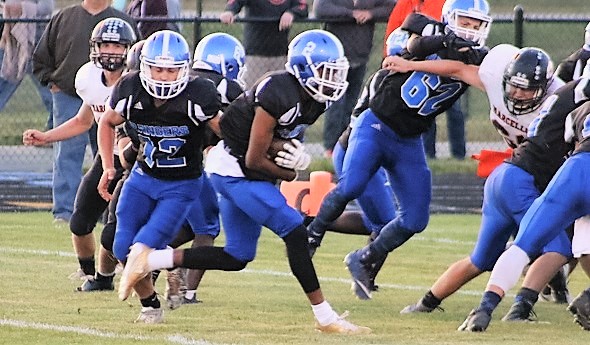
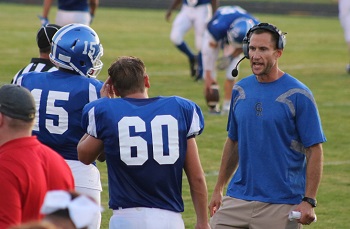
PHOTOS: (Top) Casspolis' Tyrese Hunt-Thompson (2) follows his blockers into the line against Marcellus last week. (Middle) Rangers coach Dan Purlee confers with one of his linemen on the sideline. (Photos by Billie Austin.)