


Division 5 Football Final: Powers Up
November 26, 2011
DETROIT – The final night of September was cold, wet and especially disappointing for Flint Powers Catholic.
Chargers coach Bob Buckel sensed that frustration as the bus rolled to to a stop after 6-0 loss and then silent ride home from Davison. Powers already was 2-3 heading into that game and needing to win out to guarantee a playoff spot. Now at 2-4, perfection the rest of the way was absolutely necessary to catch even the slimmest of shots at a postseason berth.
The last eight games became unofficial playoff games for the Chargers. And they won them all.
Unranked and the underdog, Powers downed No. 1 Lansing Catholic in record-setting fashion Saturday, 56-26 to claim the MHSAA Division 5 championship at Ford Field.
“We knew that we had to win out. Nobody shied to that competition,” Powers senior lineman Danny O’Brien said. “We really got after it.”
And especially Saturday. The 56 points tied Saginaw Nouvel’s from the Division 7 Final earlier in the day as the new MHSAA Finals record. They also were the most points Powers has ever scored, beginning with its first season in 1970.
Lansing Catholic senior quarterback Cooper Rush was named Division 5-6 Player of the Year earlier this week by The Associated Press, and his name can be found all over the MHSAA record book. He added 291 yards and three touchdowns passing, and another score rushing to his impressive three-year varsity career totals.
But Saturday it was Powers junior quarterback Garrett Pougnet who played his name into history.
Rewind 12 weeks ago. Lansing Catholic (13-1) beat Powers 37-17. Pougnet struggled, completing just 6 of 20 passes and running for 67 yards and a score.
His performance in the Final was one of the many differences in the rematch. This time, Pougnet was 12 of 15 passing for 258 yards and four touchdowns, and also ran 14 times for 159 yards and two scores. His 413 yards of total offense were second in MHSAA Finals history and just 13 off the record.
Buckel listed the other differences this time around: Heading into the teams’ Sept. 2 meeting, Powers (10-4) was coming off a big loss to Saginaw Nouvel and two players were out with concussions. Two more defensive backs were still playing on the junior varsity. And, of course, he used a few different formations in the rematch.
“I just said, when we get the ball, we’re going to be very aggressive,” Buckel said. “We had a play we put in this week called Ford Field. It didn’t work either time. But we just wanted to be aggressive because we really thought we might need to score 50 points to beat them, because nobody has slowed them down.”
Rush finished this season with 4,005 passing yards, good for second in the MHSAA record book for one season, and 48 passing touchdowns, which tops that list. This time, senior Connor Bartlett was the main recipient with 11 catches for 189 yards and two scores. Senior Matt Macksood also caught a touchdown pass, and finished this season with 95 catches (second for one season) for 1,590 yards (fifth) and 22 touchdowns (tied for second).
“We moved the ball pretty good when we had it on offense. We just didn’t have it. I think they scored just about every time they had the ball,” Lansing Catholic coach Jim Ahern said. “The big difference in the games where we came back – we came back from 21 down against Portland, which was a very good football team – was we got some defensive stops. We just didn’t get them tonight.”
Kzoo Rivals Unite to 'Crush Cancer'
September 14, 2016
By Geoff Kimmerly
Second Half editor
Kalamazoo football players clad in pink and teal took to Loy Norrix’s football field Friday for one of southwest Michigan’s most anticipated annual rivalry games – but also, with the help of some notable alumni, to continue to spread the word about cancer awareness.
Kalamazoo Central downed Loy Norrix 41-13 in the Cross-town Crush Cancer game, Central wearing pink jerseys symbolic of breast cancer awareness and Loy Norrix in teal signifying ovarian cancer awareness.
The jerseys were provided in large part by a donation by former Loy Norrix stars Tico and Todd “T.J.” Duckett, who served as "ambassadors" for the evening along with another past Loy Norrix star, Little John Flowers, past Kalamazoo Central football standout Duane Young and past Central baseball standout Kevan Hess. Both Duckett brothers, Flowers and Young starred at Michigan State before spending time in the NFL, Young and T.J. Duckett playing professionally for six seasons each. Hess was drafted by the Tigers out of Western Michigan University in 2009 and played three seasons in Detroit’s minor league system.
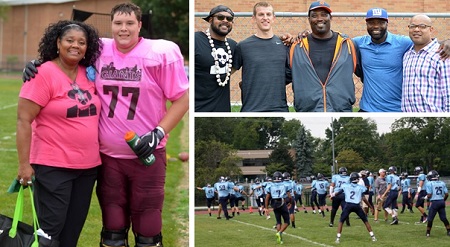 The teal jerseys had particular meaning for Tico and T.J. Duckett, as their mother Jackie Barham died after a fight with ovarian cancer.
“We chose a time such as this because of the anticipated large attendance and the potential for the greatest impact amongst our alma mater’s community members,” said the Duckett brothers in a statement leading up to the game. “Our own mother, Jackie Barham, would have celebrated more birthdays, if there was a cure for cancer. This is just one way that we can honor her memory.”
The jerseys featured the teams’ mascot names and also the Kalamazoo cityscape. Junior varsity players from both schools wore T-shirts with their dates of graduation and the cityscape as well as organizers set a theme of the entire community standing together for a common fight against cancer. The event was organized by a Kalamazoo Central parent committee headed by Terri Benton-Ollie together with administrators and other supporters representing both school communities.
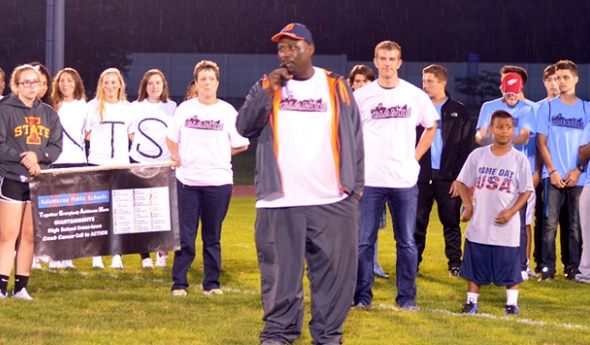
Students from both schools were joined on the field at halftime by 50 cancer survivors from the community, and funds raised will be donated to the West Michigan Cancer Center.
“We know that we must ‘tackle’ so many of our societal ills,” Benton-Ollie said. “Tragedy can be a disastrous one-moment incident or a phenomenon that must be reversed or a disease that lurks amongst us. Let’s create a ripple effect of continuous gestures and action that work in favor of the greater good and crush cancer.”
Click for more from Kalamazoo Public Schools.
PHOTOS: (Top) Former NFL player Duane Young speaks to the crowd during halftime of the "Crush Cancer" game. (Middle) Supporters and teams wore pink and blue signifying, respectively, breast and ovarian cancer awareness; the game's ambassadors were (from left) T.J. Duckett, Kevan Hess, Duane Young, Little John Flowers and Tico Duckett. (Photos by Walter Hall.)