

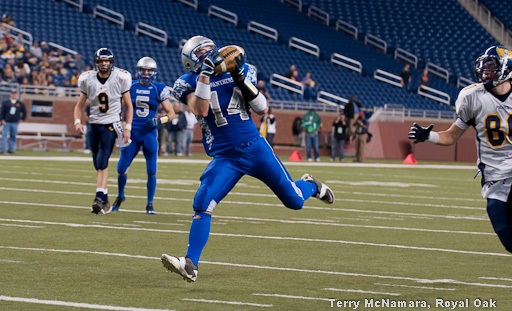
Division 7 Final: Blue Streak
November 29, 2011
DETROIT – Only a few drives into the MHSAA Division 7 Final, Bennett Lewis came to Saginaw Nouvel coach Mike Boyd with a request.
Give me the ball until Pewamo-Westphalia stops me.
Never happened. The senior running back ran for five touchdowns, and his Panthers scored 56 points – both to set or tie MHSAA Finals records.
And both were accomplished over just two quarters as Nouvel cruised to a 56-26 win and its third football championship.
“I can’t say enough how proud I am of my teammates, especially the offensive line. We’ve been playing together a long time and they really executed in the first half,” Lewis said. “Their defense is one of the defenses we can run our offense against really well. We just executed and made big plays. ”
This championship goes with Nouvel’s back-to-back Division 6 titles in 2006 and 2007, and the Panthers finished 13-0 to match their perfect record in 2006. Pewamo-Westphalia made its first appearance in an MHSAA Football Final and finished 13-1.
The Panthers had scored 63 and 62 points, respectively, during the first two rounds of the postseason. And as Boyd said after, he had an offense built for speedy strikes – especially at an inside venue like Ford Field.
Nouvel blew past the previous MHSAA Finals record of 42 points in one half set by both Farmington Hills Harrison in 2000 and Jackson Lumen Christi in 2001.
“Maybe our third drive, Bennett came off the field and came right up to me and said, ‘I want the football. Until they stop me, give me the football,’” Nouvel coach Mike Boyd said. “I said, ‘Absolutely.’
“Great competitors, great leaders. Just a great group.”
Lewis, the Associated Press’ Division 7-8 Player of the Year this fall, ran 15 times for 200 yards – all in the first half – to push his season rushing total to 2,077. The five touchdowns gave him 36 rushing for the fall. Senior quarterback Joseph Buchalski was 7 for 10 passing for 196 yards and three scores. He also ran five times for 50 yards – again, all in the first half.
“That’s the best team I’ve ever played. The fastest. (And) I don’t hesitate to say Bennett Lewis is the best player I’ve ever played,” P-W senior quarterback/cornerback Justin Thelen said. “We fought, and I’m proud of that. But they had us on our heels right away.”
Thelen was 10 for 21 passing for 176 yards and two touchdowns, and senior Alex Thelen ran 16 times for 77 yards and a score. It was a tough end to a courageous run by the Pirates, who suffered through the death of classmate and baseball teammate Brendon Nurenberg in a car crash earlier this month, but battled through with his memory an additional motivator.
“He was just a fun guy. The guys loved being around him. And the guys rallied around that,” P-W coach Brad Weber said. “They did it for Brendon for the most part. They knew he would have fun, so they did too.”

Heads and Heat
August 16, 2012
We are engaged in very serious discussions. They’re not only complicated, with unintended negative consequences possible from what are thought to be positive actions; they’re also a matter of life and death.
The topic is football – the high school sport under most scrutiny today and suffering from the most criticism it’s seen since the 1970s when catastrophic neck injuries spiked, liability awards soared, many insurers balked, and most helmet manufacturers abandoned the business altogether.
During recent years we have learned about the devastating long-term effects of repeated blows to the head; and we’re trying to reduce such hits. We’ve learned that 70 percent of concussions in football result from helmet-to-helmet contact, and we’re trying to have coaches teach blocking and tackling differently and have officials penalize “high hits” consistently and rigorously.
During the past several years we’ve learned that serious heat illness and heat-related deaths are 100 percent preventable, yet nationwide there were 35 heat-related deaths in high school football alone from 1995 to 2010; and we’re promoting practices that acclimatize athletes more gradually than “old school” traditionalists might advocate.
As we simultaneously address issues of heads and heat in football, some coaches may think we’re being overbearing, while many in medical fields say we’re out of date, citing higher standards of the American Academy of Pediatrics, National Athletic Trainers Association and National Federation of State High School Associations, as well as many of our counterpart organizations across the country.
As we consider in-season changes to improve athlete acclimatization and reduce blows to the head, we should be open to making out-of-season changes that work toward rather than in opposition to those objectives. There can be no sacred cows. The topic is too serious.
Ultimately, if we err in the outcome of this year’s discussions about heads and heat in football, it must be on the side of safety, on minimizing risks for student participants. They deserve it and, once again, the sport of football needs it.