

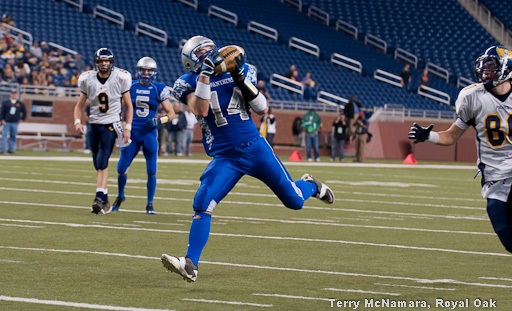
Division 7 Final: Blue Streak
November 29, 2011
DETROIT – Only a few drives into the MHSAA Division 7 Final, Bennett Lewis came to Saginaw Nouvel coach Mike Boyd with a request.
Give me the ball until Pewamo-Westphalia stops me.
Never happened. The senior running back ran for five touchdowns, and his Panthers scored 56 points – both to set or tie MHSAA Finals records.
And both were accomplished over just two quarters as Nouvel cruised to a 56-26 win and its third football championship.
“I can’t say enough how proud I am of my teammates, especially the offensive line. We’ve been playing together a long time and they really executed in the first half,” Lewis said. “Their defense is one of the defenses we can run our offense against really well. We just executed and made big plays. ”
This championship goes with Nouvel’s back-to-back Division 6 titles in 2006 and 2007, and the Panthers finished 13-0 to match their perfect record in 2006. Pewamo-Westphalia made its first appearance in an MHSAA Football Final and finished 13-1.
The Panthers had scored 63 and 62 points, respectively, during the first two rounds of the postseason. And as Boyd said after, he had an offense built for speedy strikes – especially at an inside venue like Ford Field.
Nouvel blew past the previous MHSAA Finals record of 42 points in one half set by both Farmington Hills Harrison in 2000 and Jackson Lumen Christi in 2001.
“Maybe our third drive, Bennett came off the field and came right up to me and said, ‘I want the football. Until they stop me, give me the football,’” Nouvel coach Mike Boyd said. “I said, ‘Absolutely.’
“Great competitors, great leaders. Just a great group.”
Lewis, the Associated Press’ Division 7-8 Player of the Year this fall, ran 15 times for 200 yards – all in the first half – to push his season rushing total to 2,077. The five touchdowns gave him 36 rushing for the fall. Senior quarterback Joseph Buchalski was 7 for 10 passing for 196 yards and three scores. He also ran five times for 50 yards – again, all in the first half.
“That’s the best team I’ve ever played. The fastest. (And) I don’t hesitate to say Bennett Lewis is the best player I’ve ever played,” P-W senior quarterback/cornerback Justin Thelen said. “We fought, and I’m proud of that. But they had us on our heels right away.”
Thelen was 10 for 21 passing for 176 yards and two touchdowns, and senior Alex Thelen ran 16 times for 77 yards and a score. It was a tough end to a courageous run by the Pirates, who suffered through the death of classmate and baseball teammate Brendon Nurenberg in a car crash earlier this month, but battled through with his memory an additional motivator.
“He was just a fun guy. The guys loved being around him. And the guys rallied around that,” P-W coach Brad Weber said. “They did it for Brendon for the most part. They knew he would have fun, so they did too.”

Football’s Future
March 20, 2012
Many folks, including me, will too often focus on the destination more than the trip. More on results than process. The end more than the means.
This is epidemic in sports, on all levels. There’s so much focus on the postseason that it overshadows the regular season.
In contrast, in educational athletics, we are supposed to hold to the principle that opportunities for teaching and learning are as plentiful, maybe more so, in regular season as in tournaments, at subvarsity levels as at varsity, during practices as during games.
This disease affects football as much as any high school sport. There’s been too much focus on the end of the season – playoffs. Postseason tournaments have been the demise of many great Thanksgiving Day high school football classics across the country. Playoffs continue to ruin rivalries and collapse conferences nationwide.
And, disturbingly, the focus on the end of the season misses what is most wrong with football, and may be most threatening to its future. It’s practice. Specifically, what’s allowed during preseason practice and then at practice throughout the season.
We can predict that, in high school football’s future, two-a-day practices will be fewer, practice hours will be shorter and activities will be different. Among proposals we will be presented (and should seriously consider) will be:
If this all sounds silly or radical, remember that the NCAA and NFL are already making such changes. NFL players face contact in practice on only 14 days during a 17-week regular season. Meanwhile, many high school coaches have kids knocking heads and bruising bodies two to four days a week, all season long. Giving critics the impression that interscholastic football for teens is more brutal than the higher levels of football for grown men. Inviting interference from people who think they know better.
Actually, we know better; and we need to do better. Soon.