

Dow Charged to Make Deep Playoff Run
November 10, 2015
By Bill Khan
Special for Second Half
MIDLAND — When Midland Dow football players looked at the playoff accomplishments of past Chargers teams, it felt like they were getting a lesson in ancient history.
 There was the 1976 team that won the MHSAA Class A championship back when there were only two rounds in the playoffs. There was the 1997 squad that reached the Class A title game, winning three times in the postseason before losing to Farmington Hills Harrison at the Pontiac Silverdome.
And that's it.
For a program as consistently solid as Dow, it seems strange that only two teams in school history were able to win more than one playoff game.
"Sometimes it's matchups, sometimes it's getting a couple breaks to go your way," Dow coach Jason Watkins said. "When you get to this round of the playoffs, all the teams are going to be good."
So far, none of the teams in their path have been better than the Chargers.
They have made a task that has been difficult for past Dow teams look easy, winning 42-7 over crosstown rival Midland in the first round before beating Fenton, 41-14, in the District championship game.
"It's a big win for the development of the program," Watkins said after eliminating Fenton for the second time in three years. "Since 2010, this is our fourth trip to this round; we came away empty each time. It's nice to be able to finish that and get that District championship. It's a good landmark for us. Let's try to grow the program."
The 10th-ranked Chargers (10-1) will travel to second-ranked Walled Lake Western (11-0) on Saturday to play for the Regional championship.
"It's awesome," Dow junior quarterback Bruce Mann said. "We're gonna be on the board for a long time. People are going to be able to see us and remember us."
It hasn't been a lack of opportunities that has made this season's achievement so rare for Dow. Beginning with the unbeaten 1976 MHSAA championship team, Dow has 30 winning seasons in the last 40. The Chargers have made the playoffs nine times in the last 19 years.
They won their playoff opener each of the past two years and in three of the previous five years, but had their seasons end in the second round.
"It feels great," Dow senior receiver Justin Cook said. "I've been on two losing teams in the District Finals the past two years. The third time's the charm, I guess. It feels really good to finally get the (second-round) win. We're clicking at the right time. We're getting better each week."
Those currently wearing the green and gold of Dow are mindful of those who went before them, laying the foundation for such a strong program.
"It's huge for everyone that is involved, all of the past classes who didn't make it this far or got beat at this step," senior receiver Mike Robb said. "It's a big deal."
 The season didn't begin like one that was shaping up to be special. The Chargers lost their opener to Mount Pleasant, 34-20. Not that there's any shame in that — the Oilers are 9-2 and still alive in Division 3.
In that game, Mann had only 26 yards of offense in the first half, as Dow fell behind 21-0 by halftime. He had 281 yards in the second half — and hasn't slowed up since.
It was Mann's first game in a Dow uniform after playing varsity as a freshman and sophomore for Bay City Western, where his dad, also Bruce Mann, formerly was the coach.
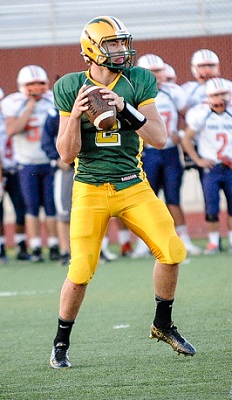
Led by Mann, the Chargers have scored at least 41 points in each of the last five games. Over that span, he is 81 for 109 (74.3 percent) passing for 1,451 yards and 24 touchdowns. For the season, he has 35 touchdown passes and only four interceptions in leading Dow to 10 consecutive victories.
"Coming into Dow, I had a bunch of friends, so it didn't take long to jell," Mann said. "It was just me calming down and realizing I'm not the only player and I have 10 other teammates behind me helping me succeed."
Mann has spread the wealth, throwing 11 touchdown passes to Robb, and nine apiece to Cook and Devontae Stine.
"Bruce has been picking up the offense each week," Cook said. "He's playing out of his mind. Every week, he's getting better. You can tell by the way he plays. He doesn't turn the ball over anymore."
Robb, the team's most dangerous receiving weapon, has become a dual threat in recent weeks.
Watkins moved him to defense for the regular-season finale against Midland. In that game, Robb returned an interception for a touchdown, in addition to catching four touchdown passes. In the playoff rematch a week later, Robb had two interceptions, returning one for a touchdown. Robb's hot streak continued against Fenton, as he caught two touchdown passes, blocked a punt and grabbed his fourth interception in three games.
"Right time, right place," Robb said of his newfound knack for picking off passes. "I love playing football. Wherever coach wants to put me, that's where I'll play."
"He's always been a special teams and offensive player for us," Watkins said. "We only moved him up to defense two weeks ago. It's something we saw in the scheme of things and the teams we were playing against. There was an opportunity to use his athleticism and some of his natural instincts. He's been on a pretty good little run the last couple weeks."
The same could be said for the Chargers as a whole, as they attempt to further enhance their legacy.
Years from now, perhaps 2015 will be spoken of with the same sense of awe as 1976 and 1997.
 Bill Khan served as a sportswriter at The Flint Journal from 1981-2011 and currently contributes to the State Champs! Sports Network. He can be reached at [email protected] with story ideas for Genesee, Lapeer, St. Clair, Sanilac, Huron, Tuscola, Saginaw, Bay, Arenac, Midland and Gladwin counties.
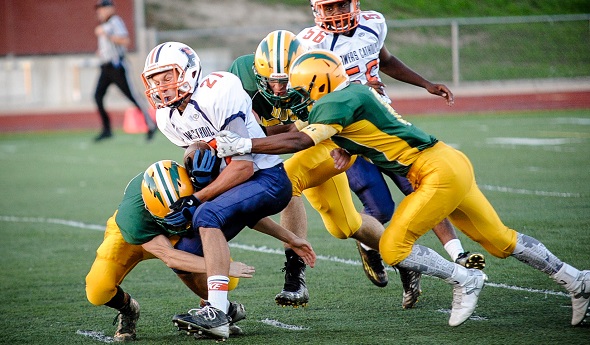
PHOTOS: (Top) A collection of Dow defenders makes a tackle during a win this season against Flint Powers Catholic. (Middle) Chargers quarterback Bruce Mann has thrown 35 touchdown passes this fall. (Click for more from HighSchoolSportsScene.com.)
Davison's McRill Packs Plenty of Thrills
August 30, 2016
By Bill Khan
Special for Second Half
DAVISON — The sense of excitement is palpable when Brenden McRill recalls one of the biggest adrenaline rushes he's had on a football field.
He's in his third year as Davison's starting quarterback, but it's the one time he got to play on the other side of the ball that makes McRill really light up.
Although he's put up impressive numbers at the game's most glamorous position, the opportunity to make eight tackles as a safety in a first-round playoff loss to Lapeer last season was about as fun as it gets for McRill.
"Oh, it felt great," he said. "I was so excited for that, because I hadn't played defense since my freshman year. I was ready to go out there and hit somebody."
Spoken like a true ... wrestler.
The willingness to absorb punishment is considered a barometer of toughness for a quarterback, and McRill is certainly willing to do that for the good of the team. Most quarterbacks, however, don't get as hyped as McRill to deliver a blow.
But he isn't wired like most quarterbacks, which is why Davison coach Kyle Zimmerman could confidently add the following hash tag to a Twitter post about McRill: #MyQBIsTougherThanYours.
The groundwork for McRill's unique makeup was forged on the wrestling mats of the Davison youth program and fine-tuned at the high school level under the guidance of Roy Hall, who has coached the Cardinals to six MHSAA team championships and four runner-up finishes since 2000.
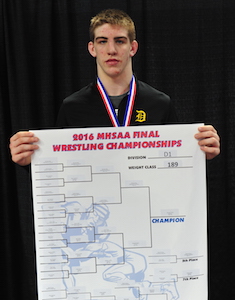
McRill was the MHSAA Division 1 champion at 189 pounds as a junior.
 "It definitely makes me different, because I love to hit," McRill said of his wrestling background. "If I'm near the sideline and see a guy, I'm going for the hit; I'm not sliding. That aggressiveness and toughness has definitely helped me."
While McRill is as tough as they come, Zimmerman is reluctant to have his quarterback playing both ways on a regular basis.
"To be honest, he probably should play defense," Zimmerman said. "He's one of our best defenders. At the first day of practice, everybody does drills to simulate stuff. He's lights-out. Anything he does on a football field, he's going to excel at. He's played end for us, he's played linebacker, he's played safety, he's played quarterback.
"We've got other guys we know can play. You know it's a huge drop-off if you put yourself in a position where you could lose someone. If you see the quarterback out there, people are going to be attacking him, trying to tire him. We want him to play at a high level on offense."
And that he does.
McRill received honorable mention on The Associated Press' Division 1-2 all-state team last season as a dual-threat quarterback. As a passer, he was 68-for-136 for 1,306 yards, 13 touchdowns and seven interceptions. He also ran 161 times for 642 yards and 11 touchdowns.
In the 2016 opener against Saginaw Arthur Hill, McRill was 3-for-5 for 52 yards and two touchdowns passing to go with five carries for 27 yards and a touchdown in the first half of a 62-12 rout of the Lumberjacks.
The mission for McRill and his teammates is to get Davison back on the state high school football map. The Cardinals made the MHSAA playoffs seven straight years from 2002-08, reaching the Semifinals three times and going 65-19 during that span. In the seven years that followed, Davison went 33-33 and made the playoffs three times.
"We had three starting sophomores that first game my sophomore year," McRill said. "There was me, offensive tackle Zach Slezak, who at the time played defense, and Corran Thornton, who started at defensive end. We started it together. Our senior year, we want to make it our best and have one of the best years Davison's ever had."
On the wrestling mat, McRill knows what it's like to compete at a high level.
McRill added his name to the list of individual MHSAA champions coached by Hall when he won the Division 1 title at 189 pounds with an overtime decision over previously unbeaten Nicholas May of Kalamazoo Loy Norrix. McRill was fifth at 152 as a freshman and third at 160 as a sophomore.
"Going into high school, I planned to win it right away my freshman year," said McRill, whose only blemishes on a 38-2 junior record were against MHSAA champions. "Just with that legacy and Coach Hall's style, you're expected to win. You're working as hard as you can. ... It felt real good to get that out of the way."
He helped Davison reach the MHSAA Division 1 Team Finals in 2014 and 2016, with a semifinal appearance in between in 2015. Each of the last four years, however, Davison has lost to the eventual champion.
"It's kind of upsetting, but it will make us hold each other more accountable that we need to finish this year," McRill said. "We need to win. We've got a lot of guys back and some incoming freshmen who are ranked guys and very good. So I'm very excited for this team coming up."
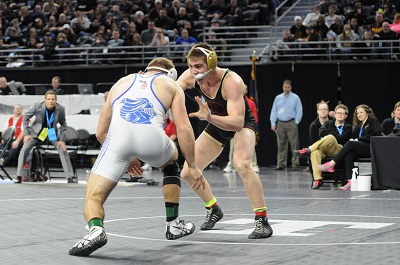 McRill does what he can to maintain his sharpness as a wrestler, but he devotes most of his attention to football over the summer.
"I try to get a couple of drills in right now when the season's going," he said. "When we get to the playoffs, I try to stay off it, focus on football and stay healthy for that. Right after football, I try to get a couple days off and get ready for wrestling. I try to train hard, because I know I have a lot of catching up to do."
McRill doesn't compete in the national wrestling tournaments that many of his competitors do over the summer, but that hasn't hurt his exposure to college scouts. He is weighing offers from Central Michigan, University of Michigan and West Virginia.
Once football and wrestling seasons conclude, McRill said he may return for one final season on the baseball diamond. He grew up playing baseball, but cut back on it once he realized his college future was likely to be in football or wrestling.
He didn't play baseball as a freshman, because he was working to win the starting quarterback job the following fall. McRill was called up to the varsity baseball team as a sophomore after throwing a no-hitter on the junior varsity team.
"I think I'm going to come out my senior year," he said. "We've got a great group of guys in baseball, too. That's one that people kind of sleep on, but we could come up with something in baseball."
In the meantime, the arm that threw a no-hitter for the JV baseball team will be firing touchdown passes for a football team that could have a special season.
"The first day I saw Brenden, I knew who my quarterback was from how he competed and how he threw," said Zimmerman, whose first year at Davison was McRill's sophomore season.
"We were probably going to take our lumps early, but it's going to pay off in the long run. He was steady his sophomore year, he was good last year and he's going to explode this year."
Bill Khan served as a sportswriter at The Flint Journal from 1981-2011 and currently contributes to the State Champs! Sports Network. He can be reached at [email protected] with story ideas for Genesee, Lapeer, St. Clair, Sanilac, Huron, Tuscola, Saginaw, Bay, Arenac, Midland and Gladwin counties.
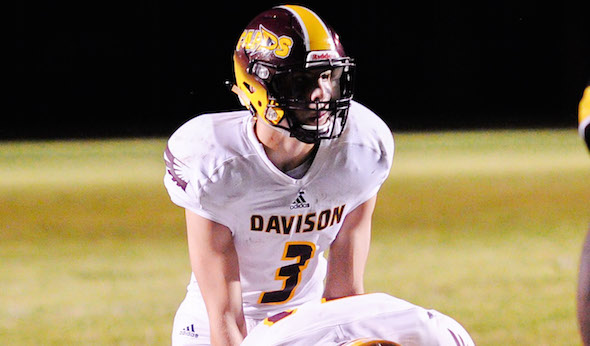
PHOTOS: (Top) Davison quarterback Brenden McRill lines up over center during his team's game last season against Saginaw. (Middle) McRill holds up his weight's bracket sheet after winning the Division 1 title at 189 pounds last winter. (Below) McRill looks to lock up during his championship match. (Click to see more from HighSchoolSportsScene.com.)