

The Drive is Complete: Finals in Review
December 4, 2013
By Geoff Kimmerly
Second Half editor
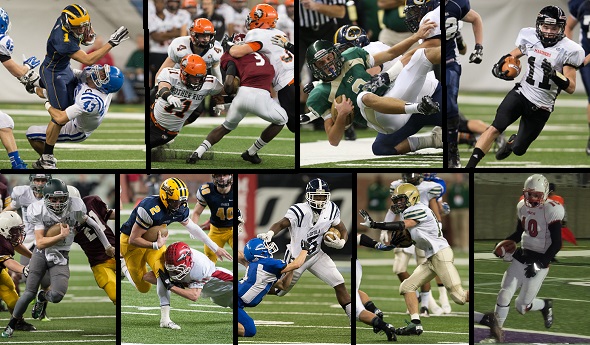
A crowd of more than 52,000 fans – 5,000 more than in 2012 – plus countless others watching on Fox Sports Detroit witnessed the end of one era, the beginning of another and the continuation of one of the most impressive in the nation while watching the MHSAA Football Finals over the last two weekends.
Second Half covered all nine championship games, with quick recaps and links to those stories below followed by notations of performances entered into the MHSAA record book and a report on some of the biggest and best stories to emerge from the 2013 11 and 8-Player Finals.
Finals in Review
 D1: Clarkston 32, Detroit Catholic Central 14 – Clarkston’s proud football tradition now includes its first MHSAA Finals appearance and championship, thanks in part to running back Ian Eriksen’s 237 yards and three touchdowns rushing. The Shamrocks fell in the championship game for the third straight season and despite avenging the first two losses by beating two-time reigning champion Detroit Cass Tech in the Semifinal. Click to read more.
D2: Birmingham Brother Rice 38, Muskegon 21 – The Warriors sent out longtime coach Al Fracassa with the team’s third straight MHSAA championship and first 14-0 season. Fracassa finished his career with a record of 430-117-7 at Brother Rice and Royal Oak Shrine and the most wins in Michigan football coaching history. Click to read more.
D3: Zeeland West 34, DeWitt 27 – The Dux have now won two MHSAA titles in two divisions over the last three seasons after also claiming the Division 4 championship in 2011. Zeeland West plowed to 441 yards rushing on 6.7 per carry. But to DeWitt’s credit, the Panthers didn’t let down despite an early 22-0 deficit and nearly blocked a punt late that could’ve set up a game-tying rally. Click to read more.
D4: Marine City 49, Grand Rapids South Christian 35 – In arguably the weekend’s most competitive scorefest, Marine City outlasted the reigning champion. The score was tied midway through the third quarter and South Christian pulled within seven points of the lead two minutes into the fourth. Click to read more.
D5: Grand Rapids West Catholic 27, Menominee 14 – Despite just making the playoffs at 5-4 and with a one-point win in Week 9, West Catholic marched through the postseason and beat Menominee for the fourth time in the playoffs in the last four seasons. The Falcons had finished runner-up in 2012, losing 12-9 to Portland. Click to read more.
D6: Ithaca 41, Clinton 22 – Despite trailing as late as four minutes into the third quarter, the Yellowjackets kept their reign going another season with a fourth straight MHSAA title, one short of tying the football record for consecutive championships. Ithaca also added to their 56-game winning streak, which is tied for longest in the nation for 11-player teams. Click to read more.
D7: Ishpeming 22, Detroit Loyola 12 – The highly-anticipated rematch of the 2012 Final ended with the same victor as Hematites quarterback Alex Briones led his team to the championship for the second time by a nearly identical score. Ishpeming won last season 20-14 and entered these playoffs ranked No. 1, while Loyola was No. 2. Click to read more.
D8: Muskegon Catholic Central 35, Beal City 12 – The Crusaders locked down one of the highest scoring offenses in MHSAA history while senior Alex Lewandowski turned in one of the top Finals rushing performances of all-time with 218 yards and three touchdowns on the ground. It was MCC’s first championship since 2008. Click to read more.
8-Player: Peck 67, Rapid River 32 – Peck was 1-8 in 11-player football only two seasons ago before making the switch and ascending to the top of 8-player as the latest power to emerge from the Thumb area. Usually a running team, the Pirates took advantage of size on the perimeter to rule the air against Rapid River, which finished runner-up for the second time in three seasons. Click to read more.
Records Report
A number of team and individual entries have been added to the MHSAA Football Finals record book, found by clicking here. A breakdown:
- Clarkston’s Ian Eriksen ran for 242 yards (on 32 carries) to place eighth for most rush yards in a Final. Muskegon Catholic Central’s Alex Lewandowski ran 16 times for 218 yards, good for 16th on that list.
 The Finals featured a number of premiere quarterbacks, but two stuck out most. Birmingham Brother Rice’s Alex Malzone tied for the sixth-most completions, 20, on just 24 attempts. His 263 passing yards ranked 12th for a Final and his four touchdown passes tied for third most. Ithaca’s Travis Smith finished with the seventh-most yards of total offense (370) – adding to a number of entries from his 2011 Finals performance – while joining the lower part of the list for most passing yards with 244. He also threw four touchdown passes.
- DeWitt quarterback Jake Johnson joined some of his Panthers predecessors in the record listings with 289 passing yards (10th all-time) and 320 yards of total offense (11th). Grand Rapids West Catholic quarterback Travis Russell placed 13th on the total offense list with 309 yards, including 133 rushing. South Christian quarterback Jon Wassink joined a long list of those who have completed at least 18 passes, doing so for 240 yards and three TDs. And Muskegon quarterback Deshaun Thrower found teammate Justin Foster with an 86-yard TD pass, good for the fifth-longest pass play.
- Menominee’s Devon Harris and Birmingham Brother Rice’s Corey Lacanaria tied for fifth with 10 receptions a piece, Harris for 149 yards and Lacanaria for 125. Grand Rapids South Christian’s Eric VanVoorst tied for seventh on the catches list with nine for 149 yards, and Marine City’s Pete Patsalis became one of eight who have caught a Finals-best three touchdown passes.
- Marine City’s Olivia Viney tied the Finals record with seven extra-point kicks (see more on her below). Four other kickers made the record book list by connecting on all five of their attempts – Brother Rice’s Jason Alessi, South Christian’s Kyle Haan, Ithaca’s Alex Vanderploeg and Muskegon Catholic Central’s Griffin Seymour.
- Marine City’s Jarrett Mathison ran for the fourth-longest kickoff return, 91 yards for a touchdown. Clinton’s Mathew Sexton ran for the second-longest punt return, 86 yards for a score.
- Marine City’s 49 points were good to tie for sixth-most by a team in Finals history.
- Zeeland West’s offense tied for the fourth-most first downs with 26 and became the 19th team to not punt in a championship game. West’s 66 rush attempts were the second-most in a Final. Brother Rice tied for seventh with 24 first downs and Clarkston tied for ninth with 23.
- Detroit Catholic Central tied Farmington Hills Harrison for the most championship game appearances, with 16; the Shamrocks have won 10 titles. Brother Rice tied for third with 13 Finals berths and moved to sixth with nine championships – plus became one of six to win at least three straight. Muskegon moved up to tied for 12 with seven Finals appearances, Muskegon Catholic tied for sixth with 12 and South Christian is tied for 14th with six Finals appearances. DeWitt and Ishpeming both joined the lower end of that list, each notching their fifth. Ithaca is now tied for third on the list of consecutive titles with four straight, only one off tying that record. MCC also tied for sixth on the championship list by winning its ninth.
- A number of entries also were added to 8-Player Finals record book, which although in its infancy boasts some of the most impressive totals for either football format. Peck quarterback Tristen Haener was added for his 379 yards and seven touchdowns passing, plus his 382 total yards and five extra-point kicks. Teammate Kyle Abrego was added for his 236 yards and four touchdowns receiving, with all four of those coming in the third quarter. Rapid River quarterback Jake Pearson was added for scoring 26 points in the game as both teams combined for 99. A number of team totals reflecting some of the same categories also were added.
Stories behind the scores
Ready for a rematch: There were two from the 2012 Finals, and both ended the same way in 2013. Brother Rice repeated against Muskegon in Division 2 with many of the same players as stood out a year ago, and Ishpeming repeated against Detroit Loyola in Division 7 with a number of new faces make big contributions.
7 for 7: Marine City’s Olivia Viney was believed to be the first female athlete to play in an MHSAA football championship game, and she put up a performance that will live on in the MHSAA record book. Viney connected on all seven of her extra-point kicks, tying the MHSAA Finals record. Viney earned a Division 3 all-state honorable mention this spring on Marine City’s girls soccer team.
Good bye, Coach: Longtime Brother Rice coach Al Fracassa retired after the game with the most wins in MHSAA history and sixth-most nationally. He coached at Royal Oak Shrine from 1960-68 before taking over the Warriors in 1969.
Ithaca reigns on: The national winning streak and four straight titles are detailed a little bit above, and next season the Yellowjackets can tie East Grand Rapids and Farmington Hills Harrison with a fifth straight MHSAA title. Quarterback Travis Smith was the only Ithaca player to dress for all four championships, and his brother Jacob is set to take over behind center next fall.
 We are the champions: Clarkston has been in the conversation on Division 1 contenders for at least the last 14 seasons, and the Wolves brought home their first title after advancing from the Semifinals for the first time in four tries. They have won at least 10 games six times beginning in 1999 and are 24-2 over the last two seasons.
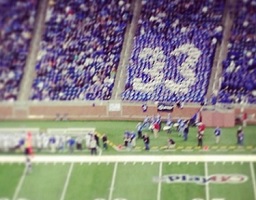
Remembering David: Although Detroit Catholic Central’s third straight loss in the Division 1 Final was heart-wrenching for the Shamrocks, their student body pulled off an awesome tribute. David Widzinski was a running back on the team last season and died in his sleep a year ago. DCC’s students, wearing blue and white shirts, created his No. 33 in the Ford Field stands, memorializing him as his jersey hung from the front railing of the section.
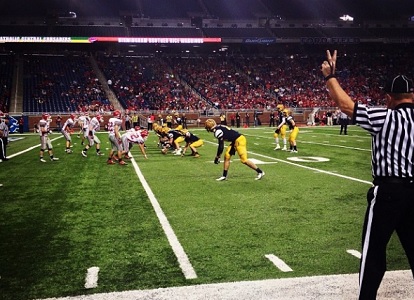
PHOTOS: (Top) Nine champions celebrated MHSAA titles over the last two weekends. (Middle top) Clarkston players march off the Ford Field turf celebrating their first MHSAA football championship. (Middle) Ithaca, from right, works against the Clinton defense in the Division 6 Final. (Below) Detroit Catholic Central students, in blue and white shirts, form a No. 33 to commemorate their deceased classmate (Click to see more like the middle photos on the MHSAA Instagram page.)
5-0 Oakridge Healing 2018 Heartbreak
October 2, 2019
By Tom Kendra
Special for Second Half
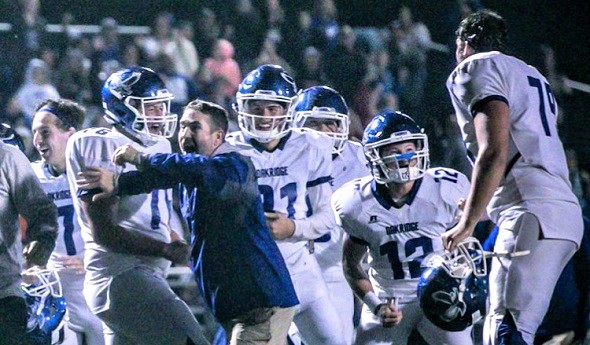
Muskegon Oakridge had an extra reason to celebrate in the rain on Friday night.
 It was about more than just overcoming sloppy conditions and the never-say-die Montague Wildcats in a matchup of No. 1 vs. No. 2 in The Associated Press’ Division 5 rankings. There was more to it than getting a leg up in the West Michigan Conference race with a thrilling 15-13 overtime win.
This was about overcoming two of the most heartbreaking losses imaginable one year ago – and dedicating the win to those who never got a shot at redemption.
“That win was for those seniors from last year,” said Oakridge running back Leroy Quinn, a four-year starter who rushed for both of his team’s touchdowns and a game-high 144 yards, putting him over 4,000 rushing yards for his career. “I love those guys, and I miss them. We all grieved together last year, and now we’re celebrating for them.”
Oakridge led Montague in their 2018 meeting 24-10 with 3:45 remaining, when the Wildcats roared back with two touchdown passes and then a game-winning, 2-point conversion run by Sebastian Archer with no time on the clock for a 25-24 win.
It was the type of gut-wrenching loss which is hard to shake off.
“It’s a helpless feeling,” said Oakridge senior nose guard and offensive tackle Will Scraver. “The only thing you can do is try to forget and focus on the next game.”
Unfortunately, less than one month later, Oakridge would experience an even more bitter defeat. The Eagles’ second loss had finality as it came in the MHSAA District championship game, as they squandered a seemingly safe 35-8 halftime lead in a stunning 40-37 loss to Hudsonville Unity Christian. Adding salt to the wound was having to sit home and watch Unity then roll over its next three opponents en route to the Division 5 championship.
“Sometimes it’s hard to put those losses behind when you have umpteen people coming up to you at the store or the gas station asking you what the heck happened,” said Harger, who is in his ninth year as the Oakridge coach after serving for 16 years under Jack Schugars, the all-time winningest coach in Muskegon-area football history.
“All we can do, as coaches and players, is to learn from our mistakes and to take care of all the little things so that we win those kind of games.”
Oakridge, 5-0 and now No. 1 in Division 5 in the latest Associated Press poll, has been focused and motivated this fall – starting with a tough road test at Belding and most recently with the big revenge win at Montague.
 Oakridge and Montague were scoreless through three quarters and tied, 7-7, after regulation. Quinn scored from three yards out in overtime, then added what proved to be the game-winning 2-point conversion run. Montague answered with a 10-yard pass from Drew Collins to Brennan Schwarz, but Nate Fair and Corey Vanderputte stuffed the 2-point conversion attempt.
Quinn, a 6-foot-1, 233-pound battering ram, has led the way with 465 rushing yards and eight touchdowns. He now has 4,065 career rushing yards, eclipsing David Nelson’s previous school record, and needs five more rushing TDs to pass Jamie Potts for that school mark.
Quinn’s play thus far has been no surprise, but how quickly others have stepped up in the backfield and on the line is the reason why Oakridge is back to No. 1 in the state.
Junior quarterback Ethen Dailey (5-11, 145) has done a solid job managing the Eagles’ offense, and speedy sophomore Vanderputte has emerged as the breakaway threat.
But it was the play of the offensive line, where Fair is the only returning starter, that keyed the win at Montague.
Oakridge, which lined up in a double tight end, full-house backfield look most of the game and threw only two passes (completing none), finished with a 222-70 edge in rushing yards.
“With the tradition out here, there are always new players ready to step up,” said Fair, who also starts at inside linebacker. “We might not have a lot of big names on the line, but we knew we were going to be good.”
Four of the Eagles’ five interior linemen are seniors, with the lone exception sophomore center Derek Driscoll. The guards are seniors Josh Havermans and Jason Pego and the tackles are Fair and Scraver. Starting at tight end are junior Luke Martin and sophomore Ethan Josza.
Harger is not ready to start talking about avenging last year’s playoff loss, as his team still has tough games remaining at North Muskegon in Week 7 and the final two weeks of the regular season at home against Ravenna and first-time opponent Traverse City St. Francis.
Oakridge could also have a couple of new playoff challenges close to home. While the Eagles appear a lock to be in Division 5, they may be joined by resurgent neighbor Muskegon Orchard View (on the bubble of Division 4 and 5) and Montague (on the Division 5 and 6 bubble).
“Our motto this year is: ‘Exceed Expectations’ and, considering the group we lost last year, these guys have done that so far,” said Harger, who is 75-16 and has made the playoffs in each of his first eight years as head coach.
“This is not a real rah-rah group of kids. I think they just love to play football and with the way last year ended, they are thankful for the opportunity to come out and play again.”
 Tom Kendra worked 23 years at The Muskegon Chronicle, including five as assistant sports editor and the final six as sports editor through 2011. E-mail him at [email protected] with story ideas for Muskegon, Oceana, Mason, Lake, Oceola, Mecosta and Newaygo counties.
PHOTOS: (Top) The Oakridge sideline celebrates late in the Eagles' 15-13 overtime win at Montague. (Middle) Oakridge senior Leroy Quinn, who became the school's all-time leading career rusher earlier this season, runs through a big hole into the end zone for a touchdown. (Photos by Tim Reilly.)