

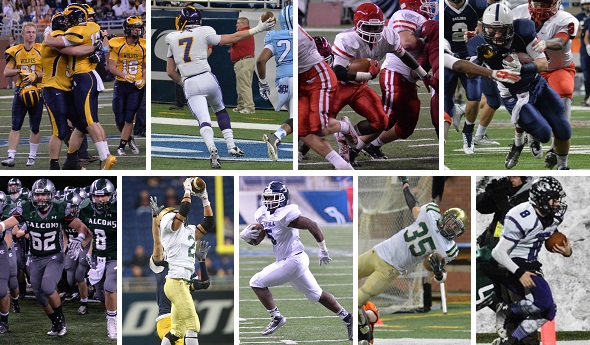
Drive Completed: 2014 Finals in Review
December 1, 2014
By Geoff Kimmerly
Second Half editor
A total of 56,303 fans attended this weekend’s 11-player Football Finals at Ford Field, the most to watch the event live since 2010 and more than 9,000 more fans than only two years ago.
They witnessed five games decided by 10 points or fewer. Four games where the eventual winner was not the first to score. Three repeat champions, but also a first-time winner and the ends of two of the longest winning streaks in MHSAA history.
Second Half covered all nine championship games including the 8-player Final on Nov. 21, with quick recaps and links to those stories below followed by notations of performances entered into the MHSAA record book and a report on some of the biggest and best stories to emerge from the 2014 Finals.
Finals in Review
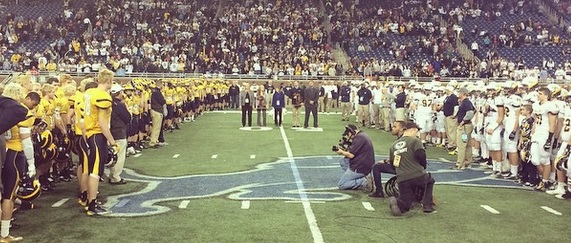
D1: Clarkston 33, Saline 25
The Wolves took over as holders of the longest MHSAA winning streak at 27 straight after claiming a second consecutive Division 1 championship. Junior running back Nolan Eriksen followed up the starring 2013 Finals performance of his brother Ian with 28 carries for 172 yards and three touchdowns. Saline finished 12-2 in making its first MHSAA championship game. Click to read more.
D2: Warren DeLaSalle 44, Muskegon Mona Shores 8
DeLaSalle came back from a 3-3 start to this season to win its first MHSAA championship. The Pilots shut down a Mona Shores offense averaging 39.5 points per game and got plenty of offensive boost from sophomore running back Allen Stritzinger, who ran for 175 yards and a touchdown. Mona Shores made its first championship game appearance after making the playoffs in 2013 for the first time. Click to read more.
D3: Orchard Lake St. Mary’s 7, Muskegon 0
This final game of the weekend was decided by one touchdown – scored by a player courageously carrying on only two days after his mother’s death. Brandon Adams scored the deciding points on a first-quarter run; his mother Katie died Thursday after fighting lung cancer. The Eaglets returned to the playoffs after missing in 2013; Muskegon finished MHSAA runner-up for the third straight season after falling to Birmingham Brother Rice in the Division 2 Finals in 2013 and 2012. Click to read more.
D4: Grand Rapids South Christian 28, Lansing Sexton 27
Sailors quarterback Jon Wassink capped his career and the team’s third straight trip to Ford Field with a second title over those three seasons. He threw for 179 yards and three touchdowns and ran for 122 yards and another score, and South Christian’s defense hung on late as Sexton made a pair of last attempts at the lead in its first MHSAA championship game appearance. Click to read more.
D5: Grand Rapids West Catholic 24, Lansing Catholic 20
West Catholic quarterback Travis Russell led a 17-play, 64-yard drive over the final seven minutes of the fourth quarter to bring the Falcons back to win their second straight MHSAA title and finish the season perfect for the first time since 1976. West Catholic opened with 17 straight points before Lansing Catholic took the lead with 7:38 to play. Click to read more.
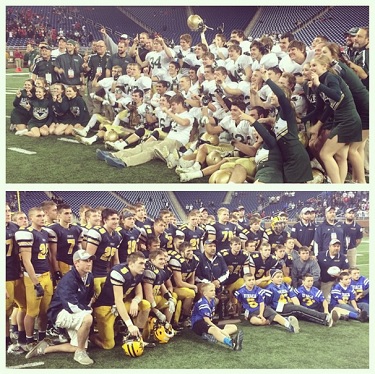 D6: Monroe St. Mary Catholic Central 22, Ithaca 12
The Falcons put an end to Ithaca’s national-best 69-game winning streak, adding some heavier impact to the team’s first MHSAA title since 1991. The Yellowjackets actually had defeated St. Mary in 2010 for their first of four straight championships, and fell just four wins shy of breaking the MHSAA record for consecutive football victories, held by Hudson. Click to read more.
D7: Detroit Loyola 29, Ishpeming 8
In the third straight Division 7 Final meeting between these two, Loyola won its first title and finished 14-0 thanks to 29 unanswered points and 297 yards rushing. Ishpeming had won 33 straight games, tied for the eighth-longest streak in MHSAA football history. Click to read more.
D8: Muskegon Catholic Central 31, Munising 6
The Crusaders became the first repeat champions in Division 8, running away after Munising scored the game’s first points. MCC had never trailed this season, but got three second-half touchdowns from senior Tommy Scott and held Munising to only 39 yards on the ground. Click to read more.
8-Player: Lawrence 56, Cedarville 12
Lawrence completed a turnaround from 1-17 over its final two seasons of 11-player in 2011 and 2012 to 8-player champion keyed by senior quarterback Derek Gribler and a speedy defense that locked down Cedarville, which also made its first 8-player Final appearance. Lawrence became the first program to win both 11 and 8-player championships. Click to read more.
Records Report
A number of team and individual entries have been added to the MHSAA Football Finals record book, found by clicking here. A breakdown:
- Warren DeLaSalle kicker Jake Townsley tied his career long field goal of 41 yards and set an MHSAA Finals record with three total, also making from 23 and 29 yards out. He also made the listing for connecting on all five of his extra-point attempts.
- DeLaSalle also became the 20th team to play in a Final and not punt in the game.
- Also in Division 2, Muskegon Mona Shores’ Darece Roberson caught what tied for the fifth-most receptions in a Final, 10.
- Muskegon Catholic Central’s Tommy Scott set the record for longest Finals kickoff return, bringing one back 99 yards for a touchdown in the first quarter of the Division 8 game against Munising. He also became the latest in a long list to score at least four touchdowns in a championship game, running for three more.
- Detroit Loyola’s Marvin Campbell also joined that list of players with at least four TDs in a Final, running for four in his team’s Division 7 victory over Ishpeming. His 215 rushing yards on 21 attempts made the championship game rushing list.
- Four quarterbacks joined the total offense list: Saline’s Josh Jackson with 319 yards – 82 rushing and 237 passing – against Clarkston in Division 1, Grand Rapids South Christian’s Jon Wassink with 312 yards – 122 rushing and 179 passing – in Division 4, and Lansing Catholic’s Tony Poljan (60 rush, 269 pass = 329) and Grand Rapids West Catholic’s Travis Russell (134, 203 = 327) in Division 5. Poljan’s 269 passing yards also made that list, and his 24 completions were fourth most for a Final.
- Muskegon Catholic Central became the sixth program in MHSAA history to play in 13 football championship games, and Orchard Lake St. Mary’s became one of nine to play in 12. Muskegon played in its eighth Final, South Christian in its seventh, Ishpeming and Monroe St. Mary in their sixth each, and West Catholic and Ithaca in their fifth each. Muskegon Catholic Central also became one of six with 10 MHSAA titles, and Orchard Lake St. Mary’s won its sixth.
- Lawrence quarterback Derek Gribler made the 8-player total offense list with 359 yards – 256 passing and 103 rushing. Lawrence as a team became the first to be listed for rushing offense – 341 yards – and set the 8-player Final record with 597 total yards and 23 first downs. Lawrence also made the most points in a quarter list with 28 in the first against Cedarville.
Stories behind the scores
End of an era: Ithaca’s winning streak began on opening night 2010 and just this month included a fourth-quarter comeback victory over Madison Heights Madison in the Regional Final and a near-goalline stand late against Boyne City in the Semifinal. The Yellowjackets’ magic ran out against Monroe St. Mary, but the streak will be remembered for years to come. Although Ithaca fell short of breaking the MHSAA football consecutive wins record, it did set a record for most in a row during the playoff era; Hudson’s 72-game winning streak ended in 1975 and included only one playoff win as that was the first season with an MHSAA tournament in the sport.
 Repeat by 3: Clarkston in Division 1, Grand Rapids West Catholic in Division 5 and Muskegon Catholic Central in Division 8 all repeated after winning 2013 championships. Although MCC became the first repeat champ in Division 8, winning back-to-back has become relatively common during the 16-season division era. There have been 25 repeat champions winning back-to-back in the same division since 2000, the first season a team could accomplish the feat.
QB Power: As explained above, four quarterbacks were added to the MHSAA Finals records listing for most total yards in a championship game. Two of those signal-callers – Saline’s Jackson and Lansing Catholic’s Poljan – are juniors expected to lead teams next season with good chances of returning to Ford Field.
Loyola Wins Round 3: With a group of players who also were standouts in the first two matchups, Loyola claimed its first MHSAA football title by defeating Ishpeming in their third straight face-off in Division 7. Bulldogs senior linebackers Paul Engram and Darryl Clemons had been their team’s leading tacklers in the 2012 loss and two of the top three last season, and senior running back Marvin Campbell was the team’s leading rusher in the 2013 defeat and second-leading rusher the year before.
PHOTOS: (Top) Nine champions celebrated MHSAA titles over the last two weekends. (Middle) A jubilant Monroe St. Mary and disappointed Ithaca pose for team pictures after the Division 6 Final. (Below) Clarkston and Saline prepare to accept their trophies after the Division 1 Final. (Click to see more like the middle photos on the MHSAA Instagram page.)
1st & Goal: 2022 Week 7 Preview
By
Geoff Kimmerly
MHSAA.com senior editor
October 7, 2022
League title pursuits will continue all over the state this weekend as we begin the final third of the 2022 regular season.
 But for those no longer in a championship race, or interested in what else lies ahead, every week of results makes the data even stronger as we prepare to announce the field and matchups for the MHSAA Playoffs at 6 p.m. Oct. 23 on Bally Sports Detroit.
The place to track how things are shaping up for the postseason is the MHSAA’s Playoff Point Summary page, where data can be sorted by division for both 11 and 8-player formats. The calculations update in near-real time as results are reported throughout the weekend.
Below are some of the matchups that could make things jump a little more over the next three days as we continue to settle into October.
Bay & Thumb
North Branch (6-0) at Armada (5-1)
The Blue Water Area Conference race shuffled last week with Armada defeating Croswell-Lexington, sending the Pioneers out of a tie for first with North Branch and into a tie for second with the Tigers. Now North Branch gets Armada this week and Croswell-Lexington next, needing to defeat one to clinch at least a share of the title – and after losing to both last season, including 34-28 to the Tigers. Armada is scoring 31 points per game and was one of only two opponents to put up more than 30 on North Branch last season – making this likely the best test so far for a Broncos defense giving up only six points per game this fall.
Keep an eye on these FRIDAY Bad Axe (5-1) at Elkton-Pigeon-Bay Port Laker (6-0), Bay City Western (4-2) at Midland (5-1), Lake Fenton (3-3) at Goodrich (5-1), Fenton (4-2) at Linden (5-1).
Greater Detroit
Carleton Airport (5-1) at Riverview (6-0)
Riverview has won 25 straight regular-season games, including 20 consecutive in the Huron League – with both streaks going back to 2019. The Pirates can clinch a third-straight league title with a win in this matchup (or claim the outright championship with a win plus a New Boston Huron loss). Riverview also owns a nine-game winning streak against Airport – but with one more win this fall, Airport will tie its winningest season since 2011, and the Jets already have avenged two 2021 defeats.
Keep an eye on these FRIDAY Walled Lake Western (5-1) at Waterford Mott (5-1), River Rouge (4-1) at Allen Park (4-2), Detroit U-D Jesuit (3-3) at Detroit Country Day (4-1), Utica Eisenhower (5-1) at Macomb Dakota (6-0).
Mid-Michigan
Lake Odessa Lakewood (5-1) at Olivet (5-1)
These two will wrap up their ninth seasons in the Greater Lansing Activities Conference with a winner-take-all championship matchup, as both are heading to the Capital Area Activities Conference next fall. Olivet owns a 6-2 edge in their GLAC matchups, and six of those meetings decided league titles. The Eagles have won five straight, with Lakewood the only other team to win the GLAC in this sport. Olivet hasn’t given up double-digit points in a game since Week 2 and got past Pewamo-Westphalia last week 20-7, while Lakewood is riding two straight shutouts.
Keep an eye on these FRIDAY Lapeer (6-0) at Grand Ledge (5-1), Parma Western (4-2) at Hastings (5-1), Big Rapids (4-2) at Howard City Tri County (6-0), Saginaw Michigan Lutheran Seminary (6-0) at Ithaca (5-1).
Northern Lower Peninsula
Boyne City (6-0) at Elk Rapids (5-1)
Elk Rapids has won as many games this fall as the last three seasons combined and have an opportunity to win a league championship for the first time since claiming the Lake Michigan Conference title in 2010. The Elks are a game behind Boyne City because of a Week 4 loss to Charlevoix, but breaking a nine-game losing streak against the Ramblers would give all three a single defeat in the Northern Michigan Football Conference Leaders with a game left for Boyne City and the Rayders. That said, the Ramblers haven’t had a game closer than 15 points this season and haven’t allowed Elk Rapids to score in their last two meetings.
Keep an eye on these FRIDAY St. Ignace (5-1) at East Jordan (3-3), Roscommon (3-3) at Lake City (4-2), Kingsford (4-2) at Petoskey (2-4). SATURDAY Sault Ste. Marie (4-2) at Traverse City St. Francis (6-0).
Southeast & Border
Tecumseh (6-0) at Chelsea (5-1)
Chelsea has won 22 straight Southeastern Conference White games, going back to 2018 and including the last three league titles with this matchup providing the opportunity to add a fourth outright. The defense has been outstanding again, giving up just under 10 points per game, and the reloaded offense has averaged 40 points per game over its last three. Tecumseh is another team enjoying long-awaited success, with all of its wins by at least 23 points and its victory total already its highest since 2013. That’s also the last season Tecumseh defeated the Bulldogs.
Keep an eye on these FRIDAY Dundee (5-1) at Hillsdale (3-3), Temperance Bedford (4-2) at Saline (6-0), Addison (4-2) at Grass Lake (3-3), Michigan Center (2-4) at Napoleon (6-0).
Southwest Border
Lawton (5-1) at Schoolcraft (4-2)
Big points totals the last three weeks have Lawton averaging 40 per game for the season just in time for what might end up the deciding game in the Southwestern Athletic Conference Valley. A win would clinch a share of the title for the Blue Devils, while Schoolcraft has played only one league game but would be in position to accomplish at least the same. The Eagles are continuing their bounce-back from their three-win 2021 campaign, and the defense was especially impressive in holding Centreville to two points in Week 2 and Muskegon Catholic Central to only 16 a week ago.
Keep an eye on these FRIDAY St. Joseph (5-1) at Stevensville Lakeshore (3-3), Buchanan (5-1) at Niles Brandywine (4-2), Three Rivers (4-2) at Sturgis (4-2), Decatur (4-2) at Delton Kellogg (4-2).
Upper Peninsula
Negaunee (6-0) at Gladstone (5-1)
Last week’s Gladstone loss to Durand, 28-24, took only a bit of the luster off this matchup of the top two teams in the Upper Peninsula this season (with Iron Mountain a strong honorable mention on that list). The Braves have clinched a share of the Great Northern Conference title and their best record since at least 2017, but even while finishing 4-6 last year they gave Negaunee a challenge before falling 31-30 during the regular season and 42-28 in a playoff rematch. The Miners have a tougher road ahead as they look to wrap up the Western Peninsula Athletic Conference Copper title, but there are plenty of signs they too have improved on a team that went 8-3 in 2021. They are scoring more and giving up about the same number of points as at this point last season, with this their toughest test since defeating the Mountaineers 19-14 in their season opener.
Keep an eye on these FRIDAY Ishpeming Westwood (3-3) at L'Anse (3-3), Houghton (5-1) at Calumet (3-3), Marquette (2-4) at Menominee (4-2), Tomahawk, Wis. (3-4) at Ishpeming (3-3).
West Michigan
Ravenna (5-1) at North Muskegon (5-1)
With the expansion and split of the West Michigan Conference, these two are the contenders for the first Rivers division championship. Both are undefeated in league play, with Ravenna a win ahead at 4-0 and able to clinch a share of the title with another victory tonight. Ravenna gave challenges to annual favorites Muskegon Oakridge and Montague during their time together in the previously one-division WMC. This is newer ground but also a deserved opportunity for North Muskegon, which despite finishing in the middle of the former WMC has made the playoffs five straight years thanks to the added bonus of that tough competition.
Keep an eye on these FRIDAY Kent City (6-0) at Reed City (5-1), Ludington (5-1) at Whitehall (6-0), Muskegon Reeths-Puffer (5-1) at Zeeland West (5-1), Grand Rapids West Catholic (6-0) at Fruitport (4-2).
8-Player
Au Gres-Sims (5-1) at Alcona (6-0)
Alcona and Rogers City are both undefeated and lined up to face each other in Week 8 for the North Star League Big Dipper title. But Au Gres-Sims, tied for first in the Little Dipper, can muddy things up if it can continue a high-scoring surge that began after a Week 2 loss to the Hurons. The Wolverines have scored at least 50 points in all four games since, and put up 72 in a 40-point win over Alcona last year. But this is a much-improved Tigers team, and only two opponents have scored more than 14 points against them this fall.
Keep an eye on these FRIDAY Concord (4-2) at Marcellus (4-2), Cedarville (5-1) at Rudyard (4-2). SATURDAY Mesick (5-1) at Brown City (5-1), New Haven Merritt Academy (4-2) at Peck (5-1).
Second Half’s weekly “1st & Goal” previews and reviews are powered by MI Student Aid, a part of the Office of Postsecondary Financial Planning located within the Michigan Department of Treasury. MI Student Aid encourages students to pursue postsecondary education by providing access to student financial resources and information. MI Student Aid administers the state’s 529 college savings programs (MET/MESP), as well as scholarship and grant programs that help make college Accessible, Affordable and Attainable for you. Connect with MI Student Aid at www.michigan.gov/mistudentaid and find more information on Facebook and Twitter @mistudentaid.
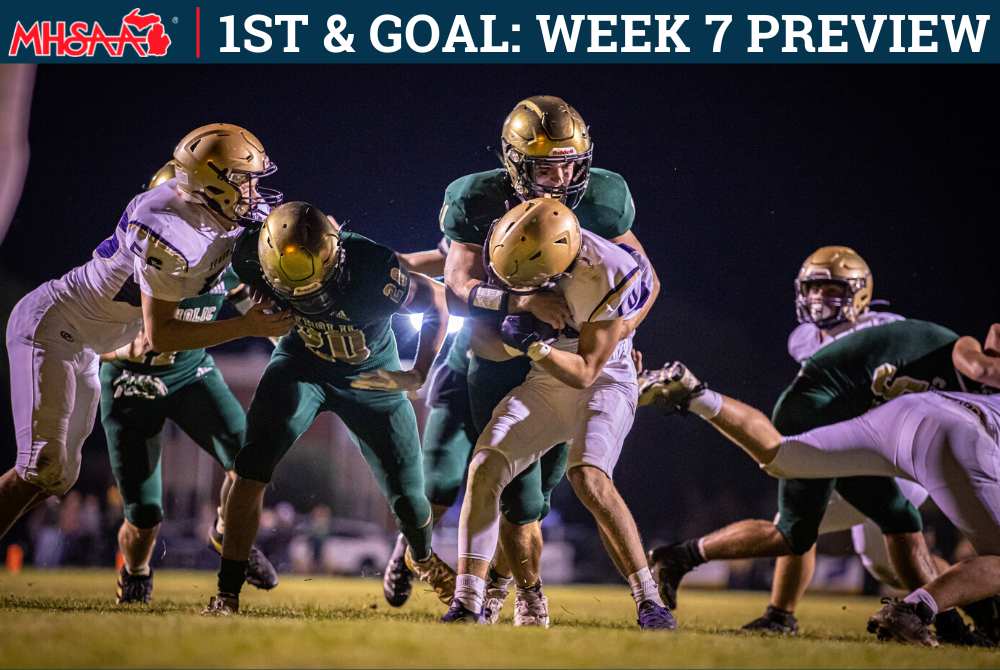
PHOTO A Muskegon Catholic Central defender makes a stop during last week's 16-12 win over Schoolcraft. (Photo by Tim Reilly.)