

Drive for Detroit: 11-Player Semis in Review
November 23, 2015
By Geoff Kimmerly
Second Half editor
Winter Storm Bella received some of the headlines entering this weekend's MHSAA 11-player Football Semifinals.
But the teams that took the field in mostly snowy conditions earned the rest, with three clinching championship game berths for the first time and seven more undefeated teams keeping perfect records intact.
See below for a few highlights from all 16 Semifinals. There's plenty more to come this week, including previews of each championship game and coverage of each Friday and Saturday.
Division 1
Romeo 48, Grand Ledge 21 – This officially can be coined the best season in Romeo history with its first MHSAA Finals berth to go with a school record for wins and a Macomb Area Conference White title. The Bulldogs (12-1) didn’t take their first lead until Jackson Butcher caught a 62-yard touchdown pass from Paul Hurley with 2:19 to go in the first half, but they then scored the last three touchdowns of the game to pull away. Hurley completed 8 of 10 passes for 133 yards and two scores, and Butcher caught five for 103 yards. Ba Blamo went over 1,000 rushing yards for the season with 172 plus two scores for Grand Ledge (12-1), which finished its deepest run since 2000. Click for more from the Macomb Daily.
Detroit Cass Tech 48, Canton 41
The Technicians (11-2) got up 14 points during the first half and then held off a comeback attempt by Canton to make the Division 1 Final for the first time since 2012. Sophomore Aaron Jackson, filling in for injured quarterback Rodney Hall, completed 4 of 5 passes for 216 yards and two touchdowns and ran for a third score, while junior Donovan Johnson ran for 154 yards and two scores and junior Timothy Cheatham gained 91 yards and two scores. Canton (10-3), in its first Semifinal since 2006, was paced by Marcus Sanders’ 298 yards rushing and three touchdowns on the ground – including one with 38 seconds to play that pulled the Chiefs to within seven of the lead. Click for more from the Detroit Free Press.
Division 2
Lowell 49, Walled Lake Western 34
The Red Arrows (12-1) avenged a 42-40 opening night loss to Walled Lake Western to earn a trip to Ford Field for the first time since 2011. Quarterback Ryan Stevens continued his sharp play with three touchdowns passing and three more rushing to give him 47 combined this season. Walled Lake Western (12-1), pursuing its first Finals berth since 1999, led 10-7 after the first quarter and got back within four heading into the fourth before Lowell scored three times over the final 12 minutes. Quarterback Kyle Thomas ran for two scores and threw for a third. Click for more from the Grand Rapids Press.
Detroit Martin Luther King 40, Livonia Franklin 6
King (13-0) moved one more step closer to a perfect run by taking a 20-0 advantage after the first quarter and following senior quarterback Armani Posey and his three touchdown passes to a lead Franklin never threatened. The Crusaders will play in an MHSAA Final for the first time since winning in 2007. Franklin, making its deepest postseason run since 1975, the first year of the MHSAA playoffs, finished 9-4 – its best record since 2005. The Patriots were only 2-7 a year ago, their fourth straight sub.-500 finish. Click for more from MLive-Detroit.
Division 3
Orchard Lake St. Mary’s 14, East Grand Rapids 7
These two perennial powers have now met six times over the last decade, including three times in MHSAA Finals – but this was the first victory for St. Mary’s (11-1). The reigning Division 3 champion got its final edge on a 70-yard touchdown run by Ryan Johnson to open the second half and will play in its fifth championship game in six seasons. This was East Grand Rapids’ first Semifinal since 2011; the Pioneers (9-4) scored on their first possession but didn’t reach the end zone again the rest of the way. Click for more from the Oakland Press.
Chelsea 35, Coldwater 7
The winner was guaranteed the first MHSAA Finals appearance in school history, and Chelsea took hold early jumping to a 28-0 first-half lead. Junior quarterback Jake Bush threw three touchdowns passes and ran for a fourth score as the Bulldogs (12-1) set a team record for wins in earning a first trip to Ford Field. Coldwater ended its deepest playoff run and winningest season but continued an impressive run that’s seen the team go from 1-8 in 2011 and 2012, to 5-5 with its first playoff berth in 2013, to 8-2 in 2014 and 12-1 this fall. Click for more from the Ann Arbor News.
Division 4
Zeeland West 46, Ada Forest Hills Eastern 8
West’s rumbling run-heavy offense is perfect for days like snowy Saturday, and the Dux (13-0) piled up nearly 400 yards in earning a return to Ford Field after falling in the Semifinal a year ago. West’s defense also played a starring role, allowing single-digit points for the fifth time in six games. Forest Hills Eastern hadn’t been held to fewer than 13 points since 2012. The Hawks did end their best season at 11-2 after four straight sub-.500 finishes including 4-5 each of the last two years. Click for more from the Holland Sentinel.
Flint Powers Catholic 21, Detroit Country Day 14
The Chargers (11-2) will return to Ford Field for the second time in five seasons after quarterback Noah Sargent scored with 26 seconds to play to give them their first lead. The dual threat standout threw for 97 yards and a touchdown and ran for 88 in addition to his go-ahead score. Country Day (11-2), playing for its first Finals berth since 2012, took a 14-0 lead into the second half. Junior Steve Mann threw for 108 yards and a touchdown for the Yellowjackets. Click for more from the Flint Journal.
Division 5
Grand Rapids West Catholic 42, Lansing Catholic 13
West Catholic (11-2) will play in its fifth Final in six years after winning this rematch of last season’s championship game. Any ideas that the Falcons were in demise after a 1-2 start clearly were exaggerated; they’ve beaten four opponents during the playoffs that entered a combined 39-3. The Cougars scored first, but West Catholic scored three times during the second quarter; for the game, sophomore quarterback Gaetano Vallone ran for two touchdowns and threw for two more. Lansing Catholic (11-2) had been held under 20 points only one other time since opening night 2013. Click for more from the Grand Rapids Press.
River Rouge 28, Ida 26
River Rouge (12-1) turned its first Semifinal appearance into its first championship game berth by holding off a late comeback attempt by Ida and stopping a 2-point conversion try that would’ve tied the score during the final seconds of regulation. River Rouge built a two-score lead during the first half, but the teams were tied 20-20 when quarterback Antoine Burgess found Alexander Carter for a go-ahead scoring pass and then added the eventual game-winning points on the conversion. Ida finished 12-1 after also playing in its first Semifinal. Click for more from the Southgate News-Herald.
Division 6
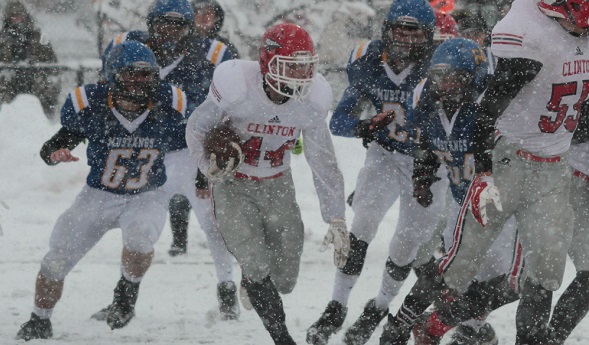
Clinton 42, Grand Rapids NorthPointe Christian 20
Clinton’s opponents were a combined 37-5 entering the playoffs, and beating previously-undefeated NorthPointe Christian earned the Redskins (13-0) a rematch of the 2013 Division 6 Final against Ithaca. Clinton’s running attack was nearly unstoppable; Noah Poore ran for 248 yards and two touchdowns, and Mathew Sexton ran for 182 yards and two scores. NorthPointe (12-1) saw its season end in the Semifinals for the second straight season and is 23-3 combined over the last two. Click for more from the Adrian Daily Telegram.
Ithaca 28, Traverse City St. Francis 19
Ithaca will play in its sixth straight Division 6 Final after coming back from a slow start to outscore St. Francis 22-6 over the final three quarters. Quarterback Jake Smith threw for 180 yards and two touchdowns and ran for 147 yards and two more scores for the Yellowjackets (13-0), who held St. Francis to eight first downs and took advantage of four turnovers. The Gladiators (12-1) scored immediately on a 95-yard return of the opening kickoff by Joe Trucco and still led 19-15 with just under 11 minutes to play. Click for more from the Mount Pleasant Morning Sun.
Division 7
Ishpeming 22, New Lothrop 14
The Hematites (12-0) will play in the Division 7 Final for the fourth straight season and for their third title in that time after winning this matchup of undefeated teams. The only game played inside this weekend – at Northern Michigan University’s Superior Dome – still looked like it was in the snow thanks to strong defenses on both sides. Ishpeming quarterback Ozzy Corp ran for 88 yards and two touchdowns and threw a scoring pass, and New Lothrop quarterback Erik Birchmeier threw for 132 yards and ran for a score as neither offense gained 200 total yards. The Hornets finished 12-1 after a sixth-straight perfect regular season. Click for more from the Marquette Mining Journal.
Pewamo-Westphalia 30, Detroit Loyola 0
Pewamo-Westphalia (13-0) will this time move on after this rematch of last season’s Semifinal that sent Loyola to Ford Field to win its first MHSAA title. The Pirates followed the snowy footsteps of running back Jared Smith, who rushed for 193 yards and two touchdowns – adding to his MHSAA single-season record for rushing scores of 52 and giving him the MHSAA record for rushing yards in a season with 3,094. The Pirates also handed Loyola (10-2) its first shutout since 2011. P-W played in a Final once before, in 2011, and Loyola played in the last three in Division 7. Click for more from the Lansing State Journal.
Division 8
Muskegon Catholic Central 33, St. Ignace 20
The Crusaders (11-2) will play for a third straight MHSAA championship after building a 20-0 lead as two running backs went over 100 yards – Walker Christoffersen had 192 and a touchdown and LaTommy Scot ran for 102 and scored both rushing and receiving. St. Ignace scored all 20 of its points during the fourth quarter with Andrew Goldthorpe running for a touchdown and catching a pass for another. The Saints (11-2) were playing in their third Semifinal in five seasons. Click for more from the Muskegon Chronicle.
Waterford Our Lady 36, Ottawa Lake Whiteford 20
The Lakers (13-0) will play for an MHSAA title for the first time since claiming Division 8 in 2002. Our Lady led only 22-14 heading into the fourth quarter before breaking away. Quarterback Clay Senerius threw two touchdown passes to bring his total to 34 this season. Whiteford (10-3) played in its first Semifinal and had more than 300 yards of total offense, but couldn’t keep pace during the fourth quarter and missed on a couple of scoring opportunities deep in Lakers territory. Click for more from the Oakland Press.
PHOTO: Clinton trudged through the snow to defeat Grand Rapids NorthPointe Christian in a Division 6 Semifinal. (Click for more from HighSchoolSportsScene.com.)
5-0 Oakridge Healing 2018 Heartbreak
October 2, 2019
By Tom Kendra
Special for Second Half
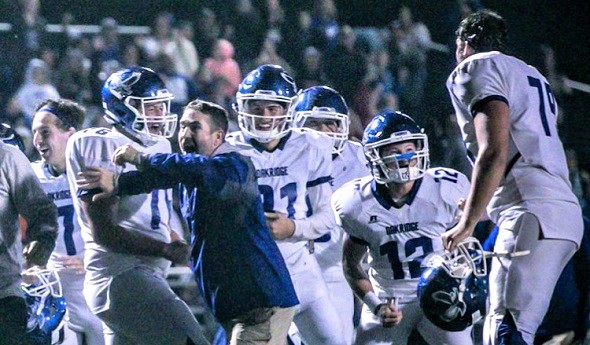
Muskegon Oakridge had an extra reason to celebrate in the rain on Friday night.
 It was about more than just overcoming sloppy conditions and the never-say-die Montague Wildcats in a matchup of No. 1 vs. No. 2 in The Associated Press’ Division 5 rankings. There was more to it than getting a leg up in the West Michigan Conference race with a thrilling 15-13 overtime win.
This was about overcoming two of the most heartbreaking losses imaginable one year ago – and dedicating the win to those who never got a shot at redemption.
“That win was for those seniors from last year,” said Oakridge running back Leroy Quinn, a four-year starter who rushed for both of his team’s touchdowns and a game-high 144 yards, putting him over 4,000 rushing yards for his career. “I love those guys, and I miss them. We all grieved together last year, and now we’re celebrating for them.”
Oakridge led Montague in their 2018 meeting 24-10 with 3:45 remaining, when the Wildcats roared back with two touchdown passes and then a game-winning, 2-point conversion run by Sebastian Archer with no time on the clock for a 25-24 win.
It was the type of gut-wrenching loss which is hard to shake off.
“It’s a helpless feeling,” said Oakridge senior nose guard and offensive tackle Will Scraver. “The only thing you can do is try to forget and focus on the next game.”
Unfortunately, less than one month later, Oakridge would experience an even more bitter defeat. The Eagles’ second loss had finality as it came in the MHSAA District championship game, as they squandered a seemingly safe 35-8 halftime lead in a stunning 40-37 loss to Hudsonville Unity Christian. Adding salt to the wound was having to sit home and watch Unity then roll over its next three opponents en route to the Division 5 championship.
“Sometimes it’s hard to put those losses behind when you have umpteen people coming up to you at the store or the gas station asking you what the heck happened,” said Harger, who is in his ninth year as the Oakridge coach after serving for 16 years under Jack Schugars, the all-time winningest coach in Muskegon-area football history.
“All we can do, as coaches and players, is to learn from our mistakes and to take care of all the little things so that we win those kind of games.”
Oakridge, 5-0 and now No. 1 in Division 5 in the latest Associated Press poll, has been focused and motivated this fall – starting with a tough road test at Belding and most recently with the big revenge win at Montague.
 Oakridge and Montague were scoreless through three quarters and tied, 7-7, after regulation. Quinn scored from three yards out in overtime, then added what proved to be the game-winning 2-point conversion run. Montague answered with a 10-yard pass from Drew Collins to Brennan Schwarz, but Nate Fair and Corey Vanderputte stuffed the 2-point conversion attempt.
Quinn, a 6-foot-1, 233-pound battering ram, has led the way with 465 rushing yards and eight touchdowns. He now has 4,065 career rushing yards, eclipsing David Nelson’s previous school record, and needs five more rushing TDs to pass Jamie Potts for that school mark.
Quinn’s play thus far has been no surprise, but how quickly others have stepped up in the backfield and on the line is the reason why Oakridge is back to No. 1 in the state.
Junior quarterback Ethen Dailey (5-11, 145) has done a solid job managing the Eagles’ offense, and speedy sophomore Vanderputte has emerged as the breakaway threat.
But it was the play of the offensive line, where Fair is the only returning starter, that keyed the win at Montague.
Oakridge, which lined up in a double tight end, full-house backfield look most of the game and threw only two passes (completing none), finished with a 222-70 edge in rushing yards.
“With the tradition out here, there are always new players ready to step up,” said Fair, who also starts at inside linebacker. “We might not have a lot of big names on the line, but we knew we were going to be good.”
Four of the Eagles’ five interior linemen are seniors, with the lone exception sophomore center Derek Driscoll. The guards are seniors Josh Havermans and Jason Pego and the tackles are Fair and Scraver. Starting at tight end are junior Luke Martin and sophomore Ethan Josza.
Harger is not ready to start talking about avenging last year’s playoff loss, as his team still has tough games remaining at North Muskegon in Week 7 and the final two weeks of the regular season at home against Ravenna and first-time opponent Traverse City St. Francis.
Oakridge could also have a couple of new playoff challenges close to home. While the Eagles appear a lock to be in Division 5, they may be joined by resurgent neighbor Muskegon Orchard View (on the bubble of Division 4 and 5) and Montague (on the Division 5 and 6 bubble).
“Our motto this year is: ‘Exceed Expectations’ and, considering the group we lost last year, these guys have done that so far,” said Harger, who is 75-16 and has made the playoffs in each of his first eight years as head coach.
“This is not a real rah-rah group of kids. I think they just love to play football and with the way last year ended, they are thankful for the opportunity to come out and play again.”
 Tom Kendra worked 23 years at The Muskegon Chronicle, including five as assistant sports editor and the final six as sports editor through 2011. E-mail him at [email protected] with story ideas for Muskegon, Oceana, Mason, Lake, Oceola, Mecosta and Newaygo counties.
PHOTOS: (Top) The Oakridge sideline celebrates late in the Eagles' 15-13 overtime win at Montague. (Middle) Oakridge senior Leroy Quinn, who became the school's all-time leading career rusher earlier this season, runs through a big hole into the end zone for a touchdown. (Photos by Tim Reilly.)