

Drive for Detroit: District Semis in Review
November 5, 2013
By Geoff Kimmerly
Second Half editor
Upsets seemed to fall with the raindrops that unexpectedly cropped up in spurts during the first weekend of the 2013 MHSAA football playoffs.
From Romeo to Dowagiac, Britton-Deerfield to Wayland with Parchment and Bath in between, teams celebrated wins that probably weren't expected by most when the brackets were revealed during the Sunday Selection Show.
A telling stat: While teams with higher playoff points averages host during the first three rounds, nearly 23 percent (31 of 136) of road teams won last weekend.
Here’s a look at the results from each division that stuck out most from the 11-player District openers and 8-player Regional Semifinals:
Division 1
Detroit Catholic Central 35, Northville 14
Detroit Catholic Central (8-2) opened the playoffs against Northville (8-2) for the second time in three seasons and with hopes of again starting off smoothly on a third straight trip to the MHSAA Finals. This opener certainly was closer than the 2011 56-6 DCC win, but the result was the same as the Shamrocks ended an outstanding run by the Kensington Lakes Activities Association overall champion. Click to read more from the Detroit Free Press.
Also noted:
Macomb Dakota 19, Warren DeLaSalle 14: DeLaSalle (6-4) gave Dakota (10-0) its closest game this season and was the first to come within single digits of the Cougars since opening night.
Walled Lake Western 44, Canton 41: Western (9-1) advanced to the District Final for the third straight season but only after holding off a late comeback by Canton (8-2).
Romeo 24, Lake Orion 21: Likely considered an upset because of Lake Orion’s playoff history, there is some back story. In three playoff games during 2005-08, Lake Orion (7-3) beat Romeo all three times by a combined six points – but this time the Bulldogs (6-4) captured a close one.
Brighton 14, Grand Blanc 7: Grand Blanc (7-3) won the KLAA West thanks to a 44-21 win over Brighton in Week 4, but the Bulldogs remain alive after entering the postseason 5-4.
Division 2
Birmingham Seaholm 17, Southfield 16
Seaholm (9-1), the Oakland Activities Association Blue champion, scored twice during the final seven minutes to eliminate OAA White winner Southfield (7-3). The Maples will play in their first District Final since 2001, the last time the team also won nine or more games. Click to read more from The Oakland Press.
Also noted:
Wyandotte Roosevelt 45, Ypsilanti Lincoln 40: Downriver League champion Roosevelt (10-0) outlasted another league title winner, Southeastern Conference White winner Lincoln (7-3).
Midland Dow 30, Fenton 21: The Chargers (8-2) returned to the playoffs for the first time since 2010 and opened by beating Flint Metro League co-champ Fenton (8-2).
Pinckney 14, South Lyon 10: In its first playoff appearance since 2001, Pinckney (7-3) won its first playoff game ever and finished a season sweep of South Lyon (6-4), also its opening-night opponent.
Detroit U-D Jesuit 37, Warren Woods Tower 14: Jesuit’s first winning season since 2002 will continue; the Cubs (6-4) ended quickly the first playoff appearance for Warren Woods Tower (6-4) since 2007.
Division 3
Grand Rapids Christian 14, Grand Rapids Forest Hills Northern 13
The reigning Division 3 champion got a scare from Forest Hills Northern (7-3), which led 13-0 in the third quarter of its first playoff game since 2002. The Eagles (8-2) made an impressive comeback to move on to their fourth straight District Final. Click to read more from the Grand Rapids Press.
Also noted:
Zeeland West 44, Zeeland East 13: The Dux (9-1) received their lone loss from East (5-5) in Week 2, but this one wasn't as close as that six-point defeat.
Byron Center 28, Battle Creek Harper Creek 3: Harper Creek (7-3) made the Semifinals the last two seasons, but were stopped quickly this time by the Bulldogs (7-3).
Wayland 38, Plainwell 28: A year after finishing 0-9 (after three straight ending 1-8), Wayland is 6-4 and knocked out a solid contender in Plainwell (8-2).
Eaton Rapids 49, Charlotte 21: Although Eaton Rapids (6-4) beat Charlotte in Week 3, it was expected by at least a few that the Greyhounds’ first playoff appearance would be a short one since Charlotte (7-3) had won five straight.
Division 4
Dowagiac 21, Edwardsburg 17
Dowagiac has been exceptional over the last three seasons – the Chieftains (7-3) are playing to reach 10 wins for the third straight. But it was hard to see this one coming with Edwardsburg (9-1) undefeated and having beaten Dowagiac 36-0 only two weeks ago to decide the Wolverine B West championship. Click for to read more from the Kalamazoo Gazette.
Also noted:
Belding 21, Spring Lake 20: This spoke to the strength of the O-K Blue, as third-place Belding (7-3) beat Lakes 8 Conference champion Spring Lake (8-2).
Allendale 24, Grand Rapids Catholic Central 21 (OT): Also from the O-K Blue, league runner-up Allendale (8-1) survived a scare from frequent playoff power GRCC (6-4).
Battle Creek Pennfield 21, Paw Paw 17: The Kalamazoo Valley Association was pretty strong too, with Pennfield (9-1) one of three co-champs and the winner in this one over Wolverine B East champ Paw Paw (8-2).
Saginaw Swan Valley 14, Yale 13: Swan Valley’s hope of returning to the Semifinals – and going to Ford Field – nearly ended until the Vikings (10-0) scored the go-ahead points with two minutes to play to escape Yale (6-4).
Division 5
Parchment 40, Jackson Lumen Christi 35
In a weekend full of upsets, this was the one that rang the statewide bell loudest. Parchment has had a nice run in a tough KVA and is 7-3 overall after finishing 3-6 only a year ago. But Lumen Christi had the highest playoff point average in Division 5 by a substantial chunk and was considered a definite contender as it pursued its first MHSAA championship since 1999. Click to read more from the Kalamazoo Gazette.
Also noted:
Reed City 49, Clare 7: The Central State Activities Association champion Coyotes (10-0) continued their dominating play in eliminating Jack Pine Conference champ Clare (7-3).
Millington 28, Almont 21: The Cardinals’ two regular season losses were their most since 2006, but Millington (8-2) is looking strong again after opening with a win over Blue Water Area Conference runner-up Almont (8-2).
Grand Rapids West Catholic 27, Portland 14: This rematch of last season’s Division 5 Final ended the opposite way, with West Catholic (6-4) continuing a five-game winning streak while Portland (7-2) closed with two straight defeats.
Detroit University Prep 42, Clinton Township Clintondale 34: University Prep (8-2) equaled its 2012 record in only its eighth season as a program and handed a first loss to Macomb Area Conference Bronze champion Clintondale (9-1) in one of its best wins during that brief history.
Division 6
Grandville Calvin Christian 14, Grand Rapids NorthPointe Christian 12
These two and Hopkins played to a three-way tie for the O-K White championship during the regular season, which resulted in part because of NorthPointe’s 13-8 win over Calvin Christian (7-3) in Week 3. This time the Squires came out on top in a matchup of teams both looking for their first playoff wins. NorthPointe finished 8-2. Click to read more from the Grand Rapids Press.
Also noted:
Montrose 42, Reese 13: The Rams (10-0) won their 10th game for the third straight season and made it two this fall over solid Reese (8-2).
Shelby 35, Montague 23: Montague (6-4) played West Michigan Conference champion Shelby (9-1) closer than in Week 4, but the Tigers (9-1) bounced back from its lone loss, in Week 9, against Division 4 Spring Lake.
Schoolcraft 28, Niles Brandywine 21: Co-KVA champ Schoolcraft (9-1) hasn't lost in two months, although Brandywine (8-2) gave the Eagles one of their closest games in a while.
Constantine 41, Michigan Center 26: This win over Michigan Center (8-2) gave Constantine (6-4) at least one postseason victory in each of the last 12 seasons.
Division 7
Britton-Deerfield 42, Hudson 28
Britton-Deerfield has made the playoffs all three seasons since its creation from the merging of the Britton-Macon and Deerfield districts. In fact, the Patriots reached the Regional Final in just their second season last fall. But Lenawee County Activities Association co-champion Hudson has reached the MHSAA Semifinals three of the last five seasons and had to be considered a possibility to get back again this month. Click to read more from the Adrian Daily Telegram.
Also noted:
Iron River West Iron County 21, Traverse City St. Francis 7: Given St. Francis’ history of postseason success, this seemed ripe for an upset – but West Iron (10-0) broke away from the Gladiators (5-5) in the second half.
Pewamo-Westphalia 57, Saugatuck 21: The Central Michigan Athletic Conference champion Pirates (9-1) bounced back from their lone loss the week before to finish the season for Southwestern Athletic Conference North winner Saugatuck (8-2).
Bath 27, Elkton-Pigeon-Bay Port 14: This is not only Bath’s first playoff run since 2000, but first winning season since that fall – and the Bees (6-4) continued with a stunner against Greater Thumb Conference West runner-up Laker (7-3).
Madison Heights Bishop Foley 42, Royal Oak Shrine 10: A Week 3 loss to Shrine (6-4) got Bishop Foley off to a rough start in the Catholic League Intersectional, but the Ventures (7-3) scored their second-most points of the season in this rematch.
Division 8
Detroit Allen 54, Adrian Lenawee Christian 32
Detroit Allen (7-2) built on its first playoff berth with its first playoff win, ending a similarly historic season for Lenawee Christian – the Cougars set a team record for wins in finishing 7-3. Both programs have been in existence for only six seasons, and this fall Allen finished second to much larger River Rouge in the Michigan Metro Athletic Conference. Click to read more from the Adrian Daily Telegram.
Also noted:
Waterford Our Lady, 34, Clarkston Everest Collegiate 7: These two previously were one as a co-op team before splitting this season; Our Lady (8-2) will move on while Everest (7-3) finished an impressive first season on its own.
Powers North Central 35, Munising 21: Although Munising (6-4) made the playoffs for the second time in three seasons, neither of these teams has much recent postseason history – but Powers (8-2) made its own with this first playoff win.
Crystal Falls Forest Park 30, Bessemer 16: The Trojans (10-0) beat the Miners (6-4) for the second time in three weeks and have 10 wins again for the first time since 2010.
L’Anse 52, Lake Linden-Hubbell 34: The Purple Hornets (8-2) bounced back from a Week 9 loss with their most points of the season to outlast one of the best offensive performances as well by Lake Linden-Hubbell (5-5).
8-Player
Engadine 28, Cedarville 26
Perhaps a little under the radar, Engadine has been arguably the hottest team in 8-player football with five straight wins after beginning this season 1-4. The Eagles’ third loss this fall was 42-16 to Cedarville (8-2) – but in six weeks, Engadine (6-4) found a way to reverse the tide just enough. Click for more from WWTV 9&10.
Also noted:
Peck 32, Deckerville 14: The 8-player champion could come from the Thumb area for the third straight season; in 2012 it was Deckerville (5-5), and Peck (10-0) is looking like a favorite this time.
Carsonville-Port Sanilac 54, Portland St. Patrick 18: The Tigers (7-3) made it two straight wins and two straight over the Shamrocks (7-3) after also beating St. Patrick 45-12 in Week 9.
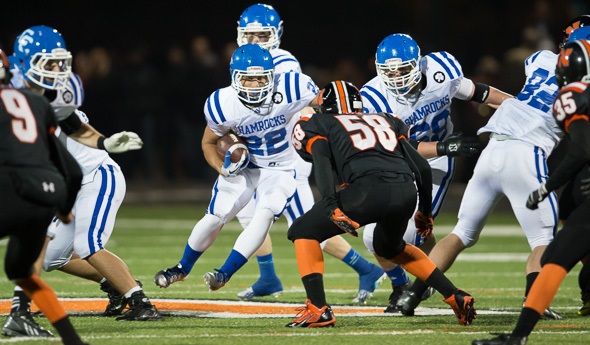
PHOTO: Detroit Catholic Central running back Connor Holton (22) prepares to sprint through a hole in the line while Northville linebacker Jack Ernst works to stop him. (See more at Terry McNamara Photography.)

1st & Goal: Week 8 In Review
October 20, 2020
By Geoff Kimmerly
Second Half editor
Even with a shortened regular season, football teams across Michigan are equaling past accomplishments or at least making better on their performances of a year ago.
Many of our notes this week highlight the crowning, at least partially in some cases, of a league champion. But those other little successes – like surpassing last season’s win total, or ending a losing streak – also make every week memorable, with many more teams seeing the fruits of work and patience during an otherwise unpredictable fall.
Below is our look at many who found reasons to celebrate during Week 8.
Bay & Thumb
HEADLINER Hemlock 12, Millington 6 Defense reigned as Hemlock (5-0) clinched the Tri-Valley Conference West championship – its first league title since 2012. Millington (4-1) continued to shine defensively, with its average points given up per game rising just a few tenths to 10.6 this season. But Hemlock’s defense was a score stronger, lowering its average points allowed this fall to 14.6 per game. Click for more from the Saginaw News and see highlights below from WJRT.
One play after picking off Millington, Hemlock's @Corbinlarkin21 cashes in with an 83-yard TD to lead the Huskies to their first league title since 2012 and take home our Highlight of the Night! @MIHemlock_High https://t.co/KBSGbraJ1D
— ABC12WJRT (@ABC12WJRT) October 17, 2020
Watch list Marine City 24, Marysville 21 The Mariners (5-0) finished a perfect run through the Macomb Area Conference Silver for the second-straight season, while extending their winning streak over Marysville (4-1) to four.
Remember this one Harbor Beach 42, Marlette 20 The Pirates (3-2) will finish second in the Greater Thumb Conference East but made sure only Sandusky will finish first by handing the Red Raiders (3-2) their only league loss of an abbreviated schedule.
More shoutouts Almont 28, Richmond 25 (OT) For the first time in a long time, these two aren’t really in the mix in the Blue Water Area Conference – but the rivalry remains notable as Almont (2-1) extended its winning streak to four. Bad Axe 26, Elkton-Pigeon-Bay Port Laker 6 With Bad Axe (4-1) and Cass City not facing off this season – that game was among those canceled early on – this win cemented a shared GTC East championship for both.
Greater Detroit
HEADLINER Sterling Heights Stevenson 42, Grosse Pointe South 35 At the end of one of the most intriguing league races of this shortened season, Sterling Heights Stevenson finished tied for first with Macomb Dakota, thanks to this win that sent Grosse Pointe South (3-2) into third place. The Titans (4-1) continued a rise that began with last season’s run to the Division 1 Semifinals after they had finished only 1-4 in the Red last fall. Click for more from the Macomb Daily.
Watch list Detroit Cass Tech 41, Detroit Martin Luther King 19 After defeating King (3-2) by eight in their season opener, the Technicians (5-0) more than doubled that during this Detroit Public School League 1-2 championship game – a great sign with the postseason approaching.
Remember this one Clarkston Everest Collegiate 41, Royal Oak Shrine 7 This was the third time in five seasons these two decided the Detroit Catholic League Intersectional 2 championship, and the Mountaineers (5-0) are a win away from a second-straight undefeated regular season.
More shoutouts Dearborn Heights Crestwood 21, Garden City 12 After a down 2019, Crestwood (5-0) clinched its second Western Wayne Athletic Conference championship in three seasons. Canton 49, Hartland 28 The Chiefs (5-0) clinched the Kensington Lakes Activities Association West title outright and can finish a perfect league run against reigning champ Plymouth.
Mid-Michigan
HEADLINER Mount Pleasant 21, Midland Dow 0 The Oilers (4-1) threw a wrench into an anticipated Saginaw Valley League Blue championship decider this week between Dow and Midland High. Mount Pleasant earned itself a chance at a shared championship instead, if the Chargers (4-1) are able to hand the Chemics their first loss Friday. Click for more from the Mount Pleasant Morning Sun.
Watch list Holt 26, Portage Northern 0 The weekend’s biggest upset statewide saw the Rams (2-2) shut down Portage Northern (4-1), not only handing the Huskies their first defeat but holding them scoreless for the first time since 2014.
Remember this one Pewamo-Westphalia 30, Fowler 7 Although the Central Michigan Athletic Conference decided to not award a league champion because of the shortened schedule, the Pirates (5-0) still ran their league winning streak to 39 and run against Fowler (4-1) to six straight since the Eagles handed them that last CMAC loss in 2014.
More shoutouts New Lothrop 49, Durand 6 The Hornets (5-0) clinched another Mid-Michigan Activities Conference title by handing Durand (4-1) its first defeat. Williamston 17, Olivet 6 The Hornets (5-0) prepped for their Capital Area Activities Conference Red decider this week by handing Olivet (4-1) its first loss.
Northern Lower Peninsula
HEADLINER McBain 23, Beal City 19 The Ramblers (5-0) locked up their first Highland Conference title since 2015 with their fourth-straight win over the Aggies (4-1), who also entered the evening unbeaten. McBain is one of 11 undefeated teams left in Division 7. See below for highlights from MI Sports Now.
McBain recorded its fourth straight win over Beal City and captured the Highland Conference championship with a 23-19 win Friday.https://t.co/0f89oD6qGp pic.twitter.com/8zfmQd6BNc
— MISportsNow (@MISportsNow) October 17, 2020
Watch list Kingsley 40, Sault Ste. Marie 6 With a game to play, the Northern Michigan Football Conference Legends has belonged firmly to the Stags (5-0), who clinched a second-straight title by handing second-place Sault Ste. Marie (3-2) its first league loss.
Remember this one Traverse City West 45, Cadillac 27 These teams finished second and third, respectively, in the Big North Conference, and West (4-1) continued its string of four-straight 40-plus point offensive efforts since losing to eventual champion Traverse City Central in the season opener.
More shoutouts Traverse City St. Francis 35, Ogemaw Heights 14 The Gladiators (3-2) continued to establish solid footing in advance of the Division 7 playoffs with a win over Division 5 Ogemaw Heights (3-2). Maple City Glen Lake 18, Benzie Central 0 The Lakers (4-1) posted their second shutout of the season and are giving up only 6.6 points per game.
Southeast & Border
HEADLINER Erie Mason 56, Sand Creek 38 The Eagles’ offense continued to roll as they clinched a share of the Tri-County Conference championship, their first league title since 2003, while handing Sand Creek (4-1) its first defeat. Erie Mason (5-0) now also has as many wins as the last four seasons combined – and with 282 points, needs 48 more to equal how many it scored over nine games a year ago. The Eagles are averaging 56.4 per game. Click for more from the Adrian Daily Telegram.
Watch list Reading 26, Homer 19 The Rangers (4-1) losing to Jonesville in Week 6 was no reason to write them off, as they’ve bounced back to hand Homer (4-1) its first loss. Reading no doubt will root for Homer to take down Jonesville this week to set up a shared Big 8 Conference title.
Remember this one Blissfield 42, Ida 40 The Royals (5-0) earned a share of the Lenawee County Athletic Association title, but only after holding off the Bluestreaks (2-3) after they were tied with less than nine minutes to play.
More shoutouts Michigan Center 42, Manchester 7 The Cardinals (2-1) got one game in this fall before having to take two weeks off, but they’ve won both matchups since returning to the field. Adrian Madison 46, Pittsford 6 The Trojans improved to 4-1, equaling their win total from last season and setting them up for a possible fifth victory – which would give Madison its winningest finish since 2009.
Southwest Corridor
HEADLINER Schoolcraft 45, Lawton 14 The Eagles (4-1) clinched a share of the Southwestern Athletic Conference Valley title, to go with their shared SAC Lakeshore championship from last season, and by defeating the Valley’s 2019 champ. Schoolcraft shut down a Lawton offense that averaged 42.5 points per game during its 4-0 start. Click for more from the Kalamazoo Gazette and see highlights below from FOX 17.
At Schoolcraft: https://t.co/OMviWXNKoB
— FOX 17 Blitz (@FOX17Blitz) October 17, 2020
Watch list Constantine 43, Kalamazoo United 28 Last season these two and Schoolcraft shared the Lakeshore title, and this win over the formerly co-leading Titans (4-1) guaranteed the Falcons (4-1) will do at least the same again.
Remember this one Stevensville Lakeshore 13, Battle Creek Lakeview 7 Although the Southwestern Athletic Conference also isn’t awarding a league champion this season, this was a display of the strength among the league’s teams as Lakeshore (4-1) handed Lakeview (4-1) its first defeat.
More shoutouts Battle Creek Harper Creek 50, Marshall 27 The Beavers (3-2) have picked up two straight impressive victories and with one more would have their winningest season since 2017. Coloma 24, Watervliet 16 The Comets (4-1) put themselves in position to force a shared Lakeshore title with Constantine up this week.
Upper Peninsula
HEADLINER Marquette 27, Escanaba 6 To say the Great Northern Conference has navigated twists and turns this fall would be an understatement. But at the end of the league schedule, Marquette (4-1) is champion for the second straight season, and Escanaba (0-2) was able to get back on the field for the first time this year. Click for more from the Marquette Mining Journal.
Watch list Menominee 41, Gladstone 0 Two losses to Marquette have Menominee at 3-2, but in the Maroons’ two wins on the field they’ve averaged 41.5 points.
Remember this one Houghton 15, Negaunee 13 The Gremlins (2-1) have been forced to miss multiple games as well, but on this night were able to break a recent two-game losing streak to the Miners (3-2) and avenge last season’s 35-0 defeat.
More shoutouts West Iron County 20, Gwinn 14 (OT) The Wykons (5-0) held Gwinn (2-3) scoreless in overtime and then scored on their ensuing set of downs to remain undefeated. Calumet 34, Hancock 18 The Copper Kings (2-2) tuned up for what could be an intriguing regular-season finale this week with Marquette.
West Michigan
HEADLINER Montague 34, Whitehall 31 (2OT) A double-overtime field goal won this game for Montague in one of the state’s longest- running rivalries, giving the Wildcats a 64-48-2 advantage since they began playing in 1921 – and more importantly, a share of another West Michigan Conference championship. Click for more from the Muskegon Chronicle.
Blitz Game of the Week: Montague 34, Whitehall 31 https://t.co/e4F95tAKoi
— FOX 17 (@FOX17) October 17, 2020
Watch list Grand Rapids Catholic Central 28, Ada Forest Hills Eastern 3 The Cougars (5-0) set themselves up to face Grand Rapids South Christian this week for the outright Ottawa-Kent Conference Gold title.
Remember this one Muskegon 15, Zeeland West 14 The Big Reds (4-1) came back from a 14-0 deficit to knock Zeeland West (4-1) out of a tie for first place (with Mona Shores) in the O-K Green.
More shoutouts Grand Rapids Forest Hills Northern 35, Lowell 22 the Huskies opened 0-2 but have won three straight to equal their win totals of each of the last two seasons. Grand Rapids West Catholic 34, Allendale 12 The Falcons (4-1) held on to second place in the O-K Blue and will now cheer for Allendale (3-2) to defeat league leader Hudsonville Unity Christian this week.
8-Player
HEADLINER Portland St. Patrick 26, Merrill 22 Both should have championship aspirations, as St. Patrick (5-0) entered this game No. 2 in Division 2 based on playoff-point average, and Merrill (4-1) was tied for No. 2 in Division 1. Click for more from the Lansing State Journal.
Watch list Morrice 57, Kingston 0 The Orioles (5-0) moved into the No. 2 spot alone in Division 1 playoff-point average and have yet to score fewer than 52 points in a game this season while allowing 34 total over five games.
Remember this one Kinde-North Huron 36, Peck 6 The Warriors clinched their second league title in four seasons, this time in the North Central Thumb League Stripes, while improving their scoring margin to a combined 222-12 this fall.
More shoutouts Cedarville 32, Munising 8 The Trojans moved to 4-1 by handing Munising (4-1) its first defeat and locking down an offense formerly averaging 34.5 points per game. Deckerville 56, Genesee 36 The Eagles (4-1) bounced right back from the Week 7 loss to Mayville with another 50-point performance.
PHOTO: Battle Creek Pennfield takes the field at the start of a 49-7 win over Jackson Northwest on Friday. (Photo by Scott Mapes.)