

Drive for Detroit: Playoff Week 1 Preview
October 31, 2019
By Geoff Kimmerly
Second Half editor
Whether your team's preferred final destination is Ford Field in Detroit or the Superior Dome in Marquette, the first steps will be taken this weekend during 144 MHSAA Playoff games across both peninsulas.

Someone's season is on the line in every game from here on out, and below we take a glance at a matchup in each division that is especially notable during these first rounds of the 11 and 8-player tournaments.
Don't let a little cool weather keep you out of the stands and supporting your favorite team at this most exciting time of year. But if you choose to stay in, take in one or more of the 30 games being broadcast on FOX Sports Detroit Prep Zone or MHSAA.tv. Click for listings and check back with MHSAA.com all weekend for scores and updated brackets.
"Drive for Detroit" is sponsored by MI Student Aid.
11-Player
Division 1
Saline (8-1) at Belleville (9-0), Saturday
This is the most power-packed opener in any division, with both teams making Division 1 Semifinals a year ago. Both have faced four playoff teams this fall, and the only loss between them was Saline’s Week 1 defeat against reigning champion Clinton Township Chippewa Valley. The Hornets are familiar with this time of year with six District titles over the last seven seasons and a Division 1 runner-up finish in 2014. But Belleville has seemed on the verge of a Ford Field run with now three straight perfect regular seasons and, like Saline, all but one of its wins this fall by double digits.
Keep an eye on these FRIDAY Brighton (7-2) at Holt (7-2), Davison (7-2) at Romeo (7-2), Rochester Adams (7-2) at Utica Eisenhower (7-2), Detroit Cass Tech (5-4) at Grosse Pointe South (7-2).
Division 2
Muskegon Mona Shores (7-2) at Midland (8-1)
This is a rematch of a 2018 Division 2 Semifinal won by the Sailors 49-28. Both of these teams were stung late this fall but should be dangerous again with fresh starts that come with the playoffs. Mona Shores, which went on last season to finish D2 runner-up, has losses to two league champions including big to rival Muskegon High two weeks ago in a matchup that determined the Ottawa-Kent Conference Black title. Midland was defeated by a similar score last week by rival Midland Dow as the two shared the Saginaw Valley League Red title. The winner of this District opener could see Dow next week – the Chargers take on Big North Conference champion Traverse City Central on the other side of the District bracket.
Keep an eye on these FRIDAY South Lyon (8-1) at Fenton (8-1), Farmington (7-1) at Oak Park (8-1), Port Huron (6-3) at Port Huron Northern (8-1). SATURDAY Detroit U-D Jesuit (6-3) at North Farmington (9-0).
Division 3
DeWitt (7-2) at East Lansing (7-2)
This is one of the most highly-anticipated rematches of the first week, with these two and Holt having shared the Capital Area Activities Conference Blue title, and with the Panthers and Trojans finishing with the same playoff point average – East Lansing got the home game because of its 21-2 win over DeWitt in Week 5. Minus that performance, the Panthers averaged 39.6 points per game this fall – so expecting another all-out shutdown by the Trojans’ defense might be an unfair ask. But DeWitt’s defense also will have to deliver, as East Lansing’s offense (32.7 ppg) is scoring at its highest pace in decades.
Keep an eye on these FRIDAY Lowell (5-4) at East Grand Rapids (6-3), Zeeland East (5-4) at Zeeland West (8-1), St. Joseph (6-3) at Edwardsburg (9-0), Bloomfield Hills Brother Rice (6-3) at Flint Kearsley (7-2).
Division 4
Sparta (8-1) at Muskegon Orchard View (9-0)
Both of these teams have enjoyed banner seasons. Orchard View posted its first winning record since 2014, earned its first playoff berth since 2008, won the Lakes 8 Conference title and finished the regular season perfect for the first time since 2005. Sparta made the playoffs for the first time since 2013, tying its most wins since 2011 with its best regular-season record since 2006. The Spartans finished second in the O-K Blue to Grand Rapids Catholic Central, which faces Allendale on the other side of this District bracket. Orchard View did beat five playoff teams on the way to the playoffs. But comparing their lone shared opponent, Sparta downed playoff qualifier Spring Lake 38-3 in Week 3 after Orchard View defeated the Lakers 22-17 on opening night.
Keep an eye on these FRIDAY Fowlerville (6-3) at Goodrich (7-2), North Branch (7-2) at Pontiac Notre Dame Prep (8-1), Ortonville Brandon (7-2) at St. Clair (8-1).
Division 5
Almont (9-0) at Richmond (8-1)
This is a rare occurrence; Almont defeated Richmond in Week 7 28-10 and went on to win the Blue Water Area Conference title outright while closing out its second-straight perfect regular season. However, the Blue Devils’ nonleague opponents both made the playoffs, and the bonus for playing those teams was enough to push Richmond past Almont into a home game this week. The Raiders, however, also won the first Richmond game this fall on the road, and their annually-awesome defense continues to play anywhere. Almont has given up 69 points this fall – 39 over five home games and 30 over four away. But take away the first Almont matchup, and Richmond is averaging a robust 33.5 points per game.
Keep an eye on these FRIDAY Central Montcalm (7-2) at Portland (7-2), Olivet (8-1) at Lansing Catholic (8-1), Reed City (6-3) at Kingsley (9-0), Kalamazoo United (5-4) at Berrien Springs (8-0).
Division 6
Menominee (6-3) at Ishpeming Westwood (7-2), Saturday
Menominee is the smallest of Great Northern Conference schools and will play in Division 6 this playoffs after years in Division 4 and then Division 5. That has the Maroons matching up with many of the best from the Western Peninsula Athletic Conference, including Westwood for the first time. The Patriots finished third in the Iron, the strongest of the two West PAC divisions this fall – and they also beat Copper champion Ishpeming 38-0 in Week 4. But Menominee presents an all-new challenge, and the Maroons are on a roll after putting up 48 points last week in handing Division 5 contender Hopkins its only loss this fall.
Keep an eye on these FRIDAY Lake City (6-3) at Maple City Glen Lake (8-1), Ravenna (7-2) at Muskegon Catholic Central (6-2), Jonesville (6-3) at Hillsdale (9-0), Constantine (7-2) at Niles Brandywine (9-0).
Division 7
Detroit Loyola (4-4) at Detroit Central (8-1)
While Cass Tech and Martin Luther King always get the bulk of attention out of the Detroit Public School League, Central has earned recognition too winning the PSL Division 3 title and 3/4 championship game. There are seven unbeaten teams in the Division 7 bracket, and they’re getting the most attention. But the Trail Blazers have won eight straight games (including a forfeit) since falling to Dearborn Heights Crestwood in Week 1. Loyola is a deceptive 4-4, considering the high level of competition it faces. A Central win in this one would further announce the Blazers will be tough to beat.
Keep an eye on these FRIDAY Harbor Springs (6-3) at Charlevoix (6-3), Byron (6-3) at Beaverton (9-0), Centreville (6-3) at Lawton (9-0). SATURDAY Houghton Lake (6-3) at Traverse City St. Francis (6-3).
Division 8
Addison (7-2) at Sand Creek (7-2)
Both of these teams have faced and will be ready for top competition. Cascades Conference champion Addison is hitting the road to start the playoffs, seeking its first postseason win since 2007 and after closing the regular season against reigning Division 8 champion Reading. Sand Creek tied for second in the Tri-County Conference, but behind undefeated Division 7 contender Clinton and with the same TCC record as annual Division 8 challenger Ottawa Lake Whiteford. The Aggies also finished just ahead of Britton Deerfield thanks to a 50-22 Week 5 win – four weeks after B-D defeated Addison 28-16 to open the season.
Keep an eye on these FRIDAY Flint Beecher (5-3) at Clarkston Everest Collegiate (8-0), Mendon (7-2) at Reading (8-1), White Pigeon (7-2) at Cassopolis (9-0). SATURDAY Ottawa Lake Whiteford (5-4) at Royal Oak Shrine Catholic (7-2).
8-Player
Division 1
Gaylord St. Mary (4-5) at Pellston (8-1)
Pellston is one of three teams statewide making its playoff debut this weekend, boasting its first winning regular-season record since 1995. The Hornets’ only loss was the eventual Midwest Central Michigan Conference East champion Hillman, and they are riding an offense scoring just more than 46 points per game. St. Mary’s story has been well-publicized; the Snowbirds had to forfeit four wins earlier this fall but won their final two games to still make the playoffs. On the field they’ve averaged nearly 58 points per game, making this a likely offensive showdown regardless of the possible wintery weather.
Keep an eye on these FRIDAY Mesick (7-2) at Kingston (7-2), Bellevue (6-3) at Martin (9-0), New Haven Merritt (8-1) at Morrice (8-1).
Division 2
Crystal Falls Forest Park (7-2) at Powers North Central (9-0)
One of the best Upper Peninsula rivalries of the last half-decade will play out again after the teams previously met in Week 6 – a 34-8 Jets win that helped lock up the Great Lakes Conference West title. These two have met in the playoffs as well the last three years – and combined for three straight MHSAA Finals championship from 2015-17 – and last year the Trojans avenged a 24-point regular-season loss with a 12-point win over the Jets in Pre-Regional play. The first meeting this fall, North Central contained an offense that otherwise has averaged 51.8 points per game. Not counting a forfeit win last week, the Jets had three shutouts and gave up only six points per game during this regular season.
Keep an eye on these FRIDAY Engadine (8-1) at Pickford (8-1), Brethren (5-4) at Climax-Scotts (7-2), Kinde North Huron (6-3) at Peck (5-4).
Second Half’s weekly “Drive for Detroit” previews are powered by MI Student Aid, a part of the Office of Postsecondary Financial Planning located within the Michigan Department of Treasury. MI Student Aid encourages students to pursue postsecondary education by providing access to student financial resources and information. MI Student Aid administers the state’s 529 college savings programs (MET/MESP), as well as scholarship and grant programs that help make college Accessible, Affordable and Attainable for you. Connect with MI Student Aid at www.michigan.gov/mistudentaid and find more information on Facebook and Twitter @mistudentaid.
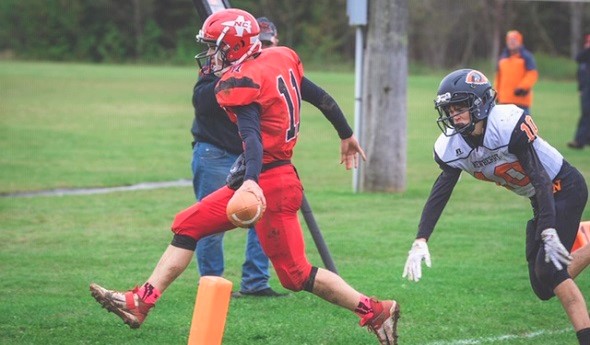
PHOTO: North Central clears a pylon for a score during a 54-0 win over Newberry on Oct. 11. (Photo by Jeff Rochefort.)
1918 Pandemic, WWI Threatened HS Sports
March 31, 2020
By Ron Pesch
Special for Second Half
Into a world filled with the challenges of World War I, a new menace arrived
It didn’t wear colors or plead allegiance to a flag. It held no prejudice. It knew no borders.
“Have you had it yet?” asked the Detroit Free Press on the front page of the Wednesday, April 3, 1918 edition. “Doctors are not agreed as to what it is, but the victims, and there are a lot of ‘em, are enthusiastically unanimous in declaring that it’s all-fired discomforting.
“Whatever the name of the disease is, there’s an epidemic of it throughout Detroit and Highland Park.
“Dust, weather, and whisky all are blamed in wild guesses as to its origin.”
The illness resembled common influenza, according to the newspaper, and in fact that’s exactly what it was, in mutated form, spurred on by many factors of the era. Sometimes referred to as the “grip” or “grippe” in the United States, this was the first of three waves that hit. By the fall and running into the summer of 1919, it would wreak havoc upon the globe, killing an unfathomable 50 million people as it spread – compared to the estimated guess of 16 million killed worldwide during WWI. In the U.S., the estimate was more than 675,000 deceased because of the flu.
The 1918 Influenza Pandemic
The United States officially entered the war in April 1917, and it was this move that led to the cancelation of the 1918 spring prep sports season in the state at a late March meeting of the Michigan Interscholastic Athletic Association (MIAA) – the predecessor of the modern-day MHSAA. The Second Half article, 'Over Here,' Athletes Gave To WWI Effort’, details that time when the Boys’ Working Reserve was created to address the labor deficiency caused by WWI. The move, in hindsight, was a wise one considering what was to come.
In the U.S., research indicates the first outbreak of an odd form of influenza appeared in Haskell County, in southwest Kansas. In early March 1918 the virus appeared at Camp Funston, a training camp located near the Fort Riley Army base in north-central Kansas. Designed to prepare troops for duty in France, the camp was one of 16 established by the federal government near the outbreak of WWI. As soldiers moved city to city, camp to camp and ultimately overseas, the disease spread nationally and globally. To date, experts still debate the global origin of the pandemic. Falsely, it was christened the “Spanish Flu”.
In Michigan, Pinckney, located about 20 miles from Ann Arbor, had reported an outbreak of various diseases, including an odd form of influenza, in late March. Camp Custer in Battle Creek reported “a flurry of influenza … thought to be caused by dust” in an early April report published in the Ann Arbor News. “A large number of men in the Ford factory are suffering from influenza,” relayed the Detroit Times at the same period. “It spreads rapidly where men work indoors and close together.”
The United States War Department, on April 4, reported via the news wire that the army’s health was good, “although bronchitis and influenza complicated with pneumonia in many northern camps increased the … death rates slightly over the preceding week.”
Word out of Lansing’s “vital statistics department” indicated that pneumonia, which “often followed influenza in its wake,” had led as the cause of death in March in Michigan, with 490 cases. Influenza was blamed as the reason in 39 instances. In mid-April, the Grand Rapids Press noted schools and industry saw operations hampered by influenza sweeping the city.
The April 25 edition of the Escanaba Morning Press included a quarter-page posting from the Board of Health highlighting precautions that should be taken by residents in order to combat what was now being referred to as an epidemic of “Spanish Influenza which is now Prevalent in Our State.” Lansing reported that pneumonia death totals swelled to 892 in April with influenza totaling 125. (Recall that the first flu shot, developed by Jonas Salk and Thomas Francis, didn’t arrive until 1938.)
Reports about the devastation from around the world continued to fill column inches in Michigan newspapers, although the spread of illness seemed to subside in the state as spring flowed into summer. July saw only 13 deaths attributed to influenza and 107 to pneumonia.
Doctors and officials continued to grasp at straws in trying to identify who was most susceptible. A theory that it attacked the underfed was proven false. Another wire article circulating in papers around the state indicated that “Persons who want to avoid the Spanish influenza, or the common garden variety of the same disease, were warned by the New York City department of health … not to kiss ‘except through a handkerchief.’”
But by late summer, life in Michigan seemed back to normal. In May of 1917, the Selective Service Act had passed, requiring all males between 21 and 30 to register for military service. On August 31, 1918, the act was expanded to cover men between ages 18 and 45 with a provision “that voluntary enlistments be closed until after the war.”
That action helped resolve a lingering question, posed by the creation of the Boys’ Working Reserve by the Interscholastic Athletic Association back in March.
“Last spring when the (MIAA) held a meeting at Ann Arbor, it was decided that ballots should be cast the third week in August by members … (to decide) whether football would be played or not,” wrote the Detroit Times in mid-August.
“Taking 18-year olds would wreck many entire elevens and threatens disruption of Schoolboys’ Interscholastic competition,” stated the Detroit Free Press in a headline. The paper then noted in an article, published after the passage of the 18 to 45 draft bill, that “With the act curtailing enlistments, the boys will be unable to go to the navy as many had planned and likely will remain here until called. The most sensible solution will be to play football and the grid game bids fair to play the greatest part of any prep school sport in preparing boys for the war.”
Votes slowly trickled in with a majority of MIAA member schools opting to compete. As a former coach stated, “the younger boys have worked up to this opportunity and cannot enlist, so they should be allowed to play football.”
Public Schools Open and Football Starts
Students across the state returned to the classroom come September as scheduled. In newspapers, readers were introduced to new teaching staff. Advertisers pitched new clothes, shoes, pencil sharpeners and other school supplies. Front pages included headlines about key victories by the Allies over the Central Powers, while cities and towns continued to offer up their “best manhood for the cause of democracy.” A railway ad in the Lansing State Journal offered trips to Camp Custer to “See the Soldiers” and “Miles of Barracks.” Midwest writers picked the Chicago Cubs over the Boston Red Sox in the World Series.
“Despite the German and the trouble he is causing the Allied forces over there and over here, the lads seem determined to make the most of the 1918 football season and prepare for the bigger battles which are in store for them,” wrote the Free Press on the fourth of September, in an article announcing game schedules for Detroit Central, Eastern, Cass Tech, Northern, Western, Northeastern and Northwestern high schools.
“High School Starts Grid Play Monday” was the headline in the Kalamazoo Gazette on Sunday, September 8. The Kalamazoo Central squad would practice for two weeks before lining up “against a strong Camp Custer Team on Sept. 21. It is hoped to bring a big Custer band here for that occasion.” However, the game was cancelled and the Camp football team disbanded.
Influenza was back in the headlines by mid-September, “raging” at epidemic levels in Boston, then Camp Devens, a nearby Army training facility; then across the military. Assistant secretary of the Navy, Franklin D. Roosevelt, was carried off a troopship in New York on a stretcher, dealing with pneumonia that set in after a bout with “Spanish influenza contracted while on his voyage home” from France after inspecting “U.S. troops in Europe.”
Approximately four thousand men were in quarantine because of an outbreak at the naval aviation training camp at Great Lakes, Illinois. Surgeon General Rupert Blue reminded the public “that it was well not to under-rate the disease,” and requested the National Research Council “to determine the exact nature of the microbe, or micro organism which is causing the so-called ‘Spanish influenza.’”
The virus had again reached Michigan by October 1, when papers announced it had hit a naval training station in River Rouge, and that there were nearly 2,000 cases diagnosed at Camp Custer. “To aid in the care of the men, 25 extra nurses have been called from Battle Creek and a dozen from Ann Arbor.”
Recognizing the danger, draft plans were abandoned for troops by the War Department. Warning placards began appearing in cities to help residents recognize the symptoms. The flu would soon overwhelm Detroit where, initially, 10 cases were reported on October 1. Ten days later, health officials frankly admitted that the city, with 953 cases, had an epidemic on their hands. “Health authorities believe that many cases of real influenza have not been reported.” On October 14, known cases had exploded to 1,924. Within 24 hours it was 2,563.
Still, Detroit schools did not close. “There is less danger to the children in the schools,” Detroit commissioner of health J.W. Inches said, “then there would be if they were closed and the youngsters ran the streets.”
On October 12, Governor Albert Sleeper suggested that all “churches, theaters, moving picture shows, pool rooms, billiard rooms, lodge rooms, dance halls” remain closed and that “all unnecessary public meetings and gatherings shall be avoided” indefinitely.
“I trust that the patriotic citizens of this state will give us their cooperation in this manner.”
Children with colds were ordered to be sent home but schools were not required to close. That decision was an option available at the discretion of local school boards. Various districts had been closing because of the virus, including Petoskey, schools in and around Ann Arbor, Jackson, Battle Creek and Kalamazoo, as well as various outlying areas like Sault Ste. Marie, Fremont, Charlotte and Allegan. More and more would follow suit.
Meanwhile in Europe, what would become known as the “100 Day Offensive” was showing success. Demands for unconditional surrender were issued by President Woodrow Wilson.
Three days before it was scheduled, Governor Sleeper called off the annual University of Michigan – Michigan Agricultural College (renamed Michigan State College in 1925) football game scheduled for Saturday, October 19. However, many high school contests around the state still were played.
“Saginaw high school’s football eleven went down to defeat at the hands of Detroit Northwestern, 1917 state champions, at Alumni Field Saturday afternoon, 20 to 0. There was nothing of disgrace in the beating, however. Saginaw fought gamely from whistle to whistle,” reported the Saginaw News. “The crowd was rather disappointing, probably due to the influenza scare …”
That night at midnight, the governor’s suggestion to suspend public gatherings became mandatory.
This second wave of attack devastated Michigan and much of the rest of the nation. The October death toll announced to the media by the state’s Vital Statistics department for influenza and pneumonia was 4,200.
On October 19, the Surgeon General announced that 283,331 cases of influenza had been reported in army camps and that 14,153 individuals had “died from influenza since the epidemic began.”
Locally, health officials made additional moves to suppress the spread. “In Flint, the population (has) been wearing … masks for a week and Muskegon is the second city of the state to take up the practice,” noted the Muskegon Chronicle on Monday, October 21, announcing the new order put in place by health officer R.J. Harrington. “All school pupils have been ordered to wear them. Factory employees will wear them continuously unless in a few instances where work is such that this is impossible. Employees at restaurants, stores, and hotels must wear them at all times when on duty.” Still many residents refused the direction.
Soon after, Port Huron closed schools and also requested residents to wear gauze masks to combat the epidemic.
Ban ends
The governor’s ban on public gatherings ended on Friday, November 8, despite protest by physicians. The announcement allowed businesses to reopen, but cities were allowed to dictate direction as they saw fit. Cancellation of gatherings still took place at various points around the state.
“Football games between Saginaw and Bay City Eastern and between (Saginaw) Arthur Hill and Flint (Central) high schools … were called off this afternoon by health officials,” stated reports out of Saginaw immediately after the ban was lifted. “… it would be unwise to bring teams here from Flint and Bay City, where the influenza situation is considerably more serious than in Saginaw.”
But a number of other schools quickly resumed play. “Hurry-up arrangements were made last night and the game” with Grand Rapids Catholic Central was announced, “even with limited time to advertise the contest,” wrote the Muskegon Chronicle, excitedly reporting plans for a Muskegon High game scheduled for Saturday at Hackley Field.
“There were no games before this issue went to press,” stated the ‘Athletics’ section of the school’s monthly publication of the Said and Done. “Most of them were postponed or annulled because of old Mr. ‘flu’ coming uninvited. He not only made us wear muzzles but he also made us stop playing football. Coach Rand however gave his men no rest, but kept them practicing every day. Then, when Grand Rapids Catholic came over they had something to hit.”
While the lift of the ban was big news, the headlines were, rightfully, dominated with bulletins from across the Atlantic. Pending defeat combined with German Revolution led Kaiser Wilhelm II to abdicate the imperial crown on November 9. The terms of the Armistice, ending WWI, began at 11 p.m. Washington, D.C., time on November 11, 1918.
Lansing Central is Mythical State Champion
In gridiron play, reigning state champion Detroit Northwestern, Detroit Central and Lansing Central quickly emerged as strong candidates for the state’s mythical crown.
Unbeaten in Michigan, Northwestern had lost to Toledo Waite. Lansing had dominated all of its first six opponents, including a 40-0 win over the Michigan Agricultural College reserves. Unbeaten and unscored upon, Lansing dispatched Northwestern from the title race on November 21 with a 10-6 win, played at Lansing’s South Field. The game was dominated by Lansing halfback Harry Kipke, who scored nine of Lansing’s 10 points. Trailing 10-0, Northwestern’s single score came on a recovered fumble in the Lansing end zone in the third quarter.
“The game was witnessed by the largest crowd which has attended a high school game in Lansing in recent years, despite the fact that a special train filled with pigskin fans had done to Ann Arbor to the M.A.C - U. of M. game.” Michigan downed the visitors from East Lansing, 21-6 at Ferry Field before an estimated 20,000 – “the largest crowd of the season by 10,000” in their rescheduled meeting.
On Thanksgiving Day, Lansing Central and Detroit Central squared off at 2 p.m., again at South Field, to determine the state title. While Detroit Central had lost to Toledo Scott a week earlier, an even larger crowd appeared for the “Capitol City” squad’s battle with the Blue and White
“From the first whistle to the final, Lansing had everything in her favor,” stated the State Journal following the “big red” team’s crushing 61-0 triumph. While rain had preceded the contest, very little fell during the game, and the field “was in fairly good condition.”
“Led by (Harry) Kipke, the most sensational prep school halfback in the state, Lansing romped over the Detroit goal-line almost at will,” stated the Free Press. Lansing led 25-0 at the half.
“He is exceedingly quick on return of punts, can both hurl and receive forward passes,” said Richard Remington of the Detroit News, when naming the junior and two of his teammates among the 11 players on his All-State team. “He has a rapid change of pace and seems to know intuitively when to cut in. He punts well, good drop kicker and place kicks seem easy to him.” Added Remington, “This year he is 50 percent better physically, and 100 percent better in knowledge of the game.” Kipke would again earn all-state selection by Remington in 1919, then move on to a Hall of Fame college career as a player and coach.

Lansing Central sought out another opponent for the following week. “We would play any high school in the country, either Chicago, Boston or New York, preferred,” said coach E.J. Shassberger, seeking a game so as to lay claim to a national title. “We think it proper that the rest of the country should know or see just what Michigan’s champion high school is like. When arrangements for a contest with Toledo Scott (which had beaten Waite 12-7 on Thanksgiving) fell through, the season was officially concluded after eight victories. (In 1952, Dick Kishpaugh, “the Kalamazoo authority on prep sports” named the 1918 Lansing Central squad as the state’s greatest of all-time. The article appeared in the December issue of The Michigan Coach magazine).
By the end of the month, the state board of health announced that influenza was subsiding within the state. Sandusky was still dealing with extreme infection, while Grand Rapids and Bay City were “among the larger communities … hit the worst, but the barely 100 cases at each of these cities give no cause for alarm.”
A December report in the Grand Rapids Press stated that “During November the vital statistics bureau reports 2,779 persons died from pneumonia and influenza.” December totals would climb slightly before falling to under 1,934 in January and 949 in February 1919, leveling to normal levels by April.
With that, prep sports were back in full swing. That winter, Holland surprised many by defeating favored Detroit Northwestern, 14-13, for the state’s 1919 Class A basketball championship. Cadillac defeated Greenville, 35-13, for the Class B crown. The tournament was hosted at Michigan Agricultural College.
Come spring, trailing Battle Creek by a half-point as the meet headed to its last event, Detroit Eastern grabbed team victory in the state track and field final, 24½ to 24 thanks to a fourth-place finish in the half-mile relay while Battle Creek failed to place in the race. High schools athletics would roar through the 1920s and survive the Great Depression before seeing another interruption.
Ron Pesch has taken an active role in researching the history of MHSAA events since 1985 and began writing for MHSAA Finals programs in 1986, adding additional features and "flashbacks" in 1992. He inherited the title of MHSAA historian from the late Dick Kishpaugh following the 1993-94 school year, and resides in Muskegon. Contact him at [email protected] with ideas for historical articles.
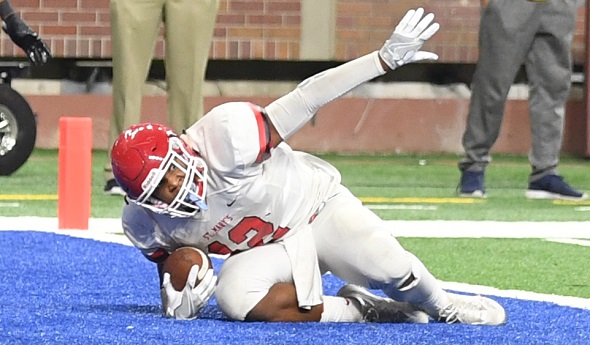
PHOTOS: (Top and last) Lansing Central was named "mythical" football state champion in 1918. (2) A Detroit Times placard explains Spanish flu in October 1918. (3) The Lansing State Journal in September 1918 advertised an opportunity to visit soldiers encamped at Fort Custer. (4) The 1919 Saginaw High yearbook. (5) An advertisement called fans to the 1918 Muskegon vs. Grand Rapids Catholic Central football game. (Images collected by Ron Pesch.)