


Drive for Detroit: Playoff Week 2 Preview
November 2, 2017
By Geoff Kimmerly
Second Half editor
 The first week of the 2017 MHSAA Football Playoffs was one of the most memorable in recent memory with a collection of twists and turns, late-game heroics and bracket-shaking upsets.
Welcome to the encore.
This week, we’ve got one of the state’s most heated rivalries, two meetings of undefeated teams, and plenty of matchups fans have been anticipating to decide District titles in 11-player and Regional championships in the 8-player divisions.
We’d love for you to check out one (or more) of the 72 games being played across the state this weekend. We also have eight being broadcast either on Prep Zone by FOX Sports Detroit or MHSAA.tv. The MHSAA playoff scoreboard page is home to results and next week’s games as they’re determined. The MHSAA Playoffs are sponsored by the Michigan Army National Guard, and “Drive for Detroit” is sponsored by MI Student Aid.
11-Player Division 1
Canton (9-1) at Belleville (10-0), Friday
The Chiefs eliminated one popular championship contender last week in downing Saline 42-12, and now get an opportunity against another of similar regard in the undefeated Tigers. Belleville has tied its most wins ever, with 10 for the first time since 1995, giving up 8.3 points per game. Canton will counter with an offense averaging 42 points per game; the Chiefs haven’t scored fewer than 35 since losing to Muskegon Mona Shores on opening night.
Others that caught my eye: FRIDAY Rochester Adams (9-1) at Utica Eisenhower (10-0), West Bloomfield (8-2) at Waterford Mott (9-1), Rockford (7-3) at Holland West Ottawa (9-1), SATURDAY Clarkston (8-2) at Davison (9-1).
11-Player Division 2
Traverse City Central (7-3) vs. Traverse City West (9-1) at Thirlby Field, Friday
One of the state’s best rivalries will write another chapter on the home field they share. West defeated Central 29-27 in their first meeting this season, in Week 3. Central won both of last year’s meetings, by two during the regular season and one in the playoffs as the teams met in the postseason for the first time. Central’s record doesn’t lend it enough credit; since falling to West the first time the Trojans have taken nonleague losses to playoff teams Portage Central and Birmingham Brother Rice, and then stunned Midland 21-13 on the road last week. West has kept churning too, downing Benton Harbor and bouncing back from a Week 9 loss to Coldwater (both opponents also playoff bound) to beat Midland Dow by 30 in their playoff opener.
Others that caught my eye: FRIDAY Muskegon Mona Shores (9-1) at Grand Rapids Forest Hills Central (10-0), Livonia Franklin (8-2) at Livonia Churchill (8-2), Flushing (8-2) at Fenton (9-1), Detroit East English (9-1) at Detroit Martin Luther King (9-1).
11-Player Division 3
Cedar Springs (7-3) at DeWitt (9-1), Friday
Cedar Springs opened the playoffs last week with arguably the biggest upset win in the state, downing undefeated East Grand Rapids at EGR. The Red Hawks won’t sneak up on anyone else. They’ve set a record with 401 points this season and even put up 44 in a loss to Grand Rapids Christian, but will be challenged by a DeWitt defense giving up only 10.3 points per game. The Panthers also lost to Grand Rapids Christian this year, in Week 1, but avenged that loss with a 42-10 victory over the Eagles in their playoff opener. No opponent has gotten within 24 points of DeWitt since Division 1 playoff qualifier Grand Ledge in Week 2.
Others that caught my eye: FRIDAY Stevensville Lakeshore (9-1) at Battle Creek Harper Creek (10-0), Riverview (9-1) at Gibraltar Carlson (9-1), Haslett (8-2) at East Lansing (8-2), Farmington Hills Harrison (7-3) at Warren Woods-Tower (8-2).
11-Player Division 4
Grand Rapids Catholic Central (10-0) at Wyoming Kelloggsville (10-0), Friday
These teams both are averaging nearly 42 points per game behind two of the state’s most powerful rushing attacks. That would seem to point to the other side of the ball; both defenses are giving up a little more than two touchdowns per game. But GRCC’s biggest wins (over Comstock Park and Grand Rapids West Catholic) were in close games where the scores got big, and it could be that kind of back-and-forth offensive display in this one as well with both offenses so loaded.
Others that caught my eye: FRIDAY Three Rivers (8-2) at Edwardsburg (9-1), River Rouge (8-2) at Chelsea (9-1), Alma (8-2) at Escanaba (8-2), SATURDAY Detroit Mumford (7-3) at Bloomfield Hills Cranbrook Kingswood (9-1).
11-Player Division 5
Clare (9-1) at Reed City (9-1), Friday
Reed City quietly has one of the most consistently successful programs in Michigan. One more win and the Coyotes will have 10 for the sixth time in seven seasons, and even as their 18-game regular-season winning streak ended on opening night against Montague – Reed City hasn’t lost since. Clare is similarly consistent, especially in Jack Pine Conference play, and also hasn’t lost since opening night (to Ithaca) to reach nine wins for the first time since 2012. Both have similarly sizable wins against playoff qualifier Remus Chippewa Hills – Clare’s last week to avenge a 2016 playoff loss – indicating this might be a tightly contested matchup.
Others that caught my eye: FRIDAY Menominee (7-3) at Kingsford (8-1), Carrollton (7-3) at Saginaw Swan Valley (9-1), Lansing Catholic (8-2) at Portland (9-1), Marine City (8-2) at Frankenmuth (10-0).
11-Player Division 6
Kent City (10-0) at Montague (10-0), Friday
Few teams this season have as impressive a resume as Montague, which in addition to handing the lone losses to Reed City and Muskegon Catholic Central has six shutouts over its 10 games. The Wildcats now also have a chance to avenge last year’s one-point playoff opener loss to Kent City, which has built a likewise impressive body of work this fall. The 10 wins are a program record, and a District title would be the Eagles’ first in this sport.
Others that caught my eye: FRIDAY Michigan City (9-1) at Jackson Lumen Christi (8-1), Detroit Central (8-2) at Warren Michigan Collegiate (10-0), Houghton Lake (7-3) at Millington (9-1), SATURDAY Maple City Glen Lake (7-2) vs. Traverse City St. Francis (9-1).
11-Player Division 7
Pewamo-Westphalia (9-1) at New Lothrop (10-0), Friday
The Hornets are hoping their annual regular-season success pays off this fall with a first MHSAA Finals trip since 2006. The Hornets are a combined 86-6 since the start of 2010 and only one of those losses came during the regular season – they’ve reached the Semifinals three times this decade but just missed taking that next step again. A game like the Week 1 win over Lake Fenton surely was meant to prepare the Hornets for matchups like this one with the reigning Division 7 champion Pirates, who despite graduating the second-leading rusher in MHSAA history is riding a nine-game winning streak and scoring 43 points per game versus last year’s 46.
Others that caught my eye: FRIDAY Reading (8-2) at Cassopolis (9-1), Riverview Gabriel Richard (9-1) at Madison Heights Madison (10-0), Elkton-Pigeon-Bay Port Laker (9-1) at Cass City (9-1), SATURDAY Ishpeming Westwood (9-1) at Lake City (10-0).
11-Player Division 8
Muskegon Catholic Central (8-1) at Mendon (10-0), Saturday
This might be the most anticipated small-school matchup in Michigan so far this season – the reigning four-time Division 8 champion against an 11-time MHSAA title winner now revived. The Hornets ran for 415 yards in last week’s 28-12 win over St. Joseph Lake Michigan Catholic, and that ability to hold onto the ball will be necessary against a Crusaders attack led by dynamic dual threat quarterback Cameron Martinez (see 2H feature Tuesday).
Others that caught my eye: FRIDAY Norway (9-1) at Iron River West Iron County (9-1), Harbor Beach (9-1) at Saginaw Nouvel (10-0), Climax-Scotts (8-2) at Pittsford (9-1), SATURDAY Frankfort (7-2) at Gaylord St. Mary (10-0).
8-Player Division 1
Morrice (9-1) at Deckerville (9-1), Friday
Morrice broke Deckerville’s 16-game regular-season winning streak with a 33-32 Week 5 win that announced the Orioles as MHSAA championship contenders – even though they were then beaten by Kingsford a week later. Morrice avenged that loss last week and now must avoid falling by the same fate to the reigning Finals runner-up Eagles, who have amped up the offense by scoring 250 of their 496 points this season over the last four weeks.
Other Regional Finals: FRIDAY Cedarville (8-2) at Stephenson (8-2), Suttons Bay (7-3) at Central Lake (10-0), Lawrence (5-5) at Bellevue (9-1).
8-Player Division 2
Onekama (9-1) at Pickford (10-0), Saturday
Perhaps the most impressive part of Pickford’s dominance this season has come on the defensive side of the ball. The Panthers are giving up only 9.6 points per game, which just doesn’t happen much in the wide-open 8-player game – and is half as many points as they gave up while reaching the Semifinals a year ago. Enter Onekama, averaging 51 points per game – only a few behind Pickford’s 56 and against a similarly competitive slate.
Other Regional Finals: FRIDAY Engadine (8-2) at Crystal Falls Forest Park (7-2), Bay City All Saints (7-3) at Kinde-North Huron (9-1), SATURDAY Flint International Academy (8-2) at Portland St. Patrick (9-1).
Second Half’s weekly “Drive for Detroit” previews and reviews are powered by MI Student Aid, a part of the Student Financial Services Bureau located within the Michigan Department of Treasury. MI Student Aid encourages students to pursue postsecondary education by providing access to student financial resources and information, including various student financial assistance programs to help make college more affordable for Michigan students. MI Student Aid administers the state’s 529 savings programs (MET/MESP) and eight additional aid programs within its Student Scholarships and Grants division. Click for more information and connect with MI Student Aid on Facebook and Twitter @mistudentaid.
PHOTO: Clare, here against Ithaca in Week 1, will play for a District title tonight against Reed City. (Click to see more from HighSchoolSportsScene.com.)
5-0 Oakridge Healing 2018 Heartbreak
October 2, 2019
By Tom Kendra
Special for Second Half
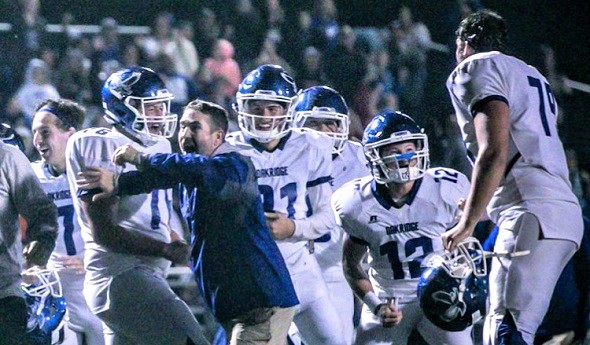
Muskegon Oakridge had an extra reason to celebrate in the rain on Friday night.
 It was about more than just overcoming sloppy conditions and the never-say-die Montague Wildcats in a matchup of No. 1 vs. No. 2 in The Associated Press’ Division 5 rankings. There was more to it than getting a leg up in the West Michigan Conference race with a thrilling 15-13 overtime win.
This was about overcoming two of the most heartbreaking losses imaginable one year ago – and dedicating the win to those who never got a shot at redemption.
“That win was for those seniors from last year,” said Oakridge running back Leroy Quinn, a four-year starter who rushed for both of his team’s touchdowns and a game-high 144 yards, putting him over 4,000 rushing yards for his career. “I love those guys, and I miss them. We all grieved together last year, and now we’re celebrating for them.”
Oakridge led Montague in their 2018 meeting 24-10 with 3:45 remaining, when the Wildcats roared back with two touchdown passes and then a game-winning, 2-point conversion run by Sebastian Archer with no time on the clock for a 25-24 win.
It was the type of gut-wrenching loss which is hard to shake off.
“It’s a helpless feeling,” said Oakridge senior nose guard and offensive tackle Will Scraver. “The only thing you can do is try to forget and focus on the next game.”
Unfortunately, less than one month later, Oakridge would experience an even more bitter defeat. The Eagles’ second loss had finality as it came in the MHSAA District championship game, as they squandered a seemingly safe 35-8 halftime lead in a stunning 40-37 loss to Hudsonville Unity Christian. Adding salt to the wound was having to sit home and watch Unity then roll over its next three opponents en route to the Division 5 championship.
“Sometimes it’s hard to put those losses behind when you have umpteen people coming up to you at the store or the gas station asking you what the heck happened,” said Harger, who is in his ninth year as the Oakridge coach after serving for 16 years under Jack Schugars, the all-time winningest coach in Muskegon-area football history.
“All we can do, as coaches and players, is to learn from our mistakes and to take care of all the little things so that we win those kind of games.”
Oakridge, 5-0 and now No. 1 in Division 5 in the latest Associated Press poll, has been focused and motivated this fall – starting with a tough road test at Belding and most recently with the big revenge win at Montague.
 Oakridge and Montague were scoreless through three quarters and tied, 7-7, after regulation. Quinn scored from three yards out in overtime, then added what proved to be the game-winning 2-point conversion run. Montague answered with a 10-yard pass from Drew Collins to Brennan Schwarz, but Nate Fair and Corey Vanderputte stuffed the 2-point conversion attempt.
Quinn, a 6-foot-1, 233-pound battering ram, has led the way with 465 rushing yards and eight touchdowns. He now has 4,065 career rushing yards, eclipsing David Nelson’s previous school record, and needs five more rushing TDs to pass Jamie Potts for that school mark.
Quinn’s play thus far has been no surprise, but how quickly others have stepped up in the backfield and on the line is the reason why Oakridge is back to No. 1 in the state.
Junior quarterback Ethen Dailey (5-11, 145) has done a solid job managing the Eagles’ offense, and speedy sophomore Vanderputte has emerged as the breakaway threat.
But it was the play of the offensive line, where Fair is the only returning starter, that keyed the win at Montague.
Oakridge, which lined up in a double tight end, full-house backfield look most of the game and threw only two passes (completing none), finished with a 222-70 edge in rushing yards.
“With the tradition out here, there are always new players ready to step up,” said Fair, who also starts at inside linebacker. “We might not have a lot of big names on the line, but we knew we were going to be good.”
Four of the Eagles’ five interior linemen are seniors, with the lone exception sophomore center Derek Driscoll. The guards are seniors Josh Havermans and Jason Pego and the tackles are Fair and Scraver. Starting at tight end are junior Luke Martin and sophomore Ethan Josza.
Harger is not ready to start talking about avenging last year’s playoff loss, as his team still has tough games remaining at North Muskegon in Week 7 and the final two weeks of the regular season at home against Ravenna and first-time opponent Traverse City St. Francis.
Oakridge could also have a couple of new playoff challenges close to home. While the Eagles appear a lock to be in Division 5, they may be joined by resurgent neighbor Muskegon Orchard View (on the bubble of Division 4 and 5) and Montague (on the Division 5 and 6 bubble).
“Our motto this year is: ‘Exceed Expectations’ and, considering the group we lost last year, these guys have done that so far,” said Harger, who is 75-16 and has made the playoffs in each of his first eight years as head coach.
“This is not a real rah-rah group of kids. I think they just love to play football and with the way last year ended, they are thankful for the opportunity to come out and play again.”
 Tom Kendra worked 23 years at The Muskegon Chronicle, including five as assistant sports editor and the final six as sports editor through 2011. E-mail him at [email protected] with story ideas for Muskegon, Oceana, Mason, Lake, Oceola, Mecosta and Newaygo counties.
PHOTOS: (Top) The Oakridge sideline celebrates late in the Eagles' 15-13 overtime win at Montague. (Middle) Oakridge senior Leroy Quinn, who became the school's all-time leading career rusher earlier this season, runs through a big hole into the end zone for a touchdown. (Photos by Tim Reilly.)