

Drive for Detroit: Playoffs R3 in Review
November 16, 2015
By Geoff Kimmerly
Second Half editor
And then, once again, there were 34.
Two undefeated 8-player finalists emerged from last week's Semifinals, while a number of moments were celebrated from another round of trophy-raising performances by 32 teams in 11-player Regional Finals.
8-Player
Powers North Central 70, Cedarville 6 – The first-year 8-player Jets will try to add a first football championship to their boys basketball title from the winter after besting last season’s runner-up, Cedarville (9-3). North Central (12-0) fell just 1.5 points shy of its previous 71.5 points per game average as it continued to dominate on both sides of the field. Click for more from the Sault Ste. Marie Evening News.
Battle Creek St. Philip 52, Deckerville 24 – The Tigers (12-0) also earned their first championship game berth in 8-player, to go with a perfect run to the Class D title in 11-player in 1985. Running back Brayden Darr scored seven touchdowns for the second straight game as St. Philip won its first meeting ever against the 2012 champion Eagles, who finished this fall 10-2. Click for more from the Battle Creek Enquirer.
Division 1
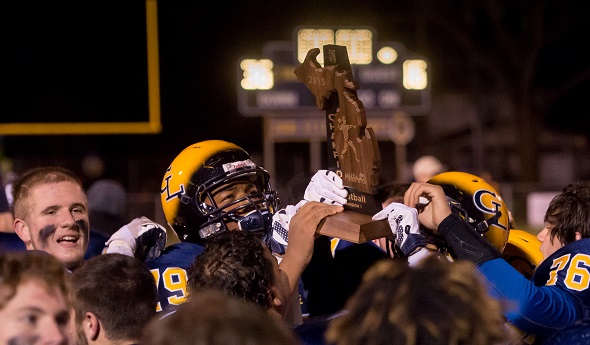
Grand Ledge 36, Rockford 16
Rockford looked like it would be moving on with a 16-3 lead after three quarters. But the Comets unloaded 33 straight points over the final 12 minutes to advance to their first MHSAA Semifinal since the 2000 Division 1 championship run. Grand Ledge never has been 12-0 before now; Rockford completed its 21st straight playoff appearance at 8-4. Click for more from the Lansing State Journal.
Also noted:
Romeo 40, Detroit Catholic Central 29 – Romeo’s first Regional title since 1992 came as the Bulldogs (11-2) set a program record for wins with yet another impressive playoff victory to go with those over Clarkston and Lapeer; DCC finished 9-3, a nice bounce-back from 4-5 in 2014.
Canton 27, Saline 7 – It sounds odd to say a win by Canton (10-2) would count as an upset, but that’s how highly Saline (11-1) has been regarded since making the Division 1 Final a year ago.
Detroit Cass Tech 16, Macomb Dakota 10 – The Technicians (10-2) scored 16 straight points after getting down 10, and neither team scored during the second half as Dakota (9-3) was eliminated by Cass Tech for the second time in three seasons.
Division 2
Lowell 36, Muskegon 7
This is as impressive a playoff win by Lowell as any since also beating the Big Reds by the same score during the 2011 run to Ford Field. Muskegon (9-3) entered after handing first and only losses, on the road, to both Traverse City Central and Muskegon Mona Shores. But the Red Arrows (11-1) dominated this one from the start and held the Muskegon offense to 151 yards and well below its average of 39 points per game. Click for more from the Grand Rapids Press.
Also noted:
Walled Lake Western 35, Midland Dow 14 – Western (12-0) piled up 424 yards of offense in ending the season for Dow (10-2) and moving on to its second Semifinal in five seasons.
Livonia Franklin 38, Berkley 6 – Franklin (9-3) was only 2-7 a year ago, but has advanced past the first round of the playoffs for the first time since 2007 and will play its first Semifinal since becoming the first MHSAA Class A champion in 1975, when the playoffs started with Semifinals; Berkley’s 9-3 final record was its best since 2010 and tied the program record for wins.
Detroit Martin Luther King 26, Detroit East English 12 – For the second time this fall, King (12-0) held off a challenge from Detroit Public School League rival East English (9-3) after also beating the Bulldogs 20-15 during Week 3.
Division 3
Coldwater 20, St. Joseph 6
Another week into the postseason and Coldwater’s wins keep getting more impressive. The undefeated Cardinals’ unprecedented run now includes a first Regional title to go with a program-record 12 wins. Coldwater scored 20 straight points to upend St. Joseph, which saw its best run since 2008 come to an end with a 10-2 record. Click for more from the Battle Creek Enquirer.
Also noted:
East Grand Rapids 35, Mount Pleasant 0 – The Pioneers (9-3) stormed into their first Semifinal since 2011 with a second straight shutout and fourth in six weeks while ending Mount Pleasant’s season also at 9-3.
Orchard Lake St. Mary’s 56, St. Johns 14 – For the fifth time in six seasons, St. Mary’s (10-1) has at least 10 wins, and for the sixth time in seventh seasons will play in a Semifinal; St. Johns (8-4) ended in the Regional Finals for the second time in four seasons.
Chelsea 35, Allen Park 12 – The Bulldogs (11-1) tied their program record for wins with their first Regional title, and against an Allen Park team (10-2) that has earned its most victories since 2006 and had won nine straight.
Division 4
Zeeland West 28, Hudsonville Unity Christian 21
Probably because statewide expectations are always high, Zeeland West hasn’t gotten a ton of attention as it’s rolled along to a fourth Semifinal appearance in five seasons. But this one was interesting throughout. Unity Christian gave the Dux (12-0) their closest game since Week 4 and finished its longest playoff run at 8-4. West had beaten Unity Christian 52-6 in Week 9. Click for more from the Grand Rapids Press.
Also noted:
Ada Forest Hills Eastern 34, Remus Chippewa Hills 7 – The Hawks’ history-making run isn’t all about offense; Forest Hills Eastern (11-1) won its first Regional title with perhaps its best defensive game and has given up only 34 points over three during the playoffs; Chippewa Hills finished its longest playoff run at 9-3.
Flint Powers Catholic 28, Richmond 7 – Aside from Richmond’s lone score, it was playoffs as usual for the Chargers (10-2), who have now outscored three opponents by a combined 110-7; Richmond finished 10-2 for the second straight season after also winning a second straight District title.
Detroit Country Day 20, Milan 13 – This had to qualify as a major scare for the Yellowjackets (11-1), whose only close losses were to a pair of larger opponents from the Detroit Catholic League Central; Milan can celebrate a nice turnaround finishing 9-3 after going 4-5 a year ago.
Division 5
Grand Rapids West Catholic 24, Menominee 14
For the sixth straight season, West Catholic (10-2) ended Menominee’s with a loss – this time the Maroons’ only loss of 2015. West Catholic scored only 24 points – but held Menominee (11-1) to its fewest since beating the Maroons in the 2013 Division 5 Final. Menominee was averaging 44 points per game heading into the weekend. Click for more from the Grand Rapids Press.
Also noted:
Lansing Catholic 25, Freeland 22 – The Cougars (11-1) also handed Freeland (11-1) its first and only loss with a fourth-quarter comeback that featured a defensive touchdown and earned Lansing Catholic a rematch of last season’s championship game, against West Catholic.
Ida 43, Buchanan 20 – The Bluestreaks (12-0) continued their best season, handing Buchanan (11-1) its first and only loss, and impressing against a Bucks defense that hadn’t given up more than 38 points and had given up more than 20 only twice.
River Rouge 51, Algonac 25 – Did you know River Rouge has won at least 10 games three of the last four seasons? The unheralded Panthers won their first Regional title and have outscored three playoff opponents 167-25, with Algonac (10-2) scoring the only points as it finished its best season ever.
Division 6
Grand Rapids NorthPointe Christian 35, Constantine 34 (OT)
NorthPointe Christian (12-0) set a program record for wins and advanced to the Semifinals for the second straight year in ending arguably the most surprising playoff run regardless of division. Constantine had reached the postseason with an at-large bid and then eliminated previously-undefeated Schoolcraft and one-loss Watervliet. But NorthPointe stopped Constantine (7-5) on a 2-point conversion try after both teams scored in overtime. Click for more from the Grand Rapids Press.
Also noted:
Ithaca 34, Laingsburg 10 – The reigning runner-up Yellowjackets (12-0) ended the longest run ever for Laingsburg (8-4), with quarterback Jake Smith throwing two touchdown passes and running for two scores.
Traverse City St. Francis 12, Boyne City 0 – The Gladiators (12-0) upended their rival for the second time this season to return to the Semifinals for the first time since 2011; Boyne City ended its second straight season of double-digit wins at 10-2.
Clinton 49, Jackson Lumen Christi 20 – The Redskins (12-0) arguably have been the most impressive team in the playoffs, adding Lumen Christi (8-4) to a list of defeated opponents including Monroe St. Mary Catholic Central and Madison Heights Madison.
Division 7
New Lothrop 34, Sandusky 15
New Lothrop drew even with its 2011 team that also started 12-0 to advance to the Semifinals, earning its third Regional title over the last five seasons. The Hornets scored all of their points during the first half in handing the first and only loss to Sandusky, which finished its best season ever at 11-1 and did hold New Lothrop to its season low in points. Click for more from the Owosso Argus-Press.
Also noted:
Ishpeming 40, McBain 2 – The Hematites (11-0) won a fourth straight Regional title scoring their most points since September and with a defense that stopped McBain’s best season since 2011 at 8-4.
Pewamo-Westphalia 40, Cassopolis 3 – The Pirates (12-0) earned a berth in the Semifinals for the fourth time in five seasons, and junior running back Jared Smith set an MHSAA record with his 50th rushing touchdown and moved into second for yards in a season with 2,901 total; Cassopolis finished its best season since 2007 at 9-2.
Detroit Loyola 50, Dansville 0 – Loyola’s offense gets the attention, and with good reason, but the Bulldogs (10-2) held Dansville (10-2) to 25 total yards in ending the Aggies’ longest playoff run.
Division 8
Ottawa Lake Whiteford 48, Climax-Scotts 14
This was the upset of the Regional round, but not as huge as it might appear on paper. Climax-Scotts (11-1) was a league champion and undefeated, and had beaten playoff regulars Pittsford and Mendon the first two weeks of the postseason. But Whiteford (10-2) is one of two Tri-County Conference teams in the Semifinals joining Division 6 Clinton and set a program record for wins in a season with this one. Click for more from the Kalamazoo Gazette.
Also noted:
St. Ignace 22, Crystal Falls Forest Park 8 – The Saints (11-1) jumped to a two-score lead and hung on for their second Regional title in four seasons while ending Forest Park’s last run as an 11-player team (at least for the time being, as it will move to 8-player next year) at 7-4.
Muskegon Catholic Central 22, Frankfort 12 – MCC (10-2) held on for its closest playoff win since 2012 against a Frankfort team that posted its best finish since 2009, at 9-3, and led by five going into the fourth quarter.
Waterford Our Lady 32, Saginaw Michigan Lutheran Seminary 6 – The Lakers (12-0) have added a first Regional title since 2006 to their long history of accomplishments, while the Cardinals (10-2) ended their best two-season run after making the Semifinals a year ago.
PHOTO: Grand Ledge players hoist their Division 1 Regional title trophy Friday after defeating Rockford. (Click for more from HighSchoolSportsScene.com.)
5-0 Oakridge Healing 2018 Heartbreak
October 2, 2019
By Tom Kendra
Special for Second Half
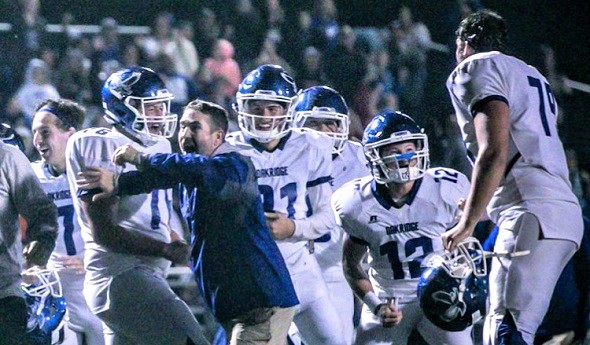
Muskegon Oakridge had an extra reason to celebrate in the rain on Friday night.
 It was about more than just overcoming sloppy conditions and the never-say-die Montague Wildcats in a matchup of No. 1 vs. No. 2 in The Associated Press’ Division 5 rankings. There was more to it than getting a leg up in the West Michigan Conference race with a thrilling 15-13 overtime win.
This was about overcoming two of the most heartbreaking losses imaginable one year ago – and dedicating the win to those who never got a shot at redemption.
“That win was for those seniors from last year,” said Oakridge running back Leroy Quinn, a four-year starter who rushed for both of his team’s touchdowns and a game-high 144 yards, putting him over 4,000 rushing yards for his career. “I love those guys, and I miss them. We all grieved together last year, and now we’re celebrating for them.”
Oakridge led Montague in their 2018 meeting 24-10 with 3:45 remaining, when the Wildcats roared back with two touchdown passes and then a game-winning, 2-point conversion run by Sebastian Archer with no time on the clock for a 25-24 win.
It was the type of gut-wrenching loss which is hard to shake off.
“It’s a helpless feeling,” said Oakridge senior nose guard and offensive tackle Will Scraver. “The only thing you can do is try to forget and focus on the next game.”
Unfortunately, less than one month later, Oakridge would experience an even more bitter defeat. The Eagles’ second loss had finality as it came in the MHSAA District championship game, as they squandered a seemingly safe 35-8 halftime lead in a stunning 40-37 loss to Hudsonville Unity Christian. Adding salt to the wound was having to sit home and watch Unity then roll over its next three opponents en route to the Division 5 championship.
“Sometimes it’s hard to put those losses behind when you have umpteen people coming up to you at the store or the gas station asking you what the heck happened,” said Harger, who is in his ninth year as the Oakridge coach after serving for 16 years under Jack Schugars, the all-time winningest coach in Muskegon-area football history.
“All we can do, as coaches and players, is to learn from our mistakes and to take care of all the little things so that we win those kind of games.”
Oakridge, 5-0 and now No. 1 in Division 5 in the latest Associated Press poll, has been focused and motivated this fall – starting with a tough road test at Belding and most recently with the big revenge win at Montague.
 Oakridge and Montague were scoreless through three quarters and tied, 7-7, after regulation. Quinn scored from three yards out in overtime, then added what proved to be the game-winning 2-point conversion run. Montague answered with a 10-yard pass from Drew Collins to Brennan Schwarz, but Nate Fair and Corey Vanderputte stuffed the 2-point conversion attempt.
Quinn, a 6-foot-1, 233-pound battering ram, has led the way with 465 rushing yards and eight touchdowns. He now has 4,065 career rushing yards, eclipsing David Nelson’s previous school record, and needs five more rushing TDs to pass Jamie Potts for that school mark.
Quinn’s play thus far has been no surprise, but how quickly others have stepped up in the backfield and on the line is the reason why Oakridge is back to No. 1 in the state.
Junior quarterback Ethen Dailey (5-11, 145) has done a solid job managing the Eagles’ offense, and speedy sophomore Vanderputte has emerged as the breakaway threat.
But it was the play of the offensive line, where Fair is the only returning starter, that keyed the win at Montague.
Oakridge, which lined up in a double tight end, full-house backfield look most of the game and threw only two passes (completing none), finished with a 222-70 edge in rushing yards.
“With the tradition out here, there are always new players ready to step up,” said Fair, who also starts at inside linebacker. “We might not have a lot of big names on the line, but we knew we were going to be good.”
Four of the Eagles’ five interior linemen are seniors, with the lone exception sophomore center Derek Driscoll. The guards are seniors Josh Havermans and Jason Pego and the tackles are Fair and Scraver. Starting at tight end are junior Luke Martin and sophomore Ethan Josza.
Harger is not ready to start talking about avenging last year’s playoff loss, as his team still has tough games remaining at North Muskegon in Week 7 and the final two weeks of the regular season at home against Ravenna and first-time opponent Traverse City St. Francis.
Oakridge could also have a couple of new playoff challenges close to home. While the Eagles appear a lock to be in Division 5, they may be joined by resurgent neighbor Muskegon Orchard View (on the bubble of Division 4 and 5) and Montague (on the Division 5 and 6 bubble).
“Our motto this year is: ‘Exceed Expectations’ and, considering the group we lost last year, these guys have done that so far,” said Harger, who is 75-16 and has made the playoffs in each of his first eight years as head coach.
“This is not a real rah-rah group of kids. I think they just love to play football and with the way last year ended, they are thankful for the opportunity to come out and play again.”
 Tom Kendra worked 23 years at The Muskegon Chronicle, including five as assistant sports editor and the final six as sports editor through 2011. E-mail him at [email protected] with story ideas for Muskegon, Oceana, Mason, Lake, Oceola, Mecosta and Newaygo counties.
PHOTOS: (Top) The Oakridge sideline celebrates late in the Eagles' 15-13 overtime win at Montague. (Middle) Oakridge senior Leroy Quinn, who became the school's all-time leading career rusher earlier this season, runs through a big hole into the end zone for a touchdown. (Photos by Tim Reilly.)