

Drive for Detroit: Week 1 in Review
August 27, 2012
By Geoff Kimmerly
Second Half editor
Two months from now, the majority of successes and failures from the opening weekend of high school football won't have made or broken most of the more than 600 teams playing in the MHSAA this fall.
But players, coaches and fans all over the state will still be talking about some of the tremendous matchups that once again marked the first nights of the season.
To identify the best of those games, it was easy to simply point toward Detroit or Grand Rapids. But that would've been too easy; below, the most significant results from every corner of our expansive state.
Greater Detroit
Detroit Cass Tech 25, Birmingham Brother Rice 18
A late start was worth the wait for those who stuck around for the finale of the Prep Kickoff Classic at Wayne State. Not that anyone was doubting Cass Tech’s defense, but it was especially impressive given the standouts the Technicians graduated after last season’s Division 1 championship run. The loss will no doubt pay off for the reigning Division 2 champion Warriors too – they’ve made the playoffs with at least three losses the last four seasons, and made it to at least the Semifinals in two of those four. Click to read more from the Detroit Free Press.
Also noted:
Southfield 21, Martin Luther King 20 (2 OT) – The Bluejays edged another Detroit PSL favorite in the second-best game of the Classic; the teams combined for 17 wins last season.
Pontiac Notre Dame Prep 17, Almont 14 – University of Michigan women’s soccer prospect Taylor Timko drilled a 35-yard field goal for the final lead with 2:48 to play.
Troy 24, Romeo 20 – Romeo has made the playoffs eight straight seasons, so Troy has additional reason to be glad after a losing season in 2011.
Carleton Airport 25, Adrian 24 – After finishing last season with a 28-21 playoff-opening loss to Adrian, Airport edged the Maples in a game that will no doubt have rankings implications.
West Michigan
Grand Rapids Forest Hills Central 59, Zeeland West 58
The Dux hadn’t lost since the 2010 playoffs after going undefeated in winning Division 4 last season. But Forest Hills Central got a start on its drive for a third-straight playoff berth as these teams combined for 117 points – tied for 11th in the MHSAA record book for games in which the losing team scored at least 40. Click to read more from the Grand Rapids Press.
Also noted:
Grand Rapids Catholic Central 33, East Grand Rapids 14 – Interesting “did you know” ... the Cougars were 2-10 against East Grand Rapids going back to 1987 before this impressive win.
Fruitport 21, Muskegon Reeths-Puffer 20 – The Trojans hung on for their fourth straight opening-night win over the Rockets.
Lowell 16, Rockford 6 – Lowell had a new quarterback and Rockford was missing its starter, but both will no doubt be putting up many more points as the fall goes on.
Muskegon 21, Orchard Lake St. Mary 14 – The Big Reds’ first four opponents include three of the best teams in the state regardless of division, but they got off to a quick start by downing the reigning Division 3 champion.
Mid-Michigan
DeWitt 38, Mount Pleasant 14
The Panthers stacked impressive offensive numbers against the reigning Division 3 runner-up Oilers, who had won 32 straight regular-season games. New quarterback Jordan Johnson, a sophomore, threw for 246 yards and three touchdowns and also ran for two scores for DeWitt.
Also noted:
Farwell 61, Coleman 54 – This ranks 13th in the MHSAA record book for total combined points in games in which the losing team scored at least 40.
Mendon 27, Fowler 7 – This replay of last season’s Division 8 Final again went Mendon’s way, but was much closer throughout.
Holt 24, Hudsonville 21 – With its annual game against Rockford no doubt a little on their minds, Holt’s Rams went to Hudsonville and first avenged another 2011 loss.
Lansing Catholic 45, Pewamo-Westphalia 21 – The Cougars look to be the quicker of the two reigning MHSAA runners-up to rebuild, with plenty of points potential despite a new quarterback and a number of other first-year starters.
Bay and Thumb
Richmond 25, Marine City 24
Knocking off the reigning Division 4 runner-up is a great way for Richmond to get rolling after two straight losing seasons. The Blue Devils recovered an on-side kick to get the ball back for the go-ahead drive. Read more from the Port Huron Times-Herald.
Also noted:
Midland 29, Canton 28 (OT) – This big-time matchup might’ve gotten lost in the Detroit and Grand Rapids area slugfests, but Midland’s win was one of the most solid of the weekend as both teams stand to be among the best in Division 1 this fall.
Deckerville 32, Carsonville-Port Sanilac 12 – The Eagles might find themselves fans of the 8-player game quickly after beating the reigning MHSAA champion in their first game since switching from 11 players.
Linden 17, Fenton 15 – These two have been playoff regulars, but this win could be especially key for Linden after it lost to Fenton by three in 2011 and just got into the postseason at 5-4.
Reese 47, Montrose 26 – Both of these teams could find themselves atop league standings when the regular season is done.
Upper Peninsula
Ishpeming 34, Iron Mountain 0
Last season Iron Mountain won this matchup and finished a game ahead of Ishpeming in the Mid-Peninsula Athletic Conference. But it appears the Hematites could be heavy favorites this fall after this dominating performance. Read more from the Marquette Mining Journal.
Also noted:
Rock Mid-Peninsula 26, Bellaire 22 – The Wolverines went 2-8 last season after three years without a team, making this win over an 8-player power all the more significant.
Norway 12, Niagara (WI) Northern Elite 9 – Norway scored with less than a minute remaining to avenge last season’s one-point loss.
Marquette 34, Detroit Denby 12 – The home team prevailed, but the neater part was that this game was played at all between opponents with a nine-hour drive between them.
Iron River West Iron County 19, Pittsford 16 – Opponents from even farther apart than Marquette and Denby met somewhat in the middle Saturday in St. Ignace for a hard-fought contest.
Lower Up North
Kingsley 18, Traverse City St. Francis 0
This was one of the state’s biggest stunners for a few reasons: Kingsley lost to St. Francis 57-8 last season, with the Gladiators then going on to the Division 7 Semifinals; Kingsley then lost an all-state running back early Friday. But the defense didn’t break. Read more from the Traverse City Record-Eagle.
Also noted:
Boyne City 22, McBain 14 – Boyne City bounced back quickly from its 2011 losing season by beating a team that had a combined 19 wins over the last two.
Manistee 36, Ludington 34 – This made two seasons in a row that Manistee won by less than a field goal; in 2011 the score was 40-39.
Johannesburg-Lewiston 28, Atlanta 26 – The Cardinals had beaten Atlanta by an average of nearly 47 points over the last three seasons before having to survive this one.
Southwest and Border
Portage Central 36, Battle Creek Harper Creek 32
The Mustangs had a hard fall last season from 9-2 in 2010 to just 3-6, and were shut out by Harper Creek 24-0; Harper Creek went on to finish 12-1 and advance to the Division 3 Semifinals. But Portage Central again could be in at least its league title mix after coming back from a three-score deficit in this opener. Click to read more from the Kalamazoo Gazette.
Also noted:
Dowagiac 21, Vicksburg 7 – Dowagiac had its best finish in 15 years last season, but lost to Vicksburg 6-3; the Chieftains hope this revenge win is the start of another special run.
Quincy 7, Bronson 6 – The Orioles had lost five straight to Bronson, and missed qualifying for the playoffs last season by just a win.
Lawton 21, Cassopolis Ross Beatty 19 – Lawton made it two straight on opening night over the Rangers; both made the playoffs last season.
Trophy Games
Each week, the MHSAA highlights trophy games around the state. Here's a list of those from Week 1.
- The Sword: Bloomfield Hills Andover and Bloomfield Hills Lahser met on the gridiron for the last time in the regular season. The two schools will merge next year. The teams annually played for The Sword. Final: Lahser 70, Andover 7.
- Brown Jug Games: Two such games were played last week, Mesick at Manton and Brooklyn Columbia Central at Napoleon. Finals: Manton 41, Mesick 6; Columbia Central 28, Napoleon 6.
- Totem Pole: Battle Creek Central was at Kalamazoo Central on Friday. This is said to be the longest running rivalry west of the Allegheny Mountains, with the two schools playing games since 1893. Final: Kalamazoo Central 20, Battle Creek Central 0.
- Addison and Hudson met on Friday in Hudson, and the two teams have played for a trophy for a number of years sponsored by a local insurance company and a local automotive group. Final: Hudson 41, Addison 0
- Cheese Log: A border battle between Ironwood and Hurley (WI) took place at Ironwood on Friday, and a cheese log has historically been on the line in this game. Final: Hurley 49, Ironwood 7.
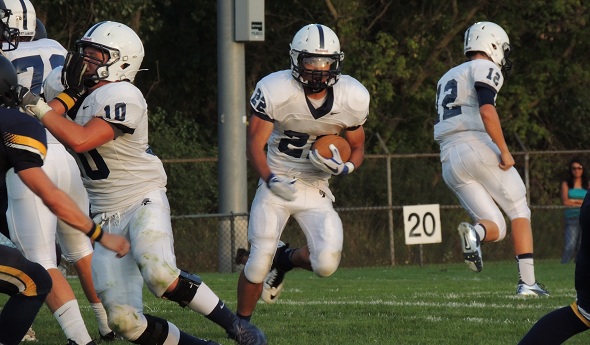
PHOTO: East Lansing junior running back Kenny Washington took a hand-off and looked to turn the corner during Friday's 38-18 win at Haslett.
1st & Goal: 2021 Week 7 Preview
By
Geoff Kimmerly
MHSAA.com senior editor
October 8, 2021
Rivalries play out every week of the nine-game football regular season – but a few we watch for every fall top the Week 7 schedule.

Neighbors Port Huron and Port Huron Northern will face off with a league title on the line, as will Marquette and Menominee, and the Muskegon High/Mona Shores matchup will decide first place in their conference as well. Saline/Temperance Bedford and St. Joseph/Stevensville Lakeshore will have similar impacts.
MHSAA.tv will carry more than 175 games live this weekend, with Bally Sports Detroit broadcasting Friday's Rockford/Caledonia game on its primary cable channel and State Champs! Sports Network streaming Saturday's Warren Michigan Collegiate/Harper Woods Chandler Park matchup. See the full schedule from the MHSAA Score Center.
Also, circle Oct. 24 on your calendars and tune your TVs to Bally Sports Detroit’s primary channel for the MHSAA’s annual football playoff selection show, kicking off at 5:30 p.m. The fields and full brackets for 11 and 8-player will be announced.
(Games below are Friday unless noted.)
Bay & Thumb
Port Huron (5-1) at Port Huron Northern (6-0)
This rivalry this season will be a championship decider with the winner tonight claiming the Macomb Area Conference Blue title outright. Port Huron is the reigning champion and won last year’s meeting 20-7, and actually has claimed the last two matchups as these teams split regular season and playoff games in 2019. It’s very possible this will be just the first chapter again this fall; Northern is ranked No. 5 in Division 2 and the Big Reds are No. 14. They’re succeeding with different strengths; Port Huron has scored 28 or more points in five straight games since an opening-night loss to Rochester Hills Stoney Creek, while the Huskies are scoring less but giving up only eight points per game.
Keep an eye on these FRIDAY Reese (5-1) at Elkton-Pigeon-Bay Port Laker (5-1), Goodrich (5-1) at Lake Fenton (5-1), Midland Dow (4-2) at Lapeer (5-1), Swartz Creek (3-3) at Flushing (3-3).
Greater Detroit
Romeo (5-1) at Sterling Heights Stevenson (5-1)
After a few tough seasons playing in one of the state’s strongest leagues, Stevenson got rolling last fall and hasn’t stopped. The Titans shared the 2020 MAC Red title but can finish an outright championship tonight – while a Romeo win would mean a shared title between the two as the Bulldogs fell by three points to Clinton Township Chippewa Valley two weeks ago. Stevenson has scored at least 30 points every game, including a Week 1 loss to still-unbeaten Rockford, while Romeo excels defensively and has given up 13 or fewer points in all of their five wins (but 37 in the loss to the Big Reds). Stevenson won last season’s meeting with Romeo 14-7.
Keep an eye on these FRIDAY Livonia Churchill (6-0) at Dearborn Fordson (5-1), Allen Park (5-1) at Harper Woods (5-1), Detroit Osborn (4-2) at Detroit Pershing (4-2). SATURDAY Harper Woods Chandler Park (4-2) at Warren Michigan Collegiate (4-2).
Mid-Michigan
Gladwin (6-0) at Clare (4-2)
The Flying G’s also took a big jump in 2020 and have guaranteed their most successful finish since 2014. They can add tonight a share of their first Jack Pine Conference championship since 2002, their first season in the league. Gladwin is scoring nearly 63 points per game and has five shutouts in six games – the only points given up were 18 three weeks ago in a 40-point win. But the JPC road always goes through reigning champ Clare, and the Pioneers have defeated the Flying G’s all 19 seasons they’ve been in the league together, including 41-30 a year ago. Clare’s defeats this season are to Freeland and Marquette teams that are a combined 10-2.
Keep an eye on these FRIDAY Carson City-Crystal (6-0) at Breckenridge (4-2), Lansing Catholic (6-0) at Charlotte (4-2), New Lothrop (4-2) at Durand (5-1), Olivet (4-2) at Lake Odessa Lakewood (4-2).
Northern Lower Peninsula
Boyne City (5-1) at Mancelona (5-0)
Mancelona’s best start since back-to-back 10-1 finishes in 2011 and 2012 fast forwards this week into what could be an unforgettable regular-season conclusion with Boyne City this week also undefeated in Northern Michigan Football Conference Leaders play and Week 8 opponent Charlevoix only a game back. The Ironmen are coming off an open date and have had a little more time to prepare for a Ramblers team that lost only to Traverse City St. Francis two weeks ago but bounced back big last week against Kalkaska. Boyne City has played one more league game than Mancelona and can clinch a share of the league title if victorious tonight; the Ramblers already own a 27-8 Week 2 win over Charlevoix as well. Boyne City won last season’s meeting 48-6.
Keep an eye on these FRIDAY Petoskey (3-3) at Cadillac (4-2), Harbor Springs (1-5) at Frankfort (5-1), Traverse City Central (5-1) at Alpena (1-5), Charlevoix (5-1) at Kalkaska (1-5).
Southeast & Border
Saline (6-0) at Temperance Bedford (5-1)
The last time Saline lost a Southeastern Conference Red game was Week 5 of 2013 – to Temperance Bedford. This matchup has determined the league champion three times since the Kicking Mules claimed the title that season, and Saline has a one-game edge heading into this weekend thanks to Bedford’s one-point loss to Ann Arbor Huron in Week 4. Three of the last five games between these two have been decided by one score – although Saline won last season 56-14. The Hornets are ranked No. 3 in Division 1, while Bedford is No. 6 in Division 2 from a league that also has Huron at No. 10 in Division 1, Dexter slated to make the playoffs and Monroe only one spot away from doing the same with three games to play.
Keep an eye on these FRIDAY Sand Creek (4-2) at Erie Mason (4-2), Napoleon (5-1) at Michigan Center (5-1), Dundee (4-2) at Clinton (4-2), Chelsea (6-0) at Tecumseh (3-3).
Southwest Corridor
Stevensville Lakeshore (5-1) at St. Joseph (5-1)
The Bears lost an overtime heartbreaker last week to Portage Central but have had to rebound quickly with this game now pitting two of the three teams sitting in first place in the Southwestern Michigan Athletic Conference. Lakeshore has defeated St. Joseph in nine of their last 10 meetings, including 26-0 and then 14-9 in the playoffs a year ago – when the Lancers were the only team to defeat the Bears. Lakeshore’s loss this fall came against Portage Northern in Week 4, and it won by four against Portage Central in the season opener. St. Joseph downed Northern 21-3 in Week 3.
Keep an eye on these FRIDAY South Haven (5-1) at Berrien Springs (6-0), Vicksburg (5-1) at Plainwell (5-1), Cassopolis (4-2) at White Pigeon (5-1), Watervliet (4-2) at Kalamazoo United (4-2).
Upper Peninsula
Menominee (4-2) at Marquette (5-1)
This matchup once again will decide the Great Northern Conference title, as Marquette can clinch the championship outright with a win and Menominee can clinch a share with a Week 9 meeting with Kingsford left on the GNC schedule. Marquette has won the last two league titles outright after sharing with Escanaba in 2018, and its only loss this season came Week 2 against Traverse City Central, which can clinch the Big North Conference title outright this week. Menominee’s losses both qualify as good ones – both came to Wisconsin teams that are 6-1, and because of that the Maroons are No. 13 in Division 6. Marquette is No. 16 in Division 3 coming off a one-point win last week over Clare (mentioned above).
Keep an eye on these FRIDAY Hancock (3-3) at Iron Mountain (3-3), L'Anse (3-3) at Ishpeming Westwood (5-1), Traverse City St. Francis (6-0) at Sault Ste. Marie (4-2). SATURDAY Calumet (4-2) at Houghton (4-2).
West Michigan
Muskegon (5-1) at Muskegon Mona Shores (5-1)
Undefeated Caledonia and Rockford meet with first place on the line in the Ottawa-Kent Conference Red, but it’s tough these days to not call Muskegon High/Mona Shores this region’s top game of any week. They are tied atop the O-K Green, both having lost to Detroit Public School League powers (Muskegon to Cass Tech and Mona Shores to Martin Luther King). The Big Reds haven’t given up a point since Week 3 and before that allowed just 20 to a Zeeland West team averaging nearly 40 per game. Mona Shores will counter with an offense averaging 47 points per game. The Sailors won last season’s meeting 21-14 on the way to eventually claiming their second-straight Division 2 championship.
Keep an eye on these FRIDAY Caledonia (6-0) at Rockford (6-0), Manistee (4-2) at Muskegon Catholic Central (5-1), Grand Rapids Christian (3-3) at Byron Center (6-0), Grand Rapids West Catholic (6-0) at Hudsonville Unity Christian (6-0).
8-Player
Mendon (5-1) at Martin (6-0)
The winner receives a share of the Southwest Michigan 8-Man Football League Tier 1 title, and this will be their first meeting since 1997. Martin is in the midst of its third season as a force in 8-player football, and Mendon made the format switch this fall and has only a nonleague loss to Bridgman keeping it from a matching perfect start. Subtract that defeat, when the Hornets were shut out, and they’re averaging 58 points per game in their wins. Martin no doubt will incorporate a little bit of what worked for the Bees to augment a defense that has given up only a combined 18 points in five games played (the sixth win was a forfeit).
Keep an eye on these FRIDAY Suttons Bay (6-0) at Marion (6-0), Waldron (5-1) at Tekonsha (4-2), Pickford (5-1) at Newberry (5-1), Genesee (4-1) at Morrice (6-0).
Second Half’s weekly “1st & Goal” previews and reviews are powered by MI Student Aid, a part of the Office of Postsecondary Financial Planning located within the Michigan Department of Treasury. MI Student Aid encourages students to pursue postsecondary education by providing access to student financial resources and information. MI Student Aid administers the state’s 529 college savings programs (MET/MESP), as well as scholarship and grant programs that help make college Accessible, Affordable and Attainable for you. Connect with MI Student Aid at www.michigan.gov/mistudentaid and find more information on Facebook and Twitter @mistudentaid.
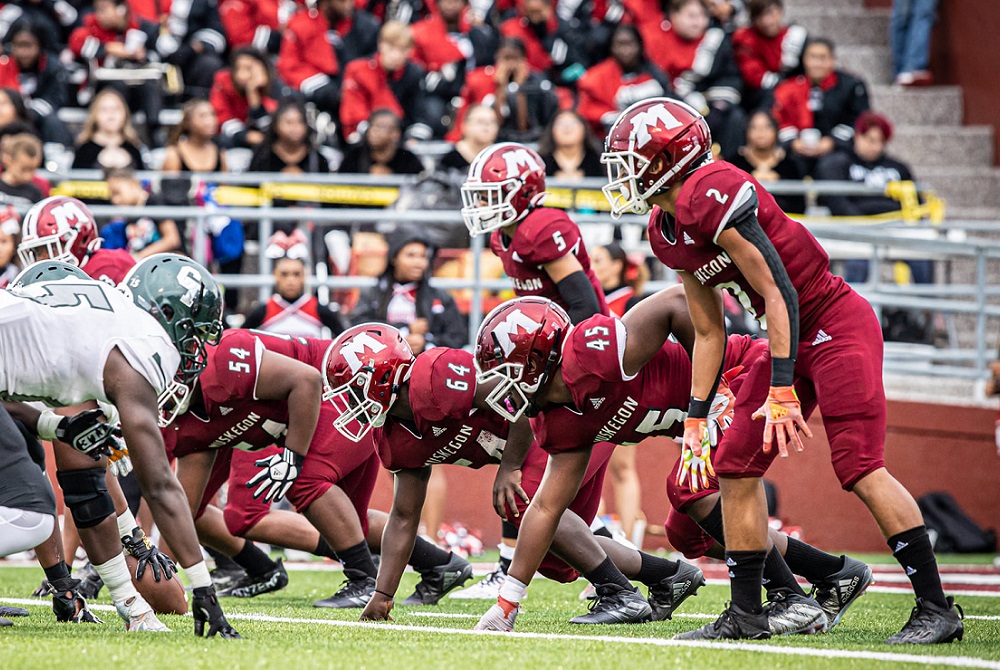
PHOTO Muskegon's defense readies for the snap this season against Detroit Cass Tech. (Photo by Tim Reilly.)