

Drive for Detroit: Week 1 in Review
August 27, 2012
By Geoff Kimmerly
Second Half editor
Two months from now, the majority of successes and failures from the opening weekend of high school football won't have made or broken most of the more than 600 teams playing in the MHSAA this fall.
But players, coaches and fans all over the state will still be talking about some of the tremendous matchups that once again marked the first nights of the season.
To identify the best of those games, it was easy to simply point toward Detroit or Grand Rapids. But that would've been too easy; below, the most significant results from every corner of our expansive state.
Greater Detroit
Detroit Cass Tech 25, Birmingham Brother Rice 18
A late start was worth the wait for those who stuck around for the finale of the Prep Kickoff Classic at Wayne State. Not that anyone was doubting Cass Tech’s defense, but it was especially impressive given the standouts the Technicians graduated after last season’s Division 1 championship run. The loss will no doubt pay off for the reigning Division 2 champion Warriors too – they’ve made the playoffs with at least three losses the last four seasons, and made it to at least the Semifinals in two of those four. Click to read more from the Detroit Free Press.
Also noted:
Southfield 21, Martin Luther King 20 (2 OT) – The Bluejays edged another Detroit PSL favorite in the second-best game of the Classic; the teams combined for 17 wins last season.
Pontiac Notre Dame Prep 17, Almont 14 – University of Michigan women’s soccer prospect Taylor Timko drilled a 35-yard field goal for the final lead with 2:48 to play.
Troy 24, Romeo 20 – Romeo has made the playoffs eight straight seasons, so Troy has additional reason to be glad after a losing season in 2011.
Carleton Airport 25, Adrian 24 – After finishing last season with a 28-21 playoff-opening loss to Adrian, Airport edged the Maples in a game that will no doubt have rankings implications.
West Michigan
Grand Rapids Forest Hills Central 59, Zeeland West 58
The Dux hadn’t lost since the 2010 playoffs after going undefeated in winning Division 4 last season. But Forest Hills Central got a start on its drive for a third-straight playoff berth as these teams combined for 117 points – tied for 11th in the MHSAA record book for games in which the losing team scored at least 40. Click to read more from the Grand Rapids Press.
Also noted:
Grand Rapids Catholic Central 33, East Grand Rapids 14 – Interesting “did you know” ... the Cougars were 2-10 against East Grand Rapids going back to 1987 before this impressive win.
Fruitport 21, Muskegon Reeths-Puffer 20 – The Trojans hung on for their fourth straight opening-night win over the Rockets.
Lowell 16, Rockford 6 – Lowell had a new quarterback and Rockford was missing its starter, but both will no doubt be putting up many more points as the fall goes on.
Muskegon 21, Orchard Lake St. Mary 14 – The Big Reds’ first four opponents include three of the best teams in the state regardless of division, but they got off to a quick start by downing the reigning Division 3 champion.
Mid-Michigan
DeWitt 38, Mount Pleasant 14
The Panthers stacked impressive offensive numbers against the reigning Division 3 runner-up Oilers, who had won 32 straight regular-season games. New quarterback Jordan Johnson, a sophomore, threw for 246 yards and three touchdowns and also ran for two scores for DeWitt.
Also noted:
Farwell 61, Coleman 54 – This ranks 13th in the MHSAA record book for total combined points in games in which the losing team scored at least 40.
Mendon 27, Fowler 7 – This replay of last season’s Division 8 Final again went Mendon’s way, but was much closer throughout.
Holt 24, Hudsonville 21 – With its annual game against Rockford no doubt a little on their minds, Holt’s Rams went to Hudsonville and first avenged another 2011 loss.
Lansing Catholic 45, Pewamo-Westphalia 21 – The Cougars look to be the quicker of the two reigning MHSAA runners-up to rebuild, with plenty of points potential despite a new quarterback and a number of other first-year starters.
Bay and Thumb
Richmond 25, Marine City 24
Knocking off the reigning Division 4 runner-up is a great way for Richmond to get rolling after two straight losing seasons. The Blue Devils recovered an on-side kick to get the ball back for the go-ahead drive. Read more from the Port Huron Times-Herald.
Also noted:
Midland 29, Canton 28 (OT) – This big-time matchup might’ve gotten lost in the Detroit and Grand Rapids area slugfests, but Midland’s win was one of the most solid of the weekend as both teams stand to be among the best in Division 1 this fall.
Deckerville 32, Carsonville-Port Sanilac 12 – The Eagles might find themselves fans of the 8-player game quickly after beating the reigning MHSAA champion in their first game since switching from 11 players.
Linden 17, Fenton 15 – These two have been playoff regulars, but this win could be especially key for Linden after it lost to Fenton by three in 2011 and just got into the postseason at 5-4.
Reese 47, Montrose 26 – Both of these teams could find themselves atop league standings when the regular season is done.
Upper Peninsula
Ishpeming 34, Iron Mountain 0
Last season Iron Mountain won this matchup and finished a game ahead of Ishpeming in the Mid-Peninsula Athletic Conference. But it appears the Hematites could be heavy favorites this fall after this dominating performance. Read more from the Marquette Mining Journal.
Also noted:
Rock Mid-Peninsula 26, Bellaire 22 – The Wolverines went 2-8 last season after three years without a team, making this win over an 8-player power all the more significant.
Norway 12, Niagara (WI) Northern Elite 9 – Norway scored with less than a minute remaining to avenge last season’s one-point loss.
Marquette 34, Detroit Denby 12 – The home team prevailed, but the neater part was that this game was played at all between opponents with a nine-hour drive between them.
Iron River West Iron County 19, Pittsford 16 – Opponents from even farther apart than Marquette and Denby met somewhat in the middle Saturday in St. Ignace for a hard-fought contest.
Lower Up North
Kingsley 18, Traverse City St. Francis 0
This was one of the state’s biggest stunners for a few reasons: Kingsley lost to St. Francis 57-8 last season, with the Gladiators then going on to the Division 7 Semifinals; Kingsley then lost an all-state running back early Friday. But the defense didn’t break. Read more from the Traverse City Record-Eagle.
Also noted:
Boyne City 22, McBain 14 – Boyne City bounced back quickly from its 2011 losing season by beating a team that had a combined 19 wins over the last two.
Manistee 36, Ludington 34 – This made two seasons in a row that Manistee won by less than a field goal; in 2011 the score was 40-39.
Johannesburg-Lewiston 28, Atlanta 26 – The Cardinals had beaten Atlanta by an average of nearly 47 points over the last three seasons before having to survive this one.
Southwest and Border
Portage Central 36, Battle Creek Harper Creek 32
The Mustangs had a hard fall last season from 9-2 in 2010 to just 3-6, and were shut out by Harper Creek 24-0; Harper Creek went on to finish 12-1 and advance to the Division 3 Semifinals. But Portage Central again could be in at least its league title mix after coming back from a three-score deficit in this opener. Click to read more from the Kalamazoo Gazette.
Also noted:
Dowagiac 21, Vicksburg 7 – Dowagiac had its best finish in 15 years last season, but lost to Vicksburg 6-3; the Chieftains hope this revenge win is the start of another special run.
Quincy 7, Bronson 6 – The Orioles had lost five straight to Bronson, and missed qualifying for the playoffs last season by just a win.
Lawton 21, Cassopolis Ross Beatty 19 – Lawton made it two straight on opening night over the Rangers; both made the playoffs last season.
Trophy Games
Each week, the MHSAA highlights trophy games around the state. Here's a list of those from Week 1.
- The Sword: Bloomfield Hills Andover and Bloomfield Hills Lahser met on the gridiron for the last time in the regular season. The two schools will merge next year. The teams annually played for The Sword. Final: Lahser 70, Andover 7.
- Brown Jug Games: Two such games were played last week, Mesick at Manton and Brooklyn Columbia Central at Napoleon. Finals: Manton 41, Mesick 6; Columbia Central 28, Napoleon 6.
- Totem Pole: Battle Creek Central was at Kalamazoo Central on Friday. This is said to be the longest running rivalry west of the Allegheny Mountains, with the two schools playing games since 1893. Final: Kalamazoo Central 20, Battle Creek Central 0.
- Addison and Hudson met on Friday in Hudson, and the two teams have played for a trophy for a number of years sponsored by a local insurance company and a local automotive group. Final: Hudson 41, Addison 0
- Cheese Log: A border battle between Ironwood and Hurley (WI) took place at Ironwood on Friday, and a cheese log has historically been on the line in this game. Final: Hurley 49, Ironwood 7.
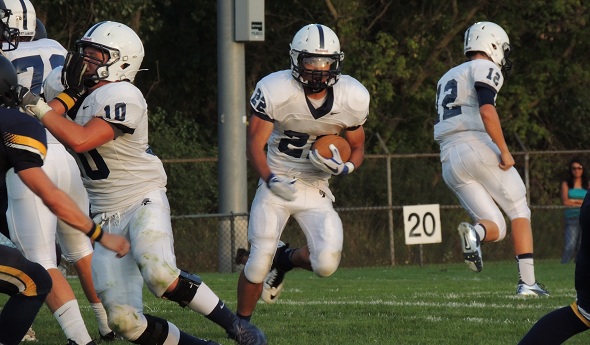
PHOTO: East Lansing junior running back Kenny Washington took a hand-off and looked to turn the corner during Friday's 38-18 win at Haslett.
1st & Goal: Playoff Week 3 Preview
November 12, 2020
By Geoff Kimmerly
Second Half editor
There inevitably will be big scores put up this weekend as we roll into the third round of the 11 and 8-player football playoffs.
But it’s fair to anticipate those games will be down to a few as 96 of 144 teams remaining on the bracket are undefeated or have only one loss this season.
We’ve switched things up for this week’s preview, looking first at our 8-Player Regional Finals, where 15 of 16 remaining teams are 8-0 or 7-1, and the 16th team’s only defeats were to schools too big to qualify for the tournament. Our 11-Player District Finals are loaded as well, with six games matching undefeated opponents and many more featuring one-loss teams squaring off or attempting to tackle an unbeaten foe. See the full schedule on MHSAA.com.
Spectator limits remain in effect (check with your local school for purchasing information), but 28 games will be broadcast on MHSAA.tv or FOX Sports Detroit. Games below are Friday unless noted. Historical context is based in part on data at Michigan-football.com.
8-Player
Division 1
Adrian Lenawee Christian (8-0) at Morrice (8-0), Saturday
The Cougars put up a season-high 78 points against an also-unbeaten opponent last week, handing rising Mayville its only loss of a memorable run. But Lenawee Christian now runs into a more established 8-player power – Morrice is a combined 31-2 over the last three seasons, won Division 1 in 2018 and made the Semifinals a year ago. It’s tough to say how much past years’ experience will make a difference, but the Orioles definitely are familiar with this caliber of opponent – and scoring 52 points per game, they are outpacing the 2018 championship-winning offense by nearly 10 on average.
Other Regional Finals FRIDAY Pickford (7-1) at Indian River Inland Lakes (7-1), Gaylord St. Mary (7-1) at Suttons Bay (8-0), Marcellus (5-2) at Martin (7-1).
Division 2
Colon (7-1) at Portland St. Patrick (8-0), Saturday
Last season’s Division 1 champion, Colon is playing in Division 2 this fall with its only loss to Lenawee Christian (see above). The Magi stand in the way of a St. Patrick program that was Division 2 runner-up last season and in 2017 as well. The Shamrocks have played only one single-digit game this season, a four-point win over Merrill. Both are continuing to steam-roll opponents offensively as during their 2019 runs – but the key might be St. Patrick solving Colon’s defense, which is giving up eight points a game this fall.
Other Regional Finals FRIDAY Cedarville (7-1) at Powers North Central (8-0), Hale (7-1) at Marion (7-1). SATURDAY Mount Pleasant Sacred Heart (7-1) at Kinde North Huron (7-1).
11-Player
Division 1
Belleville (8-0) at Canton (8-0)
Although both of these teams are undefeated, Belleville certainly has gotten more attention this fall with an offense scoring more than 50 points per game and a defense that’s given up 43 all season. Only Livonia Stevenson on opening night has come within 21 points of the Tigers. The Chiefs meanwhile have won three one-possession games – including against Stevenson last week. All in all, this is lining up very similarly to when these teams last met, in a 2017 District Final won by Canton 28-25 over an unbeaten Belleville team – and surely both teams are recalling that last matchup this week.
Keep an eye on these FRIDAY Grandville (7-1) at Rockford (6-0), Grand Blanc (7-1) at Davison (8-0). SATURDAY Detroit Catholic Central (8-0) at White Lake Lakeland (7-0), West Bloomfield (7-1) at Sterling Heights Stevenson (7-1).
Division 2
Portage Northern (7-1) at East Lansing (7-0)
The Trojans have won pretty even matchups against Northern the last two seasons, by 10 in 2018 and 35-28 a year ago. There’s only one shared opponent between the two this fall – East Lansing beat Holt 63-0, and Northern lost to the Rams 26-0 – but it’s hard to say that will play much into this matchup. What will more is how the Huskies attack one of the most successful defenses in the state this fall, as East Lansing is giving up only three points per game.
Keep an eye on these FRIDAY Traverse City Central (7-1) at Midland, North Farmington (5-3) at South Lyon (6-2), Livonia Franklin (5-3) at Livonia Churchill (5-2), Oak Park (2-6) at Wyandotte Roosevelt (6-1).
Division 3
Mason (8-0) at DeWitt (8-0)
This is the second time in a month Mason will be facing an undefeated team with a championship on the line. The first, in Week 9, Mason downed Williamston 40-10 to clinch the Capital Area Activities Conference Red title. DeWitt meanwhile has outscored its two playoff opponents by a combined 107-0 with a defense that has given up 50 points total this season (and 38 of those game in a Week 5 win over Grand Ledge). The Bulldogs also have been impressive on that side of the ball, giving up just more than 10 points per game – and their defense will need to play a significant role as DeWitt needs to score only 31 more points this week to equal last year’s 13-game total from a Semifinal run.
Keep an eye on these FRIDAY Bloomfield Hills Brother Rice (7-1) at Chelsea (8-0), Detroit Martin Luther King (5-3) at Eastpointe (8-0). SATURDAY Marquette (7-1) at Muskegon (7-1), Stevensville Lakeshore (6-2) at St. Joseph (7-1).
Division 4
Ortonville Brandon (7-1) at North Branch (8-0)
Last week saw these league champions both defeat their strongest regular-season challengers for the second time, Brandon over Goodrich and North Branch over Croswell-Lexington. Both also are making a run this weekend at history, as neither has won a District title since that round of the tournament was introduced in 1999. The only loss between them this season was Brandon’s to Division 2 Fenton in a Flint Metro League crossover of first-place teams.
Keep an eye on these FRIDAY Sault Ste. Marie (6-2) at Cadillac (5-2), Detroit Country Day (5-2) at Madison Heights Lamphere (8-0), Battle Creek Pennfield (5-3) at Williamston (7-1). SATURDAY Milan (7-1) at Redford Union (7-1).
Division 5
Kingsley (8-0) at Reed City (8-0)
These two are crossing paths for the second straight season, but with different circumstances than what led up to last year’s 48-36 Stags first-round playoff win. The Coyotes were only 6-4 in 2019, compared to this fall when they secured their fourth perfect regular season over the last six years. But Kingsley also is coming off a second-straight perfect regular season plus a Semifinal run a year ago, and this Stags team has been arguably better – they’re scoring just as much but giving up nearly a touchdown less than last season.
Keep an eye on these FRIDAY Olivet (7-1) at Lansing Catholic (6-2), Grosse Ile (5-3) at Romulus Summit Academy North (7-1), Essexville Garber (7-1) at Freeland (7-1), Detroit Denby (5-3) at Marine City (7-1).
Division 6
Montague (8-0) at Muskegon Catholic Central (8-0)
Over the illustrious history of Muskegon-area football, these two have met only once before – in a 2017 regular-season finale, won by the Wildcats. MCC was strong that season but this will be an even better test of their mutual powers. The Crusaders put together their first perfect regular season since 2016 and haven’t allowed a point in five weeks (and 18 total this fall). Montague is coming off a 43-point win over another league champ in Clare and averaging 51 points per game.
Keep an eye on these FRIDAY Millington (7-1) at Montrose (7-1), Constantine (7-1) at Buchanan (8-0), Michigan Center (5-1) at Jonesville (7-1), Clinton (7-1) at Blissfield (8-0).
Division 7
Cass City (8-0) at Hemlock (8-0)
After a series of successful seasons, Cass City took the next playoff step last fall making the Semifinals, and the Red Hawks haven’t slowed pushing their combined record over the last two years to 19-2. Arguably their best win this fall was their closest, 14-12 over also-undefeated Sandusky a week ago, while Hemlock also won close –20-17 over Bad Axe, a Cass City league foe. That was a good test for the Huskies, who also are in position to take another step as they’ve won eight games for the third season in a row and are seeking their first District title since 2011.
Keep an eye on these FRIDAY Lawton (7-1) at Schoolcraft (7-1), Jackson Lumen Christi (4-4) at Monroe St. Mary Catholic Central (6-2), Traverse City St. Francis (6-2) at Charlevoix (8-0). SATURDAY Madison Heights Bishop Foley (7-1) at Detroit Loyola (7-1).
Division 8
Reading (7-1) at Centreville (7-0)
Centreville has followed a path similar to Reading’s of a few years ago, improving substantially the last two seasons and eliminating the close losses for a perfect run this fall. The Bulldogs, after losing four games by a combined 28 points in 2019, have given up only 15 points total this season. Reading’s next step came in 2018 when it won the first of two straight Division 8 titles. A Week 6 loss to Division 6 Jonesville quieted things down for a minute this fall, but anticipation should be high again. Both teams have solid wins over Mendon, Reading’s coming last week and Centreville’s earlier to eventually clinch a league title.
Keep an eye on these FRIDAY Beal City (7-1) at Johannesburg-Lewiston (8-0), Sand Creek (7-1) at Addison (7-0), Ubly (6-2) at Flint Beecher (7-1). SATURDAY Royal Oak Shrine (6-2) at Clarkston Everest Collegiate (8-0).
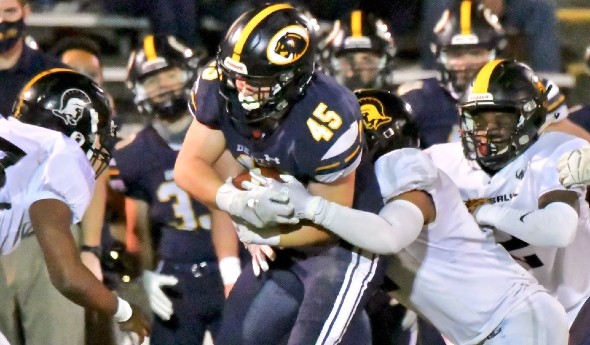
PHOTO: DeWitt earned the opportunity to play for a fifth-straight District title with last week’s win over Lansing Waverly (Photo by Terry Lyons.)