

Drive for Detroit: Week 11 in Review
November 10, 2014
By Geoff Kimmerly
Second Half editor
A total of 16 MHSAA football teams in Divisions 1-5 entered the postseason with playoff-point averages above 100 – an impressive number indicating those teams not only had strong records, but played plenty of tough competition as well.
Three of those 16 teams lost their playoff openers, joined by eight more over the weekend as more of the top achievers during the regular season were overtaken by those raising their games with only a few more to play.
The top playoff-point teams in Division 3 (DeWitt) and Division 5 (Marine City) both suffered their first and only losses this season, and 10 more undefeated teams saw their seasons end with lone defeats of the fall.
Read on to see some of the key results that whittled the playoff field to 68 that will play in 11-player Regional Finals and 8-player Semifinals this week.
DIVISION 1
Clinton Township Chippewa Valley 28, Macomb Dakota 27
This has been anticipated as a top Macomb County matchup for a few years – but instead, Dakota had beaten the Big Reds (8-3) in 16 straight dating back to 2004 and including six times in the playoffs. Dakota (8-3) had beaten Chippewa Valley 42-21 in Week 2 and in the playoffs both of the last two seasons. Junior Stefan Clairborne blocked a late extra-point attempt to highlight a game-changing special teams performance. Click for more from the Detroit News.
Also noted:
Clarkston 23, Lapeer 20 – The reigning champion Wolves (11-0) survived the third three-point game of their 24-game winning streak, handing Lapeer (10-1) the only loss of its inaugural season.
Hudsonville 37, Rockford 15 – The Eagles (7-4) avenged their one-point Week 4 loss to Rockford (8-3), and then some, to claim a second-straight District title.
Detroit Cass Tech 28, Dearborn Fordson 21 – One of these had to fall for the first time this season, and the Technicians (11-0) hung on to claim their fifth straight District championship while ending the best season for Fordson (10-1) since 2008.
DIVISION 2
Muskegon Mona Shores 41, Midland Dow 14
In what seemed like an instant, this one belonged to Mona Shores. The Sailors (10-1) jumped out to a 21-0 lead in handing Dow (10-1) its lone loss this season. Mona Shores quarterback Tyree Jackson was at the center of the offensive effort as usual, but this time on the ground with three rushing touchdowns. Dow hadn’t given up more than 21 points in a game. Click for more from the Muskegon Chronicle.
Also noted:
Farmington Hills Harrison 10, Walled Lake Western 9 (OT) – These former longtime rivals hadn’t played each other since 2001 and battled to 3-3 before Harrison (9-2) prevailed in part by blocking an extra-point attempt by Western (9-2).
Southfield 14, Oak Park 13 – The Bluejays (8-3) won a rematch of these teams' 2012 District Final, which was won by Oak Park (8-3) also close, 19-12.
Wyandotte Roosevelt 28, Brownstown Woodhaven 21 – Roosevelt (9-2) will play this weekend for its fourth straight season of at least 10 wins, but this time ended the best ever for Woodhaven (10-1) by handing the Warriors their only loss.
DIVISION 3
Mason 30, DeWitt 14
Few gave Mason (8-3) much chance against the reigning Division 3 runner-up Panthers (10-1), who entered the postseason with the highest playoff-point average in this division. But the Bulldogs, who entered the season with an experienced group of playmakers, have improved significantly around them after opening 1-3. DeWitt won their first meeting 25-10 in Week 3, but Mason has clamped down particularly on defense in earning this first Regional Final berth since 1995. Click for more from the Lansing State Journal.
Also noted:
Petoskey 20, Mount Pleasant 14 – The Northmen (9-2) earned their first Regional Final berth since 1998 by handing to Oilers (7-4) their second loss this season by six or fewer points.
Zeeland West 30, Stevensville Lakeshore 28 – Most of Friday had to be a little scary for the reigning champion Dux (11-0), who had beaten Lakeshore (8-3) in last season’s Semifinal by a much more comfortable 42-7.
New Boston Huron 44, Trenton 27 – The Chiefs (10-1) set a team record for wins and doubled last season’s total in beating Trenton (7-4) for their first District title.
DIVISION 4
Lansing Sexton 41, Saginaw Swan Valley 20
Swan Valley running back Alex Grace finished one of the most incredible three-year varsity careers in MHSAA football history with 198 more rushing yards and three touchdowns to give him 2,426 and 36 this season and 7,551 yards and 99 rushing touchdowns for his career. His career yards rank third all-time and his TDs are second. But every time Grace made a play Friday – offensively and defensively as well – the Big Reds (11-0) seemed to respond. Sexton senior Ja’Von Wray ran for 235 yards and five touchdowns as his team scored more than the Vikings (10-1) had given up in any two games combined this fall. Click for more from the Lansing State Journal.
Also noted:
Whitehall 41, Comstock Park 36 – Some termed the Vikings’ win “miraculous” as Whitehall (9-2) came back from 23 points down to win their first District title since 2003 and end the Panthers’ run at 6-5.
Edwardsburg 34, Vicksburg 6 – The Eddies (10-1) avenged a 16-14 loss to Vicksburg (8-3) in Week 3 to push into double-figure wins for the first time since 2010 and second time in program history; Vicksburg’s record was its best since 1993.
Eaton Rapids 20, Battle Creek Harper Creek 10 – The Greyhounds (8-3) have gone from never making the playoffs before 2013 to making their second Regional Final in a row, this time over near-annual playoff team Harper Creek (6-5).
DIVISION 5
Almont 35, Marine City 7
The run to the 2011 Semifinals makes it tough to call this the best win in Almont history – but it has to be a close second to that season's Regional Final win over Jackson Lumen Christi. Marine City was the reigning Division 4 champion, in Division 5 for this fall’s playoffs, and 23-1 over the last two seasons with more than 1,000 points scored during that time. Almont held the Mariners (10-1) to their fewest points since the 2011 Division 4 Final and has given up a meager 56 points this season. The Raiders, meanwhile, ran for 294 yards and scored the most points Marine City had given up since last season’s championship game at Ford Field. Click for more from the Port Huron Times Herald.
Also noted:
Reed City 22, Remus Chippewa Hills 21 – For the second straight week, Reed City (9-2) faced a rematch against a league rival, and Chippewa Hills (8-3) made this one much closer than the Coyotes’ 60-32 win in Week 8.
Flint Powers Catholic 19, Frankenmuth 15 – The Chargers (8-3) held on, on the road, in a rematch of the 2012 District Final in which they beat Frankenmuth (9-2) 34-0.
River Rouge 42, Ida 14 – The Panthers (10-1) reached double figure wins for the second time in three seasons and second time ever in ending the longest run for Ida (8-3) since 1990.
DIVISION 6
Madison Heights Madison 32, Flint Beecher 6
Madison eliminated Beecher (10-1) for the second straight season to earn its fourth Regional Final berth in six seasons – and the opportunity to end Ithaca’s 11-player nation-best 67-game winning streak this week. Madison (9-2) scored 20 unanswered points in the second half to pull away while grounding a Beecher offense that hadn’t been held to single digits since 2012. Click for more from the Royal Oak Daily Tribune.
Also noted:
Leroy Pine River 34, Sanford Meridian 27 – Pine River (8-3) won a combined 11 games from 2009-13 and had never won a playoff game before two weeks ago; Meridian (8-3) did finish with its best record since 2009.
Watervliet 28, Schoolcraft 21 – Last season Watervliet won 10 straight before falling to Schoolcraft 28-26 in the District Final; this time Watervliet (10-1) has won 10 straight since falling opening night and avenged that loss to the Eagles (7-4).
Monroe St. Mary Catholic Central 50, Clinton 15 – The Falcons (10-1) won their sixth District title in seven seasons against last year’s Finals runner-up Clinton (10-1), which is 32-3 over the last three seasons.
DIVISION 7
Saginaw Michigan Lutheran Seminary 46, Whittemore-Prescott 0
Offensive firepower has gotten more attention during Seminary’s best season since 1994 – and Seminary scored 40 or more points for the seventh time this season. But Seminary (10-1) also has five shutouts and has given up only 96 points, particularly impressive this time given Whittemore-Prescott hadn’t been shut out since 2010. Whittemore-Prescott (10-1) also had beaten all of its opponents by at least 10 points this fall in earning its best record since 2002. Click for more from the Saginaw News.
Also noted:
Ishpeming 20, Iron River West Iron County 7 – It had been nearly a year since a team had given Ishpeming (10-0) this much of a challenge, a positive for the Wykons (9-2) in falling to the Hematites in the District Final for the second straight season.
Pewamo-Westphalia 34, Hudson 27 – The Pirates (9-2) eliminated a league champion for the second straight week, this time Lenawee County Athletic Association power Hudson (9-2).
Bridgman 17, Cassopolis 14 – The Bees (8-2) set a program record for wins in claiming their first District title and ending Cassopolis at 7-4 for the second straight season.
DIVISION 8
Harbor Beach 39, Waterford Our Lady 21
The Pirates (11-0) are 46-4 over their last 50 games and earned their fourth straight District title against their toughest opponent this fall to date. Harbor Beach had given up only 31 points total entering Saturday’s tilt. But despite allowing a few more, the defense also came through with two touchdown returns off turnovers. Our Lady finished 9-2, one win better than last season. Click for more from the Oakland Press.
Also noted:
Munising 24, St. Ignace 6 – The Mustangs (10-1) have double-digit wins for the first time since 1980 and another highlight after handing St. Ignace (10-1) its lone loss.
Beal City 53, Johannesburg-Lewiston 27 – The Aggies (9-2) have topped 50 points in both of their playoff games and ended the season for Johannesburg-Lewiston (9-2) for the third time in five years.
Morenci 42, Ottawa Lake Whiteford 22 – The Bulldogs (10-1) continued their best run since reaching the 1996 Finals by finishing a sweep of Tri-County Conference rival Whiteford (7-4).
8-PLAYER
Cedarville 28, Rapid River 0
The Trojans (10-1) will play in their first 8-player Semifinal after eliminating rival Rapid River (10-1), last season’s 8-player runner-up and the Bridge Football Alliance champion ahead of Cedarville the last two seasons. Cedarville fell just short against the Rockets, losing 20-19 in Week 6, but came on big in the rematch with a touchdown in each quarter. Click for more from the Escanaba Daily Press.
Also noted:
Deckerville 72, Kingston 22 – Deckerville (9-2) won its second Regional title in three seasons by beating Kingston (7-4) a second time this fall; the Eagles won their first meeting only 14-8 in Week 2.
Peck 56, Morrice 8 – The Pirates (11-0) set up a Semifinal rematch with Lawrence by ending the first 8-player season for Morrice at a solid 6-5 – the Orioles’ best record since 2006.
Lawrence 50, Battle Creek St. Philip 14 – Lawrence (11-0) beat St. Philip (9-2) for the second time in three weeks and by scoring at least 50 points for the 10th time this fall.
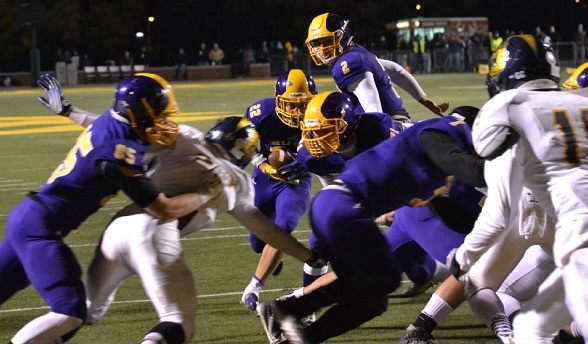
PHOTO: Warren DeLaSalle, on offense, downed Detroit East English 21-14 in their Division 2 District Final. (Photo courtesy of Detroit Public School League.)
Drive for Detroit: Week 9 Preview
October 24, 2019
By Geoff Kimmerly
Second Half editor
Sadly, thousands of Michigan high school football players will play the final game of their seasons – and in many cases their careers – this weekend.
 The sunnier news: A few thousand more may still have control over whether they will suit up again for the MHSAA Playoffs.
Week 9, the last of this regular season, began Thursday with a handful of games and will conclude around 8 p.m. Saturday with the last of the Detroit Catholic League championship games. Entering Thursday, 166 teams had clinched playoff berths in the 256-team 11-player field – with 139 hopefuls still with a chance to advance. Of that 139, 60 simply need to win this weekend to qualify – but it’s also anticipated that a record number of additional qualifiers – with 5-4 or 4-4 records – will make the field when it is selected and introduced Sunday.
Our weekly preview below highlights many contests you might expect, and many you might not. There are still five league title races completely up for grabs, and 23 where one team has clinched but another (or more) may still share the championship. Games with league titles or playoff berths are on the line were given priority over otherwise great matchups that will still be fun to watch but won’t figure in as much into what happens beyond this weekend.
Remember to tune in to FOX Sports Detroit PLUS at 7 p.m. Sunday for the “Selection Sunday Show” announcement of brackets in every division for both 11 and 8-player. The show also can be viewed on FOXSportsDetroit.com or via FOX Sports Go! Additionally, 34 games will be streamed live Friday and Saturday on MHSAA.tv – click for listings and links.
"Drive for Detroit" is sponsored by MI Student Aid.
Bay & Thumb
Lapeer (7-1) at Davison (7-1)
Just like a year ago, the Saginaw Valley League Blue title comes down to this regular-season finale. Last season, Lapeer emerged with a 28-6 win and the outright league championship. The Lightning’s only regular-season loss the last two seasons came to Lake Orion this year in Week 1, and that’s looked better every week as the Dragons stand 7-1. Also for the second straight year, Davison’s lone loss heading into this game has come to Warren De La Salle Collegiate. The Cardinals also have a notable win over Flint Metro League “Upper” champion Fenton, while Lapeer beat SVL Red second-place Midland Dow and last week Bloomfield Hills Brother Rice.
Keep an eye on these: FRIDAY Ubly (7-1) at Cass City (7-1), Central Montcalm (7-1) at Millington (4-4), New Lothrop (8-0) at Frankenmuth (8-0), Midland (8-0) at Midland Dow (5-3).
Greater Detroit
Detroit Catholic Central (4-4) vs. Orchard Lake St. Mary's (7-1), Saturday at Eastern Michigan University
The Bishop division championship game at Rynearson Stadium will match up the co-champions from the Detroit Catholic League Central – but this means more than another trophy for the Shamrocks. DCC is one of two league champions statewide facing the prospect of ending with a sub-.500 overall record. And if history holds, DCC also would look good to qualify for the playoffs at 5-4 due to its strong schedule. But the Eaglets are not without added motivation too – they fell to DCC 20-14 two weeks ago to create that shared league title.
Keep an eye on these: FRIDAY Dearborn Fordson (7-1) at Brighton (7-1), Birmingham Groves (7-1) at Brownstown Woodhaven (8-0), Detroit Martin Luther King (6-2) vs. Detroit Denby (7-1) at Detroit Renaissance, West Bloomfield (7-1) at Warren De La Salle Collegiate (5-3).
Mid-Michigan
Pewamo-Westphalia (8-0) at Williamston (5-3)
The Pirates locked up the Central Michigan Athletic Conference title last week and can extend their regular-season winning streak to 26. One of the few close victories during that run came in Week 9 last season when P-W edged Williamston 28-27. The Hornets need this one to qualify for the playoffs automatically, and having that chance is impressive on its own considering they entered Week 7 with three undefeated teams left on the schedule. Williamston then fell close to still-unbeaten Mason, but last week handed Olivet its only loss, 35-28.
Keep an eye on these: FRIDAY Okemos (1-7) at East Lansing (6-2), Lansing Waverly (3-5) at DeWitt (6-2), Grand Ledge (2-6) at Holt (6-2), Bath (3-5) at Perry (4-4).
Northern Lower Peninsula
Cadillac (5-3) at Traverse City Central (7-1), Saturday
The Trojans led the Big North Conference all season, winning all of their games since falling to DeWitt by five in Week 1. They claimed a share of the title last week, but a fifth-straight win over Cadillac to make the championship outright won’t be automatic by any means. The Vikings have bounced way back from going 1-8 last year after finishing 2-7 in 2017, and two of those three losses this fall were by a combined four points.
Keep an eye on these: FRIDAY Charlevoix (5-3) at Harbor Springs (6-2), Clare (7-1) at McBain (5-3), Kingsley (8-0) at Boyne City (4-4), Johannesburg-Lewiston (8-0) at Indian River Inland Lakes (8-0).
Southeast & Border
Livonia Clarenceville (5-3) at Whitmore Lake (6-2)
The Trojans moved into the Michigan Independent Athletic Conference this fall after decades in the Tri-County Conference, and they couldn’t have hoped for a better football outcome. Whitmore Lake is guaranteed its first winning regular season in this sport since 2013, and it claimed a share of the MIAC title last week. But that could turn into a three-team shared championship if Clarenceville – tied with Auburn Hills Oakland Christian for second place – downs Whitmore Lake in this league finale.
Keep an eye on these: FRIDAY Jonesville (6-2) at Grass Lake (7-1), Hillsdale (8-0) at Dundee (5-3), Homer (6-2) at Manchester (5-3). SATURDAY Reading (7-1) at Addison (7-1).
Southwest Corridor
Edwardsburg (8-0) at Paw Paw (8-0)
The reigning Wolverine Conference and statewide Division 4 champion Eddies are putting a 22-game winning streak on the line, having last lost in the 2017 Division 4 Final. In fact, Edwardsburg has only two league defeats since joining the Wolverine in 2012. The Eddies defeated Paw Paw twice last season, also in a District Final – but the Redskins rarely have been slowed this fall and enter this matchup with nearly the same defensive points-against average as Edwardsburg after playing the same opponents. Not counting South Haven, which forfeited to Edwardsburg and fell to Paw Paw 56-0, the Eddies are scoring 52 points per game and giving up 6.4. Paw Paw is scoring 39 points and giving up 6.9.
Keep an eye on these: FRIDAY St. Joseph (6-2) at Portage Northern (7-1), Stevensville Lakeshore (4-4) at Mattawan (4-4), Kalamazoo United (4-4) at Schoolcraft (8-0), Vicksburg (5-3) at Otsego (5-3).
Upper Peninsula
Kingsford (4-4) at Marquette (4-4)
Marquette joins Detroit Catholic Central as the other league champion also playing for an overall winning record and playoff berth this week. The Redmen have earned a share of the Great Northern Conference title and can clinch it outright against the Flivvers. But Kingsford has a lot to play for as well – a win could mean an additional qualifier playoff berth after the team just missed the postseason a year ago. Additionally, Escanaba would claim a share of the league title as well if the Flivvers are victorious.
Keep an eye on these: THURSDAY Bark River-Harris (5-3) at Ishpeming (6-2). FRIDAY L'Anse (4-4) at Calumet (7-1), Negaunee (6-2) at Ishpeming Westwood (6-2), Bessemer (0-8) at Iron Mountain (8-0).
West Michigan
East Kentwood (5-3) at Rockford (7-1)
The Ottawa-Kent Conference Red is full of possibilities after Grandville defeated Rockford 30-3 last week to move into a tie for first place with the Rams. The first option would see Rockford win this game and Grandville defeat Caledonia so they would share the title – or just one of the two could win tonight and claim the championship outright. Or, East Kentwood and Caledonia could win this weekend, with the Falcons and then perhaps Hudsonville (with a win over last-place Holland West Ottawa) making it a four-team shared championship. East Kentwood defeated Rockford 28-17 last season, and fell to Grandville by just a point four weeks ago.
Keep an eye on these: FRIDAY Portland (7-1) at Montague (6-2), Traverse City St. Francis (6-2) at Muskegon Oakridge (8-0), Hudsonville Unity Christian (5-3) at Zeeland East (5-3), Grandville (7-1) at Caledonia (3-5).
8-Player
Martin (8-0) at Climax-Scotts (7-1)
At one point in Martin history, the Clippers posted six straight 0-9 seasons from 2008-13. It’s only worth bringing those up because Martin this weekend can finish the regular season undefeated for the first time since 1987, when it won the 11-player Class D title. Climax-Scotts, like Martin, is enjoying an excellent first year of 8-player – and if the playoffs started today, they’d both be considered MHSAA championship contenders with the Clippers in Division 1 and the Panthers in Division 2.
Keep an eye on these: FRIDAY Gaylord St. Mary (3-5) at Brethren (5-3), Suttons Bay (8-0) at Mesick (7-1), Burr Oak (5-3) at Portland St. Patrick (8-0), Pickford (7-1) at Brimley (5-3).
Second Half’s weekly “Drive for Detroit” previews are powered by MI Student Aid, a part of the Office of Postsecondary Financial Planning located within the Michigan Department of Treasury. MI Student Aid encourages students to pursue postsecondary education by providing access to student financial resources and information. MI Student Aid administers the state’s 529 college savings programs (MET/MESP), as well as scholarship and grant programs that help make college Accessible, Affordable and Attainable for you. Connect with MI Student Aid at www.michigan.gov/mistudentaid and find more information on Facebook and Twitter @mistudentaid.
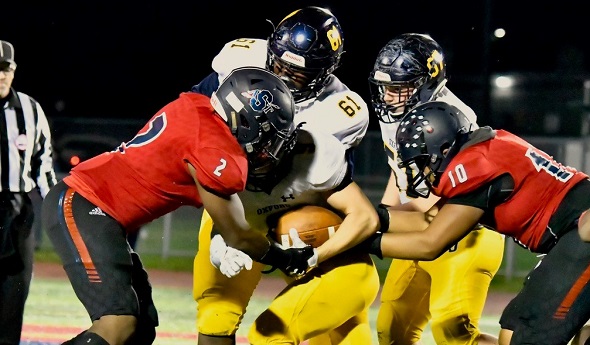
PHOTO: Southfield Arts & Technology defenders, in red, stop an Oxford ball carrier during a Week 7 win. The Warriors are among teams needing a victory this weekend to potentially qualify for the playoffs. (Photo by Terry Lyons.)