

Drive for Detroit: Week 12 in Review
November 17, 2014
By Geoff Kimmerly
Second Half editor
The third weekend of this season's MHSAA Football Playoffs was highlighted by the continuation of one of the state's most impressive winning streaks – and the finishes of two others of note.
Ithaca emerged from a fourth-quarter deficit against Madison Heights Madison to win another Division 6 Regional title and push its winning streak to 68 games, the longest 11-player streak in the country.
But there will be a new Division 2 champion; reigning three-time title-winner Birmingham Brother Rice fell to Catholic League rival Warren DeLaSalle. And for the first time in its short MHSAA history, the 8-player tournament will have a champion not from Michigan's thumb – 2013 champion Peck and 2012 winner Deckerville both were eliminated in Semifinals.
We touch briefly below on both 8-player games and all 32 11-player Regional Finals, with links to additional coverage of the games of particular note.
8-PLAYER
Cedarville 36, Deckerville 20
Cedarville eliminated a former champion to earn an opportunity to win its first title. The Trojans (11-1) put up 36 points despite playing through a blizzard and facing powerful Deckerville (9-3), which finished this fall with its only losses against the other teams in the Semifinals – Cedarville, Lawrence and Peck. Click for more from the Sault Ste. Marie Evening News.
Lawrence 66, Peck 40
This was a reversal of last season’s Semifinal between these teams, and Lawrence (12-0) hopes to now finish similarly as Peck when it won last season's championship. The Tigers again rode the many talents of quarterback Derek Gribler, who ran for 280 yards and three touchdowns and threw for 271 yards and six scores in one of the most impressive performances in the MHSAA’s young 8-player history. Peck finished 11-1 and had beaten Lawrence 73-34 in last season’s Semifinal before taking down Rapid River for the championship. Click for more from the St. Joseph Herald-Palladium.
DIVISION 1
Saline 42, Canton 35
Saline (11-1) advanced to the Semifinals for the first time, in the process setting a team record for wins; in fact, the Hornets’ two best finishes have come during the last three years. But it wasn’t without a wild finish. Canton ran for nearly 400 yards, and Saline quarterback Josh Jackson repeatedly matched – with the Hornets’ defense then coming up big at the end. The Chiefs (9-3) did post their best record since 2010. Click for more from AnnArbor.com.
Other Regional Finals:
East Kentwood 31, Hudsonville 14 – The Falcons (11-1) made their first Semifinal since 2002 by winning a rematch against surging Hudsonville (7-5) after claiming the first meeting 35-28.
Clarkston 40, Walled Lake Central 22 – The reigning champion Wolves (12-0) ended the longest run for Walled Lake Central (9-3) since 2011.
Detroit Cass Tech 48, Clinton Township Chippewa Valley 35 – Wow; Cass Tech running back Mike Weber ran for 404 yards and five touchdowns as the Technicians (12-0) won their 12th game for the fourth season in five and ended the longest run for Chippewa Valley (8-4) since 2004.
DIVISION 2
Warren DeLaSalle 26, Birmingham Brother Rice 21
As well as DeLaSalle (9-3) has played over the last month, this still has to count as a stunner – although DeLaSalle has been on the verge of a such a power move all season. DeLaSalle’s three losses came during one disappointing run – by seven to Brother Rice in Week 4, four to Orchard Lake St. Mary’s in Week 5 and then to Dearborn Fordson by four in Week 6. Those opponents are a combined 31-4 with St. Mary’s still alive in Division 3. This win earned the Pilots their fourth Semifinal berth over the last nine years – and ended a four-year Brother Rice run of 47-7. Click for more from the Detroit Free Press.
Other Regional Finals:
Muskegon Mona 39, Battle Creek Lakeview 0 – The offensively-powerful Sailors (11-1) put up their best defensive performance by handing Lakeview (9-2) its first shutout since 2012.
Farmington Hills Harrison 23, Flushing 10 – The Raiders (9-3) ended with their best record since 1997, but Harrison (10-2) moved on to its four Semifinal over the last decade.
Southfield 35, Wyandotte Roosevelt 7 – The Bluejays (9-3) have come back off a Week 9 loss to make the Semifinals for the first time since 2008; Roosevelt (9-3) can still celebrate extending its District title string to four straight.
DIVISION 3
Zeeland West 30, Lowell 27
The reigning Division 3 champion Dux (12-0) survived a second-straight close call after defeating Stevensville Lakeshore by only two in the District Final. Dakota Guerink and Nick Jasch both ran for two touchdowns and West’s defense made a late stop to ice the win. Lowell’s Max Dean capped a solid season with four more touchdown runs as the Red Arrows (10-2) finished with double-figure wins for the eighth time in nine seasons and 12th in 15 years. Click for more from the Holland Sentinel.
Other Regional Finals:
Muskegon 42, Petoskey 7 – The Big Reds (11-1) have scored 128 points in three playoff games in advance of facing Zeeland West this week; Petoskey (9-3) finished four wins better than 2013 and made a Regional Final for the first time since 1998.
Orchard Lake St. Mary’s 49, Mason 10 – The Eaglets (10-2) have now doubled last season’s win total and made their sixth Semifinal in eight seasons; Mason (8-4) made its first Regional Final since 1995 despite a 1-3 start this fall.
New Boston Huron 38, Redford Thurston 29 – Huron’s best season ever continues as the Chiefs (11-1) won their fifth straight by at least 10 points while Thurston can still celebrate a District title despite also opening this fall 1-3.
DIVISION 4
Detroit Country Day 21, Chelsea 0
As an at-large qualifier, Country Day (8-4) has cruised through the playoffs somewhat under the radar. But keep in mind that its losses this fall were to three reigning MHSAA champions – Brother Rice, Zeeland West and Division 8 Muskegon Catholic Central – and reigning Division 7 runner-up Detroit Loyola. The Yellowjackets have been nothing if not steady during the playoffs, outscoring their opponents by a combined 77-6 – with Chelsea (9-3) suffering its only loss of more than seven points this fall but after bouncing back from 2-7 a year ago. Click for more from the Oakland Press.
Other Regional Finals:
Grand Rapids South Christian 49, Whitehall 14 – The Sailors (10-2) made it 10 straight and nine straight by double figures in advancing to the Semifinals for the third straight season; Whitehall finished 9-3 after going 1-8 only a year ago.
Edwardsburg 42, Eaton Rapids 8 – The Eddies are back in the Semifinals for the first time since 2010 with their third game in four weeks holding an opponent under 10 points; Eaton Rapids finished its second playoff season 8-4, a win better than its first playoff season a year ago.
Lansing Sexton 35, Richmond 7 – The Big Reds (12-0) booked their return to the Semifinals by locking down an offense averaging 40 points per game for Richmond (10-2) entering the weekend.
DIVISION 5
Menominee 43, Freeland 35
Menominee’s offense has been typical of the Maroons (12-0) – they’re 12 points from scoring 600 for the second straight year and have averaged more than 40 per game three of the last four seasons. But a defensive stand late finally stopped Freeland (10-2) in this back-and-forth battle that ended with Menominee heading to the Semifinals for the third straight season – to face Grand Rapids West Catholic, last year’s opponent in the Division 5 Final. Click for more from the Midland Daily News.
Other Regional Finals:
Grand Rapids West Catholic 56, Reed City 28 – Although Reed City (9-3) became only the second team to score this many points on the Falcons, West Catholic (12-0) broke 50 for the first time since Week 2.
Lansing Catholic 49, Flint Powers Catholic 21 – The Cougars (12-0) have arrived in the Semifinals for the second time in four seasons by outscoring their playoff opponents 180-35, although Powers (8-4) put up the most points among the three teams eliminated.
Almont 35, River Rouge 12 – Make this officially the best season in Almont history at 12-0 and the Raiders’ defense arguably the most impressive in the state (still giving up only 5.7 points per game); River Rouge (10-2) hadn’t lost since Week 2 and finished with double-figure wins for the second time in three seasons.
DIVISION 6
Ithaca 41, Madison Heights Madison 27
With a quarter to play, Ithaca’s winning streak was in danger for one of the few times since it began opening night of 2010. The Yellowjackets (12-0) trailed 27-19, an unfamiliar spot for a team that rarely has had to come back during the last five seasons. But they scored 22 unanswered points over the final seven minutes to give a signature win to a current group of younger players that didn’t play a large role in Ithaca’s runs of the last four seasons. Click for more from the Mount Pleasant Morning Sun.
Other Regional Finals:
Boyne City 28, Leroy Pine River 16 – The Ramblers (12-0) are back in the Semifinals for the first time since 2001 after ending the longest playoff run ever for Pine River (8-4).
Grand Rapids NorthPointe Christian 41, Watervliet 35 – The Mustangs (11-1) have built steadily to this first Regional title over their seven seasons of football; Watervliet’s end was heart-breaking as it was the second time in four seasons the Panthers (10-2) fell in a Regional by a touchdown.
Monroe St. Mary Catholic Central 27, Jackson Lumen Christi 26 – Only the possibility of Ithaca’s winning streak ending kept this from being the main game in Division 6, as St. Mary (11-1) returned to the Semifinal by handing Lumen Christi (11-1) its lone loss despite more than 400 yards rushing by Khari Willis.
DIVISION 7
Detroit Loyola 60, New Lothrop 26
Loyola (12-0) pulled one victory closer to returning to Ford Field for the third straight season by winning big in this matchup of undefeated teams. Marvin Campbell, the team’s top running back during its 2013 run as well, had five touchdowns as Loyola got ahead early and never trailed. It was the third time in four seasons New Lothrop (11-1) had reached the Regional Final; the Hornets haven’t lost a regular season game since 2009. Click for more from the Detroit Free Press.
Other Regional Finals:
Ishpeming 22, Traverse City St. Francis 13 – The two-time reigning champion Hematites (11-0) stood strong against a challenge in their first game this season decided by fewer than 10 points; St. Francis finished its best since 2011 at 11-2.
Saginaw Michigan Lutheran Seminary 44, Elkton-Pigeon-Bay Port Laker 8 – The Cardinals are back in the Semifinals for the first time since winning the Class D title in 1986; Laker’s lone loss this season ended their best run since 2002 at 11-1.
Pewamo-Westphalia 53, Bridgman 12 – The Pirates (10-2) have become regulars at this stage of the playoffs with four straight Regional Final appearances and three titles during that time; Bridgman ended its longest playoff run at 8-3 and with a team record for wins.
DIVISION 8
Munising 43, Crystal Falls Forest Park 14
The road downstate in Division 8 generally goes through Crystal Falls Forest Park – and Munising traveled it well this weekend, figuratively speaking. This Regional Final was moved to the Superior Dome at Northern Michigan University, and the Mustangs (10-1) left with their second Regional title and first since 1980. Forest Park (9-1) had made Semifinals in eight of the previous 10 seasons before suffering this first in-state loss this fall – the Trojans’ other defeat was by four to Hurley of Wisconsin. Click for more from the Marquette Mining Journal.
Other Regionals Finals:
Beal City 28, Baldwin 0 – The Aggies (10-2) returned to the Semifinals for the third straight year by shutting down an offense for Baldwin (10-2) averaging 47 points per game heading into the weekend.
Muskegon Catholic Central 48, Mendon 7 – The Crusaders (12-0) again made quick work of a former MHSAA champion, with Mendon (10-2) joining Fowler and Fulton among those that have fallen to MCC this postseason.
Harbor Beach 21, Morenci 7 – Morenci (10-2) had been strong on defense and held Harbor Beach (12-0) to half its 46-ppg average, but also was held to a season low.
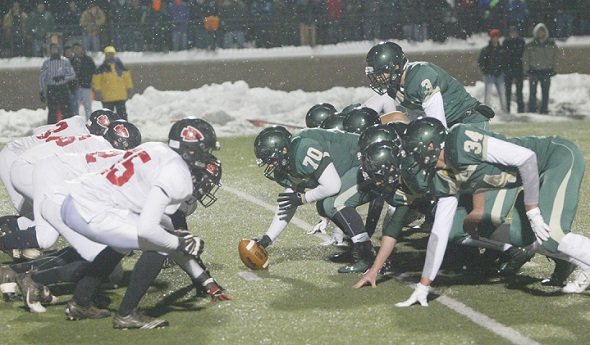
PHOTO: Zeeland West advanced past Lowell 30-27 in a snowy Division 3 Regional Final. (Click to see more from HighSchoolSportsScene.com)
Performance: Cass Tech's Rodney Hall
December 1, 2016
 Rodney Hall
Detroit Cass Tech senior – Football
A year ago, Hall’s junior season ended on the Ford Field sideline, watching Cass Tech fall 41-27 to Romeo in the Division 1 Final after he suffered a lower leg injury two weeks before. But he came back this season fueled by championship motivation, and made it pay off. Hall threw for 220 yards and an MHSAA Finals record-tying five touchdown passes to lead the Technicians to a 49-20 win over Detroit Catholic Central in the Division 1 Final on Saturday and earn the Michigan National Guard “Performance of the Week.”
Hall started a pair of playoff games as a freshman before taking over the varsity fulltime in 2014 and leading Cass Tech to a 12-1 record. The Technicians were a combined 36-3 under him the last three seasons and scored a program-record 619 points (44.2 per game) this fall. The 6-foot-2, 210-pound signal-caller completed 10 of 18 passes in the Final and also ran for 58 yards on only seven carries. He finished this season 142 of 238 passing for 2,535 yards and 28 touchdowns, after a junior season when he threw for 2,232 yards and 20 touchdowns and ran for 1,053 yards and 14 scores.
 After admitting Saturday to being a little timid to run at the start of the fall, and with a steel plate still in his ankle, Hall ran for a combined 253 yards and three touchdowns over his final three playoff games. He has committed to sign to play football at Northern Illinois University but said he’s unsure which course of study he’ll pursue. MLive-Detroit reported Hall carries a 3.4 grade-point average in its feature on the Technicians standout as one of 10 finalists for MLive’s High School Football Player of the Year award.
Coach Thomas Wilcher said: Let's say it like this: He lost one game his first year, two games his second year, zero games his third year. That's enough said. ... I think the most important thing about Rodney Hall is you have to look at his stats. He has phenomenal stats. He has a phenomenal win-loss record. I haven't been around anything like that before. I just look at his game – (he's) the gamer. He's always bringing back a victory. We went down to the wire several times, and it was all about him. And I just told him this week, 'Look, I don't need you to run the ball. All I want you to do is throw the ball. You should throw the ball for over 300 yards.’ That’s it. And I told him, just stick with the game plan; no running. And I just kept telling the offensive coordinator, don't let him run. Let him throw it. That's it."
Performance Point: “Just to be able to make it back to this point and play in this game, I was just excited to come play, and glad we won,” Hall said. “The offense was clicking, and guys were open. They did the rest. I just put it to them. … (At last season’s Final) I was crying. I was hurt that I couldn't be out there to help my teammates. I wanted (this year) bad. We made history at Cass because I think we’re the first team to go 14-0 and win the state championship. We just wanted to win this game because we’ve been losing ever since we came into high school. We have a lot of wins, but we’ve been coming up short for the last three years – and it’s great to come out with the championship this year.”
Learning to run again: “I came in (to this season), I was a little timid to run, actually. I didn't want to get hurt again and miss this opportunity. Coach, he's been pressing me to run all year, and when I finally do, I get positive yards.”
 Star among the stars: “Quarterback is simple. You just have to keep everybody on the right track and make sure teammates don’t get down when we get behind. The last two weeks we’ve been losing, and I just remind my guys, ‘Come on, we can win this. We’re going to go back and score.’ Just remind them to keep scoring, remind the defense we’re going to keep getting stops, and just keep everybody’s heads up.”
Pass is present: “This year, I’ve been a way better passer. Because all offseason, I haven’t been able to run. I’ve just been working the pocket, making sure I’m looking at everything, making sure I’m reading the defense better. And I’ve had a better passing year this year, I believe.”
Leaving a legacy: “I just can’t believe it’s over with. I just want people to know I was a guy to go out there and give it all I’ve got. Just sell out for the team, and that’s what you should do – and you’ll end up a champion.”
- Geoff Kimmerly, Second Half editor
Every week during the 2016-17 school year, Second Half and the Michigan National Guard will recognize a “Performance of the Week" from among the MHSAA's 750 member high schools.
The Michigan Army National Guard provides trained and ready forces in support of the National Military Strategy, and responds as needed to state, local, and regional emergencies to ensure peace, order, and public safety. The Guard adds value to our communities through continuous interaction. National Guard soldiers are part of the local community. Guardsmen typically train one weekend per month and two weeks in the summer. This training maintains readiness when needed, be it either to defend our nation's freedom or protect lives and property of Michigan citizens during a local natural disaster.
Previous 2016-17 honorees:
Nov. 24: Ally Cummings, Novi volleyball – Read
Nov. 17: Chloe Idoni, Fenton volleyball – Read
Nov. 10: Adelyn Ackley, Hart cross country – Read
Nov. 3: Casey Kirkbride, Mattawan soccer – Read
Oct. 27: Colton Yesney, Negaunee cross country – Read
Oct. 20: Varun Shanker, Midland Dow tennis – Read
Oct. 13: Anne Forsyth, Ann Arbor Pioneer cross country – Read
Oct. 6: Shuaib Aljabaly, Coldwater cross country – Read
Sept. 29: Taylor Seaman, Brighton swimming & diving – Read
Sept. 22: Maggie Farrell, Battle Creek Lakeview cross country – Read
Sept. 15: Franki Strefling, Buchanan volleyball – Read
Sept. 8: Noah Jacobs, Corunna cross country – Read
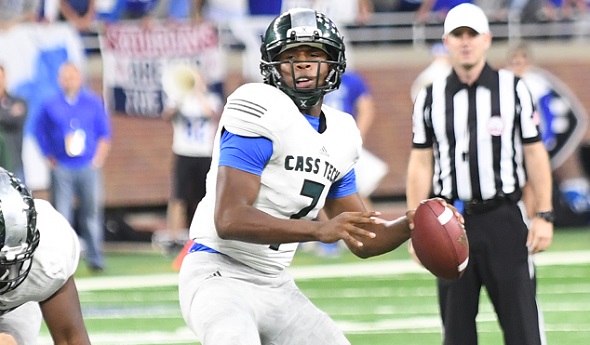
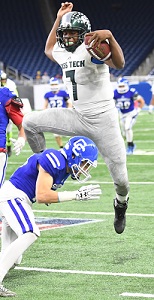
PHOTOS: (Top) Detroit Cass Tech's Rodney Hall prepares to unload a pass during Saturday's Division 1 Final at Ford Field. (Middle) Hall hurdles a would-be Detroit Catholic Central tackler.