

Drive for Detroit: Week 2 in Review
September 4, 2015
By Geoff Kimmerly
Second Half editor
For the second year in a row, storms crashed the second week of Michigan's high school football season.
But the rain could only postpone about 70 games and some dramatic early-season finishes that surely will be difference-makers in the standings in weeks to come.
See below for our look at the most significant of the week's results from every region and our 8-player teams.
Bay & Thumb
Marlette 28, Bad Axe 27
Bad Axe (1-1) stormed into the fall with a big season-opening win over Harbor Beach, and looked like it would add a second victory over a 2014 playoff team before Marlette went ahead during the fourth quarter on a 67-yard scoring pass. Click for more from the Port Huron Times-Herald.
Also noted:
Bay City John Glenn 28, Cadillac 14 – After a nice bounce-back last season for John Glenn (2-0), the Bobcats continued to surge by avenging last season’s 31-7 loss to Cadillac (0-2).
Port Huron 28, New Baltimore Anchor Bay 26 – The Big Reds (1-1) bounced back from a tough loss in Week 1 by keeping a five-game streak going against Anchor Bay (1-1).
Byron 14, Carson City-Crystal 7 – Byron (2-0) is starting nicely after last season’s 4-5 finish, this week avenging last season’s loss to the Eagles (1-1), who are coming off three straight playoff appearances.
Clio 7, Stanton Central Montcalm 6 – The Mustangs are 2-0 for the second straight season with a second straight one-point win over Central Montcalm (0-2).
Greater Detroit
Macomb Dakota 28, Clinton Township Chippewa Valley 21
One of the best football rivalries in all of the Macomb Area Conference, this annual matchup continues to meet expectations. Dakota (2-0) has won 11 straight over the Big Reds during the regular season, but was coming off a one-point loss to Chippewa Valley (1-1) in last season’s District Final. Click for more from MLive-Detroit.
Also noted:
Wyandotte Roosevelt 23, Allen Park 14 – Both of these teams are regular contenders in the Downriver Conference, with Roosevelt (2-0) now taking the upper hand after finishing third last season when Allen Park (1-1) was league runner-up.
Detroit Loyola 42, Muskegon Oakridge 13 – Reigning Division 7 champion Loyola (1-1) looks up to another run after winning big over solid Oakridge (1-1).
Farmington 20, Oak Park 19 – Farmington (2-0) had lost three straight to Oak Park (0-2), including in last season’s playoff opener.
Detroit U-D Jesuit 23, Detroit Country Day 13 – Jesuit (2-0) equaled last season’s win total by beating a second playoff team from a year ago; Country Day is 1-1.
Mid-Michigan
Mason 21, Eaton Rapids 6
The build-up made this the premier game in the Lansing area Thursday, as both teams made the playoffs the last two seasons. But the result remained the same as it's been going back to 1993, the last time Mason fell to Eaton Rapids (1-1). The teams played to only a 10-7 win for Mason last season, but the Bulldogs (2-0) broke away this time relying again on an experienced offense and stout defense. Click for more from Mason Today.
Also noted:
Portland 37, Hillsdale 14 – The Raiders (2-0) are bouncing back nicely from their first losing season since 2002, knocking off the Hornets (1-1), who had won 13 of their last 15 regular-season games.
Stockbridge 53, Sand Creek 48 – Panthers quarterback Mason Gee-Montgomery threw himself into the MHSAA record book with seven touchdown passes as Stockbridge (2-0) went over 50 points for the second time in two games in dropping Sand Creek to 1-1.
Beal City 43, Clare 36 (OT) – These two have played classics two straight seasons, with Beal City (2-0) adding to last year’s one-point win by outlasting Clare (0-2) this time.
Corunna 19, Montrose 13 (OT) – This might be the best win for the Cavaliers (2-0) since at least 2007, or longer ago, as they’ve made the playoffs just once over the last decade while the Rams (1-1) are an annual contender.
Northern Lower Peninsula
Gaylord 45, Grayling 6
These rivals took nearly 20 seasons off before reviving their annual game last fall, and it’s been all Blue Devils so far with both victories by a combined score of 80-6. The score this time wouldn’t make this seem like a big game aside from the neighborly connection, but it could have a bearing on both teams’ futures. Gaylord (2-0) is trying to return to the playoffs for the first time since 2005, and this could be huge toward achieving that goal after the team started 3-0 nonleague last season but went only 2-4 in Big North Conference play. Grayling (1-1) missed the playoffs last fall for the first time in five seasons and faces a tough road ahead starting with Maple City Glen Lake this week. Click for more from the Gaylord Herald-Times.
Also noted:
Kalkaska 40, Elk Rapids 23 – It was quite a comeback by the Blazers (1-1), who fell to Elk Rapids 48-0 only a year ago but this time dropped the Elks to 0-2.
Houghton Lake 12, Lakeview 7 – Not only did this avenge a 45-6 loss to Lakeview (1-1) last year, but it set up Houghton Lake (1-1) to surpass its one-win finishes of 2014, 2013 and 2012.
Manistee 40, Muskegon Orchard View 14 – The Chippewas are 2-0 for the first time since 2009 and after losing to Orchard View 34-7 a year ago; the Cardinals are 0-2.
Maple City Glen Lake 26, Suttons Bay 14 – Glen Lake (2-0) needs one more win to equal last season’s 3-6 finish and now has victories this fall over two 2014 playoff teams and five straight wins over Suttons Bay (0-2).
Southeast & Border
Morenci 26, Hudson 20 (3 OT)
This quickly is turning into one of the top rivalry games from this corner of the state. Morenci (2-0) now has won the last two meetings (by a combined 11 points) after losing 11 in 12 to the Tigers (1-1) from 2002-13. Click for more from the Adrian Daily Telegram.
Also noted:
Concord 44, Union City 36 – The Yellow Jackets (2-0) haven’t won two games total since 2010, and hadn’t beaten Union City (1-1) since 1988.
Napoleon 13, Grass Lake 8 – Napoleon (1-1) had lost 10 straight to Grass Lake (1-1), but now is 1-0 to start the Cascades Conference schedule for the first time since 2010.
Jackson 56, Lansing Everett 27 – Jackson (2-0) has its most win since 2010 and got there by adding a victory over Everett (0-2), a playoff team the last three seasons.
Onsted 21, Adrian Madison 20 (OT) – The Wildcats needed a little extra to survive Madison (1-1) for the second straight season and to start 2-0 for the second straight.
Southwest Corridor
Portage Central 28, Battle Creek Lakeview 21
These two may end up champions of their separate divisions of the Southwest Michigan Athletic Conference, but regardless this will be remembered as one of the league’s marquee battles of 2015. Portage Central came back from a second-half touchdown deficit and now has a little more momentum to ride heading into next week’s SMAC West opener against Stevensville Lakeshore. Click for more from the Kalamazoo Gazette.
Also noted:
Benton Harbor 14, Battle Creek Central 9 – Not only did the Tigers (1-1) break a 20-game losing streak, but they did so against a Central team that’s only a combined 15 points from being undefeated instead of 0-2.
Cassopolis 41, Mendon 6 – This has started like a rare down season for Mendon, which is 0-2 for the first time since 2006; but Cassopolis is 2-0 for the first time since 2010.
Constantine 21, Decatur 20 (OT) – The landscape this season is drastically different for the Falcons (1-1) with a new league and six new opponents, but a win over usually-powerful Decatur (1-1) is a great way to bounce back from a three-point loss on opening night.
Schoolcraft 34, Watervliet 33 – The Eagles will hop into a new league next week 2-0 after edging a Watervliet team that has started 1-1 but won 10 games each of the last two seasons.
Upper Peninsula
L’Anse 30, Iron River West Iron County 26
This was quite a reversal from last season’s 54-8 win by West Iron, with L’Anse (2-0) handing the Wykons their first loss in the Western Peninsula Athletic Conference since 2012. West Iron also hadn’t started 0-2 since 2002. Click for more from the Iron Mountain Daily News.
Also noted:
Escanaba 16, Petoskey 7 – The Eskymos are 2-0 for the first time since 2011 after beating a Petoskey team that won nine game a year ago but fell to 1-1.
Newberry 47, Felch North Dickinson 36 – The Indians (2-0) got their first win in four tries against North Dickinson since joining the Nordics (1-1) in the Mid-Eastern Conference.
Lake Linden-Hubbell 35, Hurley (Wis.) 6 – The Great Western Conference is a team fewer this season, but Lake Linden-Hubbell (2-0) is a game up after avenging last season’s 28-6 loss to Hurley.
Negaunee 21, Calumet 14 – Make that three of the last four meetings between these two decided by eight points or fewer, with Negaunee (2-0) winning all four matchups and dropping Calumet this time to 1-1.
West Michigan
Muskegon 42, Grand Rapids Christian 14
There weren’t a lot of better ways the Big Reds (1-1) could’ve bounced back from a three-point loss to Detroit Catholic Central on opening night. Christian (1-1) itself was coming itself off a nice nail-biter win over Grand Rapids South Christian. Now Muskegon will face Grandville this week trying to become the first team in Michigan high school history to win 800 games. Click for more from the Grand Rapids Press.
Also noted:
Montague 70, Ravenna 48 – This goes down as one of the more interesting recent chapters in this West Michigan Conference rivalry, with Montague (2-0) scoring its most points since 2010 and Ravenna (1-1) scoring enough to beat most.
Caledonia 23, Grand Rapids South Christian 7 – The Fighting Scots (2-0) have outscored two teams that went a combined 18-7 last season by a combined score of 63-10; South Christian fell to 0-2.
Grandville 38, Lansing Sexton 25 – Grandville is 2-0 after handing reigning Division 4 runner-up Sexton its second loss, which was absolutely necessary as the Bulldogs might face the toughest schedule of any team in Michigan over the next seven weeks.
Grand Rapids Forest Hills Northern 40, Byron Center 28 – The Huskies finished last season on a 1-3 spiral, but are 2-0 after beating 2014 playoff team Byron Center (1-1) for the second straight year.
8-Player
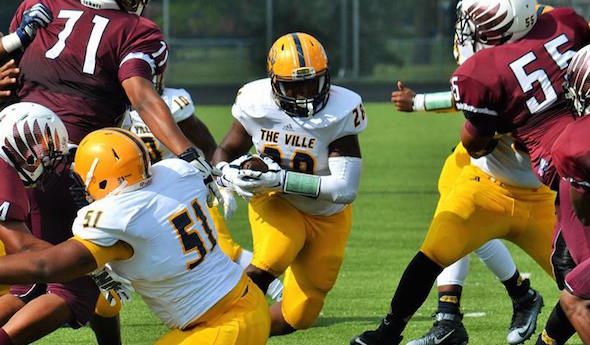
Kingston 20, Kinde-North Huron 12 Kingston still has been outscored 54-20 after two games, but came back strong after a big opening night loss to Deckerville. North Huron entered off a big win over Carsonville-Port Sanilac; this gave Kingston a 3-2 advantage in the series since the two schools first started playing 8-player in 2012. Both are 1-1 this season. Also noted: Cedarville 34, Pickford 20 – Pickford (1-1) is new to 8-player this fall, but gave Cedarville one of its few close games since this the Trojans (2-0) made the switch in 2011. Webberville 34, Tekonsha 32 – The Spartans are 2-0 but have walked the edge, with both wins by two points; this one dropped Tekonsha to 1-1. PHOTO: Detroit East English (on offense) downed Detroit Renaissance 40-7 in their Week 2 matchup. (Photo courtesy of the Detroit Public School League.)
Performance: Cass Tech's Rodney Hall
December 1, 2016
 Rodney Hall
Detroit Cass Tech senior – Football
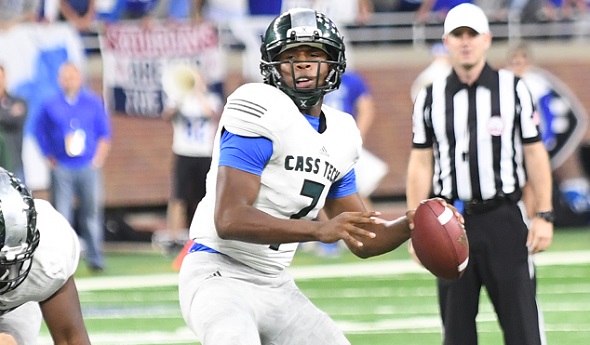
A year ago, Hall’s junior season ended on the Ford Field sideline, watching Cass Tech fall 41-27 to Romeo in the Division 1 Final after he suffered a lower leg injury two weeks before. But he came back this season fueled by championship motivation, and made it pay off. Hall threw for 220 yards and an MHSAA Finals record-tying five touchdown passes to lead the Technicians to a 49-20 win over Detroit Catholic Central in the Division 1 Final on Saturday and earn the Michigan National Guard “Performance of the Week.”
Hall started a pair of playoff games as a freshman before taking over the varsity fulltime in 2014 and leading Cass Tech to a 12-1 record. The Technicians were a combined 36-3 under him the last three seasons and scored a program-record 619 points (44.2 per game) this fall. The 6-foot-2, 210-pound signal-caller completed 10 of 18 passes in the Final and also ran for 58 yards on only seven carries. He finished this season 142 of 238 passing for 2,535 yards and 28 touchdowns, after a junior season when he threw for 2,232 yards and 20 touchdowns and ran for 1,053 yards and 14 scores.
 After admitting Saturday to being a little timid to run at the start of the fall, and with a steel plate still in his ankle, Hall ran for a combined 253 yards and three touchdowns over his final three playoff games. He has committed to sign to play football at Northern Illinois University but said he’s unsure which course of study he’ll pursue. MLive-Detroit reported Hall carries a 3.4 grade-point average in its feature on the Technicians standout as one of 10 finalists for MLive’s High School Football Player of the Year award.
Coach Thomas Wilcher said: Let's say it like this: He lost one game his first year, two games his second year, zero games his third year. That's enough said. ... I think the most important thing about Rodney Hall is you have to look at his stats. He has phenomenal stats. He has a phenomenal win-loss record. I haven't been around anything like that before. I just look at his game – (he's) the gamer. He's always bringing back a victory. We went down to the wire several times, and it was all about him. And I just told him this week, 'Look, I don't need you to run the ball. All I want you to do is throw the ball. You should throw the ball for over 300 yards.’ That’s it. And I told him, just stick with the game plan; no running. And I just kept telling the offensive coordinator, don't let him run. Let him throw it. That's it."
Performance Point: “Just to be able to make it back to this point and play in this game, I was just excited to come play, and glad we won,” Hall said. “The offense was clicking, and guys were open. They did the rest. I just put it to them. … (At last season’s Final) I was crying. I was hurt that I couldn't be out there to help my teammates. I wanted (this year) bad. We made history at Cass because I think we’re the first team to go 14-0 and win the state championship. We just wanted to win this game because we’ve been losing ever since we came into high school. We have a lot of wins, but we’ve been coming up short for the last three years – and it’s great to come out with the championship this year.”
Learning to run again: “I came in (to this season), I was a little timid to run, actually. I didn't want to get hurt again and miss this opportunity. Coach, he's been pressing me to run all year, and when I finally do, I get positive yards.”
 Star among the stars: “Quarterback is simple. You just have to keep everybody on the right track and make sure teammates don’t get down when we get behind. The last two weeks we’ve been losing, and I just remind my guys, ‘Come on, we can win this. We’re going to go back and score.’ Just remind them to keep scoring, remind the defense we’re going to keep getting stops, and just keep everybody’s heads up.”
Pass is present: “This year, I’ve been a way better passer. Because all offseason, I haven’t been able to run. I’ve just been working the pocket, making sure I’m looking at everything, making sure I’m reading the defense better. And I’ve had a better passing year this year, I believe.”
Leaving a legacy: “I just can’t believe it’s over with. I just want people to know I was a guy to go out there and give it all I’ve got. Just sell out for the team, and that’s what you should do – and you’ll end up a champion.”
- Geoff Kimmerly, Second Half editor
Every week during the 2016-17 school year, Second Half and the Michigan National Guard will recognize a “Performance of the Week" from among the MHSAA's 750 member high schools.
The Michigan Army National Guard provides trained and ready forces in support of the National Military Strategy, and responds as needed to state, local, and regional emergencies to ensure peace, order, and public safety. The Guard adds value to our communities through continuous interaction. National Guard soldiers are part of the local community. Guardsmen typically train one weekend per month and two weeks in the summer. This training maintains readiness when needed, be it either to defend our nation's freedom or protect lives and property of Michigan citizens during a local natural disaster.
Previous 2016-17 honorees:
Nov. 24: Ally Cummings, Novi volleyball – Read
Nov. 17: Chloe Idoni, Fenton volleyball – Read
Nov. 10: Adelyn Ackley, Hart cross country – Read
Nov. 3: Casey Kirkbride, Mattawan soccer – Read
Oct. 27: Colton Yesney, Negaunee cross country – Read
Oct. 20: Varun Shanker, Midland Dow tennis – Read
Oct. 13: Anne Forsyth, Ann Arbor Pioneer cross country – Read
Oct. 6: Shuaib Aljabaly, Coldwater cross country – Read
Sept. 29: Taylor Seaman, Brighton swimming & diving – Read
Sept. 22: Maggie Farrell, Battle Creek Lakeview cross country – Read
Sept. 15: Franki Strefling, Buchanan volleyball – Read
Sept. 8: Noah Jacobs, Corunna cross country – Read
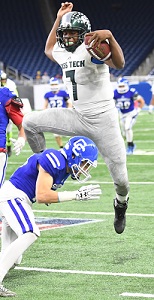
PHOTOS: (Top) Detroit Cass Tech's Rodney Hall prepares to unload a pass during Saturday's Division 1 Final at Ford Field. (Middle) Hall hurdles a would-be Detroit Catholic Central tackler.