

Drive for Detroit: Week 4 Preview
September 14, 2017
By Geoff Kimmerly
Second Half editor
This is the time of year, every year, when we begin to notice the start of separation among the fast starters and truly elite teams in Michigan high school football.
 There are 122 teams (of 617 total) without a loss as the regular season creeps toward the midway point. And that number will go down by at least a few this weekend as a number of league races also take a turn with undefeated contenders facing off.
This week’s Drive for Detroit preview powered by MI Student Aid features three of those matchups and mentions a half-dozen more. Remember to stay with us Friday night and into Saturday for scores as they come in on the MHSAA Score Center, and click on teams off that page for updated standings and playoff points. MHSAA.tv will broadcast nine games across both peninsulas this weekend – click here for the schedule. All games below will be played Friday.
Bay & Thumb
Linden (3-0) at Fenton (3-0)
Fenton has claimed outright Flint Metro League titles by defeating Linden in the regular-season finale the last three seasons – wins by the Eagles in 2014 and 2016 would’ve meant a shared championship – but this fall the meeting comes in the heart of the league schedule. Linden has handed lone losses this season to both Flushing and Holly, and Fenton did the same to Ortonville Brandon – giving this the feeling of a few-weeks-early championship game again.
Others that caught my eye: Lake Fenton (2-1) at Goodrich (3-0), Marysville (2-1) at Marine City (3-0), Freeland (3-0) at Saginaw Swan Valley (2-1), Houghton Lake (2-1) at Beaverton (3-0).
Greater Detroit
Bloomfield Hills Cranbrook Kingswood (3-0) at Dearborn Divine Child (3-0)
Cranbrook Kingswood has experienced an upswing in football since longtime Detroit Country Day coach Joe D’Angelo took over in 2013. Coming off three straight playoff seasons, the Cranes have opened by outscoring their first three opponents by a combined 114-7 – and two of those teams also made the playoffs last fall. Divine Child has been similarly strong against a similar group of teams and has Big Ten-committed prospects on both sides of the ball (QB/S Theo Day – Michigan State, DE/TE Aidan Hutchinson – Michigan) as it continues to build of last season’s Division 3 Semifinal run.
Others that caught my eye: Warren Mott (3-0) at Macomb Dakota (2-1), Detroit Central (2-1) at Detroit Renaissance (3-0), Clarkston (3-0) at West Bloomfield (1-2), Waterford Mott (2-1) at Walled Lake Western (3-0).
Mid-Michigan
Grand Ledge (2-1) at Lansing Sexton (3-0)
Grand Ledge and DeWitt were considered the unquestioned elite in the Lansing area heading into this season. Then the Panthers downed the Comets 14-7 in Week 2 to rise to the top of the list. But Sexton is building a solid argument as well giving up only 21 points so far and after handing Portland its first regular-season loss since 2014. Another victory tonight would put the Big Reds firmly in the discussion; the winner regardless will take a significant step toward the Capital Area Activities Conference Blue title.
Others that caught my eye: Vermontville Maple Valley (3-0) at Lake Odessa Lakewood (3-0), Lansing Catholic (3-0) at Williamston (2-1), Perry (2-1) at Olivet (3-0), Fulton (2-1) at Fowler (2-1).
Northern Lower Peninsula
Lincoln Alcona (3-0) at AuGres-Sims (3-0)
It’s hard to remember that 11-year span at the start of this century when Alcona didn’t make the playoffs once; the Tigers have qualified four of the last five seasons and are well on their way again with two wins this fall over playoff teams from a year ago. AuGres-Sims started what it hopes is a similar bounce-back going 7-3 last year despite falling to Alcona 58-20. If like opponents mean anything – they have two so far in 2017 – tonight’s game should be a lot closer than that last meeting and could end up deciding the North Star League title.
Others that caught my eye: Whittemore-Prescott (2-1) at Gaylord St. Mary (3-0), Evart (2-1) at McBain (2-1), Johannesburg-Lewiston (2-1) at Charlevoix (1-2), Kalkaska (3-0) at Elk Rapids (2-1).
Southeast & Border
Ypsilanti Community (2-1) at Adrian (2-1)
Once an annual power, we didn’t talk about Adrian for a few seasons until the Maples ended a string of four sub-.500 finishes by winning a District title last fall. They fell in an odd one, 11-7, last weekend after the power went out Friday and they had to resume Sunday morning. Ypsilanti Community also fell last week, to Pinckney, but has equaled last season’s win total and shut out Tecumseh on opening night.
Others that caught my eye: Dundee (2-1) at Hudson (3-0), Brooklyn Columbia Central (2-1) at Ida (3-0), Chelsea (2-1) at Tecumseh (2-1), Addison (3-0) at Napoleon (2-1)
Southwest Corridor
Stevensville Lakeshore (3-0) at St. Joseph (3-0)
Last week Lakeshore/Portage Central was the big game in the southwest part of the state, and following a 24-7 win the Lancers are headlining again as they face their other annual main competition in the Southwestern Michigan Athletic Conference West. Lakeshore has beaten St. Joseph in four straight. But the Bears have been tough defensively and can rely on running back Ryan Haynes, who has piled up more than 400 yards on the ground.
Others that caught my eye: Union City (3-0) at Quincy (3-0), Dowagiac (2-1) at Edwardsburg (3-0), Traverse City Central (2-1) at Portage Central (2-1), St. Joseph Lake Michigan Catholic (3-0) at Parchment (2-1).
Upper Peninsula
Ishpeming Westwood (3-0) at Gladstone (3-0)
Like Lakeshore above, Westwood finds itself in the top spot for as second straight week after downing previously undefeated L’Anse 38-10 to eclipse its win total from a year ago. The Patriots also handed Munising its lone loss this season, but the toughest competition so far should come from Gladstone – which switched to the Mid-Peninsula Conference this season after battling the biggest in the U.P. in the Great Northern Conference for more than two decades. Last week’s 43-0 win over Negaunee gave the Braves as many wins as they had all of last season and as many as they’ve had in any season since 2010.
Others that caught my eye: Marquette (1-2) at Escanaba (2-1), Munising (2-1) at Newberry (2-1), Gwinn (2-1) at Norway (3-0), Hancock (3-0) at L'Anse (2-1).
West Michigan
Muskegon (3-0) at Byron Center (3-0)
The Grand Rapids and Muskegon areas are loaded with outstanding matchups this weekend – see the others mentioned below – but this gets top billing because of Byron Center’s opportunity. Muskegon is a state power and came within minutes of winning the Division 3 title last year. But the Bulldogs finished 10-2 – earning their most wins since 2000 – with both losses to the Big Reds, in Week 4 and again in a Division 3 Regional Final.
Others that caught my eye: Grand Rapids Christian (3-0) at Grand Rapids South Christian (3-0), Zeeland East (3-0) at Holland (3-0), Whitehall (2-1) at Muskegon Oakridge (3-0), Muskegon Reeths-Puffer (3-0) at Muskegon Mona Shores (3-0).
8-Player
Bellevue (3-0) at Portland St. Patrick (3-0)
The Broncos moved into 8-player this season coming off two straight 3-5 finishes and one win in 2014. So far, it’s a perfect fit. Bellevue’s start has been nearly perfect defensively – it’s outscored its first three opponents by a combined 146-6. St. Patrick has a lot more experience in the 8-player format – the Shamrocks twice have come within a win or two of the MHSAA championship game since making the move in 2012. They’re coming off a 38-22 win over rival Webberville, which Bellevue beat 40-6 on opening night.
Others that caught my eye: Ontonagon (2-0) at Rapid River (3-0), Wyoming Tri-unity Christian (2-1) at Onekama (3-0), Deckerville (3-0) at Kingston (2-1), New Haven Merritt (2-1) at Bay City All Saints (2-1).
Second Half’s weekly “Drive for Detroit” previews are powered by MI Student Aid, a part of the Student Financial Services Bureau located within the Michigan Department of Treasury. MI Student Aid encourages students to pursue postsecondary education by providing access to student financial resources and information, including various student financial assistance programs to help make college more affordable for Michigan students. MI Student Aid administers the state’s 529 savings programs (MET/MESP) and eight additional aid programs within its Student Scholarships and Grants division. Click for more information and connect with MI Student Aid on Facebook and Twitter @mistudentaid.
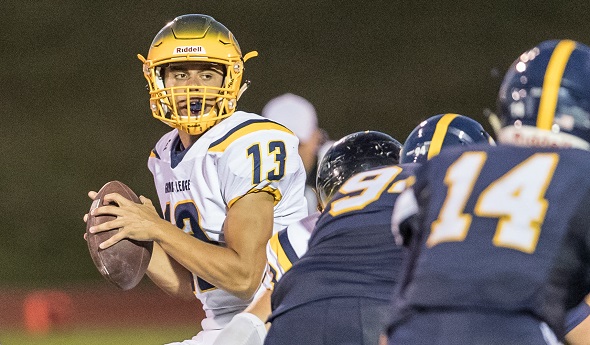
PHOTO: Grand Ledge quarterback Nolan Bird targets a receiver during his team’s 14-7 loss to DeWitt in Week 2. (Click for more from HighSchoolSportsScene.com.)
Chance Paying Off Big for Sturgis Again
By
Wes Morgan
Special for MHSAA.com
September 30, 2020
The entirety of 2020 thus far has been a matter of conjecture. Trying to predict anything with any degree of certainty – including the sporting world – has proved to be a worthless expenditure of time.
 That the Sturgis High School varsity football team would have as many victories in the first two weeks of the season as it had in the previous two years certainly wouldn’t have been the most absurd thought for Trojans fans. But based on recent history, it surely didn’t seem like the most likely scenario.
And it wasn’t the kind of lofty expectation anyone wanted to throw on the back of first-year head coach Chance Stewart, who was hired June 4.
The 2-0 start is the first for Sturgis since 2003. The 25-21 win over rival Three Rivers to start the year broke a seven-game losing streak for the Trojans, who finished 4-23 over the last three years.
Toss in the fact that the season itself almost didn’t materialize due to COVID-19 restrictions in the state, and that like every other program in Michigan, Sturgis will participate in the playoffs following an abbreviated regular season – and there’s a much louder buzz around town these days.
It will be only the Trojans’ third postseason appearance since Stewart’s final prep game at quarterback in Orange and Black in 2013 — a 16-0 Pre-District loss at St. Joseph. He went on to a brief stint at Western Michigan University and a phenomenal career at Hillsdale College, which yielded a G-MAC Player of the Year award, a single-season school and league record of 3,588 passing yards en route to a conference championship in 2018 and finishing with a school-record 10,064 passing yards. Stewart also recorded 73 career touchdowns in his 41 games played for the Chargers.
At just 24 years old, he’s not that far removed from the young men he’s now charged with overseeing at Sturgis. And in such bizarre times with protocols no one could have imagined just a year ago, Stewart is obviously pleased with how September unfolded.
“These kids are playing extremely hard right now,” Stewart said following the team’s 36-6 win over Allegan this past weekend. “The effort has been outrageously great for us the last two weeks. Finally getting the opportunity to come back after football was taken away from them, the effort was one thing we were hoping we wouldn’t have to worry about. And we didn’t have to. They came out ready to get after it.”
A total of 15 seniors are on the squad this year, but the roster changes weekly as Stewart has given junior varsity players an opportunity to play their way into Friday night spots with the new five-quarter rule instituted by the Michigan High School Athletic Association. Still, it’s the veteran group that mostly has fueled Sturgis so far.
“We have a great senior class here that’s leading the way for the rest of the guys, saying this is how things are going to be done now,” Stewart said. “That senior class really wants to go out on top and they really set the tone the first two weeks.”
Captains Rylee Cain (tight end/linebacker) and Brady Webb (quarterback, linebacker) were selected by their peers, and their production on the field has been solid. Webb threw for 81 yards and two touchdowns in the opener against the Wildcats. Defensively, Webb has logged 11.5 tackles (four for loss), and Cain has 13 tackles (four for loss) and an interception through the first two weeks, which included limited time on the field as the Trojans downed Allegan 36-6. Webb’s 28-yard hookup with Xander Cosby was a game-winner with 43 seconds remaining against Three Rivers.
 Stewart also pointed out the crucial play of senior Julian Alldridge, a right guard who will begin lining up at right tackle, and Jaden Bodi, who prepared in camp to play receiver and linebacker but was moved to right guard and defensive end.
“Alldridge has done a phenomenal job so far with helping out,” Stewart said. “From three weeks ago to now, (Bodi) is in two new positions with no questions asked. He just wants to do whatever he can to help the football team.”
Following Jimmy Lamb’s resignation from the head coaching position last year to focus on his new duties in an administrative role in the district, Sturgis athletics director Mark Adams believed Stewart, despite being green behind the ears, had enough experience on the field and the leadership skills to take over.
“That’s something you really need if you’re going to be a good coach,” Adams said. “When my son was growing up, Chance had his own football league at his house and teams from around (St. Joseph County) would come to it. He’s just that kind of guy. He’s organized, he’s imaginative, and talking to him in his interview about his X’s and O’s, I learned a lot of football from him then. He’s young and energetic and has a lot of great ideas, not just for football, but for the community and other things.”
Stewart always hoped to get an opportunity like this, he just didn’t expect it to come so quickly.
“It was special (playing quarterback here),” he said. “It’s special because my dad got to do it back in the 80s. Playing out here, wearing the Sturgis jersey has been really special to us.
Bigger than that, I think was just what the program was able to do for me to help me grow from just a 14-year-old scrawny kid into the person I am now. It’s because of those relationships I created out here. I was lucky enough to play for two coaches that really cared about their players in Coach (Bill) Keim and Coach Lamb — two guys to this day I still look up to. Now I get to give back in that same role that those guys were able to help me.”
 Wes Morgan has reported for the Kalamazoo Gazette, ESPN and ESPNChicago.com, 247Sports and Blue & Gold Illustrated over the last 12 years and is the publisher of JoeInsider.com. He can be reached at [email protected] with story ideas for Berrien, Cass, St. Joseph and Branch counties.
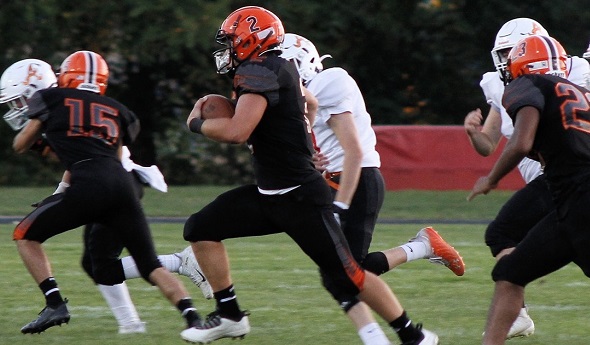
PHOTOS: (Top) A Sturgis ball carrier follows his blocks in Allegan territory during Friday’s win. (Middle) Chance Stewart has returned home to coach the high school program for which he starred at quarterback less than a decade ago. (Top photo by Scott Rains; middle by Wes Morgan.)