


Drive for Detroit: Week 4 in Review
September 22, 2014
By Geoff Kimmerly
Second Half editor
A total of 93 teams remain undefeated after the fourth week of this MHSAA football season.
A number of them had to overcome major challenges last week to remain flawless.
Read on for last week's most significant results from every corner of the state, kicked off by a bit of the story behind one of the surprise 4-0 teams of 2014.
Southwest and Border
Vicksburg 25, Paw Paw 20
This wins out as the biggest result from a weekend of many from this part of the state for a few reasons, including its contribution to Vicksburg's overall body of work. The Bulldogs won four games last season and three in 2012, but improved to 4-0 this fall by beating the reigning Wolverine B East champion after beating reigning West champion Edwardsburg a week ago. Paw Paw (3-1) has lost only four regular-season games since the start of 2010. Click to read more from the Kalamazoo Gazette.
Also noted:
Edwardsburg 24, Plainwell 22 – The Eddies (3-1) bounced back from a two-point loss to Vicksburg by beating a Plainwell (3-1) team that had outscored its first three opponents by a combined 105-19.
Decatur 28, Gobles 14 – Decatur (4-0) has won 12 straight nonleague games over the last four seasons, including two over the always-solid Tigers (3-1).
Stevensville Lakeshore 17, St. Joseph 7 – The Lancers (4-0) are already starting to separate in the Southwestern Michigan Athletic Conference West having now beaten the Bears (3-1) in addition to reigning champion Portage Central in successive weeks.
Coldwater 35, Parma Western 28 – Coldwater is 4-0 for the first time since 1983 and got there by holding off a Parma Western (2-2) team that has lost two games by a combined eight points.
West Michigan
Rockford 28, Hudsonville 27
This was everything it was billed, the Rams winning for the fifth straight time but the matchup returning to “classic” status after a few one-sided contests. Hudsonville (3-1) scored late in the fourth quarter to pull within a point of the lead, but went for a 2-point conversion and the lead – and Rockford (4-0) made the stop. Click for more from the Grand Rapids Press.
Also noted:
Grand Rapids West Catholic 35, Hudsonville Unity Christian 21 – Unity Christian (2-2) has impressed early, but West Catholic (4-0) remains the elite of small Class B programs on this side of the state.
East Kentwood 39, Grandville 38 – The Falcons (4-0) are off to their best start since 2004, and Grandville (2-2) is only 11 points over two losses from the same record.
Whitehall 41, Mason County Central 27 – Whitehall (4-0) is off to its best start since 2006 thanks to avenging last season’s 14-point loss to Mason County Central (2-2).
Muskegon 37, East Grand Rapids 7 – Few prepared for league play like Muskegon (4-0), which opened with wins over Detroit Catholic Central, Grand Rapids Christian, Grandville and now the Pioneers (2-2).
Bay and Thumb
Millington 27, Frankenmuth 13
The rivalry remains revved, with Millington ending Frankenmuth’s 17-game Tri-Valley Conference East winning streak and on the Eagles’ home field. Frankenmuth (3-1) had last lost a league game in 2011, also to the Cardinals (4-0). Click for more from The Saginaw News.
Also noted:
Flint Beecher 32, Goodrich 13 – The Bucs (4-0) look like early favorites to push reigning champion Montrose in the Genesee Area Conference Red, although Goodrich (3-1) gets the Rams first, this week.
Coleman 29, Carson City-Crystal 26 – A pair of two-point losses kept Coleman (3-1) from last season’s Mid-State Activities Conference title, making this three-point win over the reigning champion Eagles (3-1) that much sweeter.
Grand Blanc 13, Brighton 10 – The Bobcats (3-1) are off to a great start toward repeating as champions of the Kensington Lakes Activities Association West, with Brighton (2-2) last season’s runner-up.
Mount Pleasant 24, Midland 21 – This has turned into a Saginaw Valley Association rivalry, with four of the last five between the two decided by eight points or fewer; Mount Pleasant (3-1) has beaten Midland (2-2) four of those last five.
Greater Detroit
Ypsilanti Community 20, Chelsea 14
Coming off its first sub-.500 season in the last 16, Chelsea (3-1) has looked so far much more like its usual playoff team self. That makes this arguably the most impressive win of the new Ypsilanti Community’s first two seasons – and gives the Grizzlies (3-1) a nice edge in the tough Southeastern Conference White. Click for more from annarbor.com.
Also noted:
Dearborn Heights Robichaud 36, Saginaw Nouvel 13 – The Bulldogs (4-0) are off to another impressive start as they play for a fourth-straight playoff berth, while Nouvel (1-3) finds itself in a rare position of needing to win out to guarantee a return.
Oxford 21, Lake Orion 14 – What better way for Oxford (4-0) to prepare for reigning Division 1 champion and league favorite Clarkston than by beating last season’s Oakland Activities Association Red co-runner-up Lake Orion (2-2).
Birmingham Brother Rice 28, Warren DeLaSalle 21 – Rival Detroit Catholic Central is up next for Brother Rice (4-0), but the Warriors first had to survive a second-straight close one against the Pilots (3-1).
Warren Michigan Collegiate 20, Detroit University Prep 0 – Not only did the Cougars (4-0) avenge last season’s two-point loss to University Prep (3-1), but they also continued a now three-game shutout streak.
Mid-Michigan
Battle Creek Harper Creek 52, Charlotte 45 (3 OT)
This has been the best game of the four-week history of the Interstate 8 Athletic Conference, with Harper Creek rebounding from a Week 3 loss to league favorite Jackson Lumen Christi by surviving against the Orioles (1-3). Harper Creek (2-2) led by three scores at one point before Charlotte surged back and tied the score with less than a minute left in regulation. Click for more from the Battle Creek Enquirer.
Also noted:
Lansing Everett 42, Holt 41 (OT) – These are two of five Capital Area Activities Conference Blue teams that look capable of making the playoffs, and Everett (2-2) can breathe just a bit easier while Holt (1-3) has its work cut out to stay alive.
Grand Ledge 20, Okemos 7 – The Chieftains (2-2) clearly are improved and another CAAC Blue playoff contender, but Grand Ledge (2-2) remains a step ahead.
St. Johns 42, Mason 21 – This solidified the Redwings (4-0) as DeWitt’s top competition in the CAAC Red, and left Mason (1-3) needing to win out against a manageable group after starting with four strong opponents.
Williamston 32, Eaton Rapids 13 – The Hornets (4-0) are back among the best in the Lansing area, off to their best start since their Finals runner-up season of 2010 after soundly defeating the Greyhounds (2-2).
Upper Peninsula
Negaunee had outscored Iron Mountain (2-2) by a combined score of 64-14 the last two seasons dominating this matchup while the Mountaineers worked through a couple of middling seasons. Iron Mountain looks up to one of the toughest schedules in the U.P., while the Miners (2-2), coming off back-to-back 10-win seasons, must rebound from two straight losses with a tough second half of the schedule looming. Click for more from the Iron Mountain Daily News.
Also noted:
Ishpeming 38, Ishpeming Westwood 14 – Make that 17 straight over Westwood (3-1) for the Hematites (4-0), who by way of their eight-game schedule need one more win to become the first team this season to qualify for the playoffs.
Menominee 49, Gladstone 6 – The Braves (3-1) remain off to a strong start, but Menominee (4-0) remains the team to beat in the Great Northern U.P. Conference.
Marquette 24, Escanaba 22 – The Redmen (3-1) kicked off the Great Northern U.P. Conference schedule by breaking a three-game losing streak to the Eskymos (1-3).
Lake Linden-Hubbell 28, Bessemer 20 – The Lakes improved to 3-1 while dropping Bessemer to the same in a battle of 2013 playoff teams.
Lower Up North
Tawas 34, Lincoln Alcona 20
Tawas looked like it might be on the upswing with a 2-1 start after winning a combined five games over the last two seasons. Beating a Lincoln Alcona team that had won 15 straight regular-season games made the point loud and clear. The Tigers (3-1) beat Tawas by 20 in 2013 and 36 points in 2012. Click for more from the Bay City Times.
Also noted:
Petoskey 42, Traverse City West 21 – Despite falling to favorite Cadillac last week, Petoskey (3-1) stayed in the Big North Conference mix by doubling up the Titans (1-3).
Cadillac 41, Alpena 28 – Make that 15 wins in 16 games for Cadillac (4-0), although Alpena (2-2) deserves a mention for its improvement.
Elk Rapids 38, Maple City Glen Lake 12 – Despite a 1-2 start, don’t forget the Elks (2-2), who beat solid Glen Lake (2-1) in impressive fashion.
Hillman 34, Rogers City 32 (2 OT) – The Tigers are figuring out every way to win, now doing so twice by more than 40 points and twice by a touchdown or less; Rogers City (1-3) is better than its record.
8-Player
Peck 53, Dryden 6
The way both had outscored their first three opponents, this looked like it could be higher scoring. But the reigning MHSAA champion Peck (4-0) impressed as much on defense as offense, scoring at least 48 points for the fourth time this fall while giving up its first score of the season. Dryden (3-1) hadn’t given up a point since opening night. Click for more from the Port Huron Times-Herald.
Also noted:
Deckerville 54, Morrice 26 – The Eagles (4-0) continued to shine against the Orioles (2-2), who playing 8-player for the first time after some success at the 11-player level.
Posen 30, Ewen-Trout Creek 24 – After opening with two losses, Posen (2-2) has bounced back well in pursuit of a second-straight playoff berth.
PHOTO: Mount Pleasant has won four of its last five against Midland, including 24-21 on Friday. (Click to see more from HighSchoolSportsScene.com).
1st & Goal: Week 6 Preview
October 1, 2020
By Geoff Kimmerly
Second Half editor
We may have only just begun this abbreviated Michigan high school football season, but this weekend we’ll reach the midway point – and the beginning of another October full of opportunities.
Every game matters even more with a six-game schedule, and early league leaders are meeting everywhere over the next two days – including in five leagues in the Grand Rapids/Muskegon areas alone.
Below is a quick look at some of the especially intriguing matchups. Check out the MHSAA Score Center beforehand for kickoff times and locations of all games, and come back Friday and Saturday for scores as they’re reported.
This week’s broadcast schedule includes 48 varsity football games on MHSAA.tv; click the link for listings.
Bay & Thumb
Mount Pleasant (2-0) at Midland (2-0)
Seven of the last 10 meetings between these Saginaw Valley League Blue foes have been decided by eight points or fewer, including Midland’s 22-21 win a year ago that helped the Chemics to a shared conference title. Along with matchups both still face with Midland Dow, tonight’s should significantly shape this season’s league race.
Keep an eye on these: FRIDAY New Lothrop (2-0) at Montrose (2-0), Grand Blanc (1-1) at Lapeer (2-0), Midland Bullock Creek (1-1) at Hemlock (2-0). SATURDAY Croswell-Lexington (2-0) at North Branch (2-0).
Greater Detroit
West Bloomfield (2-0) at Clarkston (2-0)
The Wolves quickly are making last season’s uncharacteristic 3-6 finish – their first below .500 since 2002 – a distant memory, but this matchup will allow them the opportunity to avenge a 2019 loss for the first time. West Bloomfield claimed last year’s matchup 24-0 on the way to finishing 10-2, and more interestingly hasn’t lost a game by more than seven points since 2016. With both programs surging again, we could be in for another close contest.
Keep an eye on these: FRIDAY Detroit Denby (2-0) at Detroit Martin Luther King (1-1), North Farmington (1-1) at Birmingham Groves (1-1), Clinton Township Chippewa Valley (1-1) at Sterling Heights Stevenson (2-0). SATURDAY Warren De La Salle Collegiate (1-1) at Detroit Catholic Central (2-0).
Mid-Michigan
Lansing Catholic (2-0) at Portland (1-1)
Lansing Catholic rode last year’s first win in this rivalry since 2015 all the way to the Division 5 championship, and the Cougars have tuned up on both sides of the ball outscoring their first two opponents by a combined 85-3. The Raiders will hope for a result similar to last year’s first meeting with Lansing Catholic, a 21-20 win, before they fell 21-0 in that District Final rematch. Portland last week bounced back with a shutout of Charlotte after falling big in its opener to DeWitt.
Keep an eye on these: FRIDAY Reed City (2-0) at Central Montcalm (2-0), Canton (2-0) at Brighton (1-1), Stockbridge (1-1) at Lake Odessa Lakewood (1-1), Ortonville Brandon (2-0) at Corunna (1-1).
Northern Lower Peninsula
Kingsley (2-0) at Traverse City St. Francis (1-1)
The Stags ended their six-game losing streak to St. Francis last season with a 26-7 victory that eventually decided the Northern Michigan Football League Legends title. Kingsley hasn’t slowed down, running its regular-season winning streak to 16 last week. But St. Francis’ 14-7 loss to new league member Sault Ste. Marie in the season opener is looking even better after the Sault’s win over Marquette, and the Gladiators still have reason to hope for at least a three-way tie for the Legends championship.
Keep an eye on these: FRIDAY Traverse City Central (2-0) at Cadillac (2-0), Harbor Springs (2-0) at Manistee (2-0), Frankfort (1-1) at Johannesburg-Lewiston (2-0), Charlevoix (2-0) at Boyne City (1-1).
Southeast & Border
Clinton (2-0) at Blissfield (2-0)
Reshuffling among southeastern Lower Peninsula leagues took these teams’ regular Week 2 nonconference meeting up a few levels. It already was a solid nonleague matchup – they’ve played regularly since 2012 and split the last four meetings with Clinton winning last season 45-13. Now they find themselves tied for the early lead in the Lenawee County Athletic Association, with Blissfield coming off a 31-14 win over reigning champion Hillsdale last week.
Keep an eye on these: FRIDAY Saline (2-0) at Monroe (2-0), Hillsdale (1-1) at Ida (1-1), Battle Creek Harper Creek (1-1) at Jackson Lumen Christi (1-1). SATURDAY Schoolcraft (2-0) at Chelsea (2-0).
Southwest Corridor
Cassopolis (2-0) at Centreville (2-0)
The Rangers are up to 26-1 in league play since the Southwest 10 Conference was formed in 2017, and that means even more considering five of the remaining six 11-player football members made the playoffs in 2019. Cassopolis’ closest league win last year was 15-0 over Centreville, which has continued its rejuvenation and could have its sights set on more after losing four games in 2019 by a combined 28 points. The Bulldogs avenged one of those defeats downing White Pigeon 14-8 last week.
Keep an eye on these: FRIDAY Sturgis (2-0) at Paw Paw (2-0), Portage Central (0-2) at St. Joseph (2-0), Constantine (1-1) at Watervliet (2-0), Stevensville Lakeshore (1-1) at Battle Creek Central (1-1).
Upper Peninsula
Gladstone (1-0) at Sault Ste. Marie (2-0)
Gladstone provided an uplifting story last weekend, coming off short prep time to edge Negaunee 22-20 and after also missing out on opening weekend. Next up is the team generating the most buzz in the Upper Peninsula. Sault Ste. Marie has wins over Traverse City St. Francis and Marquette – and will be looking to avenge last season’s 20-8 loss to the Braves.
Keep an eye on these: FRIDAY Marquette (1-1) at Kingsford (2-0), L'Anse (1-1) at Negaunee (1-1), Menominee (1-1) at Escanaba (0-0), Norway (0-2) at Bark River-Harris (0-2).
West Michigan
Zeeland East (2-0) at Zeeland West (2-0)
This next-door showdown always means a lot. It might mean even more now that Muskegon Mona Shores and Muskegon High have joined the Zeeland schools to make what was a strong Ottawa-Kent Conference Green now one of the most powerful football leagues in the state. West won both meetings last year, by 20 and then 31 points in a Division 3 playoff opener.
Keep an eye on these: FRIDAY Cedar Springs (2-0) at Grand Rapids Catholic Central (2-0), Grand Rapids Forest Hills Central (2-0) at Byron Center (2-0), Grandville (2-0) at Hudsonville (2-0), North Muskegon (2-0) at Whitehall (2-0).
8-Player
Whittemore-Prescott (2-0) at Gaylord St. Mary (2-0)
Whittemore-Prescott was a late addition to 8-player before the start of this fall. But it looks like the Cardinals made a sound decision. Their two wins in two weeks equal their total for the entire 2019 season. That said, St. Mary certainly will be W-P’s biggest challenge to date. The Snowbirds have put 111 points on the board over just two games and could be prepping for a serious run in their second season of this format.
Keep an eye on these: FRIDAY Adrian Lenawee Christian (2-0) at Climax-Scotts (2-0), Brethren (1-1) at Mesick (1-1), Indian River Inland Lakes (2-0) at Onekama (1-1). SATURDAY Hillman (1-1) at Portland St. Patrick (2-0).
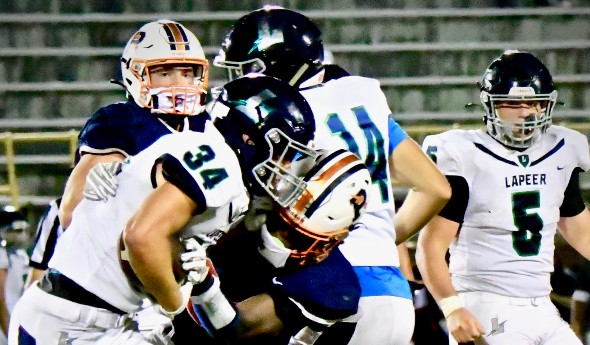
PHOTO: Lapeer is looking to improve to 3-0 after downing Flint Powers Catholic 36-21 last week. (Photo by Terry Lyons.)