

Drive for Detroit: Week 5 Preview
September 26, 2019
By Geoff Kimmerly
Second Half editor
With 600 high school teams in Michigan and good games always to be found, just about any week could be called “Rivalry Week” as the term is often hyped at the college and pro levels.
 But this week in this state is a little more special this fall.
A number of the best rivalries – longtime or emerging – will be played out over the next two days, and we offer a glance at a number of those games below. You’ll have a chance to check out a bunch, as seven of the games mentioned in this preview are among the 32 that will be broadcast live on MHSAA.tv – click here for the schedule.
"Drive for Detroit" is sponsored by MI Student Aid.
Bay & Thumb
Grand Blanc (4-0) at Davison (4-0)
These teams entered this game last season under almost identical circumstances – and Davison exited with a 49-7 win on the way to finishing second to Lapeer in the Saginaw Valley League Blue. Those three appear to be the main title contenders again, and Davison has won its first two Blue games by a combined 104-0 while Grand Blanc also opened league play last week with a shutout. Last season’s loss started a rough finish for the Bobcats, and they face a tough regular-season second half again with Lapeer, Flint Powers Catholic and Saline coming up. Obviously, a win tonight would provide a sizable lift heading into that string.
Keep an eye on these: FRIDAY Harbor Beach (4-0) at Ubly (4-0), Saginaw Swan Valley (3-1) at Frankenmuth (4-0), Fenton (3-1) at Flint Kearsley (4-0), Breckenridge (3-1) at Merrill (3-1).
Greater Detroit
Macomb Dakota (3-1) at Clinton Township Chippewa Valley (4-0)
One of the best rivalries in the state again matches up the teams tied for first in the Macomb Area Conference Red. Chippewa Valley is riding an 18-game winning streak after claiming last season’s Division 1 championship and has won four straight over Dakota – with victories over the Cougars during the playoffs as well the last two seasons. Dakota’s only slip-up this fall came Week 1 against still-unbeaten Orchard Lake St. Mary’s, and it will be interesting to see how this meeting shakes out. The Big Reds won by only seven, 24-17, the first time they played in 2018 but 51-10 in the District Final rematch.
Keep an eye on these: FRIDAY West Bloomfield (3-1) at Lake Orion (4-0), Brownstown Woodhaven (4-0) at Allen Park (3-1), North Farmington (4-0) at Auburn Hills Avondale (3-1), Warren De La Salle Collegiate (2-2) at Orchard Lake St. Mary's (4-0).
Mid-Michigan
Portland (4-0) at Lansing Catholic (4-0)
This one gets top billing by just a smidge over East Lansing/DeWitt, as Portland can claim supremacy in the Lansing area so far thanks to its two-point Week 2 win over the Panthers. The Raiders have otherwise dominated coming off last year’s Division 5 runner-up finish, but Lansing Catholic surely has been looking forward to this opportunity. Not only will tonight’s game likely eventually decide the Capital Area Activities Conference White champion, but Portland handed the Cougars their only two losses last season – by a combined 12 points.
Keep an eye on these: FRIDAY East Lansing (3-1) at DeWitt (3-1), Sanford Meridian (4-0) at Clare (4-0), St. Johns (3-1) at Mason (4-0), Laingsburg (3-1) at Pewamo-Westphalia (4-0).
Northern Lower Peninsula
Johannesburg-Lewiston (4-0) at Tawas (3-1)
The Cardinals are tied for first in the Northern Michigan Football League Legacy division after winning the title outright a year ago, and they’ve dominated for most of 2019 so far. But this nonleague meeting starts a string of games against four straight playoff hopefuls. Tawas was a qualifier last season and this fall is just a two-point opening-night loss to Alcona from a perfect start as well.
Keep an eye on these: FRIDAY Charlevoix (3-1) at Frankfort (2-2), Mancelona (2-2) at Elk Rapids (2-2). SATURDAY Alpena (2-2) at Traverse City West (2-2), Gaylord (2-2) at Traverse City Central (3-1).
Southeast & Border
Marshall (3-1) at Jackson Lumen Christi (4-0)
By nature of this kind of success, as Lumen Christi’s state-best 27-game winning streak continues to grow, every matchup will be scrutinized that much more. The Titans have beaten Marshall in three straight but scored a season low in last year’s 21-0 shutout of the Redhawks. And this is a better Marshall team; after three straight seasons winning three or four games, Marshall is a one-point opening-night loss to Freeland from 4-0. Meanwhile, another win could just about seal up the Interstate 8 Athletic Conference title for Lumen – its final three league opponents are a combined 3-9.
Keep an eye on these: FRIDAY Chelsea (4-0) at Jackson (3-1), Britton Deerfield (3-1) at Sand Creek (3-1), Hillsdale (4-0) at Hudson (2-2), Brooklyn Columbia Central (3-1) at Onsted (2-2).
Southwest Corridor
Battle Creek Lakeview (4-0) at Kalamazoo Central (2-2)
Lakeview has had a nice run through the 2010s with five playoff appearances in a row from 2012-16. But last season the Spartans won two games, their fewest since 2002 – although that should be fading from memory with this start. A win tonight would bury it further, as defeating reigning champion Kalamazoo Central would earn Lakeview a share of the Southwestern Michigan Athletic Conference East title – its first since 2015. But making it happen might take the Spartans’ best performance so far. The Maroon Giants have suffered their two losses by just a combined seven points, and the last three meetings with Lakeview all have been decided by eight points or fewer.
Keep an eye on these: FRIDAY Cassopolis (4-0) at Decatur (2-2), Portage Central (2-2) at Stevensville Lakeshore (2-2), Benton Harbor (2-2) at Battle Creek Central (1-3). SATURDAY Delton Kellogg (3-1) at Schoolcraft (4-0).
Upper Peninsula
Lake Linden-Hubbell (3-1) at L'Anse (3-1)
These teams are enjoying similar jumpstarts this fall but with this nonleague matchup key to their postseason hopes. The Lakes were 10-1 as recently as 2016, but won just two games last season. A two-point Week 2 loss to Ishpeming is all that’s kept them from 4-0, but their next two games are against the leaders of their Western Peninsula Athletic Conference Iron division. Despite opening with a loss to Hancock, the Purple Hornets have equaled their win total from all of last season as they pursue a first playoff berth since 2013 – but with a tough slate of West PAC Copper games coming up to finish the regular season.
Keep an eye on these: FRIDAY Escanaba (3-1) at Kingsford (2-2), Iron Mountain (4-0) at Bark River-Harris (3-1), Boyne City (2-2) at Menominee (3-1), Ogemaw Heights (3-1) at Sault Ste. Marie (3-1).
West Michigan
Muskegon Oakridge (4-0) at Montague (4-0)
This has as much claim to being Michigan’s best matchup of the weekend as any listed above or below, after Montague won last year’s meeting 25-24 on a touchdown and 2-point conversion with no time left. Oakridge went on to win out before falling by three to eventual Division 5 champion Hudsonville Unity Christian in the District Final – meaning the Eagles’ two defeats were by a combined four points to teams that ended up at Ford Field. Montague was runner-up in Division 6 and opened 2019 by avenging last season’s loss to Reed City.
Keep an eye on these: FRIDAY Hudsonville Unity Christian (3-1) at Grand Rapids South Christian (3-1), Byron Center (4-0) at Zeeland West (4-0), East Kentwood (3-1) at Grandville (4-0), Manistee (3-1) at Muskegon Orchard View (4-0).
8-Player
Colon (4-0) at Climax-Scotts (4-0)
As expected, things got a little more competitive last week for Climax-Scotts as it continued to march through its first season of 8-player. But a 16-12 win over Camden-Frontier set the Panthers up to take on reigning Southern Central Athletic Association A champion Colon with an opportunity to win a share of the league title. The Magi have outscored their opponents by a combined 197-18 and have a few reasons to be amped. Not only does this stack up as one of the top 8-player matchups of the regular season statewide, but Climax-Scotts beat Colon in 11 straight 11-player games from 2008 through 2017.
Keep an eye on these: FRIDAY Vestaburg (4-0) at Portland St. Patrick (4-0), Mio (3-1) at Hillman (4-0), Cedarville (2-2) at Brimley (4-0), Martin (4-0) at St. Joseph Lake Michigan Catholic (2-2).
Second Half’s weekly “Drive for Detroit” previews are powered by MI Student Aid, a part of the Office of Postsecondary Financial Planning located within the Michigan Department of Treasury. MI Student Aid encourages students to pursue postsecondary education by providing access to student financial resources and information. MI Student Aid administers the state’s 529 college savings programs (MET/MESP), as well as scholarship and grant programs that help make college Accessible, Affordable and Attainable for you. Connect with MI Student Aid at www.michigan.gov/mistudentaid and find more information on Facebook and Twitter @mistudentaid.
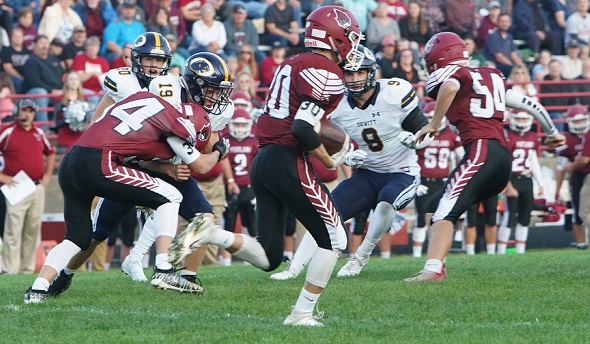
PHOTO: Portland edged DeWitt 29-27 in Week 2. Both play this weekend in games that eventually could decide their leagues’ champions. (Click for more from HighSchoolSportsScene.com.)
A Game for Every Fan: Week 5
September 24, 2015
By Geoff Kimmerly
Second Half editor
Halftime of this weekend’s games will mark the midway point of the 2015 football regular season.
And the final results this Friday and Saturday could prove to be turning points for a number of teams playing for league titles all over the state.
The Week 5 slate is filled with matchups of teams tied for first place in their respective leagues, plus others pitting leaders against those in second and hoping to move up. The report below touches on many, but not all of these – tune in to the Score Center this weekend for scores and updated standings as those games are decided.
Bay & Thumb
Frankenmuth (4-0) at Millington (4-0)
The latest chapter in this Tri-Valley Conference East rivalry should again decide the champion. Millington handed the Eagles their only loss of the 2014 regular season – although these two then shared the title with Birch Run after the Panthers beat the Cardinals. Millington has won nine of the last 15 meetings, but Frankenmuth holds a slim 22-20 edge going back to their first reported meeting in 1956.
Others that caught my eye: Almont (4-0) at Richmond (4-0), Mount Pleasant (3-1) at Lapeer (4-0), Flint Powers Catholic (3-1) at Midland Dow (3-1), St. Clair Shores South Lake (4-0) at Marine City (3-1).
Greater Detroit
Detroit Cass Tech (4-0) at Detroit Martin Luther King (4-0)
This Detroit Public School League rivalry game always is anticipated, but this season more than most. King’s only regular-season loss last season was to Cass Tech, in the PSL championship game; the Crusaders then saw their season end in the first round of the playoffs the next week. However, they opened this fall by beating reigning Division 2 champion Warren DeLaSalle. Cass Tech hasn’t lost a regular-season game since Week 8 of 2012 – to King – but despite dominating four opponents that had winning records a year ago, might be behind the Crusaders in terms of generating statewide buzz.
Others that caught my eye: Warren Mott (4-0) at Clinton Township Chippewa Valley (3-1), Belleville (3-1) at Dearborn Heights Robichaud (4-0), Southfield (3-1) at Farmington Hills Harrison (3-1), Warren DeLaSalle (3-1) at Orchard Lake St. Mary's (4-0).
Mid-Michigan
Olivet (3-1) at Lake Odessa Lakewood (4-0)
Lakewood has plenty of history it would like to still make, but consider this from the Vikings’ start: they are 4-0 for the first time since 1974. Those four wins tie the total for all of last season and tie the team’s most for a season since 2005. Lakewood’s 176 points through four games is more than they scored during 14 of the last 20 seasons. But Olivet certainly can dampen the excitement by winning tonight’s Greater Lansing Activities Conference matchup, like the Eagles did last season 42-9 on the way to winning the league title.
Others that caught my eye: Jackson (3-1) at Grand Ledge (4-0), Flint Beecher (4-0) at Corunna (3-1), Haslett (3-1) at Mason (2-2), Holt (2-2) at East Lansing (2-2).
Northern Lower Peninsula
Boyne City (4-0) at Traverse City St. Francis (4-0)
By the smallest of margins, this game gets top billing over two others matching undefeated teams. For starters, Boyne City won the matchup last season 28-27 – and eventually, the Northern Michigan Football Conference Leaders division title. The Ramblers then made the Division 6 Semifinals, and then graduated a significant group of contributors – but has come back to shut out two of its first four opponents. Then again, St. Francis didn’t give up a point this season until last week and is sparking statewide chatter like its contending teams of a few years ago.
Others that caught my eye: Gaylord (4-0) at Traverse City Central (4-0), St. Ignace (4-0) at Johannesburg-Lewiston (4-0), Onekama (4-0) at Maple City Glen Lake (3-1), McBain (3-1) at Manton (2-2).
Southeast & Border
Clinton (4-0) at Morenci (4-0)
Morenci won 10 games last fall for the first time since 1996 – but the only blemish on an otherwise incredible regular-season run was a 28-26 loss to Clinton that ended up deciding the Tri-County Conference championship. All four of the Bulldogs’ wins this season are against teams .500 or better so far, lining this up as again a likely league title decider – Clinton has shut out two of its first four opponents and won 31 straight regular-season games.
Others that caught my eye: Brooklyn Columbia Central (4-0) at Ida (4-0), Monroe (3-1) at Ann Arbor Pioneer (4-0), Chelsea (4-0) at Tecumseh (2-2), New Boston Huron (2-2) at Milan (3-1).
Southwest Corridor
Berrien Springs (4-0) at Bridgman (4-0)
Both of these programs have enjoyed recent success; Bridgman has made the playoffs three straight seasons, and Berrien Springs made the postseason last year and two of the last four. But there’s a little more intrigue although these teams don’t play in the same division of the Berrien-Cass-St. Joseph Conference. Bridgman has never started 4-0 – and looks like the BCS Blue favorite. Berrien Springs likely will battle Buchanan in the BCS White and hasn’t allowed a point in two weeks, most recently shutting out BCS Red favorite Cassopolis.
Others that caught my eye: Saugatuck (4-0) at Decatur (3-1), Dowagiac (3-1) at Edwardsburg (4-0), Jackson Lumen Christi (4-0) at Marshall (3-1), Sturgis (3-1) at Vicksburg (3-1).
Upper Peninsula
Lake Linden-Hubbell (4-0) at L'Anse (3-1)
The Lakes are used to success and have made the playoffs nine of the last 11 seasons – but are 4-0 for the first time since winning 10 games in 2009 and on pace to score their most points since 1997. L’Anse has bounced back from 4-5 a year ago but has a tough schedule over the season’s second half – and would enjoy the momentum from playing a tough opponent well this weekend.
Others that caught my eye: Crystal Falls Forest Park (2-2) at Newberry (3-1), Detroit Country Day (3-1) at Escanaba (2-2), Ishpeming Westwood (2-2) at Iron Mountain (2-2), Felch North Dickinson (1-3) at Bark River-Harris (4-0).
West Michigan
Montague (4-0) at Whitehall (3-1)
The season’s first half has been one of resurgence for Montague, one of the state’s most successful programs during the first decade of the 2000s. The Wildcats are 4-0 for the first time since 2010 and after going only 2-7 a year ago. They’re giving up points, but scoring more including 70 on Ravenna and 55 against Shelby. Whitehall did fall by a score to undefeated Traverse City Central last week, but otherwise navigated well a solid nonleague slate – and beat Montague 48-20 a year ago.
Others that caught my eye: Hudsonville Unity Christian (3-1) at Byron Center (3-1), Grand Rapids Christian (3-1) at Hudsonville (3-1), Zeeland East (3-1) at Muskegon Mona Shores (4-0), Caledonia (2-2) at Rockford (2-2).
8-Player
Posen (4-0) at Pickford (3-1)
Pickford should be finding 8-player football to its liking so far. The Panthers, in their first season, have one more win than they earned all of 2014 and have lost this fall only to reigning MHSAA runner-up Cedarville. Posen has shown to be in a similar elite class so far, especially after last week’s 30-point win over always-tough Bellaire – and the Vikings have guaranteed tying their best finish since 2010.
Others that caught my eye: Webberville (4-0) at Waldron (4-0), Owendale-Gagetown (4-0) at Akron-Fairgrove (3-1).
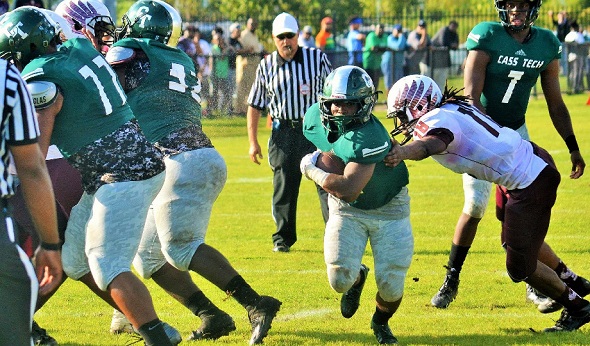
PHOTO: A Detroit Cass Tech ball carrier breaks through during the Technicians’ win this season against Detroit Renaissance. (Photo courtesy of Detroit Public School League.)