


Drive for Detroit: Week 6 in Review
October 8, 2013
By Geoff Kimmerly
Second Half editor
A handful of undefeated teams ended perfect seasons for others during Week 6, and a number of league races began to clear up as we finished the second third of the football regular season.
But we'll assume no team celebrated its win with more relief than the team that hadn't won in quite a while.
We don't often point to a lack of success, but Lincoln Park deserves a shout for its perseverance over the last eight seasons. The Railsplitters sit 1-5 thanks to their first win last week since the second week of 2006.
You do the math, but keep in mind the streak included four losses by five points or fewer. Lincoln Park clearly earned some fans statewide as it battled on, and they'll surely be rooting for that next win to come soon as well.
For the rest of Week 6 results of most significance all over the state, read on.
West Michigan
Shelby 22, Muskegon Oakridge 19
Thanks in part to a trick play-turned-touchdown with 25 seconds to play, Shelby ended Oakridge’s 18-game regular-season winning streak and a personal four-game losing streak against its West Michigan Conference rival. Shelby (6-0) still has a few tough games left on the league schedule, and Oakridge (5-1) will be hoping for an upset so it can claim a share of the title. Click to read more from the Muskegon Chronicle.
Also noted:
Lowell 42, East Grand Rapids 39 (4 OT): This is one of those games that draws statewide eyes, and was decided in extra periods after East Grand Rapids (3-3) cut a halftime deficit before Lowell (6-0) prevailed.
Muskegon Reeths-Puffer 46, Zeeland East 26: The Reeths-Puffer revival continues, with the Rockets now 5-1 – they won a combined 10 games from 2008-12 – and their win over Zeeland East (5-1) was one of their most impressive of the last decade.
Grand Rapids South Christian 35, Grand Rapids Catholic Central 29 (OT): Losing to GRCC and finished second in the O-K Gold to the Cougars (3-3) was one of South Christian’s few disappointments during its Division 4 championship season of 2012; the Sailors (5-1) look strong to claim the league title this time.
Grandville Calvin Christian 17, Hopkins 16: This turned the O-K Silver into a three-team race, with these two and NorthPointe Christian all tied for first with two league games to play (but none against each other). Calvin Christian improved to 3-3 overall and Hopkins fell to 4-2.
Lower Up North
Lincoln Alcona 63, Oscoda 10
Lincoln Alcona moved to the North Star League this fall. So far, so good. The Tigers claimed their first league title ever with this Battle of F41 trophy game win, and at 6-0 qualified for the playoffs for the second straight season – and fourth time ever. Click to read more from the Bay City Times.
Also noted:
Grayling 48, Elk Rapids 28: The Elks (4-2) were major obstacles Grayling (5-1) needed to overcome to continue surging in the Lake Michigan Conference.
Indian River Inland Lakes 56, Central Lake 30: Inland Lakes (4-2) equaled its win totals of each of the last four seasons; Central Lake fell to 2-4.
Petoskey 42, Traverse City Central 37: Neither is likely to still contend in the Big North Conference this season, but this likely will end up a key result as both are 3-3 overall.
Lake City 46, McBain 0: Wow. Lake City (6-0) has given up just six points this season, and also shut out a McBain team that at 4-2 will push for a playoff spot.
Upper Peninsula
Crystal Falls Forest Park 43, Felch North Dickinson 20
These small-school powers have faced off at least once every season (and multiple times when they've also met in the playoffs) since 1992. Forest Park (6-0) entered in first place in the Great Western Conference, and North Dickinson (5-1) is the same in the Mid-Eastern Conference. Although this helps neither’s league chances, it does give Forest Park a 16-11 edge in their 27 recent meetings. Click to read more from the Iron County Reporter.
Also noted:
Iron River West Iron County 41, Calumet 0: The Copper Kings (0-6) are having a are down season, but West Iron (6-0) appears to be building one of its best.
Marquette 24, Kingsford 0: Marquette (5-1) kept pace just one win back of Great Northern UP Conference leader Menominee with another impressive win, this one over the frequently-contending Flivvers (4-2).
Rapid River 45, Cedarville 28: Few teams have had Cedarville’s number during the three seasons of 8-player football, and only Rapid River (6-0) has beaten the Trojans (5-1) the last two seasons.
Engadine 36, Posen 20: Engadine (1-5) has had a tough couple seasons, but beating solid Posen (4-2) is something the Vikings surely enjoyed.
Greater Detroit and Southeast
Milan 21, Monroe St. Mary Catholic Central 14
Make that 15 straight regular-season wins for Milan (6-0) and a strong edge moving forward as it attempts to claim a second straight Huron League championship. To beat its toughest competition this season, Milan had to hold off St. Mary (5-1) after jumping out to a 14-0 lead. Click to read more from the Monroe Evening News.
Also noted:
Waterford Our Lady 21, Royal Oak Shrine 14: The Lakers (4-2) have now won four straight and have a one-game lead in the Catholic League Intersectional after handing a first loss this season to Shrine (5-1).
Manchester 29, Grass Lake 18: The Warriors (5-1) were one of two teams challenging first-place Manchester (5-1) atop the Cascades Conference; the other, Michigan Center, comes up in Week 8.
Ida 36, Hudson 28 (OT): The Bluestreaks (5-1) took a strong step toward their first Lenawee County Athletic Association championship since sharing the title in 1997 by outlasting the formerly first-place Tigers (5-1).
St. Clair 36, Marysville 13: This left St. Clair (6-0) and Marine City as the lone undefeated teams in the Macomb Area Conference Gold, with Marysville (4-2) now a game back in the league standings.
Bay and Thumb
Marlette 36, Vassar 35
Marlette (6-0) has had some solid teams over the last decade, but never one that has come out of the gate like this one. Marlette has scored at least 35 points in every game and just edged a Vassar team (3-3) contending for a playoff spot. MHSAA Student Advisory Council member Connor Thomas caught three touchdown passes for the Raiders. Click to read more from the Tuscola Advertiser.
Also noted:
Frankenmuth 21, Millington 6: The Eagles (5-1) have beaten their rivals two straight seasons and can clinch a share of the Tri-Valley Conference East title this week. Millington (4-2) must hope for a loss and then beat second-place North Branch to stay in the hunt.
Davison 35, Flint Powers Catholic 17: Ended is the rough start for Davison (3-3), which has won three straight to potentially set up a Week 9 matchup with Flint Carman-Ainsworth for the Saginaw Valley Association South title. Powers is 3-3 with losses to teams that are combined 12-6 this fall.
Fenton 30, Lapeer East 7: The Tigers (6-0) are making space atop the Flint Metro League standings, pushing the Eagles (3-3) back to fourth with Lapeer West and Swartz Creek still tied for second.
Saginaw Heritage 21, Saginaw Arthur Hill 8: These teams appear to be moving different directions – Arthur Hill (3-3) has lost three straight, and Heritage (4-2) has won its last three.
Southwest and Border
Schoolcraft 28, Battle Creek Pennfield 22
It’s possible some considered Schoolcraft (5-1) out of the Kalamazoo Valley Association race after it fell to Olivet in Week 3. Not so fast. The reigning champion is just a game back and now will be rooting for Pennfield (5-1) – which also is tied for second place and faces first-place Olivet this week. The Eagles also must face Constantine in Week 8, another matchup we’ll surely be watching. Click to read more from the Kalamazoo Gazette.
Also noted:
Climax-Scotts 21, Pittsford 14: Climax-Scotts (6-0) has won six straight over the Wildcats (4-2), but they haven’t come easily; this was the fourth straight decided by eight points or fewer.
Bridgman 22, Cassopolis 21: This also has turned into a close one of late, with Bridgman (4-2) also beating Cassopolis (3-3) last season by only three points.
Lawton 33, Hartford 22: The Blue Devils (6-0) kept pace with Watervliet in the ultra-competitive Southwestern Athletic Conference South, with Hartford (3-3) now looking to win out to make the playoffs for the fourth straight season.
Lawrence 53, Deckerville 38: The move to 8-player continues to look great for Lawrence (4-1 in 8-player, 5-1 overall), which looks like a title contender after beating last season’s MHSAA champion Deckerville (3-3).
Mid-Michigan
Homer 40, Jonesville 12
Homer moved to 6-0, and in the process earned its first playoff appearance since 2006 and got within one more win of claiming at least a share of its first Big 8 Conference title since 2005. Jonesville fell to 5-1, but still looks strong to make the postseason for the second straight. Click to read more from the Jackson Citizen-Patriot.
Also noted:
Lansing Sexton 48, Holt 7: No team since Chelsea on opening night has come closer than 21 points to the Big Reds (6-0), who handed Holt (3-3) its first loss since Week 2.
Lansing Everett 25, East Lansing 17: This left Everett (5-1) with Grand Ledge and Holt as one of three teams one game back of Sexton in the Capital Area Activities Conference Blue, but the only one of the three still to face the Big Reds; East Lansing (3-3) has dropped two straight and faces Sexton this week.
Jackson Lumen Christi 35, Mason 0: This should sew up the CAAC Gold title for the Titans (6-0), with Mason (4-2) still looking great to qualify for the playoffs.
Portland 43, Williamston 22: This gave Portland (6-0) at least a share of the CAAC White title, with Williamston (4-2) and Lansing Catholic a game back and facing each other this week.
Trophy games
Each week, the MHSAA highlights trophy games around the state. Here are a few in addition to the one mentioned above:
County Line Trophy: Bath vs. Laingsburg. These two renewed this rivalry in 1986 and have played annually since, with the Bees last weekend ending a two-game losing streak to their rival. Final: Bath 20, Laingsburg 19.
Old US 131 Trophy: Big Rapids vs. Morley-Stanwood. Big Rapids has followed up three straight losses to this rival with two straight wins. Final: Big Rapids 30, Morley-Stanwood 9.
Friendship Trophy: Coopersville vs. Sparta. These two have played every season since 1966, most recently as members of the O-K Blue. Final: Sparta 41, Coopersville 14.
Hinker Bell Game: Escanaba vs. Menominee. These two continue to face off annually in a game that recalls this trophy although it disappeared a number of years ago. Final: Menominee 44, Escanaba 0.
PHOTO: Lowell (on offense) needed four overtimes to hold off East Grand Rapids on the Pioneers' Homecoming night.
Drive for Detroit: Week 8 Preview
October 17, 2019
By Geoff Kimmerly
Second Half editor
How much should fans enjoy the final two weeks of this football regular season?
 There are 93 leagues for the sport statewide, and 35 championships remain completely up for grabs. Another 35 leagues have had one team clinch a share of the title but still have the possibility for another to join the celebration.
And the playoff picture is similarly a slightly-filled canvas. A total of 346 teams (out of 531 total) remain eligible for at least an additional qualifier berth in the 256-team 11-player field. A total of 110 teams have secured their spots – but 86 more teams can clinch with a win this week.
On the 8-player side, the 32 playoff spots will remain in flux through Week 9 – and it looks like up to 55 teams still have a chance to make that field.
Below again is a look at many games that will tilt these numbers this weekend. The MHSAA.tv live streaming schedule includes 33 games – click for the full listing and links to each game. All games below are Friday unless noted.
"Drive for Detroit" is sponsored by MI Student Aid.
Bay & Thumb
Marine City (7-0) at Marysville (5-2)
The Mariners handed St. Clair its lone league loss last week to earn a share of the Macomb Area Conference Silver title, and will finish the league schedule against the other team tied for second in Marysville. If the Vikings are able to break a two-game losing streak in this series, it will create a three-way shared Silver championship. But they will have to crack a Marine City defense giving up just 8.4 points per game.
Keep an eye on these: FRIDAY Fenton (6-1) at Goodrich (6-1), Flint Powers Catholic (5-2) at Grand Blanc (5-2), Bloomfield Hills Brother Rice (5-2) at Lapeer (6-1), Montrose (6-1) at Byron (5-2).
Greater Detroit
Romeo (6-1) at Clinton Township Chippewa Valley (7-0)
For the second straight season, Chippewa Valley enters this Macomb Area Conference Red finale with a perfect record and Romeo has a chance to break up the league title with a win. The Bulldogs and Utica Eisenhower are tied for second, one game behind the Big Reds, and Romeo fell only 41-34 last season in giving Chippewa Valley one of the toughest games of its undefeated Division 1 championship run.
Keep an eye on these: FRIDAY Royal Oak Shrine (6-1) at Clarkston Everest Collegiate (6-0), Clawson (4-3) at Clinton Township Clintondale (5-2), Farmington (7-0) at North Farmington (7-0), Belleville (7-0) at Livonia Franklin (6-1), Detroit Catholic Central (4-3) at River Rouge (6-1).
Mid-Michigan
Fowler (7-0) at Pewamo-Westphalia (7-0)
This season has been a little unfair to the Eagles, and be sure they’ll use that as motivation tonight. It’s hard to not talk about Pewamo-Westphalia – a lot – when the Pirates are outscoring their opponents by a combined 312-14 with five shutouts, including one over reigning Division 8 champion Reading (which is otherwise averaging 52 points per game). But a few miles over from that all-out domination, rival Fowler is outscoring its opponents 295-70, giving up more than 13 points in a game just once, and with a chance to take the Central Michigan Athletic Conference title outright if they get past the rival Pirates for the first time since 2014.
Keep an eye on these: FRIDAY Portland (7-0) at Mason (7-0), St. Joseph (6-1) at DeWitt (5-2), Fowlerville (6-1) at Lansing Catholic (6-1), Olivet (7-0) at Williamston (4-3).
Northern Lower Peninsula
Maple City Glen Lake (6-1) at Charlevoix (5-2)
The leaders of the Northern Michigan Football League Leaders division will meet for the outright championship tonight. A win would give Glen Lake its third straight league title, and of course it would be celebrated – especially bouncing back from last week’s loss to Kingsley. But a win for Charlevoix would be historic; the Rayders not only would clinch a first playoff berth since 2016, but the league title would be the program’s first since 1987 and after a number of runner-up finishes over the years. Glen Lake has won the last six meetings between these teams, including three over the last three years in NMFL play.
Keep an eye on these: FRIDAY Breckenridge (6-1) at Oscoda (7-0), Beal City (7-0) at McBain (4-3), Johannesburg-Lewiston (7-0) at Frankfort (3-4), Ogemaw Heights (5-2) at Grayling (3-4).
Southeast & Border
Milan (7-0) at Carleton Airport (5-2)
Milan claimed a share of the Huron League championship last week. And although third-place Airport can’t win a share as well whatever happens tonight, second-place Monroe St. Mary Catholic Central surely is cheering the Jets on. Milan has won the last eight against Airport, including once in the playoffs, but four of those games were decided by eight or fewer points – including last season’s when the Big Reds won 35-30.
Keep an eye on these: FRIDAY Ann Arbor Pioneer (4-3) at Saline (6-1), Manchester (5-2) at Grass Lake (6-1), Britton Deerfield (4-3) at Ottawa Lake Whiteford (4-3), Jackson (5-2) at Pinckney (5-2).
Southwest Corridor
Kalamazoo United (4-3) at Constantine (5-2)
As we consider what United will try to accomplish over the next two weeks – defeating Constantine and then unbeaten Schoolcraft to earn a third-straight playoff berth and repeat as Southwestern Athletic Conference Valley champion – it’s important to keep in mind the Titans’ start this fall. They began 0-3 – but the first loss was by two to still-unbeaten Jackson Lumen Christi, and the third defeat by just nine to still-undefeated Berrien Springs. Constantine is in a similar place, however – its losses to Berrien Springs and Schoolcraft were by a combined eight points.
Keep an eye on these: FRIDAY Muskegon Catholic Central (4-2) at Benton Harbor (4-3), Parma Western (5-2) at Marshall (4-3), White Pigeon (6-1) at Mendon (6-1), Dowagiac (4-3) at Vicksburg (5-2).
Upper Peninsula
Traverse City Central (6-1) at Escanaba (6-1)
The Eskymos’ chances of getting some help to climb back into the Great Northern Conference title race are getting slimmer by the week as a three-point Week 4 loss to Marquette still stands as the lone decider for first in that league. But Escanaba can continue to gear up for the playoffs and a run at a fourth-straight District title, and playing much larger Central is a great way to get ready. The Trojans have clinched a share of the Big North Conference title and haven’t lost since Week 1. Interestingly, their six-game winning streak started against Marquette – and they’d surely love to go 2-0 against the GNC’s best after falling to Escanaba by 17 a year ago.
Keep an eye on these: FRIDAY Hancock (4-3) at Calumet (6-1), Iron Mountain (7-0) at L’Anse (4-3), Kingsford (4-3) at Menominee (4-3), Lake Linden-Hubbell (4-3) at Bark River-Harris (5-2).
West Michigan
Muskegon (7-0) at Muskegon Mona Shores (6-1)
Championships could be decided all over the Ottawa-Kent Conference this weekend, but this annual matchup in the Black always is one of the most-hyped games in the state and again deserves lots of attention after both teams reached Ford Field last season. Since falling in the 2018 Division 3 Final, Muskegon has been challenged only by East Grand Rapids in a five-point Week 3 win. The reigning Division 2 runner-up Sailors fell to still-unbeaten Rockford by 13 in Week 4 but otherwise have won all of their games by at least 20 points. The Big Reds have won the last four in this series, and regardless of the outcome this latest chapter will be entertaining – the total points scored has increased every game over the last four, with Muskegon winning 55-35 in 2018.
Keep an eye on these: FRIDAY Rockford (7-0) at Grandville (6-1), Ravenna (6-1) at Muskegon Oakridge (7-0), Grand Rapids Christian (5-2) at East Grand Rapids (5-2), Byron Center (7-0) vs. Hudsonville Unity Christian (5-2) at Hope College.
8-Player
Deckerville (7-0) at Kingston (6-1)
A share of the North Central Thumb League Blue championship goes to the victor, and in Deckerville’s case would guarantee a fourth consecutive league title. Two of the last five years this matchup determined the league champion, and a third time Kingston defeated Morrice to help Deckerville take back a share of first place after falling to the Orioles a week earlier in 2017. The Eagles have won all 12 against the Cardinals since the teams began playing each other regularly in 2010, including a pair of victories last season as they also met in the playoffs.
Keep an eye on these: FRIDAY Burr Oak (5-2) at Climax-Scotts (6-1), Onekama (5-2) at Suttons Bay (7-0). SATURDAY Morrice (7-0) vs. Crystal Falls Forest Park (5-2) at Pickford, Mio (7-0) at Gaylord St. Mary (2-5).
Second Half’s weekly “Drive for Detroit” previews are powered by MI Student Aid, a part of the Office of Postsecondary Financial Planning located within the Michigan Department of Treasury. MI Student Aid encourages students to pursue postsecondary education by providing access to student financial resources and information. MI Student Aid administers the state’s 529 college savings programs (MET/MESP), as well as scholarship and grant programs that help make college Accessible, Affordable and Attainable for you. Connect with MI Student Aid at www.michigan.gov/mistudentaid and find more information on Facebook and Twitter @mistudentaid.
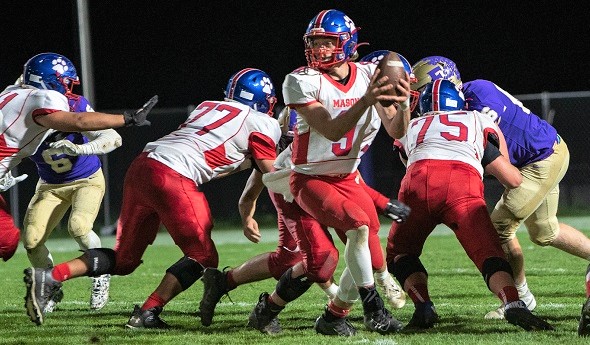
PHOTO: Mason works the ground game during a 21-14 league title-deciding win over Fowlerville on Oct. 4. (Click to see more from High School Sports Scene.)