

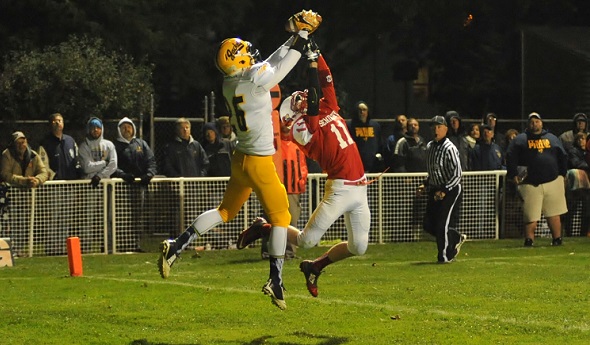
Drive for Detroit: Week 6 in Review
October 5, 2015
By Geoff Kimmerly
Second Half editor
A dramatic event like an emotion-sapping comeback often will steer a team to greater heights as it moves toward the most important games of the season.
That would be good news for some of this week's most impressive football winners.
Traverse City Central trailed 21-0 before beating Petoskey in overtime; Grand Rapids Christian was down 26-0 before winning in OT as well. Calumet trailed Iron River West Iron County 22-0 at halftime before unloading 40 unanswered points, while Northville came back from 14-0 and Muskegon Catholic Central 13-0 to win their likely league title-deciding games.
Those five and a number of others are discussed below – as are a large handful of the 56 11-player teams that have clinched spots in this season's playoff field.
Bay & Thumb
Flint Beecher 27, Lake Fenton 26 (OT)
While a 20-8 Week 5 loss to upstart Corunna no doubt stunned Beecher a bit, the reigning champ Buccaneers came right back to edge Lake Fenton to remain a half-win ahead of the pack in the Genesee Area Conference Red. Beecher is 4-1 in the league with rival Montrose remaining; Corunna, Goodrich and Lake Fenton all are 3-1 in league play with two more games. Beecher made a two-point conversion in overtime, then stopped Lake Fenton’s conversion attempt. Click for more from the Flint Journal.
Also noted:
Algonac 33, Croswell-Lexington 21 – The Muskrats (6-0) gave up their first points since Week 2, but stayed on pace to face Almont this week to decide the Blue Water Area Conference title while dropping Croswell-Lexington (4-2) to fourth place.
Sandusky 48, Marlette 6 – The Redskins (6-0) remained a game ahead of the pack in the Greater Thumb Conference East while putting Marlette (3-3) in a must-win situation to make the playoffs.
Vassar 56, Cass City 21 – The Vulcans (5-1) will face Unionville-Sebewaing this week for first place in the GTC West, but Cass City (4-2) still looks good to make the playoffs for the second straight season.
Burton Bendle 34, Flint Hamady 26 – The Tigers (5-1) pulled within a win of qualifying for the playoffs after going 3-6 a year ago, handing Hamady (5-1) the only loss during what has been its best season since 2012.
Greater Detroit
Northville 24, Livonia Stevenson 14
Since the formation of the Kensington Lakes Activities Association in 2008, Northville is 32-6 in league games – with half of those losses coming to Stevenson. This avenging of last season’s 46-21 loss to the Spartans gave Northville (6-0) a share of the KLAA Central title, although Stevenson (5-1) can still hope for a claim with the Mustangs needing to beat also second-place Novi this week to finish an outright title run. Click for more from MLive-Detroit.
Also noted:
Bloomfield Hills Cranbrook Kingswood 14, Riverview Gabriel Richard 13 – The Cranes (6-0) have equaled their most wins in a season since 2005 and remain tied with Waterford Our Lady atop the Detroit Catholic League C-D standings after pushing Gabriel Richard (5-1) to third.
Allen Park 23, Trenton 13 – The Downriver League is back to a three-team race, with this result bringing Trenton (5-1) back into a tie with Allen Park (5-1) and Wyandotte Roosevelt for first.
Walled Lake Western 34, Walled Lake Northern 31 – The Warriors (6-0) clinched a share of the KLAA North title but not before the Knights (4-2) provided their toughest test since opening night.
Sterling Heights 25, Marine City 19 – In three seasons as a league opponent, the closest Sterling Heights (5-1) had come to Marine City (3-3) was 24 points before claiming this victory to take a one-game lead over three teams in the Macomb Area Conference Gold.
Mid-Michigan
Hartland 14, Brighton 7
The KLAA West title will come down to this week thanks to the Eagles’ win over Brighton (5-1), which created a three-way tie atop the division standings with Howell. Hartland (4-2) shared the league title a year ago, but fell to Howell in this season’s West opener. Brighton gets Howell this week, while Hartland takes on reigning co-champion Grand Blanc. Click for more from the Livingston Daily.
Also noted:
Fowlerville 31, Williamston 28 – The Gladiators’ upset of the Hornets pushed them to 3-3, guaranteeing their most wins in a season since 2010, while putting Williamston (4-2) in a tougher spot with Portland, Haslett and Lake Fenton to finish.
Holt 14, Lansing Sexton 13 – The Rams’ resurgence continued as they moved to 4-2, but it’s hard to not feel for the Big Reds, who are 1-5 but with two one-point losses and a third by two points.
Ithaca 38, Saginaw Michigan Lutheran Seminary 0 – The challenge didn’t come as expected, with Ithaca (6-0) handing MLS (5-1) its first loss and pulling within a win of clinching another Tri-Valley Conference West title.
DeWitt 27, Haslett 10 – The Panthers (6-0) have yet to give up more than 14 points this season, although Haslett (3-3) did hold DeWitt to its season low on offense.
Northern Lower Peninsula
Traverse City Central 28, Petoskey 27 (OT)
The Trojans (6-0) came all the way back from three scores down and stopped a two-point conversion run in overtime to remain atop the Big North Conference, one game ahead of three teams including Petoskey (4-2). Traverse City Central’s last four wins have come by seven points or fewer, and it had lost to the Northmen the last two seasons. Click for more from the Traverse City Record-Eagle.
Also noted:
Beal City 42, McBain 22 – The Aggies (5-1) bounced back from last week’s shocking loss to Evart to stay tied for first with McBain (4-2) in the Highland Conference with one league game left for both.
Traverse City St. Francis 63, Grayling 28 – The Gladiators (6-0) all but locked up the Northern Michigan Football Conference Leaders title with their win over Grayling (4-2) giving them victories over both second-place teams.
Reed City 22, Big Rapids 7 – The Coyotes (6-0) remain tied for first in the Central State Activities Association Gold, while Big Rapids (4-2) moved to third but with a chance to stay in the hunt this week against co-leader Remus Chippewa Hills.
Johannesburg-Lewiston 58, Detroit Consortium 30 – Logan Huff did a lot of everything for the Cardinals (5-1), running eight times for 245 yards and three touchdowns, leading the team with 11 tackles and grabbing an interception against Consortium (2-4).
Southeast & Border
Saline 37, Ann Arbor Pioneer 21
Saline remained in control of the Southeastern Conference Red winning a game that played much closer than the final 16-point margin. Pioneer (5-1) scored the first points the Hornets had given up since Week 3. But Saline (6-0) took advantage of a few key Pioneer errors to clinch a share of the league title with third-place Monroe the last team on the league schedule. Click for more from the Detroit Free Press.
Also noted:
Temperance Bedford 34, Monroe 28 – If the Mules (2-4) get into the playoffs with an at-large bid, edging the Trojans (3-3) might be a big reason why.
Parma Western 28, Battle Creek Harper Creek 25 – Defeating Harper Creek (3-3) could go down as the key victory of a milestone season for the Panthers; Western (4-2) needs two more wins to qualify for the playoffs for the first time, and its Week 8 and 9 opponents are a combined 0-12.
Homer 46, Springport 0 – The Trojans (5-1) pulled to within a win of clinching a share of the Big Eight Conference title, while putting Springport (3-3) into a must-win situation the rest of the way.
Ypsilanti Community 30, Ypsilanti Lincoln 12 – The Grizzlies (3-3) won their third straight and get a shot at first-place Chelsea this week to earn a share of the Southwestern Conference White championship; Lincoln (2-4) must win out to have a slim shot at making the playoffs for the third straight season.
Southwest Corridor
Coldwater 26, Jackson Lumen Christi 7
The Cardinals (6-0) had lost at least 27 straight to Lumen Christi (4-2) and including the game that decided last season’s inaugural Interstate 8 Athletic Conference championship. But this historical win puts Coldwater only one from clinching a share of the league title and in the playoffs for the third straight season; the Cardinals only qualified for the first time in 2013. Click for more from the Coldwater Daily Reporter.
Also noted:
Climax-Scotts 36, Pittsford 0 – Make that 43 straight in the Southern Central Athletic Association for Climax-Scotts (6-0), plus a share of the league title with Pittsford (5-1) one of two teams in second place.
Watervliet 55, Constantine 34 – The Panthers (5-1) kept pace with Delton Kellogg atop the Southwestern Athletic Conference Division 1 while knocking Constantine (3-3) out of the title race.
Plainwell 17, Dowagiac 8 – The Trojans (4-2) have stayed in the upper half of a tough Wolverine B Conference that combined two divisions into one this fall, with Dowagiac (3-3) tied for fifth of 10 teams.
Schoolcraft 47, Lawton 0 – Schoolcraft (6-0) earned a second straight shutout, but this week's much more significant as Lawton (5-1) also entered undefeated and tied for first in the SAC Division 2.
Upper Peninsula
Calumet 40, Iron River West Iron County 22
Reigning Western Peninsula Athletic Conference champion West Iron (1-5) is not the same team this fall. But the Wykons still gave Calumet (4-2) all it could handle as the Copper Kings came back to give themselves a chance to claim the league title this week against co-leader L’Anse. Click for more from the Houghton Daily Mining Gazette.
Also noted:
Sault Ste. Marie 37, Gladstone 27 – The Blue Devils (4-2) continue to line themselves up to return to the playoffs, while Gladstone (2-4) must end a four-game slide to have an at-large shot.
Kingsford 49, Marquette 7 – The Flivvers (4-2) ended a two-game losing streak to Marquette, and may have ended any hope of the Redmen (2-4) returning to the playoffs.
Newberry 50, Gaylord St. Mary 26 – The Indians pulled within a win of tying last season’s total and two from its highest victory count since going 6-3 in 2005.
Hurley, Wis. 52, Bark River-Harris 34 – This didn’t have league implications, but was the first loss of an otherwise stellar season so far for the Broncos (5-1).
West Michigan
Muskegon Catholic Central 29, Fruitport 26
The Lakes 8 Conference championship will belong at least in part to MCC (4-1), which claimed a share against second-place Fruitport (3-3) on a go-ahead touchdown pass with less than a minute to play. The Crusaders have earned at least a share of the league title both seasons in the conference. Click for more from the Muskegon Chronicle.
Also noted:
Grand Rapids Christian 39, East Grand Rapids 33 (OT) – The Eagles (4-2) made the biggest comeback of all teams mentioned above, and with it retained a first-place tie with Lowell while East Grand Rapids (4-2) fell into a tie for third in the Ottawa-Kent Conference White.
Hudsonville 22, East Kentwood 13 – Four teams including both of these still have a shot in the O-K Red, but sharing first with Rockford is a nice spot for Hudsonville (5-1), especially if East Kentwood (4-2) can help with the Rams this week.
Scottville Mason County Central 39, Manistee 6 – The Spartans (4-2) get overlooked a bit in the strong West Michigan Conference, but handing Manistee (5-1) its first loss is headline-worthy.
Cedar Springs 34, Grand Rapids Forest Hills Northern 8 – The reigning O-K Bronze champion Red Hawks (4-2) are again tied with Forest Hills Eastern for first after delivering the first loss this fall to Forest Hills Northern (5-1), which was emerging as the favorite.
8-Player
Posen 28, Cedarville 26
This is more than just the best win of Posen’s six-year 8-player history; it’s arguably the most momentous victory for the Vikings (6-0) in some time. Posen is 6-0, tying its most wins in a season total since going 8-4 in 2004, and joined Rapid River as the only teams to defeat reigning MHSAA runner-up Cedarville (4-2) during the regular season since 2011. Click for more from the Alpena News.
Also noted:
Battle Creek St. Philip 49, Webberville 0 – Webberville (4-2) continues to improve, but St. Philip (6-0) remains among a handful of championship contenders.
Morrice 34, Deckerville 30 – This definitely is the most impressive win in two seasons of 8-player for the Orioles (5-1), as no opponent had come within 20 points of the Eagles (5-1) this fall.
PHOTO: Ithaca, in yellow, won a battle of undefeated teams by downing Saginaw Michigan Lutheran Seminary on Friday. (Click for more from HighSchoolSportsScene.com.)
1st & Goal: 2022 Week 3 Preview
By
Geoff Kimmerly
MHSAA.com senior editor
September 9, 2022
With Labor Day behind us, all Michigan high schools are back in session – and just in time for league competition to begin for several conferences across the state.
 League matchups make up most of our “games to watch” as we prep for Week 3, with the most intriguing from every region highlighted below.
Games are Friday unless noted. Click for the full schedule from MHSAA.com and check out the broadcast schedule from MHSAA.tv.
Bay & Thumb
Armada (2-0) at Croswell-Lexington (2-0)
The way this season has begun – and the way last season ended – makes this matchup look like a potential title-decider in the Blue Water Area Conference. Croswell-Lexington was last year champion, thanks in part to holding off co-runner-up Armada 30-14 in the final game on the league schedule. The Pioneers have outscored their first two opponents this fall by a combined 95-14, while Armada made a loud statement immediately with a 28-27 season-opening win over Marine City, last season’s Division 5 runner-up.
Keep an eye on these FRIDAY Marlette (2-0) at Ubly (2-0), Grand Blanc (1-1) at Saginaw Heritage (2-0), Traverse City Central (1-1) at Davison (1-1), Hemlock (1-1) at Millington (2-0).
Greater Detroit
Livonia Churchill (1-1) at Belleville (2-0)
Belleville is off to another strong start this fall coming off last season’s Division 1 championship. But tonight’s matchup could help the Tigers do one better this fall in their repeat attempt. Churchill last season won the Week 3 meeting 28-21, handing Belleville its first regular-season loss since 2016 and only loss of 2021. But the Chargers must bounce back quickly to make this game another classic after seeing a seven-game winning streak against Westland John Glenn end with a 21-20 loss last week.
Keep an eye on these FRIDAY Clarkston (1-1) at Rochester Adams (2-0), Utica Eisenhower (2-0) at Clinton Township Chippewa Valley (2-0), DeWitt (2-0) at Detroit Catholic Central (1-1), Warren Michigan Collegiate (2-0) at Detroit Country Day (2-0).
Mid-Michigan
Fowler (2-0) at Bath (2-0)
The Bees are off to their best start since 2017, already avenging one loss from when the team finished 2-7 a year ago. But this matchup could tell a lot more about where Bath is headed in 2022. The Bees fell to Fowler 47-14 last season and will be seeking to break a five-game losing streak to the Eagles. Fowler has opened with wins over 2021 playoff qualifiers Carson City-Crystal and Petersburg Summerfield, both by 20-plus points.
Keep an eye on these FRIDAY Saginaw Nouvel (2-0) at Ithaca (1-1), Fowlerville (1-1) at Mason (2-0), Pewamo-Westphalia (1-1) at Dansville (2-0), Durand (2-0) at Ovid-Elsie (1-1).
Northern Lower Peninsula
St. Ignace (2-0) at Frankfort (2-0)
The Saints own one of the best rebound stories of the early going after finishing 2-7 a year ago and winning one game in 2020. They’ve outscored their first opponents by a combined 74-6. Granted, both opponents are winless so far this season and were winless last year as well, but Frankfort will give St. Ignace a better idea how it measures up in what should be a super-competitive Northern Michigan Football League Legacy division. The Panthers have followed their best finish (6-4) since 2017 with a pair of big victories including last week over 2021 playoff qualifier Mancelona.
Keep an eye on these FRIDAY Mount Pleasant (2-0) at Cadillac (1-1), Boyne City (2-0) at Grayling (1-1), Charlevoix (2-0) at Mancelona (1-1), Bay City Western (1-1) at Traverse City West (1-1).
Southeast & Border
Napoleon (2-0) at Manchester (2-0), Saturday
This Saturday showdown presents some interesting possibilities as both look to rise in the Cascades Conference. Napoleon was a contender into October last season before losing the final two games on the league schedule, but was in play in part thanks to a 20-18 win over Manchester in Week 3. The Flying Dutchmen have factored into the race a couple of times since their league title season of 2015, and edged reigning Cascades champion Addison 29-26 last week to re-enter the mix.
Keep an eye on these FRIDAY Grosse Ile (2-0) at Milan (1-1), Hanover-Horton (1-1) at Addison (1-1), Hastings (1-1) at Jackson Lumen Christi (0-2), Centreville (1-1) at Sand Creek (1-1).
Southwest Corridor
Lawton (2-0) at Constantine (1-1)
Lawton is off to another solid start coming off last season’s run to the Division 7 championship game, and additionally the Blue Devils have won 12 straight regular-season games and 25 of their last 26. All but two of those 25 wins were by double digits – with the lone loss to Schoolcraft in 2020 – but Lawton also hasn’t played Constantine since 2017. The Falcons saw their 15-game regular-season winning streak end with a 22-20 loss to reigning Division 8 champion Hudson last week. Before that, no regular-season opponent had come within single digits of catching Constantine since the second game of 2020.
Keep an eye on these FRIDAY Schoolcraft (2-0) at Kalamazoo United (2-0), Battle Creek Lakeview (1-0) at Portage Central (0-2), Plainwell (2-0) at Sturgis (1-1), Allegan (2-0) at Berrien Springs (2-0).
Upper Peninsula
Gladstone (2-0) at Menominee (1-1)
The Maroons regained the Great Northern Conference title last season, sharing it with Kingsford, but earned that claim also because they were able to survive a 35-34 challenge from Gladstone. Menominee has won three straight in this series, but is coming off a rough outing last week against an opponent from Illinois. Gladstone, meanwhile, is off to its third 2-0 start in four seasons but looking to get to 3-0 for the first time since 2017. There’s a little more reason for excitement this time though – both of those first two wins came against 2021 league champions.
Keep an eye on these FRIDAY Houghton (2-0) at Iron Mountain (1-1), Cheboygan (1-1) at Sault Ste. Marie (2-0), Ishpeming Westwood (0-2) at Calumet (0-2). SATURDAY Gaylord (2-0) at Marquette (0-2).
West Michigan
Zeeland East (0-2) at Zeeland West (2-0)
On first glance, this might not seem like much more than the next chapter in a rivalry. But there is some near-uniqueness to this rivalry – it’s one of the few in Michigan where the schools are next door to each other. West has won the last four meetings, including a matchup during the 2019 playoffs, and has rocketed to wins over Stevensville Lakeshore and Cedar Springs – two playoff teams from last season. East’s losses, however, also have come to 2021 playoff qualifiers – Williamston and Spring Lake – and the Chix lost to the Lakers by just seven points.
Keep an eye on these FRIDAY Grand Rapids Forest Hills Central (2-0) at Byron Center (1-1), East Kentwood (1-1) at Grand Haven (1-1), Grand Rapids West Catholic (2-0) at Spring Lake (1-1), Ludington (2-0) at Fremont (2-0).
8-Player
Lake Linden-Hubbell (2-0) at Norway (2-0)
Two-time reigning Division 2 champion Powers North Central has set the pace lately in the Great Lakes Conference West. But the league is full of contenders. The Jets are ranked No. 1 this week, but Crystal Falls Forest Park is No. 3, Lake Linden-Hubbell is No. 5 and Norway could make its way into the Division 1 top 10 with a win over the Lakes. The Knights won last season’s meeting 30-8 and have opened this fall outscoring its first two opponents by a combined 102-12. Lake Linde-Hubbell’s margin is a similar 119-30.
Keep an eye on these FRIDAY Adrian Lenawee Christian (2-0) at Pittsford (2-0), Bridgman (2-0) at Mendon (1-1), Merrill (2-0) at Fulton (1-1). SATURDAY Marion (2-0) at Mesick (2-0).
Second Half’s weekly “1st & Goal” previews and reviews are powered by MI Student Aid, a part of the Office of Postsecondary Financial Planning located within the Michigan Department of Treasury. MI Student Aid encourages students to pursue postsecondary education by providing access to student financial resources and information. MI Student Aid administers the state’s 529 college savings programs (MET/MESP), as well as scholarship and grant programs that help make college Accessible, Affordable and Attainable for you. Connect with MI Student Aid at www.michigan.gov/mistudentaid and find more information on Facebook and Twitter @mistudentaid.
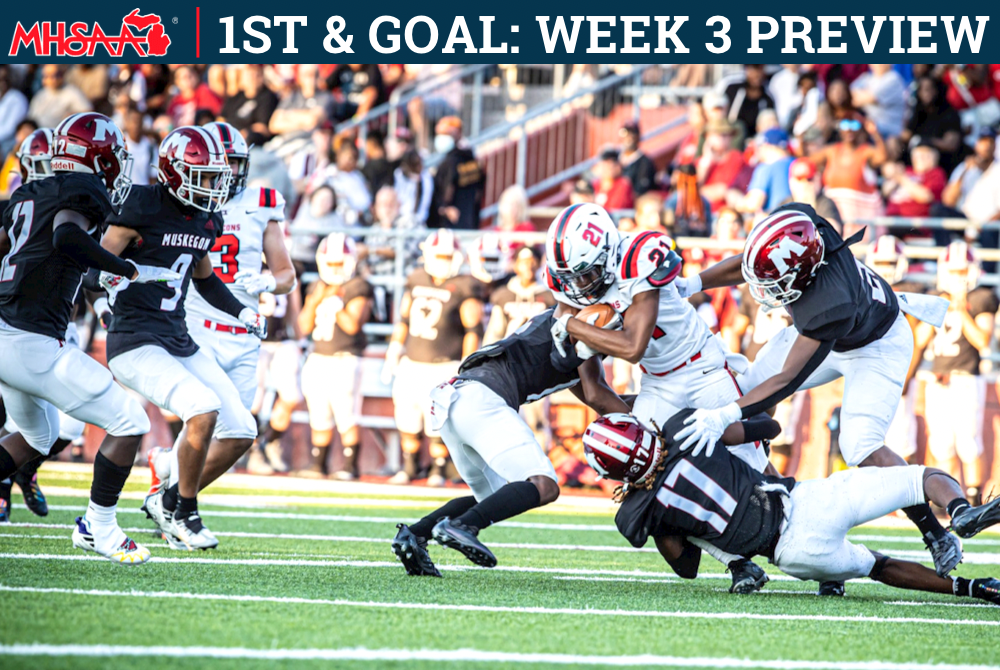
PHOTO: A trio of Muskegon defenders bring down an East Kentwood ball carrier during the Big Reds’ 20-14 season-opening win. (Photo by Tim Reilly.)