

Drive for Detroit: Week 7 in Review
October 12, 2015
By Geoff Kimmerly
Second Half editor
Every game night provides the opportunity for teams and athletes to make history. From 11-player to 8, Week 7 saw its share of those moments.
In last week's preview, we noted at least 20 leagues with games that had immediate championship implications. As we now review, we touch on a number of those below.
Bay & Thumb
Algonac 21, Almont 7
Algonac continued its history-making run, clinching a share of the Blue Water Area Conference title, its first league championship since 1972. The Muskrats (7-0), also celebrating a first winning season and playoff berth since 2005, grabbed the title share against an Almont team that had won 17 straight league games and hadn’t been held to single-digit scoring since Week 3 of 2012. Almont (6-1) is now tied for second place with Richmond, Algonac’s opponent this week. Click for more from the Port Huron Times-Herald.
Also noted:
Vassar 36, Unionville-Sebewaing 24 – The Vulcans (6-1) clinched a share of the Greater Thumb Conference West title by outlasting second-place USA (5-2) and moved to 8-0 against the Patriots since they’ve been in the same league.
Marysville 48, Sterling Heights 21 – The Vikings (5-2) turned the Macomb Area Conference Gold race into a three-team battle with a league game to play by handing Sterling Heights (5-2) its first league loss; those two are tied with Marine City for first place.
Lapeer 49, Midland 21 – The Lightning (7-0) remains perfect for the regular season over its two-year history and earned a share of the Saginaw Valley League Red title by downing the second-place Chemics (6-1).
Sanford Meridian 30, Harrison 8 – The Mustangs (7-0) can clinch a share of the Jack Pine Conference title this week now that they’ve beaten both second-place teams, Clare and Harrison (5-2).
Greater Detroit
Plymouth 31, Canton 20
Plymouth broke a two-game losing streak to the rival Chiefs (5-2) to close out an outright championship in the Kensington Lakes Activities Association South, and after trailing Canton 20-10 at halftime. This was the eighth straight game between the two decided by 12 points or fewer, and earned Plymouth (6-1) the opportunity to host Northville in this week’s KLAA Kensington title game. Click for more from Observer & Eccentric.
Also noted:
Farmington Hills Harrison 13, Farmington 12 – Harrison (6-1) edged one neighbor, Farmington (4-3), to earn a share of the Oakland Activities Association White title, and can finish the run against another, North Farmington, this week.
Birmingham Groves 47, Berkley 14 – A 6-0 start for Groves last season turned into a 1-4 finish beginning with a three-point loss to Berkley (5-2), but the 2015 meeting was all Groves (7-0) as it earned a share of the OAA Blue title.
Orchard Lake St. Mary’s 14, Detroit Catholic Central 7 – The Shamrocks (5-2) and Warren DeLaSalle meet this week to figure out the rest, but those two and St. Mary’s (6-1) are all in the Prep Bowl mix.
Pontiac Notre Dame Prep 33, River Rouge 30 – Notre Dame Prep’s bounce-back from 3-6 last season to 6-1 this fall has included four wins by seven points or fewer including this one over previously-undefeated River Rouge (6-1).
Mid-Michigan
Brighton 14, Howell 11
These KLAA West rivals both played without key contributors and traded their share of momentum-stopping fumbles and interceptions before Brighton (6-1) closed out the win to earn a share of the division championship. The teams have split their last six games. Brighton also clinched a playoff spot, and Howell (5-2) remains alive for what would be a first playoff berth since 2012. Click for more from the Livingston Daily.
Also noted:
Hartland 30, Grand Blanc 27 (OT) – The Eagles (5-2) earned the other share of the KLAA West title by outlasting last season’s champion, Grand Blanc (4-3), and thanks to a win over Brighton two weeks ago also will play for the Lakes Conference title.
DeWitt 49, St. Johns 21 – It’s time to stop talking about DeWitt (7-0) being inexperienced and under the radar after it clinched an outright Capital Area Activities Conference Red title over three others still alive for playoff berths, including the Redwings (5-2).
East Lansing 14, Lansing Sexton 8 – The Trojans (4-3) are staying alive for the playoffs after going 1-8 only a year ago, although they face undefeated Grand Ledge next; Sexton (1-6) suffered its fifth loss by eight points or fewer.
Mount Pleasant Sacred Heart 48, Vestaburg 7 – The Irish’s win-out campaign to make the playoffs after an 0-3 start now includes claiming a share of the Mid-State Activities Conference title with this win over second-place Vestaburg (5-2) that put Sacred Heart at 4-3 overall.
Northern Lower Peninsula
Frankfort 27, Harbor Springs 7
The Panthers quietly are putting up one of the most impressive defensive stands in the state this fall. Since giving up 10 points on opening night in a four-point loss to Maple City Glen Lake, Frankfort (6-1) hasn’t given up more than one score in a game and 32 more points total. This win allowed the Panthers to equal their total for all of last season and got them within another of clinching the Northern Michigan Football League Legends title, while dropping fourth-place Harbor Springs to 4-3. Click for more from the Benzie County Record Patriot.
Also noted:
McBain 34, Lake City 13 – McBain (5-2) closed out a share of the Highland Conference championship with Beal City by downing third-place Lake City (3-4)
Whittemore-Prescott 30, Rogers City 22 – The Cardinals (4-3) are North Star Big Dipper champions for the second straight season but must beat Little Dipper champ Hillman this week to keep on track for an automatic playoff berth.
Hillman 46, Oscoda 39 – The Tigers (6-1) just survived Oscoda (4-3) to earn a playoff appearance for the 10th straight season.
Johannesburg-Lewiston 48, Lincoln Alcona 22 – Another impressive run continues for Johannesburg-Lewiston, which downed Alcona (5-2) thanks to two touchdown runs and 225 yards (plus 17 tackles) by Logan Huff and four scoring runs by cousin Brandon Huff.
Southeast & Border
Ypsilanti Community 34, Chelsea 24
The third-year Ypsilanti Community program, which emerged from the former Ypsilanti High, has beaten Chelsea all three times the teams have met – although this might be the best win in the young Grizzlies’ history. After opening 0-3 this fall, Community has won four straight and with this victory clinched a shared Southeastern Conference White championship with the Bulldogs (6-1). Click for more from AnnArbor.com.
Also noted:
Monroe St. Mary Catholic Central 41, Milan 14 – The Falcons (7-0) clinched a share of the Huron League by winning this matchup of first-place teams, with Milan (5-2) needing help from Monroe Jefferson this week to also earn a share.
Homer 44, Quincy 18 – This win, combined with Concord’s overtime loss to Springport, gave Homer (6-1) the outright championship in the Big 8 Conference.
Saline 28, Monroe 0 – The Hornets (7-0) closed out an outright title in the Southeastern Conference Red while pushing Monroe (3-4) into the pool of those hoping to make the playoffs with an at-large bid.
Ottawa Lake-Whiteford 34, Morenci 6 – The Bobcats (6-1) nearly reversed last season’s 49-0 loss to Morenci (5-2) to move into second place in the Tri-County Conference with first-place Clinton coming up in Week 9.
Southwest Corridor
Benton Harbor 10, Stevensville Lakeshore 7 (OT)
Benton Harbor (4-3) can’t win the Southwestern Michigan Athletic Conference West title and is tied for third place. But many statewide eyes have turned toward the Tigers, who are in pursuit of their first playoff berth and went 0-18 over the last two seasons – and 4-68 over the last eight. Benton Harbor held Lakeshore (4-3) scoreless to start overtime, then won on a 22-yard field goal. Click for more from the St. Joseph Herald-Palladium.
Also noted:
Mattawan 21, Battle Creek Central 18 – This turned the SMAC East into a three-team battle with one league game left to play; Mattawan, Central and Battle Creek Lakeview all are tied for first and none play each other the rest of the way.
Watervliet 56, Delton Kellogg 35 – The Panthers (6-1) won this matchup of first-place teams in the Southwestern Athletic Conference Lakeshore and earned an outright title; Delton (5-2) now must beat an undefeated team over the next two weeks to earn a first playoff berth since 2001.
Dowagiac 16, Sturgis 7 – The Chieftains (4-3) gave Wolverine B Conference leader Edwardsburg a hand, handing second-place Sturgis (5-2) a second loss that resulted in the Eddies gaining a share of the league title.
Schoolcraft 41, Gobles 12 – The Eagles (7-0) are enjoying their move to the new SAC Central; they earned the title outright with this win and gave up a total of 30 points over five league games. Gobles (4-3) was one of two opponents to put up more than one score.
Upper Peninsula
Ishpeming 22, Negaunee 16
The numbers got more incredible for Ishpeming: 38 wins over its last 39 regular-season games, three straight Mid-Peninsula Conference titles and only 49 points given up in six games this fall. The Hematites (6-0) earned a share of the league title and ended Negaunee’s final drive with an interception to run their latest string of success against the Miners (6-1) to six wins in their last seven meetings.
Also noted:
Kingsford 14, Iron Mountain 12 – The Flivvers (5-2) moved a win closer to returning to the playoffs after missing last season, while Iron Mountain (4-3) must now win out to ensure a second straight bid.
Calumet 34, L’Anse 14 – The Copper Kings (5-2) guaranteed a share of the Western Peninsula Athletic Conference title for the second time in four seasons by downing second-place L’Anse (4-3).
Munising 19, Bark River-Harris 12 – Munising (6-1) must beat Crystal Falls Forest Park this week to guarantee a piece of the Mid-Eastern Conference title, but earned the opportunity by handing Bark River-Harris (5-2) its second straight loss.
Lake Linden-Hubbell 46, Houghton 34 – The Lakes (7-0) continue to cruise, with this win equaling last season’s total and setting the team up to earn its best finish since 2010 with another victory.
West Michigan
Grand Rapids West Catholic 42, Comstock Park 35
This didn’t clinch the Ottawa-Kent Conference Blue for West Catholic (5-2), but it did give the Falcons a one-win lead and victories over both second-place teams, Comstock Park (5-2) and Allendale. West Catholic trailed by two touchdowns during the first half and then withstood a fourth-quarter blitz by the Panthers. Click for more from the Grand Rapids Press.
Also noted:
East Kentwood 30, Rockford 29 – After two straight losses, the Falcons (5-2) bounced back to stay out of must-win territory while forcing Rockford (4-3) to win out to guarantee extending a 20-year playoff streak.
Caledonia 52, Grand Rapids Christian 31 – Considering the Fighting Scots (3-4) have lost to East Grand Rapids, Muskegon Mona Shores, Rockford and Lowell, beating Grand Rapids Christian (4-3) seems like less of an upset.
Grand Rapids NorthPointe Christian 47, Wyoming Godwin Heights 6 – The Mustangs (7-0) earned a share of the O-K Silver title after finishing second each of the last two seasons, while sending Godwin Heights (4-3) into second place after the two entered tied for first.
Hesperia 47, Lakeview 20 – Hesperia’s best season since 2002 now includes a Central State Activities Association Silver championship and first winning record since 2007, and after the team finished just 1-8 a year ago; a win by Lakeview (4-3) would’ve split the title three ways.
8-Player
Stephenson 76, Rapid River 38
Suddenly it’s Stephenson (5-2), not Rapid River (5-2), that stands as Powers North Central’s top competition in the Western Upper Peninsula Conference. Eight-player football appears to be to the Eagles’ liking; they finished 1-8 a year ago in 11-player and appear to be reclaiming the success they enjoyed in the former format during the 1990s and 2000s. Click for more from the Escanaba Daily Press.
Also noted:
Battle Creek St. Philip 55, Waldron 16 – The Tigers (7-0) have won three straight Southern Michigan League Titles and every league game since falling to Waldron (6-1) in 2012.
Cedarville 29, Bellaire 28 – A week after falling by two to Posen, Cedarville (5-2) bounced back to edge rival Bellaire (4-3) in Bridge Alliance play.
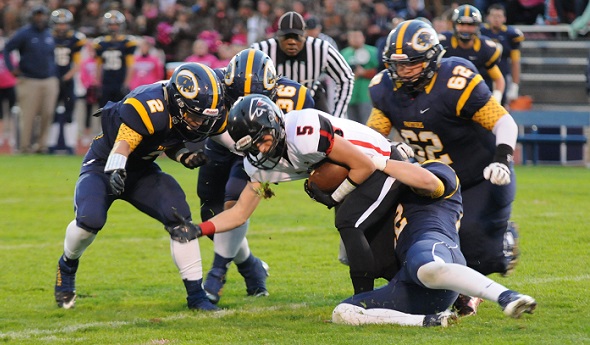
PHOTO: DeWitt defenders swarm a St. Johns ball-carrier during Friday's league title-clinching victory. (Click for more from HighSchoolSportsScene.com.)
Familiar Name Home Again for Mona Shores
September 23, 2020
By Tom Kendra
Special for Second Half
One of the biggest names in Muskegon Mona Shores football history is back at quarterback – after a 40-year hiatus.
 Mark Konecny, who went on to Alma College and then became the first Michigan Intercollegiate Athletic Association player to make it to the NFL, moved back home from Colorado in 2017. Now it’s his son (same name) who is connecting with receivers for the reigning Division 2 champion Sailors.
“It’s kind of cool to be here playing on the same field and practicing on the same field as him,” said Konecny, a 6-foot, 190-pound junior who wears No. 10, while his dad wore No. 11 at Shores. “I came here for a veer camp in the summer before my 8th-grade year and I liked Coach Koziak and the kids and thought it would be a good fit for me, and it has been.”
Konecny is the backup to senior Brady Rose (5-7, 172), a state Player of the Year candidate who powered the Sailors to a 35-26 upset of Detroit Martin Luther King in last year’s MHSAA Division 2 Final. But that doesn’t mean Konecny won’t play a key role in Friday’s showdown at crosstown rival Muskegon High.
Konecny threw a pair of first-half touchdown passes Friday as Shores picked up right where it left off with a 55-0 pounding of Muskegon Reeths-Puffer in an Ottawa-Kent Conference Green game.
While the explosive Rose is a magician running the veer offense, Koziak said having a backup like Konecny with a rocket arm adds another dimension to the attack.
“We want to get our best players on the field, but there can only be one quarterback, so it’s kind of a problem,” said Koziak, who led Mona Shores to its first-ever playoff berth in 2013 and then to the Finals three times in the past six years. “Brady is an amazing leader and high school football player, while Mark is more of a prototypical QB who can really spin it. So we’ll try to find unique ways to get them on the field at the same time.”
One of those unique ways came in the first quarter Friday, when Konecny lined up as a slot receiver and received a backwards toss from Rose. Konecny then fired his first-ever varsity pass, which a wide-open Elijah Farnum took 59 yards for a touchdown.
On the next possession, Konecny took over at quarterback and Rose moved to the slot, the position he played last year before stepping in for injured starting quarterback Caden Broersma early in the Semifinal against Walled Lake Western. With the Puffer defense focused on Rose, Konecny gunned a four-yard scoring pass to a sliding Keondre Pierce on a seam route.
 The two-quarterback attack might be required Friday at Muskegon, as Shores managed just 15 rushing yards and three first downs in last year’s humbling 53-0 loss to the Big Reds.
Muskegon holds a 32-7 all-time edge over Mona Shores, and had won 14 in a row before the Sailors broke through with back-to-back regular-season wins in 2014 and 2015. The Big Reds have since won five straight in the series, including a playoff victory in 2015.
Friday’s game will be the first on the new synthetic field turf at renovated Hackley Stadium, where the Big Reds have been playing since 1927.
Muskegon coach Shane Fairfield hinted before Monday’s practice that the Big Reds could also use multiple quarterbacks in Friday’s game. Projected starter Amari Crowley did not play in Muskegon’s 59-14 opening win at Holland, but is expected to be back Friday. Junior Myles Walton stepped in last week and rushed for 133 yards and completed 4-of-5 passes for 52 yards.
Konecny’s dad remembers classic battles against Muskegon back during his era, and leading the Sailors to a 20-7 win over Muskegon his senior year in 1980 before suffering a season-ending broken collarbone the following week at Traverse City.
He was converted to running back at Alma College, where he became the first in school history to rush for more than 1,000 yards in a season with 1,059 in 1984 in earning all-MIAA honors. He played two years in the Canadian Football League, before realizing his dream of playing in the NFL in 1987 with the Miami Dolphins.
Konecny’s best NFL season came with the Philadelphia Eagles in 1988, when he returned 17 kickoffs for 276 yards and 32 punts for 226 yards.
After football, he worked as a fireman in Littleton, Colo., for 25 years, but fate led him back home to Mona Shores when Koziak invited him to speak at a team fundraiser in 2017. Later that year, the younger Konecny took part in the school’s veer camp and the family decided to come home for good.
Things have fallen into place ever since. Konecny got a job with the Norton Shores Fire Department; his wife, Lauri, landed a kindergarten teaching job at Campbell Elementary in the Mona Shores district; and their only child, Mark, quarterbacked the Sailors freshmen to a 7-1-1 record two years ago and the junior varsity to an 8-1 record last fall.
 The elder Konecny coached the Shores special teams the past two years, but stepped aside during the offseason to give his son some space and just be another dad in the stands.
“I want these next two years to be all about him and the work that he has put in,” said Konecny, who was inducted into the Muskegon Area Sports Hall of Fame in 2007. “I just want to be an advocate for him and do whatever I can, lend whatever knowledge or experience I can, to help him achieve his goals.”
The younger Konecny is always trying to learn – soaking in lessons from Koziak and offensive coordinator Aaron James about the nuances of the veer offense and working with his father and former MSU quarterback Ryan Van Dyke on the mechanics of quarterback play. But perhaps the best lessons of all come from Rose.
“We compete with each other, but we also encourage each other,” explained Konecny, who has played hockey in the past but plans to powerlift and play baseball this school year. “What Brady does on the field just logistically doesn’t make sense for someone his size. But you see him in the weight room and around our teammates, and he’s such a leader. He’s a great influence on me.”
Koziak said he has no doubt Konecny will be a college quarterback in a couple of years.
“One of the things I really like about Mark is that he has a very inquisitive football mind,” said Koziak. “He wants to know why we do certain things we do in terms of motion or blocking on a particular play – not just what he has to do, but why.”
Konecny also has an incredible work ethic, never missing a chance to throw with his teammates or to hit the weight room. He recently became a rare junior skill athlete to join the Mona Shores 1,000-pound club – meaning his combined best lift in the bench, squat and dead lift tops that weight.
And when he’s not doing one of those things, he can often be spotted at his dad’s old favorite workout spot: the giant Lake Michigan sand dunes at Lake Harbor Park.
“Every so often, we’ll be sitting around the house and he’ll be restless and go run the dunes,” the elder Konecny said with a smile. “Those are the same dunes that I used to run when I played at Shores, so that’s kind of neat. Like father, like son, I guess.”
 Tom Kendra worked 23 years at The Muskegon Chronicle, including five as assistant sports editor and the final six as sports editor through 2011. E-mail him at [email protected] with story ideas for Muskegon, Oceana, Mason, Lake, Oceola, Mecosta and Newaygo counties.
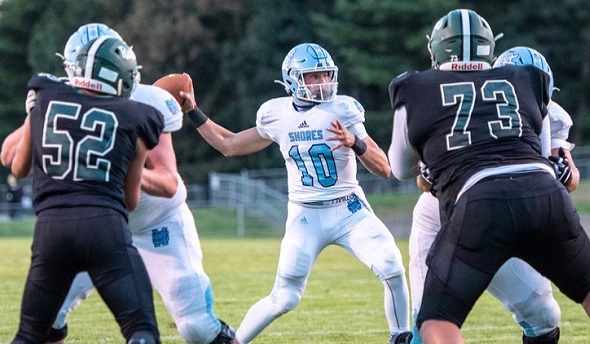
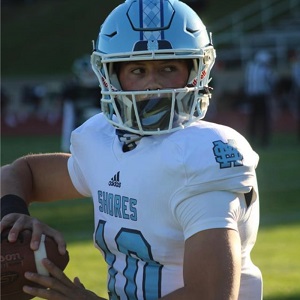
PHOTOS: (Top) Mona Shores junior quarterback Mark Konecny drops back to pass during Friday's game at Muskegon Reeths-Puffer. (Middle) Konecny warms up Friday. (Below) The elder Mark Konecny. (Mona Shores photos by Eric Sturr and Mike Meekhof, respectively. Head shot courtesy of the Muskegon Area Sports Hall of Fame.)