

Drive for Detroit: Week 7 in Review
October 8, 2018
By Geoff Kimmerly
Second Half editor
Southfield Arts & Technology over West Bloomfield, Grandville over Holland West Ottawa, Rochester Adams over Farmington Hills Harrison and Webberville over Camden-Frontier.
 Those are just a few more upsets in addition to those we delved into in today’s “Drive for Detroit” review after Friday night provided a season’s worth of the unexpected.
Of course, the majority of headlines came from league championships won and playoff berths earned. And we tell of many of those as well in our latest report from around the state.
“Drive for Detroit” is powered by MI Student Aid.
Bay & Thumb
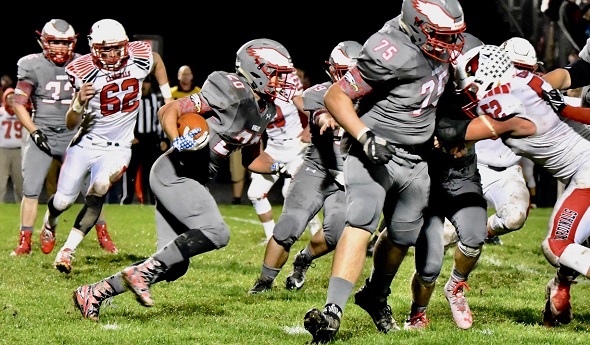
HEADLINER: Frankenmuth 35, Millington 12 The Eagles (6-1) extended their Tri-Valley Conference East winning streak to 29 and their league title streak to seven seasons with their fourth straight win over the rival Cardinals (5-2). Frankenmuth led just 7-6 at halftime before scoring 21 unanswered points over the third quarter and first few minutes of the fourth. Click for more from the Saginaw News and see below for highlights from WEYI.
Frankenmuth defeats Millington in the rivalry showdown to take sole possession of first place in the division @MuthSportsNet @FMuthAthleticshttps://t.co/gCf4IdkTSG pic.twitter.com/UMPRbB3InR
— Jeanna Trotman (@JeannaTrotmanTV) October 6, 2018
Also of note: Lapeer 31, Flint Carman-Ainsworth 28 The Lightning (7-0) will face Davison in Week 9 for the Saginaw Valley League Blue title – after just getting past what might be the best 3-4 team in the state. The Cavaliers have lost three of those games by seven points or fewer.
Remember this one: Flushing 26, Fenton 7 This guarantees an end to Fenton’s Flint Metro League title streak at seven seasons (including shared titles), and puts Flushing (5-2) in line to earn a share this month if leader Swartz Creek trips up over the next two weeks. Fenton (5-2) still can qualify for the playoffs for the 11th straight season with one more win.
More shoutouts: Almont 51, Richmond 12 The Raiders (7-0) earned a share of the Blue Water Area Conference championship by avenging last season’s loss to the Blue Devils (4-3). Hemlock 16, Saginaw Michigan Lutheran Seminary 7 With Ithaca dominating the TVC West yearly, others don't get a ton of attention – but Hemlock (6-1) secured a third straight playoff berth by knocking the Cardinals (6-1) out of a tie they shared with the Yellowjackets for first in the league.
Greater Detroit
HEADLINER: Dearborn Heights Crestwood 32, Dearborn Heights Robichaud 22 The dream season continues for Crestwood, which clinched the Western Wayne Athletic Conference title – its first league championship since 1985. The Chargers (7-0) also reached seven wins for the first time since 2000 – and achieved both against neighbor Robichaud (6-1), which also entered undefeated. Click for more from the Press & Guide and see highlights below from State Champs Sports Network.
??VIDEO: Check out the highlights of the Crestwood vs. Robichaud football game from last night. @WeAreCrestwood pic.twitter.com/WjC5kIXzTd
— STATE CHAMPS! (@statechampsnet) October 6, 2018
Also of note: Oxford 20, Clarkston 17 This rises to the top of the week’s upsets because of all that Clarkston (6-1) has accomplished the last few seasons. The reigning Division 1 champion has won two titles over the last four years and last season beat Oxford 49-0. The Wildcats (5-2) are seeking their first playoff berth since 2014 and hadn’t beaten Clarkston since 2011.
Remember this one: Orchard Lake St. Mary’s 31, Detroit Catholic Central 29 This was another sizable upset – and if St. Mary’s (3-4) rebounds from an 0-3 start to make the playoffs with an at-large bid, it will mean more than just knocking the Shamrocks (5-2) out of a first-place tie in the Detroit Catholic League Central.
More shoutouts: Detroit Martin Luther King 27, Detroit Denby 18 The Crusaders (6-1) finished a perfect run through the Detroit Public School League Black, but this says a lot as well about Denby (5-2) for playing it close, as King’s only loss was by three to powerful Muskegon. Warren DeLaSalle 35, Davison 7 These two have MHSAA championship aspirations, and reigning Division 2 title winner DeLaSalle (6-1) looks pretty powerful after handing Davison (6-1) its first defeat.
Mid-Michigan
HEADLINER: Breckenridge 30, Carson City-Crystal 12 To put the last three seasons in perspective, recall that Breckenridge (7-0) was 0-9 in its final season in the TVC West in 2015. Since, the Huskies are 26-3 overall, 19-0 in Mid-State Activities Conference play, and with this win over the Eagles (6-1) claimed a third straight league title. Click for more from the Mount Pleasant Morning Sun and see highlights below from FOX 17.
Breckenridge 30, Carson City 12 https://t.co/J9oKhyqXtj
— FOX 17 Blitz (@FOX17Blitz) October 6, 2018
Also of note: Olivet 34, Lake Odessa Lakewood 14 The Greater Lansing Activities Conference is owned by these two programs, with Olivet (7-0) clinching its second straight outright title and third in the league’s five years of existence. Lakewood (5-2) won the other two championships, in 2015 and 2016.
Remember this one: Clare 21, Beaverton 2 With the Pioneers (6-1) handing the Beavers (5-2) their first league loss, the Jack Pine Conference title is going to come down to the final week of the league season. These two and Roscommon all are 5-1 in league play.
More shoutouts: Williamston 14, Mason 7 Three teams clinched shares this week of the Capital Area Activities Conference Red title – Williamston, Haslett and St. Johns – but the Hornets arguably had the toughest league finale opponent as Mason (3-4) has lost now three games by seven points or fewer. Pewamo-Westphalia 61, Dansville 0 The fact these two both entered this Central Michigan Athletic Conference-deciding game undefeated in league play says a lot about P-W’s absolute dominance. The Pirates (7-0) have won 27 straight in the CMAC, while Dansville (5-2) won their other five this season by an average of 36 points per game.
Northern Lower Peninsula
HEADLINER: Johannesburg-Lewiston 18, Harbor Springs 15 The Cardinals (6-1) have to play out the string, but defeating former co-leader Harbor Springs (6-1) put them in position to claim their first league title since 2009. Johannesburg-Lewiston can finish the Northern Michigan Football League Legacy run with wins over Newberry and Indian River Inland Lakes, which are a combined 2-12 overall. Click for more from the Gaylord Herald-Times and see highlights below from MI Sports Now.
No. 5 Johannesburg-Lewiston slips past Harbor Springs in NMFL Legacy thriller. https://t.co/6eMjW6K2u7 pic.twitter.com/PfwcmCmxbk
— MISportsNow (@MISportsNow) October 6, 2018
Also of note: Manistee 35, Muskegon Catholic Central 27 The Chippewas (7-0) finished an outright title run in the Lakes 8 Conference and tied their most wins in a season since 1961 (according to Michigan-football.com). The Crusaders (3-4) must win out to have a chance at an eighth straight postseason bid.
Remember this one: Elk Rapids 31, Frankfort 21 The playoff hopes for both hang in the balance; Elk Rapids (5-2) must win one of its next two facing two opponents with winning records, while Frankfort (4-3) now must win out for an automatic bid although the Panthers would be a strong at-large contender at 5-4.
More shoutouts: Petoskey 22, Gaylord 21 The Northmen (4-3) have now won as many games as the last two seasons combined, and forced the Blue Devils (5-2) into a tough spot needing to win one of their final two games to get back to the playoffs for the first time since 2015. Kingsley 56, Maple City Glen Lake 22 The Stags (6-1) most likely won’t catch Traverse City St. Francis in the NMFL Legends division, but did get a win over the Leaders division champ Lakers (3-4).
Southeast & Border
HEADLINER: Adrian Lenawee Christian 24, Pittsford 7 The Cougars (6-1) claimed a share of the Southern Central Athletic Association title by beating first-place Pittsford for the first time since 2015, holding the Wildcats to their fewest points since Week 2 of last season. It’s Lenawee Christian’s first league title in football – the Cougars split the championship with Pittsford and Climax-Scotts. Click for more from the Adrian Daily Telegram.
Also of note: Grass Lake 32, Napoleon 7 The Warriors (7-0) finished a run of three straight wins over 2017 tri-champions Addison, Michigan Center and Napoleon (5-2) to clinch a share of the Cascades Conference title.
Remember this one: Hillsdale 44, Ida 28 The Hornets (7-0) moved within one more win of clinching a share of the Lenawee County Athletic Association title, although they still must play two more league opponents with winning records after dealing Ida (5-2) just its second defeat.
More shoutouts: Dexter 17, Pinckney 14 The next one won’t come easily with two tough opponents ahead, but Dexter (5-2) is a win away from clinching its first playoff appearance. Ypsilanti Community 25, Ypsilanti Lincoln 7 The Grizzlies (3-4) got off to an 0-3 start but have turned things around and beat rival Lincoln (4-3) for the first time in three seasons.
Southwest Corridor
HEADLINER: Edwardsburg 38, Three Rivers 15 Although the Eddies (7-0) still must beat at least one of two bottom-half teams in the Wolverine Conference to clinch, this win against co-leader Three Rivers (6-1) paved the way for a sixth straight championship. The reigning Division 4 runner-up is on pace to outscore last season’s team and has given up only 34 points – incredible compared even to the impressive 88 they surrendered during the 2017 regular season. Click for more from the Niles Daily Star.
Edwardsburg 38, Three Rivers 15 https://t.co/FReAxey9JO
— FOX 17 Blitz (@FOX17Blitz) October 6, 2018
Also of note: Climax-Scotts 28, Athens 14 There’s a chance all four SCAA teams make the playoffs, and Climax-Scotts (3-3) came back to earn a share of the league title after a 1-3 start. Athens also is 3-3 playing a five-game schedule.
Remember this one: Kalamazoo United 29, Delton Kellogg 12 Four of six teams in the Southwestern Athletic Conference Valley are 5-2 or better, and United (7-0) is tied with Schoolcraft for first place. The Panthers (5-2) will try to become the league’s fourth playoff qualifier over the next two weeks.
More shoutouts: Portage Northern 35, Battle Creek Central 21 The Southwestern Michigan Athletic Conference West co-leading Huskies (5-2) tuned up with a strong crossover win over the East’s second-place Bearcats (4-3). Niles 18, Kalamazoo Central 13 The Vikings (3-4) have two more tough games left as they seek an at-large bid, but beating SMAC East leader Central (4-3) should remain memorable no matter how things finish up.
Upper Peninsula
HEADLINER: Ishpeming 14, Iron River West Iron County 0 It’s fair to say the Hematites (7-0) have made it all the way back from back-to-back three-win seasons. They can clinch a share of the Western Peninsula Athletic Conference small-school title this week after handing the Wykons (5-2) their first shutout since 2015. Click for more from the Iron Mountain Daily News.
Also of note: Escanaba 28, Gladstone 15 The Eskymos (5-2) are the only team of five in the Great Northern Conference that can still earn an automatic playoff berth, and they’ll also be rooting for Gladstone (3-4) this week to down league leader Marquette and create a shared GNC title.
Remember this one: Gwinn 26, Norway 21 Gwinn’s final two games are against teams with winning records, but the Modeltowners (5-2) are in position to earn a playoff berth and potentially knocked Norway (3-4) out of the mix.
More shoutouts: Iron Mountain 28, Hancock 21 The Mountaineers (5-2) also moved within a win of clinching a postseason appearance after going 1-8 only a year ago. Calumet 35, Houghton 0 The Copper Kings (7-0) haven’t given up a point since mid-September and only 32 total this season.
West Michigan
HEADLINER: Montague 25, Muskegon Oakridge 24 Perhaps the most wow-inspiring result of the weekend saw Montague score on the final play as time ran out in the fourth quarter – and then add a two-point conversion for a walk-off win. It was Montague’s second straight and third in four seasons over the rival Eagles (6-1) and earned the Wildcats (6-1) a share of the West Michigan Conference championship. Click for more from the Local Sports Journal and see below for highlights from WOOD TV.
Montague rolls the dice and goes for two on the final play of the game. Wildcats beat Oakridge in a key West Michigan Conference showdown. #frenzy8 https://t.co/BPY8vFKdEu
— Jack Doles (@jackdoles) October 6, 2018
Also of note: Grand Rapids South Christian 24, Grand Rapids Christian 10 The Ottawa-Kent Conference Gold took a turn as the Sailors (4-3) knocked the Eagles (5-2) out of a tie for first. Christian faces first-place East Grand Rapids this week to try to regain a shared lead.
Remember this one: Rockford 13, Hudsonville 7 The Rams (4-3) have gone from 1-3 and on the verge of missing the playoffs for the first time since 1994 to tied for second in the 0-K Red with this win over former co-leader Hudsonville (5-2). Rockford is in control of its league title destiny with first-place East Kentwood coming up in Week 9.
More shoutouts: Grand Rapids Catholic Central 35, Spring Lake 12 In successive weeks, the Cougars (6-1) have played a part in dealing Allendale and Spring Lake (5-2) out of the O-K Blue race, and now are tied for the lead with Grand Rapids West Catholic. East Grand Rapids 33, Middleville Thornapple Kellogg 13 The Pioneers (5-2) held onto the top spot in the Gold by downing a Trojans team that at 5-2 is enjoying its best season since 2011.
8-Player
HEADLINER: Brethren 36, Mesick 22 The Bobcats (5-2) won one game in 2015, their final season of 11-player, and improved to two victories in 2016, three last fall and now own the outright West Michigan D League title. One more win would put Brethren at six for the first time since going 8-3 in 1990. Click for more from the Manistee News Advocate.
Also of note: New Haven Merritt 54, Caseville 7 The Mustangs (4-3) moved into first place alone in the North Central Thumb League White. But despite falling into a second-place tie, Caseville (4-3) with one more win will have its most successful season since bringing back football in 2012.
Remember this one: Litchfield 54, St. Joseph Michigan Lutheran 6 The Terriers (1-6) won their first game since Week 9 of 2012, building on eight and 10-point losses earlier this season that were its closest defeats in six years.
More shoutouts Kinde-North Huron 28, Peck 22 The Warriors (4-3) extended their winning streak versus the Pirates (5-2) to four, this time knocking them out of a first-place tie in the NCTL Blue. Ontonagon 20, Stephenson 8 After a 1-3 start, Ontonagon (4-3) downed Stephenson (4-3) for the first time in five tries in 8-player to keep its hopes of returning to the playoffs alive.
Second Half’s weekly “Drive for Detroit” previews and reviews are powered by MI Student Aid, a part of the Student Financial Services Bureau located within the Michigan Department of Treasury. MI Student Aid encourages students to pursue postsecondary education by providing access to student financial resources and information, including various student financial assistance programs to help make college more affordable for Michigan students. MI Student Aid administers the state’s 529 savings programs (MET/MESP) and eight additional aid programs within its Student Scholarships and Grants division. Click for more information and connect with MI Student Aid on Facebook and Twitter @mistudentaid.
PHOTO: A Frankenmuth ball carrier follows his blockers during Friday's league title-clinching win over Millington. (Photo by Terry Lyons.)
Drive for Detroit: Playoff Week 3 Review
November 13, 2017
By Geoff Kimmerly
Second Half editor
A longtime observer of Michigan high school football had a hard time remembering a playoff weekend with as many close finishes as fans enjoyed Friday and Saturday.
Start with the games in 11-player Division 1, where all four were decided by fourth-quarter scores or stops, and nail-biters dominated a weekend that saw 32 teams move on to 11-Player Regional Finals and the four finalists for 8-player championships book trips to Marquette’s Superior Dome.
We start with a brief glance below at all four 8-Player Semifinals and then move into all 32 11-player games. The MHSAA Playoffs are sponsored by the Michigan Army National Guard, and “Drive for Detroit” is sponsored by MI Student Aid.
8-Player Division 1
Central Lake 54, Stephenson 20
The Trojans (12-0) rode a ravenous rushing attack in a snowstorm to earn its first MHSAA championship game berth while also tying its program record for wins in a season. Central Lake plodded to more than 400 yards against a Stephenson defense that had given up only 16.7 points per game entering the day. The Eagles finished 9-3. Click for more from the Traverse City Record-Eagle.
Central Lake leads Stephenson 28-14 with 7:24 left in the first half. pic.twitter.com/1eXzSZKJVm
— Brandon Folsom (@folsombrandonj) November 11, 2017
Deckerville 52, Bellevue 18
Deckerville rattled off 44 straight points to earn a second straight trip to the MHSAA Finals. Bellevue led 12-8 early before the Eagles (11-1) went on their run against another otherwise-stellar defense – the Broncos (10-2) were giving up only 9.5 points per game entering the day and this season set a program record for wins. Click for more from the Huron Daily Tribune.
8-Player Division 2
Crystal Falls Forest Park 36, Pickford 34
Forest Park will add to its 13 championship game appearances as an 11-player program with its first in 8-player after handing Pickford its lone loss this season. The Trojans (10-2) last made a championship game in 2009 and moved to 8-player a year ago. They put up the most points Pickford (11-1) gave up in a game this season by 12. The Panthers fell in their second straight Semifinal but moved to 27-7 in three years of 8-player. Click for more from the Iron Mountain Daily News.
Portland St. Patrick 33, Kinde-North Huron 14
The Shamrocks are 53-12 since moving to 8-player in 2012, and in their first Semifinal since that first season finally broke through to earn a first championship game berth since 1997. St. Patrick (11-1) scored 21 points during the fourth quarter to pull away against a North Huron program that also was playing in its second 8-Player Semifinal and finished 10-2. Click for more from the Lansing State Journal.
TD Shamrocks. Isaiah Smith punches it in from the 1. Shamrocks take a 3 score lead, 27-8. 4:54 left in the game. pic.twitter.com/c2UXSydvQp
— Jake Atnip (@JakeAtnip) November 11, 2017
11-Player Division 1
West Bloomfield 28, Utica Eisenhower 25
Quarterback Bryce Veasley scored the winning touchdown with under a minute to play to send West Bloomfield (10-2) to its first MHSAA Semifinal in football. The Lakers edged an Eisenhower program much more familiar with this stage of the playoffs; the Eagles were playing for a third Regional title this decade and made the Semifinals a year ago. Eisenhower (11-1) had given up more than 20 points in a game to only one other opponent this fall. Click for more from the Oakland Press.
ICYMI: Watch the highlights from West Bloomfield's Regional Final win over Eisenhower! @wbhsTHESWAMP @wbhslakernation @19Bellamy @bry0e pic.twitter.com/nTP0CuKNgD
— STATE CHAMPS! (@statechampsnet) November 12, 2017
Other Regional Finals:
Clarkston 29, Holland West Ottawa 22 – The Wolves (10-2) scored 23 unanswered fourth-quarter points to win their second Regional title in four seasons and end West Ottawa’s winningest football season at 10-2.
Detroit Catholic Central 27, Canton 26 – The Shamrocks (8-4) stopped a Canton two-point conversion attempt with 34 seconds to play to win their fifth Regional title this decade while handing the Chiefs (10-2) their first loss since opening night.
Detroit Cass Tech 32, Clinton Township Chippewa Valley 26 – In maybe the most dramatic finish of all this weekend, Chippewa Valley (10-2) took the lead with 1:25 to play and Cass Tech (9-2) took it back as the clock ticked under 10 seconds to win an eighth straight Regional title.
11-Player Division 2
Livonia Franklin 31, Flushing 29
Franklin (10-2) clinched its second Regional title in three seasons on kicker Brad Gibson’s 27-yard field goal with 13 seconds to play. Flushing had taken the lead just more than a minute before with a two-point conversion after a late score. Flushing was playing for its first Regional title and finished 9-3, tying its most successful season (2014) since 1997. Click for more from the Observer & Eccentric.
@fhspatriots Game winner pic.twitter.com/88PlO3k2Ut
— Victor Rusnell (@victorhula) November 11, 2017
Other Regional Finals:
Grand Rapids Forest Hills Central 28, Traverse City Central 10 – Forest Hills Central (12-0) won its first football Regional title since 1995 with 28 unanswered points over the second and third quarters; Traverse City Central (8-4) was playing for its first Regional title since 1991.
Detroit Martin Luther King 55, Ypsilanti Lincoln 14 – The Crusaders (11-1) won their third straight Regional title and fifth in seven years while finishing the most successful playoff run ever for Lincoln (9-3), which hadn’t lost since an 0-2 start.
Warren DeLaSalle 14, Oak Park 7 – A last-minute touchdown gave DeLaSalle (10-2) its first Regional title since 2014 as both teams scored their fewest points since opening night; Oak Park (9-3) tied its most successful season after also going 9-3 in 2012.
11-Player Division 3
Riverview 36, Dearborn Divine Child 31
The Riverview dream season continues, this time after a close win over one of last season’s Division 3 semifinalists. The Pirates (11-1) won their first Regional title since 2002, with the reminder again that they went only 2-7 a year ago. Riverview led by 12 heading into the fourth quarter and held off Divine Child (10-2) during a late comeback attempt. Click for more from the Southgate News-Herald.
Other Regional Finals:
Muskegon 49, DeWitt 0 – The Big Reds (12-0) were great on offense as usual, but defensively this was the most impressive of their six shutouts this fall; DeWitt (10-2) was averaging 39 points per game entering the day.
Battle Creek Harper Creek 16, East Lansing 13 – The Beavers (12-0) scored all 16 of their points during the fourth quarter to clinch their first Regional title since 2012 and hand East Lansing (9-3) its first defeat this season since Week 3; the Trojans finished their best season since 2011.
Farmington Hills Harrison 34, Linden 21 – The Hawks (9-3) added to their inspired run with a first Regional title since 2014; Linden (9-3) was playing for its first Regional title but did finish its winningest season since 2012.
11-Player Division 4
River Rouge 21, Bloomfield Hills Cranbrook Kingswood 14
The Panthers (10-2) reached 10 victories for the fourth straight season and fifth in six seasons by clinching this third straight Regional title. River Rouge never broke away but did go ahead to stay midway through the fourth quarter to seal its closest win of the season (the two losses were by nine and seven). Cranbrook Kingswood (10-2) did cap its winningest season in program history. Click for more from the Southgate News-Herald.
Other Regional Finals:
Escanaba 39, Williamston 21 – The Eskymos (10-2) began pulling away during the first half on the way to their first Regional title since 1981; for Williamston (7-5), it was the only loss this season by more than seven points.
Grand Rapids Catholic Central 42, Belding 3 – GRCC (12-0) rode another giant dose of running back Nolan Fugate to its 18th straight win; Belding (9-3) ended its most successful season since 1998.
Edwardsburg 52, Lansing Sexton 30 –The Eddies (11-1) won their second straight Regional title with their fifth game over 50 points this season; Sexton (8-4) did become the first team to top 30 against Edwardsburg this fall.
11-Player Division 5
Grand Rapids West Catholic 28, Portland 26
The latest of frequent playoff meetings between these annual contenders turned out to be another classic as West Catholic (10-2) stopped a late two-point conversion attempt to secure the win – after also beating Portland by three last season on the way to winning the Division 5 title. The Raiders (10-2) fought back from two touchdowns down in the fourth quarter. Click for more from the Grand Rapids Press.
ICYMI: Watch the highlights from @GRWCatholic's 28-26 win over Portland for its 8th straight regional title! @GRWCFootball @WEST_is_BEST17 pic.twitter.com/sYz7xaoi4g
— STATE CHAMPS! (@statechampsnet) November 12, 2017
Other Regional Finals:
Reed City 46, Menominee 34 – The Coyotes (11-1) closed this weekend’s action in Saturday’s final game by claiming their first Regional title against a Menominee team playing in its ninth straight Regional Final; the Maroons, last season’s Division 5 runners-up, finished 8-4.
Saginaw Swan Valley 48, Muskegon Oakridge 14 – The Vikings (11-1) will play in their third Semifinal in nine years as Alex Fries threw three touchdown passes and ran for a fourth score; Oakridge (9-3) was playing for its first Regional title since 2013.
Frankenmuth 17, Algonac 7 – The Eagles (12-0) won their second straight Regional title and set a program record for wins by outlasting the Blue Water Area Conference champion Muskrats (10-2) in a defensive struggle; Frankenmuth held Algonac to 161 yards.
11-Player Division 6
Ithaca 33, Montague 23
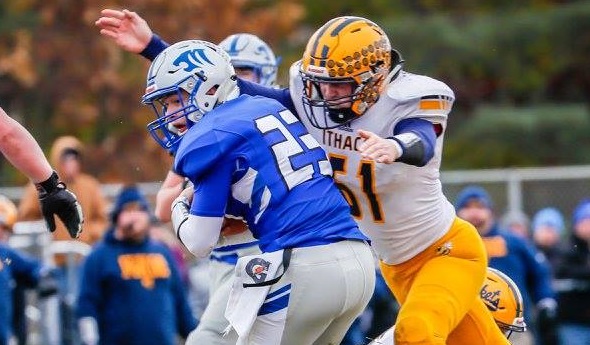
Ithaca made a statement in a game pitting teams that have combined to win seven of the last nine Division 6 titles. Following quarterback Joey Bentley – 218 yards and four touchdowns rushing, one more touchdown passing – the Yellowjackets (12-0) led by 18 late before Montague added a final score. The Wildcats (11-1) did put up the most points Ithaca has given up this season – the Yellowjackets have now allowed only 101 over 12 games. Click for more from the Mount Pleasant Morning Sun.
ICYMI: Watch the highlights from Ithaca's Regional Final win over Montague on Saturday afternoon! @Coach_Burn @joey_sports @IHSPublications pic.twitter.com/w9WImG4c8Q
— STATE CHAMPS! (@statechampsnet) November 13, 2017
Other Regional Finals:
Traverse City St. Francis 33, Millington 26 – The Gladiators (11-1) hung on to win their second Regional title in three seasons as Millington (10-2) put up the most points St. Francis has given up this season – although the Gladiators also became just the second to score more than 30 on the Cardinals.
Jackson Lumen Christi 44, Watervliet 22 – The reigning Division 6 champion Titans (10-1) locked down a Watervliet offense that had scored at least 36 points every game and averaged 52 per game during the Panthers’ 11-0 start.
Warren Michigan Collegiate 32, Blissfield 6 – The Cougars (12-0) won their second Regional title in 10 seasons as a program, ending Blissfield’s first winning season since 2012 and winningest since 2009 at 7-5.
11-Player Division 7
Lake City 20, Breckenridge 18
Someone was going to celebrate a major accomplishment after this game. Lake City improved to 12-0, extending its program record for wins in claiming its first Regional title and with last year’s 2-7 finish becoming tougher to believe by the week. Breckenridge was 0-9 only three years ago and won its first playoff game just two weeks ago on the way to finishing 10-2 this fall. Click for more from the Cadillac News.
Other Regional Finals:
Pewamo-Westphalia 34, Elkton-Pigeon-Bay Port Laker 0 – The Pirates’ fifth shutout this season moved them to 11-1 and landed them their sixth Regional title in seven seasons; Laker (10-2) did contain P-W to its third-fewest points this fall.
Saugatuck 7, Cassopolis 6 – A go-ahead score with under three minutes to play pushed Saugatuck (9-3) just past the Rangers (10-2) for its first Regional title since 2010; Cassopolis had guarded that lead since the first quarter.
Madison Heights Madison 22, Monroe St. Mary Catholic Central 20 – Madison (12-0) will play in its first Semifinal since 2007 after coming back from two touchdowns down during the second half; the Falcons finished 7-5 after a 1-3 start this fall.
11-Player Division 8
Iron River West Iron County 35, Frankfort 20
West Iron’s first Regional title since 1977 came with a program record-setting 11th win as the Wykons haven’t lost since falling by two points on opening night. West Iron scored the first 22 points and locked down a Frankfort offense that had scored 45 per game entering the game. The Panthers finished 8-3 after making the Regional Finals for the third straight season. Click for more from the Iron Mountain Daily News.
Other Regional Finals:
Saginaw Nouvel 54, Lincoln Alcona 34 – Nouvel (12-0) picked the best time to score its most points in a game this season, coming off a District Final scare against Harbor Beach; the Panthers opened a 28-0 lead on the Tigers (9-3), who were playing in their first Regional Final.
Mendon 14, Climax-Scotts 6 – A week after stunning reigning champion Muskegon Catholic Central, Mendon (12-0) had to hold off the Panthers (9-3) for 2½ quarters to earn its first Regional title since 2011.
Ottawa Lake Whiteford 60, Clarkston Everest Collegiate 20 – Last season’s Division 8 runner-up Bobcats (12-0) clearly are intent on getting back to Ford Field; they finished this one on a 44-6 run to end the longest tournament run in the five-year history of Everest Collegiate (9-3).
Second Half’s weekly “Drive for Detroit” previews and reviews are powered by MI Student Aid, a part of the Student Financial Services Bureau located within the Michigan Department of Treasury. MI Student Aid encourages students to pursue postsecondary education by providing access to student financial resources and information, including various student financial assistance programs to help make college more affordable for Michigan students. MI Student Aid administers the state’s 529 savings programs (MET/MESP) and eight additional aid programs within its Student Scholarships and Grants division. Click for more information and connect with MI Student Aid on Facebook and Twitter @mistudentaid.
PHOTO: Ithaca’s Devon Smith (51) closes in on a Montague ball carrier during Saturday’s Division 6 Regional Final. (Photo by Tim Reilly.)