

Drive for Detroit: Week 8 Preview
October 11, 2018
By Geoff Kimmerly
Second Half editor
Every fall we say it again: We can’t believe how quickly football season flies by.
 But here we are in Week 8, midway through another October, heading into the home stretch for many and the most anticipated weeks for the most fortunate.
With two regular-season games to play, 117 of 256 11-player playoff spots are filled, and 83 more teams can clinch postseason berths this weekend. The Detroit Public School League begins its playoffs tonight and Saturday, while many other leagues across the state will either be finishing up their schedules and/or crowning champions over the next 72 hours.
All games below are tonight unless noted. Check out the MHSAA Score Center for the full schedule and results as games are completed. MHSAA.tv will broadcast 11 games this weekend including five mentioned below. Our “Drive for Detroit” previews are powered by MI Student Aid.
Bay & Thumb
Roseville (5-2) at Port Huron Northern (6-1)
Both are undefeated in Macomb Area Conference Blue play heading into this winner-take-all league finale. The Huskies are attempting to take the next step after finishing second in the MAC Gold both of the last two seasons, while Roseville was one of three teams to share the Blue title a year ago – and is looking to also avenge last season’s 13-7 first-round playoff loss to Northern.
Others that caught my eye: FRIDAY Midland Dow (5-2) at Mount Pleasant (7-0), Sandusky (7-0) at Harbor Beach (6-1), Fenton (5-2) at Swartz Creek (6-1), Haslett (6-1) at Goodrich (5-2).
Greater Detroit
Warren DeLaSalle (6-1) at Detroit Catholic Central (5-2), Sunday
The Detroit area features league championship-deciding games Friday, Saturday and Sunday, with this a clash of MHSAA title contenders as well. Reigning Division 2 champion DeLaSalle has clinched a share of the Catholic League Central title after winning it outright a year ago by defeating the Shamrocks. The Pilots then beat DCC the following week as well in the Prep Bowl, and this weekend’s game could potentially be the first of two straight between these powers again.
Others that caught my eye: FRIDAY Farmington (6-1) at Birmingham Seaholm (6-1), Walled Lake Western (5-2) at South Lyon (7-0), Riverview (6-1) at Grosse Ile (7-0), SATURDAY St. Clair Shores Lake Shore (6-1) at Warren Woods Tower (7-0).
Mid-Michigan
Saginaw Michigan Lutheran Seminary (6-1) at Ithaca (6-1)
The Cardinals’ loss last week to Hemlock took some of the juice out of this one, but an MLS win would create a three-team share of the Tri-Valley Conference West championship between these two and the Huskies. Ithaca hasn’t lost a league game since 2009, and counting the share it owns already this fall has won 10 straight TVC West titles. The Cardinals’ defense has been especially impressive, giving up just over nine points per game, and it will need to come up big again as Ithaca’s offense remains on a scorching 45-ppg pace.
Others that caught my eye: FRIDAY Pewamo-Westphalia (7-0) at Fowler (4-3), Lake Fenton (4-3) at Williamston (6-1), Climax-Scotts (3-3) at Breckenridge (7-0), Brighton (6-1) at Howell (4-3).
Northern Lower Peninsula
Gaylord (5-2) at Traverse City West (5-2), Saturday
The Blue Devils can’t move into a first-place tie in the Big North Conference with a win in this one, but they can make the league race pretty messy. West is undefeated in league play, but a Gaylord win would give Traverse City Central and Petoskey opportunities to share or win the championship outright. The reigning league champion Titans have beaten Gaylord in 12 straight – but this is a better Blue Devils team than most during that string. A sixth win would tie Gaylord’s most in a season over the last 15.
Others that caught my eye: FRIDAY Escanaba (5-2) at Traverse City Central (6-1), Kingsley (6-1) at Cheboygan (4-3), Boyne City (3-4) at Benzie Central (4-3), Elk Rapids (5-2) at Harbor Springs (6-1).
Southeast & Border
Springport (7-0) at Reading (7-0)
The Big 8 Conference title comes down to this, one of three matchups this week between 7-0 teams. Reading has won 16 straight league games, including a sweep of all seven in earning last season’s championship, but these two have split their last eight meetings. The Rangers might have the most statistically impressive defense in the state – they’ve given up just 19 points this season – and it will be key against a Springport offense averaging 45 points (although Reading averages 50).
Others that caught my eye: FRIDAY Monroe (6-1) at Saline (6-1), Clinton (6-1) at Ottawa Lake Whiteford (7-0), Hillsdale (7-0) at Brooklyn Columbia Central (6-1), Michigan Center (6-1) at Napoleon (5-2).
Southwest Corridor
Constantine (6-1) at Kalamazoo United (7-0)
Constantine’s loss two weeks ago to Schoolcraft has it sitting third in the Southwestern Athletic Conference Valley behind the Eagles and United. Those co-leaders meet in Week 9 – but Kalamazoo of course won’t look past tonight. The last two games between the Falcons and Titans have been decided by a combined seven points – although both in Kalamazoo’s favor. Constantine’s running attack may need to be the key to slowing down a United offense averaging 60 points per game.
Others that caught my eye: FRIDAY Olivet (7-0) at Berrien Springs (6-1), Cassopolis (7-0) at Mendon (4-3), Mattawan (5-2) at Portage Central (5-2), Athens (3-3) at Three Oaks River Valley (4-3).
Upper Peninsula
Gladstone (3-4) at Marquette (3-4)
When it a matchup between two sub-.500 teams the best in a region? When both are fighting for playoff possibilities – and a league title. Thanks to one-point wins over Escanaba and Kingsford, the Redmen have all but wrapped up the Great Northern Conference championship. Gladstone has only the slimmest chance of ending up with a piece of the league title, but the Braves can still shake things up – and like Marquette must finish 5-4 to earn an opportunity for an at-large playoff bid.
Others that caught my eye: FRIDAY Iron River West Iron County (5-2) at Gwinn (5-2), Rogers City (6-1) at St. Ignace (4-3), Munising (4-3) at Ishpeming (7-0), Negaunee (4-3) at Houghton (3-4).
West Michigan
Muskegon Mona Shores (7-0) at Muskegon (7-0)
With the reigning Division 3 champion Big Reds down the road, Mona Shores probably isn’t getting as much attention as it might elsewhere. But the Sailors can earn it tonight in this battle for a share of the Ottawa-Kent Conference Black title. Mona Shores gave Muskegon the latter’s closest game a year ago, losing by just 11. The Big Reds have proven themselves again this fall against some of the state’s elite – but the Sailors belong in that conversation too and have the enviable opportunity to show it.
Others that caught my eye: FRIDAY Zeeland East (6-1) at Zeeland West (6-1), East Grand Rapids (5-2) at Grand Rapids Christian (5-2), Lake City (7-0) at Kent City (7-0), Grand Rapids West Catholic (4-3) at Grand Rapids Catholic Central (6-1).
8-Player
Posen (6-1) at AuGres-Sims (7-0)
AuGres-Sims’ first season of 8-player football couldn’t be going much better, as it clinched a share of the Midwest Central Football Conference East last week and can finish the outright title tonight against second-place Posen (which is tied for that position with Hillman). The Wolverines have four shutouts and have given up a combined 30 points over their other three games. But Posen deserves it’s due too – its six wins are as many as the last two seasons combined, and the only defeat was by four to Hillman two weeks ago. An upset tonight would be one of the most memorable wins of the last decade for one of the state’s first 8-player adopters.
Others that caught my eye: FRIDAY Rapid River (5-2) at Engadine (6-1), Peck (5-2) at Kingston (6-1), Suttons Bay (6-1) at Onekama (6-1), Ontonagon (4-3) at Crystal Falls Forest Park (4-3).
Second Half’s weekly “Drive for Detroit” previews and reviews are powered by MI Student Aid, a part of the Student Financial Services Bureau located within the Michigan Department of Treasury. MI Student Aid encourages students to pursue postsecondary education by providing access to student financial resources and information, including various student financial assistance programs to help make college more affordable for Michigan students. MI Student Aid administers the state’s 529 savings programs (MET/MESP) and eight additional aid programs within its Student Scholarships and Grants division. Click for more information and connect with MI Student Aid on Facebook and Twitter @mistudentaid.
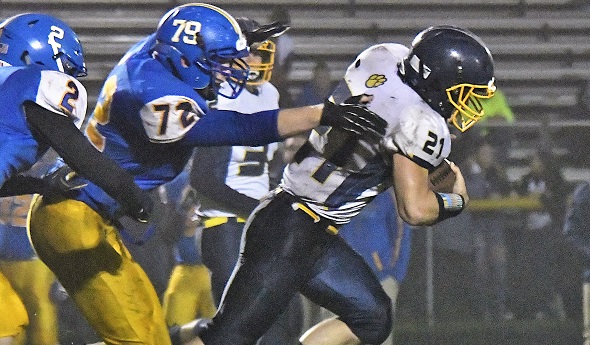
PHOTO: Breckenridge charges ahead against Carson City-Crystal last week on the way to clinching the Mid-State Activities Conference title. (Click for more from HighSchoolSportsScene.com.)

1st & Goal: 2022 Week 3 Preview
By
Geoff Kimmerly
MHSAA.com senior editor
September 9, 2022
With Labor Day behind us, all Michigan high schools are back in session – and just in time for league competition to begin for several conferences across the state.
 League matchups make up most of our “games to watch” as we prep for Week 3, with the most intriguing from every region highlighted below.
Games are Friday unless noted. Click for the full schedule from MHSAA.com and check out the broadcast schedule from MHSAA.tv.
Bay & Thumb
Armada (2-0) at Croswell-Lexington (2-0)
The way this season has begun – and the way last season ended – makes this matchup look like a potential title-decider in the Blue Water Area Conference. Croswell-Lexington was last year champion, thanks in part to holding off co-runner-up Armada 30-14 in the final game on the league schedule. The Pioneers have outscored their first two opponents this fall by a combined 95-14, while Armada made a loud statement immediately with a 28-27 season-opening win over Marine City, last season’s Division 5 runner-up.
Keep an eye on these FRIDAY Marlette (2-0) at Ubly (2-0), Grand Blanc (1-1) at Saginaw Heritage (2-0), Traverse City Central (1-1) at Davison (1-1), Hemlock (1-1) at Millington (2-0).
Greater Detroit
Livonia Churchill (1-1) at Belleville (2-0)
Belleville is off to another strong start this fall coming off last season’s Division 1 championship. But tonight’s matchup could help the Tigers do one better this fall in their repeat attempt. Churchill last season won the Week 3 meeting 28-21, handing Belleville its first regular-season loss since 2016 and only loss of 2021. But the Chargers must bounce back quickly to make this game another classic after seeing a seven-game winning streak against Westland John Glenn end with a 21-20 loss last week.
Keep an eye on these FRIDAY Clarkston (1-1) at Rochester Adams (2-0), Utica Eisenhower (2-0) at Clinton Township Chippewa Valley (2-0), DeWitt (2-0) at Detroit Catholic Central (1-1), Warren Michigan Collegiate (2-0) at Detroit Country Day (2-0).
Mid-Michigan
Fowler (2-0) at Bath (2-0)
The Bees are off to their best start since 2017, already avenging one loss from when the team finished 2-7 a year ago. But this matchup could tell a lot more about where Bath is headed in 2022. The Bees fell to Fowler 47-14 last season and will be seeking to break a five-game losing streak to the Eagles. Fowler has opened with wins over 2021 playoff qualifiers Carson City-Crystal and Petersburg Summerfield, both by 20-plus points.
Keep an eye on these FRIDAY Saginaw Nouvel (2-0) at Ithaca (1-1), Fowlerville (1-1) at Mason (2-0), Pewamo-Westphalia (1-1) at Dansville (2-0), Durand (2-0) at Ovid-Elsie (1-1).
Northern Lower Peninsula
St. Ignace (2-0) at Frankfort (2-0)
The Saints own one of the best rebound stories of the early going after finishing 2-7 a year ago and winning one game in 2020. They’ve outscored their first opponents by a combined 74-6. Granted, both opponents are winless so far this season and were winless last year as well, but Frankfort will give St. Ignace a better idea how it measures up in what should be a super-competitive Northern Michigan Football League Legacy division. The Panthers have followed their best finish (6-4) since 2017 with a pair of big victories including last week over 2021 playoff qualifier Mancelona.
Keep an eye on these FRIDAY Mount Pleasant (2-0) at Cadillac (1-1), Boyne City (2-0) at Grayling (1-1), Charlevoix (2-0) at Mancelona (1-1), Bay City Western (1-1) at Traverse City West (1-1).
Southeast & Border
Napoleon (2-0) at Manchester (2-0), Saturday
This Saturday showdown presents some interesting possibilities as both look to rise in the Cascades Conference. Napoleon was a contender into October last season before losing the final two games on the league schedule, but was in play in part thanks to a 20-18 win over Manchester in Week 3. The Flying Dutchmen have factored into the race a couple of times since their league title season of 2015, and edged reigning Cascades champion Addison 29-26 last week to re-enter the mix.
Keep an eye on these FRIDAY Grosse Ile (2-0) at Milan (1-1), Hanover-Horton (1-1) at Addison (1-1), Hastings (1-1) at Jackson Lumen Christi (0-2), Centreville (1-1) at Sand Creek (1-1).
Southwest Corridor
Lawton (2-0) at Constantine (1-1)
Lawton is off to another solid start coming off last season’s run to the Division 7 championship game, and additionally the Blue Devils have won 12 straight regular-season games and 25 of their last 26. All but two of those 25 wins were by double digits – with the lone loss to Schoolcraft in 2020 – but Lawton also hasn’t played Constantine since 2017. The Falcons saw their 15-game regular-season winning streak end with a 22-20 loss to reigning Division 8 champion Hudson last week. Before that, no regular-season opponent had come within single digits of catching Constantine since the second game of 2020.
Keep an eye on these FRIDAY Schoolcraft (2-0) at Kalamazoo United (2-0), Battle Creek Lakeview (1-0) at Portage Central (0-2), Plainwell (2-0) at Sturgis (1-1), Allegan (2-0) at Berrien Springs (2-0).
Upper Peninsula
Gladstone (2-0) at Menominee (1-1)
The Maroons regained the Great Northern Conference title last season, sharing it with Kingsford, but earned that claim also because they were able to survive a 35-34 challenge from Gladstone. Menominee has won three straight in this series, but is coming off a rough outing last week against an opponent from Illinois. Gladstone, meanwhile, is off to its third 2-0 start in four seasons but looking to get to 3-0 for the first time since 2017. There’s a little more reason for excitement this time though – both of those first two wins came against 2021 league champions.
Keep an eye on these FRIDAY Houghton (2-0) at Iron Mountain (1-1), Cheboygan (1-1) at Sault Ste. Marie (2-0), Ishpeming Westwood (0-2) at Calumet (0-2). SATURDAY Gaylord (2-0) at Marquette (0-2).
West Michigan
Zeeland East (0-2) at Zeeland West (2-0)
On first glance, this might not seem like much more than the next chapter in a rivalry. But there is some near-uniqueness to this rivalry – it’s one of the few in Michigan where the schools are next door to each other. West has won the last four meetings, including a matchup during the 2019 playoffs, and has rocketed to wins over Stevensville Lakeshore and Cedar Springs – two playoff teams from last season. East’s losses, however, also have come to 2021 playoff qualifiers – Williamston and Spring Lake – and the Chix lost to the Lakers by just seven points.
Keep an eye on these FRIDAY Grand Rapids Forest Hills Central (2-0) at Byron Center (1-1), East Kentwood (1-1) at Grand Haven (1-1), Grand Rapids West Catholic (2-0) at Spring Lake (1-1), Ludington (2-0) at Fremont (2-0).
8-Player
Lake Linden-Hubbell (2-0) at Norway (2-0)
Two-time reigning Division 2 champion Powers North Central has set the pace lately in the Great Lakes Conference West. But the league is full of contenders. The Jets are ranked No. 1 this week, but Crystal Falls Forest Park is No. 3, Lake Linden-Hubbell is No. 5 and Norway could make its way into the Division 1 top 10 with a win over the Lakes. The Knights won last season’s meeting 30-8 and have opened this fall outscoring its first two opponents by a combined 102-12. Lake Linde-Hubbell’s margin is a similar 119-30.
Keep an eye on these FRIDAY Adrian Lenawee Christian (2-0) at Pittsford (2-0), Bridgman (2-0) at Mendon (1-1), Merrill (2-0) at Fulton (1-1). SATURDAY Marion (2-0) at Mesick (2-0).
Second Half’s weekly “1st & Goal” previews and reviews are powered by MI Student Aid, a part of the Office of Postsecondary Financial Planning located within the Michigan Department of Treasury. MI Student Aid encourages students to pursue postsecondary education by providing access to student financial resources and information. MI Student Aid administers the state’s 529 college savings programs (MET/MESP), as well as scholarship and grant programs that help make college Accessible, Affordable and Attainable for you. Connect with MI Student Aid at www.michigan.gov/mistudentaid and find more information on Facebook and Twitter @mistudentaid.
PHOTO: A trio of Muskegon defenders bring down an East Kentwood ball carrier during the Big Reds’ 20-14 season-opening win. (Photo by Tim Reilly.)