

Drive for Detroit: Week 9 in Review
October 23, 2017
By Geoff Kimmerly
Second Half editor
By now, you know which teams made the playoffs, what the first-round matchups look like and what the roads will be for your favorites to arrive at either the Superior Dome or Ford Field next month.
 But a lot was still undecided heading into Week 9 – in fact, nearly one third of the playoff berths were still up for grabs.
So as we’ve done each Monday since mid-August, our “Drive for Detroit” – powered by MI Student Aid – will give you 45 glimpses below into how we got to this point.
Bay & Thumb
Lapeer 35, Flint Carman-Ainsworth 23
With both 5-3 entering the weekend, a win would guarantee the victor a playoff berth. In the end, both teams qualified, but Carman-Ainsworth had to wait a little longer to find out its season would go on. Lapeer has made the playoffs all four years since the former West and East high schools merged into one. Carman-Ainsworth made the playoffs as an at-large qualifier for the second straight year, no doubt helped that its losses this fall came to to Grand Blanc, Davison, Midland Dow and Lapeer (which are a combined 28-8). Click for more from the Lapeer County Press.
It’s a playoff like atmosphere tonight at Lapeer! The Lightning & Carman-Ainsworth each needing a win to make postseason pic.twitter.com/28lM2qUmRN
— Jason Lewis (@JasonLewis_TV) October 20, 2017
Also noted:
Bridgeport 54, Chesaning 31 – The Bearcats (6-3) have as many wins as the last three seasons combined and earned their first playoff berth since 1999; Chesaning (4-5) missed the playoffs but did double its win total from a year ago.
Frankenmuth 20, Freeland 7 – After missing perfect regular seasons the last two because of losses to Freeland (6-3), Frankenmuth (9-0) got past its nemesis and ended up with the highest playoff point average in Division 5.
Midland 49, Midland Dow 21 – The Chemics (8-1) broke a four-game losing streak to rival Dow (7-2), in doing so doubling their win total from a year ago.
Lake Fenton 35, Williamston 28 – The Blue Devils (8-1) staved off their most challenging opponent since a Week 1 loss to New Lothrop … and earned the opportunity to face Williamston (5-4) again this week in a Division 4 opener.
Greater Detroit
Detroit Martin Luther King 21, Detroit East English 0
King completed its second Detroit Public School overall title run in three seasons with this win in the PSL A final at Ford Field. The Crusaders also made it eight straight victories over East English (8-1), which hadn’t been shut out since 2013. King, the two-time reigning MHSAA Division 2 champion, finished the regular season 8-1 with its only loss to Toledo Central Catholic (which also is 8-1). Click for more from MLive-Detroit.
Also noted:
Warren DeLaSalle 35, Detroit Catholic Central 14 – The Pilots (7-2) beat Detroit Catholic Central (5-4) in Week 8 to clinch the Catholic League Central title, and then again Saturday for the A-B championship.
Detroit Central 40, Detroit Denby 0 – After opening the Detroit Public School League Black schedule with a 12-6 loss to Denby (6-2), Central (7-2) avenged in a big way in Friday’s PSL B championship game.
Waterford Mott 42, Fenton 28 – The Corsairs (8-1) reached eight wins for the first time since 1973 by handing Fenton (8-1) its lone loss of the regular season.
Canton 35, Livonia Churchill 21 – The overall Kensington Lakes Activities Association championship went to the Chiefs (8-1), who have won eight straight and swept the KLAA Black; Churchill (7-2) swept the Red to reach this final.
Mid-Michigan
Clare 38, Beaverton 14
Clare continues to own the Jack Pine Conference. Both of these teams entered the regular-season finale undefeated in league play – Beaverton undefeated overall as well – but the Pioneers (8-1) emerged with a big win to claim their 10th league title in 11 seasons and run their league winning streak back up to 14 straight games. The Beavers (8-1) do still have their best record since 1970, and home-field advantage this week and should they advance to a Division 7 District Final. Click for more from the Mount Pleasant Morning Sun.
Also noted:
Ithaca 38, Carrollton 6 – It becomes easy to take for granted after so many years, but Ithaca (9-0) completed its eighth straight perfect regular season by downing playoff qualifier Carrollton (6-3); the Yellowjackets’ only losses since the start of 2010 were in the 2014 Division 6 Final and in a Division 5 Regional Final last season.
East Lansing 21, Okemos 7 – The Trojans (7-2) have come back from a 1-2 start to earn a home playoff game, while this victory kept Okemos (5-4) out of the postseason; the Chiefs still finished with more wins than their last two seasons combined.
Middleville Thornapple Kellogg 24, Grand Rapids Christian 20 – In easily one of the most massive upsets of the regular season, Middleville TK (2-7) won for the first time since opening night and avenged last season’s 54-0 loss to the Eagles (7-2).
Ovid-Elsie 23, Richmond 14 – The Marauders (7-2) continued their bounce-back from 4-5 a year ago with what likely would be considered an upset of the Blue Water Area Conference runner-up Blue Devils (7-2).
Northern Lower Peninsula
Boyne City 19, Traverse City St. Francis 13
Arguably the most dramatic play statewide this weekend gave Boyne City the go-ahead points during the final minute (click the link below for more). The Ramblers (9-0) broke a three-game losing streak against the rival Gladiators and clinched the Northern Michigan Football League Legends championship outright. Boyne City also completed its second perfect regular season in four years, its 19 points only the second-most St. Francis (8-1) has given up this season. Defense certainly prevailed – the Rambers’ 19 also tied their second-fewest scored this season. Click for more from the Petoskey News-Review.
Also noted:
Johannesburg-Lewiston 50, Harbor Springs 8 – The Cardinals (6-3) clinched a playoff berth after missing last season for the first time in six; Harbor Springs (4-5) fell shy of an at-large opportunity.
Grayling 50, Kalkaska 33 – The Vikings (6-3) clinched a third straight playoff berth and eighth in nine seasons, while Kalkaska also (4-5) missed out on a chance at an at-large bid.
Hillman 58, Indian River Inland Lakes 8 – The Tigers (5-4) got the needed win to extend their playoff streak to 12 straight seasons; Inland Lakes (2-7) did take a step this fall after going winless in 2016.
AuGres-Sims 50, Adrian Lenawee Christian 6 – The Wolverines (8-0) capped their first perfect regular season since 2006 and with a big win over another playoff team in Lenawee Christian (6-3), which qualified after missing the postseason in 2016.
Southeast & Border
Michigan Center 45, Reading 43
Michigan Center also has the argument for the most dramatic play of the weekend, scoring during the final minute to cap a fourth-quarter comeback and beat Reading in the crossover of champions from the Cascades and Big 8 conferences, respectively. The Rangers (7-2) suffered their first loss since Week 1 but still have more victories this season than the last two combined. Michigan Center (8-1) needs one more win to tie its program record. Click for more from the Jackson Citizen Patriot.
The Captains in tonight’s Cascades/Big 8 Conference Championship! Michigan Center hosts Reading! @JTV_Sports pic.twitter.com/WeVFL7TNPB
— Josh Burgett (@jburgett34) October 20, 2017
Also noted:
Union City 44, Addison 20 – The Chargers (7-2) have rebounded from two straight sub-.500 finishes to tie for second in the Big 8 Conference and earn this win over Cascades co-champion Addison (7-2).
Hudson 54, Blissfield 8 – The Tigers (8-1) locked up the Lenawee County Athletic Association championship, made more impressive as Blissfield (5-4) was one of six teams in the league, out of eight, to finish with overall winning records in the regular season.
Hillsdale 17, Brooklyn Columbia Central 10 – The Hornets (5-4) closed with three straight wins over playoff teams to earn an at-large berth after missing last season for the first time in 16; Columbia Central (6-3) is headed to the postseason for the third straight season.
Morenci 40, Petersburg Summerfield 28 – After opening this season 0-2, Morenci (6-3) won all but one of their Tri-County Conference games to finish second and secure their fourth straight playoff berth; Summerfield (6-3) finished third in the league and also qualified for the fourth straight season.
Southwest Corridor
Vicksburg 30, Three Rivers 20
Vicksburg (7-2) had only an outside chance Friday of gaining a share of the Wolverine B Conference championship. But the Bulldogs could prevent rival Three Rivers from claiming part of the league title – and this 30-20 win gave the outright championship to Edwardsburg, while Vicksburg, Three Rivers and Plainwell ended up tied for second place. Three Rivers (7-2) will have to wait only six days for a chance at vengeance; emotions surely will be running high when these two meet again in a Division 4 District opener Friday. Click for more from JoeInsider.com.
Also noted:
Coldwater 24, Traverse City West 9 – The Cardinals (6-3) took a long trip north needing a win to earn a fifth straight playoff appearance, and got it by holding the Titans (8-1) to 20 fewer points than they’d scored in any game over the first eight.
Dowagiac 21, Paw Paw 12 – The Chieftains (6-3) needed a third straight win over Paw Paw (4-5) to make the playoffs for the third straight year, and in the process took an at-large opportunity away from the Redskins.
Delton Kellogg 40, Constantine 7 – The Panthers (5-4) got what they needed to earn an at-large playoff bid for the second time in three seasons, and one more win would tie their most since 2001; Constantine (3-6) saw an 18-year playoff streak come to an end.
Battle Creek Pennfield 28, Olivet 21 – The Panthers (4-5) didn’t make the playoffs and were out of consideration after Week 8, but they rallied to give Olivet (8-1) its first loss.
Upper Peninsula
Kingsford 21, Escanaba 14
First a few weeks ago, it looked like Escanaba/Gladstone might be the matchup of the best in the Upper Peninsula. After the Eskymos won that game, Kingsford (6-2) emerged from an early schedule of Wisconsin opponents to become the next challenger. So it’s fair to call the Flivvers the best above the bridge after it finished a perfect run through the Great Northern Conference while suffering its only loss this season to Menasha, Wis., in Week 1. Escanaba (7-2) could host up to two playoff games, however, and its losses were by a combined 14 points. Kingsford is in line to host up to three playoff games. Click for more from the Iron Mountain Daily News.
Also noted:
Calumet 20, Gladstone 16 – The Copper Kings (6-3) needed a win to guarantee a fourth straight playoff appearance and 12th in 13 seasons, and had to get it against a Gladstone team that at 7-2 is enjoying its first winning season since 2009 and first playoff season since 2008.
Ishpeming Westwood 30, Negaunee 14 – The Patriots (8-1) set a program single-season record for wins and after going only 2-7 a year ago; in the process they also helped end Negaunee’s five-year playoff streak as the Miners finished 4-5.
Menominee 34, Marquette 17 – The Maroons (6-3) earned their 22nd straight playoff berth, good to tie for second-longest streak all-time, but only by getting past the rival Redmen (4-5) as they sought an at-large opportunity.
Hancock 21, Houghton 0 – The win over Houghton (1-8) wasn’t a huge surprise, but Hancock (7-2) obviously should celebrate its first playoff berth since 2006.
West Michigan
Montague 34, Muskegon Catholic Central 10
This meeting of league champions – Montague from the West Michigan Conference and MCC (7-1) from the Lakes 8 – was anticipated as well because both were undefeated and both are potential MHSAA champions, MCC in Division 8 and Montague in Division 6. This meeting was the first between the two Muskegon-area powers, and the Wildcats (9-0) were able to finish off a second perfect regular season in three years and end MCC’s 27-game winning streak. Click for more from the Local Sports Journal.
Also noted:
Holland West Ottawa 34, Grandville 18 – In the end, what looked a few weeks ago like an unpredictable Ottawa-Kent Conference Red race turned into an outright championship for West Ottawa (8-1); the title had been split three straight seasons, and a Grandville win would’ve earned the Bulldogs and Rockford shares.
Zeeland East 28, Zeeland West 8 – East (9-0) completed a perfect regular season for the first time since 2012 and claimed the outright O-K Green title, the Chix’ first league title since winning the O-K Black also in 2012. But East also must see West (6-3) again immediately in a Division 3 opener.
East Grand Rapids 13, Grand Rapids South Christian 7 – The Sailors (7-2) also had a chance to turn the O-K Gold into a three-team title share, but East Grand Rapids (9-0) held on not just for the outright championship but its first perfect regular season since 2010.
Fennville 40, Saugatuck 7 – Fennville (5-4) fell shy of the playoffs and Saugatuck (6-3) will play on, but this win gave the Blackhawks the outright Southwestern Athletic Conference Lakeshore title with one more league win than the Indians.
8-Player
Kinde-North Huron 56, Bay City All Saints 46
North Huron (8-1) finished its North Central Thumb League Stripes championship run against All Saints, who were tied with the Warriors for first place entering the weekend. It’s been an incredible turnaround for North Huron, which was 2-7 a year ago and last won a league title in 2006 (sharing it that year with Kingston). These teams could meet again; North Huron is home in their shared Division 2 Regional and All Saints (6-3) will open on the road at Marion. Click for more from the Huron Daily Tribune.
Also noted:
Pickford 53, Rudyard 14 – The Panthers (9-0) held off Rudyard’s attempt at creating a shared Bridge Alliance title, as the Bulldogs (7-2) instead fell into a three-way tie for second.
Bellaire 42, Onaway 20 – Although Onaway finished only 3-6, this was a key game because it was Bellaire’s fourth straight win and likely the playoff clincher after a 1-4 start to this season.
Powers North Central 32, Stephenson 20 – After the reigning MHSAA champion Jets (6-2) started 1-2, things looked dim; in retrospect, those losses were by only a combined 10 points and this win over Stephenson (7-2) was their fifth straight.
Eben Junction Superior Central 46, Rapid River 22 – Superior Central (4-5) fell short of the playoffs but closed with three straight wins for the second straight season, and this time dealt Western Eight Conference champion Rapid River (7-2) its only league loss.
Second Half’s weekly “Drive for Detroit” previews and reviews are powered by MI Student Aid, a part of the Student Financial Services Bureau located within the Michigan Department of Treasury. MI Student Aid encourages students to pursue postsecondary education by providing access to student financial resources and information, including various student financial assistance programs to help make college more affordable for Michigan students. MI Student Aid administers the state’s 529 savings programs (MET/MESP) and eight additional aid programs within its Student Scholarships and Grants division. Click for more information and connect with MI Student Aid on Facebook and Twitter @mistudentaid.
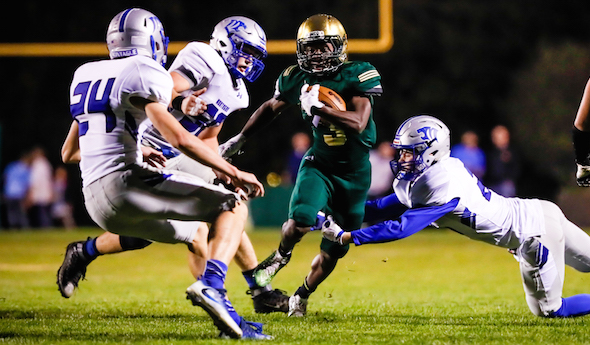
PHOTO: Montague, here on defense surrounding a ball carrier, won a meeting of undefeated teams Friday in its first game ever against Muskegon Catholic Central. (Photo by Tim Reilly.)
Griggs, Kelloggsville Set to Break Free Again
August 22, 2017
By Dean Holzwarth
Special for Second Half
WYOMING – If opposing teams think it’s going to be easy tackling Thomas Griggs this season, they might want to rethink their approach.
 Griggs, a 5-foot-10, 210-pound running back for the Wyoming Kelloggsville football team, is difficult to stop and a load to bring down.
“He was referred to in the South Bend Tribune last year as a bowling ball with legs,” longtime Rockets head coach Don Galster said. “Those kids did not want to tackle him.”
Just a year ago, Griggs blossomed into one of the top running backs in the Grand Rapids area while leading Kelloggsville to a major turnaround.
The Rockets went 3-6 in 2015, but behind Grigg’s breakout season, finished 8-2 while winning the Ottawa-Kent Conference Silver title with an unbeaten league run.
Those eight were the most wins for a Kelloggsville team since 2009, when it went 10-1.
After a wild 50-47 loss to Whitehall in the opener, Kelloggsville reeled off eight straight wins and advanced to the playoffs. Its season, however, ended in Pre-District play against former conference rival Allendale.
“Last year was really good,” said Griggs, a three-year starter. “Everybody didn’t think we were capable of doing what we did, but our senior class last year put in the hard work. Being able to contribute to last year’s success made me feel even better.”
Griggs rushed for nearly 1,400 yards and tallied 20 touchdowns. He averaged 8.7 yards per carry while wreaking havoc on opposing defenses.
“My stats were good as a sophomore, but we didn’t win a lot of games,” Griggs said. “Coming into my junior year I knew I was going to do better because I worked hard over the summer.”
Griggs, a soft-spoken young man with aspirations to play college football, has a valuable skill set. He’s a punishing hard-nosed runner, but possesses other key attributes.
“What makes him special is he’s got great vision, great feet and he reads blocks very well,” Galster said. “He just doesn’t want to go down, and he has learned how to run the ball in our offense, which has been key.”
As evident by his yards per carry average, it typically takes more than one defender to pull Griggs to the ground. He takes pride in his ability to stay on his feet.
“I always want to break at least one tackle every play,” Griggs said. “I don’t want to let that first person tackle me, and I try to get as many yards as I can.”
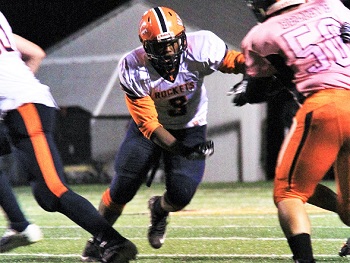 Galster remembers his first encounter with his standout senior. It was an early glimpse into the future.
“He was in eighth grade and the principal brought him over to introduce me to him,” Galster recalled. “I thought, ‘This is a big kid,’ and he just has a ton of ability. He works hard, and he’s a quiet leader. Every year he’s gotten better, and he makes the other guys better.”
Griggs started playing football when he was 7. He actually started out as a center before moving to fullback.
It was a role he embraced.
“In my head, I think I can do anything. So when they put me at center, I had the mindset of I was going to be the best center,” Griggs said.
The Rockets are expected to compete for another conference crown with a bevy of talent back in the fold.
Griggs is one of three returning to the backfield, including dual-threat quarterback Alex Guzman. The Rockets graduated only two seniors on offense.
“There’s not a lot of jealousy with those guys, and it motivates them to work harder,” Galster said. “We have a lot of weapons, but these guys understand that it all starts with the offensive line. If they open holes for them, then we will have some success.”
Griggs said having multiple options on the ground will make it tough for other teams to game plan.
“It’s better for us as a team because other teams can’t come into the game saying they are only going to stop me and then they are going to win,” he said. “We have other players that are going to show up and do what they have to do.”
Kelloggsville’s senior class is a tight-knit group with the potential to duplicate last year’s run.
“As a group, we’re pretty good, and we have that hate-to-lose mentality,” said Griggs, who also averaged 19 points per game as a starting basketball point guard last winter. “I’m glad people have started to notice us, and now we just have to keep it going.”
 Dean Holzwarth covered primarily high school sports for the Grand Rapids Press and MLive for 16 years and more recently served as sports editor of the Ionia Sentinel and as a sports photojournalist for WZZM and WOODTV. Contact him at [email protected] with story ideas for Allegan, Kent and Ottawa counties.
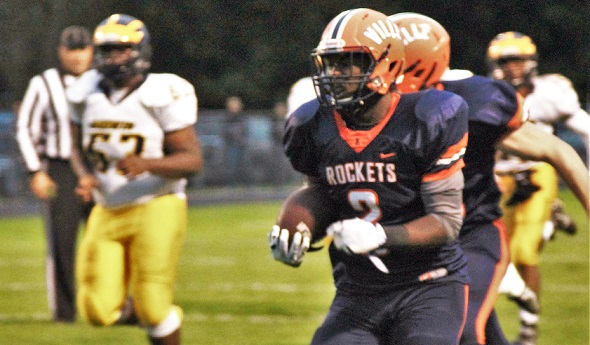
PHOTOS: (Top) Wyoming Kelloggsville's Thomas Griggs runs away from the crowd against Wyoming Godwin Heights. (Middle) Griggs readies to receive a handoff against Belding. (Photos courtesy of the Wyoming Kelloggsville yearbook staff.)