

Drive for Detroit: Week 9 in Review
October 23, 2012
By Geoff Kimmerly
Second Half editor
Just like that, another MHSAA football regular season is done. But not without hoopla that lasted into the final moments of Week 9.
The best seasons, at least for fans, are those filled with drama from the opening kickoff of Week 1 until the moment playoff brackets are announced on the Sunday Selection Show. This fall, eight teams that had never made the playoffs earned first-time trips to the postseason. A number of league title races came right down to the end.
And many of those closing moments are covered below in this week's Drive for Detroit.
West Michigan
Zeeland East 40, Muskegon 39
The Big Reds (8-1) appeared relatively invincible this fall and may yet prove to be the rest of the season. But with the O-K Black championship on the line, Zeeland East was one point better and stopped Muskegon's two-point conversion attempt during the closing minutes. Click to read more from the Holland Sentinel.
Also noted:
Grand Rapids Christian 21, Lowell 7 – Last season, Christian (8-1) beat Lowell (7-2) in the O-K White opener and made it stand up the rest of the way. This time, the Eagles had to wait until the end to claim a second-straight league title.
Grand Rapids West Catholic 17, Grand Rapids Northview 14 – Although Northview (7-2) did earn its first playoff berth this fall, West Catholic (6-3) held on to the O-K Bronze title – its sixth-straight league championship.
Hudsonville Unity Christian 28, Hamilton 27 – Hamilton needed a win to get into the playoffs automatically, and Unity Christian needed a win to have a remote shot; after a weekend of close calls, both got in at 5-4.
Muskegon Catholic Central 21, Traverse City St. Francis 13 – Few small schools have had as much football success as these two; the Crusaders (6-3) won this time to earn a playoff berth, and in the process ended any hopes of extending the MHSAA-best 22-season postseason streak held by the Gladiators (4-5).
Greater Detroit
Detroit Martin Luther King 51, Detroit East English 48
A loss to Detroit Crockett (now part of East English) in last season's Detroit Public School League championship game started a string of four straight in the regular season including three to start this fall (one was a forfeit). But King (6-3) closed the regular season strong by avenging a Week 2 loss to East English (7-2), in the process gaining a playoff berth as well. Click to read more from the Detroit Free Press.
Also noted:
Orchard Lake St. Mary 27, Detroit Catholic Central 10 – A week after falling to the Shamrocks (5-4), which resulted in a three-way shared Detroit Catholic League Central title, the Eaglets (7-2) avenged the defeat by winning this Prep Bowl game.
Ann Arbor Gabriel Richard 17, Pontiac Notre Dame Prep 12 – Notre Dame (8-1) earned a 12-point win over Gabriel Richard in the first Catholic League AA game this season, but ended with a split after this Prep Bowl stunner.
Farmington Hills Harrison 48, West Bloomfield 20 – It’s true, the Hawks have missed the playoffs twice in the last decade. But it does feel like they get in every year, and Harrison (6-3) got in again by downing the Lakers (2-7).
Carleton Airport 11, Tecumseh 10 – After losing three of its last five, Airport (6-3) got into the playoffs by edging the Indians (7-2)
Lower Up North
Grayling 21, Boyne City 0
Only one of these teams could finish unbeaten. And thanks mostly to a stout defense, it was Grayling. The Vikings finished 9-0 for the first time and also won the Lake Michigan Conference championship for the first time. Boyne City dropped to 8-1 and finished second in the league. Click to read more from the Traverse City Record-Eagle.
Also noted:
Bellaire 28, Rapid River 16 – The Eagles (6-3) opened this season with two losses and suffered another in Week 8, but regained some momentum by downing the reigning MHSAA 8-player runner-up Rockets (7-2).
Mancelona 40, Indian River Indian Lakes 8 – The Ironmen iced their second-straight 9-0 regular season finish, while dropping Inland Lakes to 4-5.
Traverse City Central 42, Cadillac 21 – After opening this fall with a loss, the Trojans (8-1) have won eight straight and put the finishing touch on the Big North Conference title by beating the Vikings (6-3).
West Branch Ogemaw Heights 42, Alpena 13 – The Falcons (6-3) finished the bounce-back from its 4-5 finish in 2011 by making the playoffs thanks to this win over Alpena (1-8).
Southwest and Border
Lawton 33, Watervliet 26
The Southwestern Athletic Conference South has been one of the state's most competitive leagues all season, with four of six teams contending for the title and a fifth just missing joining them in the playoffs. Watervliet (8-0) looked good to finish off the championship run for the second straight season. But Lawton (8-1) forced a share by avenging its 33-0 loss to the Panthers that cost it a share of the title last season. Click to read more from the St. Joseph Herald-Palladium.
Also noted:
Paw Paw 46, Edwardsburg 36 – The Redskins finished 9-0 for the first time since 2005, but gave up a season-high number of points to the Eddies (6-3).
Mattawan 20, Portage Northern 14 – This only meant second place in the Southwestern Michigan Athletic Conference West, but Mattawan (8-1) and Portage Northern (7-2) both will continue this week.
Mendon 15, Pewamo-Westphalia 12 (OT) – The Hornets won their 23rd straight game, but P-W (6-3) gave them the closest of the streak (not counting a 1-0 forfeit win earlier this fall).
Bridgman 34, Wyoming Tri-unity Christian 18 – Not only did the Bees (6-3) complete their best regular season since 1997, but they made the playoffs for the first time since 1977.
Thumb and Bay
Montrose 22, Lake Fenton 21
The Genesee Area Red Conference title came down to the final play of double overtime in the final game of the regular season. Montrose (8-1) stopped Lake Fenton's attempt and claimed the championship for the second straight season, while the Blue Devils (7-2) finished runners-up for the second straight. Click to read more from the Flint Journal.
Also noted:
Midland 21, Midland Dow 6 – The Chemics (9-0) made it 10 wins in 11 games against the rival Chargers (5-4), and also won the Saginaw Valley Association North title outright.
Linden 43, Swartz Creek 0 – The Eagles (8-1) claimed half of the Flint Metro League championship while denying the Dragons (7-2) of the same.
Fenton 30, Lapeer West 21 – Same for Fenton (8-1), which won the other half of the Metro League title while knocking Lapeer West (6-3) out of the running.
Deckerville 24, Peck 18 (3 OT) – The Eagles (8-1) needed a third overtime to win the North Central Thumb 8-Man League title against runner-up Peck (7-2).
Upper Peninsula
Manistique 12, Harbor Springs 6 (2 OT)
The Emeralds, winners of one game each the last two seasons, won six of their last seven this fall to finish 6-3 and earn a first playoff berth since 2008; Harbor Springs finished 3-6. Click to read more from the Marquette Mining Journal.
Also noted:
Iron Mountain 34, Norway 13 – The Mountaineers needed this one to squeak into the playoffs at 5-4; Norway finished 3-6.
St. Ignace 14, Cheboygan 10 – The Saints capped their second straight 9-0 regular season against a Cheboygan team that also made the playoffs at 6-3.
Stephenson 35, Powers North Central 6 – The Eagles (7-2) were already in the playoffs, and Powers North Central (5-4) still got in despite the loss.
Calumet 36, Gladstone 12 – The Copper Kings (6-3) got the necessary win to keep an eight-season playoff streak alive, while dropping Gladstone to 2-7.
Crystal Falls Forest Park 33, Lake Linden-Hubbell 14 – Forest Park (7-2) won its third straight over the rival Lakes (4-5), which may have lost out on an opportunity to reach the playoffs at 5-4.
Mid-Michigan
Howell 24, Jackson Lumen Christi 21
The Highlanders (6-3) drilled a late field goal to earn a playoff berth and keep the Titans (8-1) from a perfect regular season. Lumen Christi still made the playoffs for the 15th straight season. Howell didn't make it in 2011, but this will be its sixth appearance in seven years. Click for more from the Livingston Daily Press & Argus.
Also noted:
DeWitt 21, Fruitport 20 – The Panthers (7-2) bounced back from a Week 8 loss to Portland by handing Lakes 8 Conference champion Fruitport (8-1) its only loss of the regular season.
Lansing Waverly 41, Fowlerville 14 – The Warriors (6-3) earned their first playoff berth since 2002, but more impressively finished their finest regular season since 1982; Fowlerville ended 1-8.
Grass Lake 28, Leslie 14 – The Warriors (8-1) made it three straight over two seasons against the Blackhawks (8-1) while handing them their only regular-season loss.
Portland St. Patrick 34, Waldron 26 – The Shamrocks (9-0) won the Southern Michigan 8-Man Football League title by beating the second-place Spartans (6-3).
Trophy Games
Every week, the MHSAA highlights trophy games played around the state. Here are three from Week 9:
Little Brown Jug – This trophy, contested by Sault Ste. Marie and Newberry, was established in 1923 and is the oldest jug game we know of in Michigan. It might possibly be the oldest trophy game in high school football in our state. Final: Sault Ste. Marie 38, Newberry 6.
Copper Bowl – Hancock and Houghton have waged this game since 1953. Houghton ended a two-game losing streak. Final: Houghton 29, Hancock 14.
The Curb – This was the first-year of this trophy game between Royal Oak and Berkley, with the prize a 30-pound piece of Woodward Avenue curb. Final: Berkley 42, Royal Oak 29.
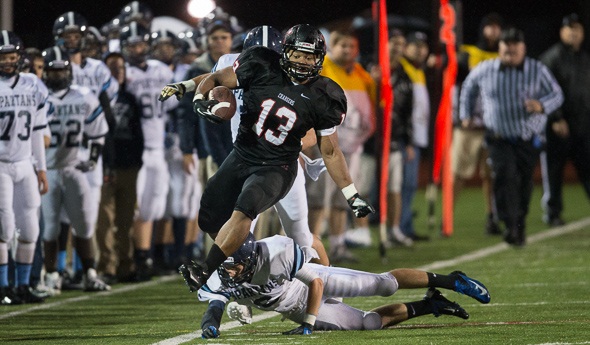
PHOTO: Livonia Churchill's Romello Brown (13) sprints down the sideline away from the grasp of a Livonia Stevenson defender as Churchill won Friday 49-10. (Click to see more at Terry McNamara Photography.)
Performance: Muskegon's La'Darius Jefferson
November 29, 2017
 La’Darius Jefferson
Muskegon senior – Football
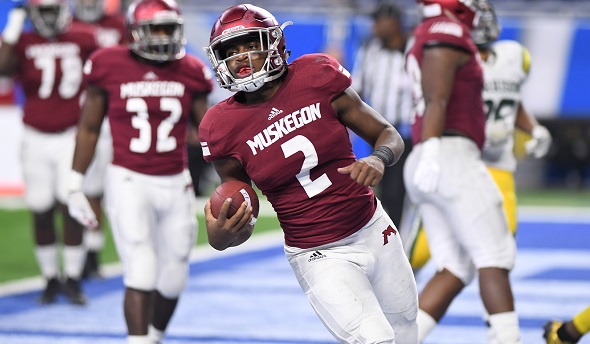
Muskegon’s 6-foot-2, 215-pound quarterback ran 32 times for 247 yards and four touchdowns to lead the Big Reds to a 28-10 win over Farmington Hills Harrison in Saturday’s Division 3 Final, earning Jefferson the Michigan Army National Guard “Performance of the Week.” The championship was Muskegon’s first since 2008 and came after the Big Reds fell by a point to Orchard Lake St. Mary’s in the 2016 championship game – when the Eaglets scored with four seconds to play.
Jefferson, who also celebrated his 18th birthday Saturday, finished this season with 2,097 yards and 33 touchdowns rushing and 1,205 yards and 21 touchdowns passing. His rushing touchdown total will make the MHSAA record book, and his performance Saturday earned four entries for accomplishments in a championship game. After splitting time at quarterback as a junior – and running for two touchdowns in the 2016 Final – Jefferson led arguably the best team in the state, regardless of division. The Big Reds scored 722 points, which rank third-most in state history, averaging 51.2 per game, which ranks 10th. Their average margin of victory was 45 points, and they outscored their five playoff opponents by a combined 221-36.
 Individual awards are piling up for Jefferson, who was named Division 3-4 Player of the Year by The Associated Press and statewide Michigan High School Football Player of the Year by MLive. He previously had committed to continue his football and academic careers at University of Central Florida, but has re-opened his recruiting with Michigan State and Georgia Tech among those recruiting him hardest. Jefferson, who also ran track last spring, has big plans aside from football; he carries a 3.4 cumulative grade-point average and is a member of National Honor Society, and he plans to study aerospace engineering wherever he ends up.
Coach Shane Fairfield said: “He is just a selfless kid that loves to win, that loves family. He’s driven by the relationships in his home. And he loves his teammates. And he was more vocal and determined this week to get this win, because his biggest thing is he wants all the kids who aren’t going to have the chance to experience what he’s going to experience after he graduates to have some type of experience that they can say either, ‘Hey, I played with La’Darius’ or ‘I won a state championship when I was in high school.’ And that’s it – he’s very aware of how lucky and fortunate he is to be in the position he is, and he just wants to share that with all of his teammates.”
Performance Point: “It’s amazing. It’s something people dream of,” Jefferson said. “People dream about scoring the last touchdown in their backyard, making the final hoop. It’s a blessing. I’m trying to hold my tears in. We worked so hard to get here. We’ve been gassed and pounded. It’s so special. … This is the best thing that’s ever happened to me besides my family.”
Team of destiny: “It’s something these boys have been dreaming about. I kid you not; I told Eli Jackson, 44, our eighth grade year that we were going to win it. I mean, we’re here.”
Motivated Muskegon: “We had a chip on our shoulder until (the clock) was zero-zero. We weren’t done. We had a chip on our shoulder all year. Everybody we played, we said we’re going to punish. … Everybody doubted us. Everybody said we lost Kalil Pimpleton, one of the best players in the state (who played this fall at Virginia Tech). We lost JaCorey Sullivan (Central Michigan) … Andrew Ward (Nebraska), one of the best defensive players in the state last year. We lost them big boys up front. So we overcame.”
 Checkmate: “I’ve been more humble (this season). I enjoy the moment. I feel like last year it was an amp moment; I wasn’t feeling it. I told myself, it’s all I’ve got. It’s my last job. I go through every day and I do a checklist. As a kid I dreamed about winning player of the year and breaking records and doing all this, and I did all that. The final checklist was win a state championship, and I can go home and check that off.”
Soaring on and off the field: “I know I want to be a successful young man beyond football. I want to go to college and study aerospace engineering, get my degree and help provide for my family. I’ve got goals beyond football. I thought as a kid that football was the only thing that I had, (but) I can do without football. I’m a great student. I work hard; I work my butt off in the classroom. I want to build planes. Who don’t want to build planes? Who don’t want to be like, ‘Oh, La’Darius built this big machine that’s flying?’ It’s cool; it’s unique.”
- Geoff Kimmerly, Second Half editor
Every week during the 2017-18 school year, Second Half and the Michigan Army National Guard will recognize a “Performance of the Week" from among the MHSAA's 750 member high schools.
The Michigan Army National Guard provides trained and ready forces in support of the National Military Strategy, and responds as needed to state, local, and regional emergencies to ensure peace, order, and public safety. The Guard adds value to our communities through continuous interaction. National Guard soldiers are part of the local community. Guardsmen typically train one weekend per month and two weeks in the summer. This training maintains readiness when needed, be it either to defend our nation's freedom or protect lives and property of Michigan citizens during a local natural disaster.
Previous 2017-18 honorees:
November 23: Ashley Turak, Farmington Hills Harrison swimming - Read
November 16: Bryce Veasley, West Bloomfield football - Read
November 9: Jose Penaloza, Holland soccer - Read
November 2: Karenna Duffey, Macomb L'Anse Creuse North cross country - Read
October 26: Anika Dy, Traverse City Central golf - Read
October 19: Andrew Zhang, Bloomfield Hills tennis - Read
October 12: Nolan Fugate, Grand Rapids Catholic Central football - Read
October 5: Marissa Ackerman, Munising tennis - Read
September 28: Minh Le, Portage Central soccer - Read
September 21: Olivia Theis, Lansing Catholic cross country - Read
September 14: Maddy Chinn, Pontiac Notre Dame Prep volleyball - Read
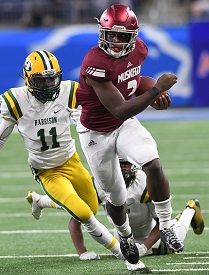
PHOTOS: (Top) La'Darius Jefferson crosses into the end zone for one of his four touchdowns during the Division 3 Final on Saturday at Ford Field. (Middle) Jefferson breaks into an opening while Harrison defenders pursue.