

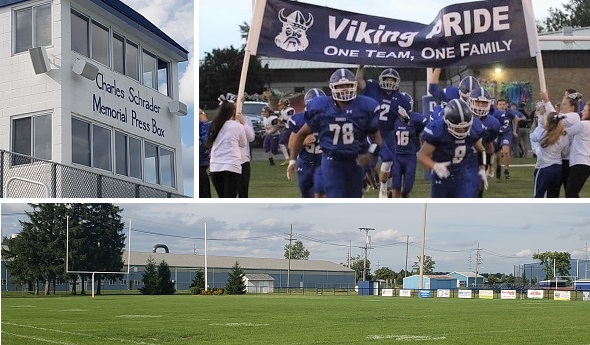
Dundee Says Good-Bye to Longtime Home
October 25, 2019
By Doug Donnelly
Special for Second Half
DUNDEE – One more memory.
 After 85 years of playing prep football in the same location, Dundee will close the doors on its stadium tonight with plans to move into a new athletic complex next fall. Vikings head coach Kyle McElvany called tonight’s game against undefeated and state-ranked Hillsdale one more chance for the Vikings to make an ever-lasting memory.
“There is so much tradition and history here over the course of 85-plus years,” McElvany said. “It’s humbling. We hope to go out and make our alumni and community proud.”
Dundee hasn’t been to the playoffs in seven years, but a victory over Hillsdale would make certain the Vikings are in the 256-team field when the 11-player tournament pairings are announced Sunday. It would make for a memorable way to close out the history of the stadium, too.
Late last month, school officials announced that 1969 Dundee alum John D. Craig, retired chairman, president and CEO of EnerSys, has donated $1 million to be used exclusively toward the creation of the John D. Craig and Family Athletic Complex. The school will begin next week discussing the new complex at a public meeting. The plan is to build the new stadium in time for the 2020 season opener against Romulus Summit Academy North.
The Vikings have been playing football for decades in the current stadium, located behind what once was the high school in the village of fewer than 4,000 people. The new athletic complex will be built on the northwest side of the new high school.
“Our administration has already started to work on the project from a development standpoint, and I hope to get involved as well once our season is wrapped up,” McElvany said.
The new stadium will have a total visitor seating for approximately 2,500, new stadium lights and a new engineered natural grass athletic field. The facility will be capable of hosting football games, track meets and band festivals, and also feature a new scoreboard, new permanent concessions and restroom facilities.
The old stadium has been home to several great memories for Vikings fans over the years. One of them came earlier this season when Dundee’s defense made a goal-line stand during the final seconds to hold on for a 15-14 win over Ida. It was Dundee’s first football win over Ida in six years.
“To see the crowd and community on the field embracing those kids after that game was very special,” McElvany said.
Over the years, Dundee has won championships, completed undefeated seasons and hosted playoff games in the old stadium. In 2011, Dundee was still recovering from a tornado that caused millions of dollars in damage in the community when its football team brought some solace to the area with an 8-3 record and the only playoff win in school history.
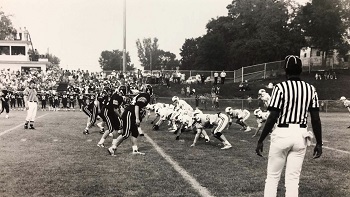 “The greatest game ever for us in that stadium was the 2011 District playoff game versus Brooklyn Columbia Central,” said Dylan Williams, a 2012 Dundee graduate. “The field was all torn up from the tornado still. We took the lead in the fourth quarter with about a minute to go and held them.”
The most successful era for Dundee came during the 1960s when the Vikings won both Huron League and Southeastern Conference championships. Dundee didn’t lose for more than three years from 1963-1966 (finishing a combined 32-0-3), an accomplishment that remains the longest unbeaten streak in Monroe County Region history.
“The undying friendship, teamwork and dedication to a goal learned on this field will be with us all forever,” said Bob Busz, who played for those teams and graduated in 1966.
Ted Rath, a 2002 Dundee graduate and current assistant coach with the Los Angeles Rams, recalled several great memories from his time at Dundee. He was a student manager in 1994 and 1995 when his brother was playing quarterback, and then played for the Vikings himself. He met his wife, Robin, on that field while she was attending cheerleading practice.
“So many memories come flooding to mind when I think of my football experiences on that field,” Rath said. “I have been blessed to travel this great country and the world because of the sport of football. I have been to places like Wembley Stadium in London and Lambeau Field in Green Bay and many places in between. When I think about all the places that this sport has taken me, I realize that none are as sweet as that field in Dundee, Michigan.
“If I could stand on that field this week and say one thing it would simply be thank you,” Rath wrote in an e-mail. “Thank you for the memories, thank you for the victories, but also thank you for the defeats. The lessons learned on that field have shaped my life and driven me to become a better Christian, husband, father and person.”
While the new athletic complex is a welcome addition to the district and community, former players and coaches can’t help but recall the great times they made in the old stadium. Thoughts of fans rushing onto the field, wins over rival Ida and simply lining up for the kickoff at games at the stadium will keep the facility alive for Vikings fans for years to come.
Tyler Anson, a 2006 graduate, said he used to find his favorite spot at every home game to quietly reflect right before kickoff.
“My favorite memory from the stadium was always standing in the back of the end zone right before the national anthem,” Anson said. “There was something about being under the lights, looking down the field seeing the crowd, and hearing the anthem knowing you’re about to go to war with your brothers. It’s a feeling that will always give me chills.”
 Doug Donnelly has served as a sports and news reporter and city editor over 25 years, writing for the Daily Chief-Union in Upper Sandusky, Ohio from 1992-1995, the Monroe Evening News from 1995-2012 and the Adrian Daily Telegram since 2013. He's also written a book on high school basketball in Monroe County and compiles record books for various schools in southeast Michigan. E-mail him at [email protected] with story ideas for Jackson, Washtenaw, Hillsdale, Lenawee and Monroe counties.
PHOTOS: (Top) Dundee’s football stadium has hosted games for 85 years. (Middle) Vikings fans stretch into the hillside next to the bleachers during a game. (Top team and middle football photos courtesy of Kyle McElvany; press box and field photos by Doug Donnelly.)
Orchard View Buy-In Reaps Big Turnaround
October 30, 2019
By Tom Kendra
Special for Second Half
It was far from love at first sight.
 When returning Muskegon Orchard View standouts like senior Dayton Rose and junior Owen Swanson first met their new varsity football coach Fred Rademacher back in January, they weren’t so sure what to expect moving forward.
“I was very skeptical,” said Rose, who at 6-foot-2 and 225 pounds was asked to move from tight end back inside to guard in Rademacher’s wing-T offense. “I caught a lot of passes last year, and I really didn’t want to go back to the wing-T.
“Then I told him that I was a second-team all-state punter. He told me: ‘That’s nice, but I don’t punt.’ At that point, I was really wondering about this dude.”
Fast forward to present day, and there’s overflowing mutual admiration between team and coach at this eastern Muskegon County school district, which had emerged as a mid-sized state powerhouse for a solid decade from 1995 to 2005 before falling off the map.
The Cardinals are not only back in the MHSAA Playoffs after a 10-year hiatus, but they returned in style improving from 2-7 last fall to a perfect 9-0 this regular season. OV is ranked No. 2 in Division 4 heading into Friday night’s home showdown against No. 7 Sparta (8-1).
“We have a great senior class,” said Rademacher, whose most recent head coaching job was at Hastings, where he was 44-43 over nine years. “There are 14 seniors that are great football players, and they like to work hard. You add in a coaching staff that has bought in and an administration that is backing us, and it’s a formula for success.”
 Orchard View opened the season with a hard-fought home win over Spring Lake, then went on the road for three straight weeks – coming home a perfect 4-0 after wins over Kent City, perennial power Muskegon Catholic Central and Belding.
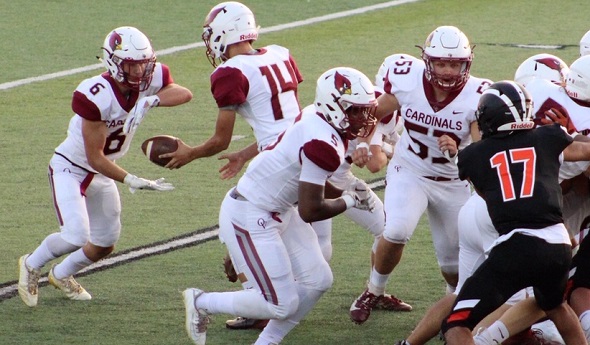
The Cardinals did it on the field by ditching the spread offense and going back to the wing-T, which they ran to so much success under John Shillito (making the MHSAA Finals in 1995 and 1999) and Matt McDonald (winning the school’s lone championship, in Division 4 in 2004).
Rose, a dominating pulling guard, is one of six seniors among the starting front seven on offense – with the only underclassmen junior guard Jayshawn Sandin-Davis. The other starters up front are center Jordan Tuttle, tackles Dominic Baushke and Xavier Ruiz and ends AJ Herrera and Hayden Stanfield.
The ground game is keyed by the 1-2 punch of shifty junior fullback Brendan Hyatt and bruising senior halfback Edmari Mitchell, along with regular subs in senior Alex Andrews and sophomore Darius Williams.
“I like my backs to be unselfish,” said Rademacher, 51, who was an assistant at East Kentwood for four years under Shillito before taking the Hastings job. “They have adopted my viewpoint that it doesn’t really matter who scores the touchdown as long as we score a touchdown.”
Rademacher is a Flint native whose father, Fred, was the first varsity football coach at Flint Powers Catholic. His varsity assistants include OV principal Dan Bolhuis and defensive coordinator Brian Andrews, along with Morgan Wansten (running backs and defensive line), Eric Prow (offensive and defensive lines) and Pete Vellenga (defensive backs and offensive line).
The trigger man for the Cardinals is Swanson, who has done an admirable job distributing the ball and carrying out all of the fakes that are an integral part of the wing-T. He has been deadly on keeper runs, and his strong arm adds another dimension to the attack – which may be required to win a loaded District that also includes Grand Rapids Catholic Central, which has won two Division 4 titles over the past three years.
 “I love to throw the ball, like any quarterback, so I wasn’t real happy at first about the new offense,” said Swanson, who plays four sports – football, basketball, bowling and baseball. “But going 9-0 makes up for everything.”
The Cardinals capped their turnaround tale with a 32-20 home victory last week over North Muskegon. OV raced out to a 24-0 lead in that game, before NM rallied back behind the arm of senior quarterback John Hayhurst.
Rose, the leader of the Cardinals’ defense at middle linebacker, knows that unit is going to have to play much better pass defense against Sparta, which is led by four-year starting quarterback Jakel Davis.
The secondary of Hyatt and Andrews at safety and Brendan Nelson and Williams at cornerback will be put to the test, both in coverage and in knowing when to come up and fill on keeper runs.
True to his coach’s word, Rose has punted just three times the entire season, as Rademacher has chosen to go for it on fourth down from all over the field.
Rose said he and his teammates have come to understand that there is a method to their new coach’s madness, and that belief has produced a new-found confidence in the OV program. Rademacher got a head start on preparation this week, skipping the team’s playoff selection show watch party Sunday to map out this week’s practice plan.
“He’s a little weird, and it takes awhile to get to know him,” concedes Rose, who hopes to continue playing football at the Division II or Division III college level next year. “I mean, we have no music at our practices and he doesn’t get any of our jokes. He is the definition of an old man. But hey, we’re winning.”
 Tom Kendra worked 23 years at The Muskegon Chronicle, including five as assistant sports editor and the final six as sports editor through 2011. E-mail him at [email protected] with story ideas for Muskegon, Oceana, Mason, Lake, Oceola, Mecosta and Newaygo counties.
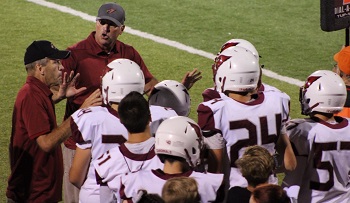
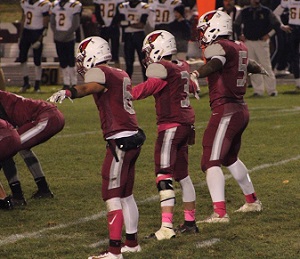
PHOTOS: (Top) Senior guard Dayton Rose pulls down the line as Alex Andrews gets a handoff from quarterback Owen Swanson during Orchard View’s 42-35 win at Belding on Sept. 20. (Middle) First-year coach Fred Rademacher (gray hat) talks to his team during that Cardinals' win. (Below) Orchard View is back to playing wing-T football as the backfield, from left, of Alex Andrews, Brendan Hyatt and Edmari Mitchell get their proper spacing before a play during a 32-20 win over visiting North Muskegon on Oct. 25. (Photos by Katie Ream.)