

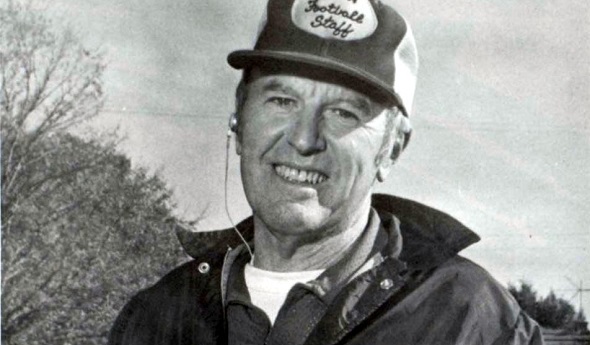
Early Wins Leader Maskill Built Champions
November 12, 2019
By Ron Pesch
Special for Second Half
The long shadows of “midcentury modern” coaching legends have mostly disappeared from the gridirons of Michigan.
One more vanished in late October at the age of 96.
Bill Maskill was once the winningest football coach in Michigan high school history, chalking up the majority of his victories at Galesburg-Augusta. One of only six who could claim such an honor – coaches are first counted after reaching 200 wins – he received his start in coaching at Sheridan High School (now known as Central Montcalm since the Sheridan and Stanton school districts merged in 1963). In 1980, he became only the second coach to compile 200 varsity victories as a coach, and in the fall of 1982 he surpassed Muskegon Heights’ coaching legend Oscar E. ‘Okie’ Johnson on the victory list.
Maskill’s coaching accomplishments – and their historic significance – are a reminder of a change in eras. Michigan prep sports in the pre-playoff days were filled with coaches with Swiss-Army like skills, as many were expected to coach multiple sports at their respective schools. The gridiron season was unlike today’s in many ways, and the differences are reflected in a variety of manners within the state record books.
Coaching and player season performances up to the creation of the MHSAA Playoffs in 1975 were constrained by the schedule. In general, nine games was the max. (With the playoffs, a season can extend up to 14 games.) Maskill’s victory total now ranks 16th overall in Michigan high school history, as there are 63 coaches with at least 200 varsity wins. Two coaches, John Herrington of Farmington Hills Harrison – the state’s current leader – and Al Fracassa, long of Bloomfield Hills Brother Rice, amassed more than 400 varsity victories during their careers. In both cases, more than 65 victories were earned during the postseason.
The MHSAA postseason was approaching its eighth year of existence when Maskill passed Johnson as the winningest football coach in state history. To that point, Maskill’s Rams had twice qualified for the playoffs – the first time in 1976, and again in 1980 – but had yet to win a game during the postseason.
But he stayed atop the state’s football wins list for more than a decade – and later found playoff successes as well, more crowning achievements for a coach whose many wins came after turning around both programs fortunate enough to employ him over a combined 44 seasons.
A Rough Start
Maskill’s career, at least in his eyes, was nearly derailed during his first season at the helm.
“The year was 1949, and Bill Maskill was in his first year as varsity football coach at Sheridan High, about 50 miles north of Lansing. He thought it would probably be his last. His team did not win a single game. ‘A couple of times, I thought of throwing in the towel,’” Maskill told Mick McCabe of the Detroit Free Press in October 1982, when he surpassed Johnson in victories.
There was little likelihood that Maskill would be dismissed as coach after that disappointing season. But it took a few years for his Redskins to become competitive.
“Previous to his work there, Sheridan had not played football and there was little interest in the game,” noted the Battle Creek Enquirer in the spring of 1957, when Maskill was announced as the new football and baseball coach at Galesburg-Augusta High School. “He built up interest to the point that during the past five years, Sheridan has won the Montcalm County League championship once and finished second for four years. During this period, the team’s overall record was 31 won, 9 lost and 2 tied. In baseball, he had one county championship, finished second twice and third twice.”
A 1941 graduate of Detroit DeLaSalle, Maskill had been a hard-plunging fullback on the football team who also boxed in Catholic Youth Organization tournaments. Following graduation, he initially enrolled at the University of Michigan in 1942, receiving his freshman numerals from coach Wally Weber, but only after a year at prep school near Pittsburgh.
“I screwed around a lot in high school and couldn’t get into Michigan,” he told McCabe years later, laughing. “They sent me to this prep school, and I couldn’t believe all the studying I had to do. It was the best thing to ever happen to me.”
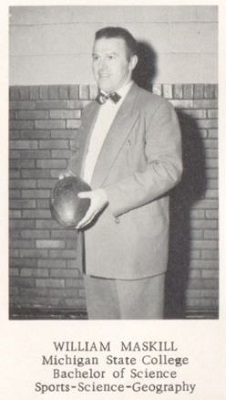
He ended up at Michigan State, where he earned a varsity letter from coach Charlie Bachman in 1944 and his bachelor’s degree.
“He was hard of hearing; he had it bad,” recalled Bob Ludwig of Muskegon, a football teammate with Maskill in the backfield for the Spartans in 1945. “Our quarterback would mouth the words of the play to him.”
Over time, Maskill had multiple operations in hopes of correcting the issue.
The attempts improved his hearing, according to Maskill, “to about six percent. And that’s the truth. But there are some advantages. The kids can cuss at me and I don’t know it.”
The disability never stopped him. He told McCabe that the only thing he ever wanted to be in life was a football coach: “I just liked playing football, and that made me want to coach.”
Another Rough Start
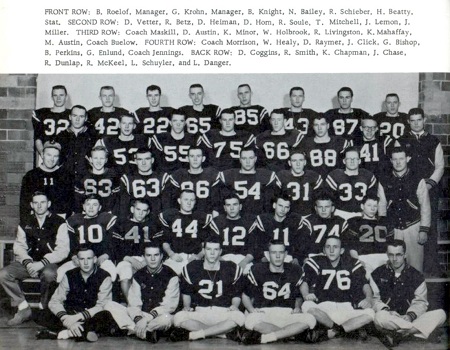
At Galesburg-Augusta, he inherited a team that finished with a single tie amid eight losses the year prior to his arrival. Improvement certainly wasn’t reflected in the standings in Maskill’s first year in charge. The Rams completed the eight-game season without a victory or a tie to show for their efforts. That changed in year two, as G-A finished with a 7-1 mark. The only loss was to unbeaten Bangor, 40-21, in the season finale. In 1959, Maskill and his stable of assistants had completely flipped the table, as the Rams ended with a perfect 8-0 mark.
“Galesburg-Augusta blasted Bangor, 27-0, before a crowd of more than 2,500 fans at jam-packed Angell Field in Kalamazoo … in a battle between the Kalamazoo Valley’s unbeaten football teams. Bangor’s great 21-game winning streak simply collapsed before the high-powered running attack as the Rams rolled to their seventh straight victory of the season,” wrote Dick Kishpaugh in his coverage for the Enquirer. Kishpaugh would later be known as Michigan’s authority on high school sports.
A week later, the Rams trounced a solid Paw Paw team on the road, 33-7. They finished third in the United Press International season-ending Class C-D rankings behind Charlevoix and Cassopolis.
Statewide Success
That was the first of eight G-A squads to finish the regular season undefeated for Maskill. The next four would each be named mythical state champions according to the polls.
His 1962 team allowed only 14 points across eight games to end the year as Class C-D champion ahead of St. Joseph Catholic according to The Associated Press poll of Michigan sportswriters and sportscasters.
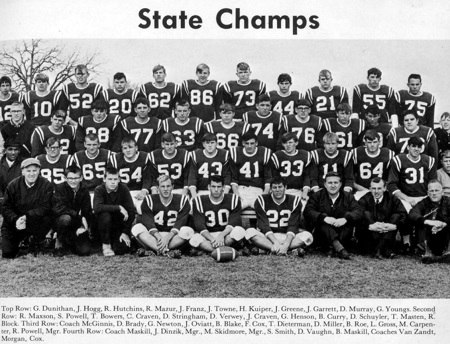
Maskill’s 1966 and 1967 Rams squads each finished unbeaten and untied in nine contests. The 1967 team scored a school-record 389 points on the year, and held opponents to a mere seven points – a touchdown and an extra point scored by Springfield in a midseason 27-7 triumph. The 1970 team also finished with a flawless 9-0 mark, topping the 1967 team’s offensive output with 408 points on the season.
Maskill’s 1976 team ended the regular season 9-0 and was one of only four teams to advance to the Class C postseason in place during those earliest days of the MHSAA playoff system. G-A immediately was eliminated by Flat Rock, the eventual champion.
The media spotlight came to Galesburg-Augusta in 1980 for a regular season-ending contest with Constantine. A victory would give the veteran coach another perfect regular season and push Maskill’s career win total to 200. The week played out under television station coverage and multiple newspaper reports.
“More than 120 of Maskill’s former players were on hand, some wearing varsity letter jackets that were nearly 20 years old. All trotted onto the field, according to their graduation years, during halftime festivities,” said Bob Byington in the Enquirer. “… The warmest embrace and greeting were reserved for Maskill’s son, Bill Jr., an assistant coach at the University of Louisville. The younger Maskill drove in from Kentucky to surprise his dad …”
 The Rams won 28-6 to finish 9-0, qualifying for the MHSAA Playoffs for the second time in school history. The team ranked fifth in the final AP poll. A loss to White Pigeon in the opening round capped the season.
Despite impressive 8-1 records in 1981, 1982 and 1983, the Rams didn’t return to the playoffs until 1985. There, they won their first postseason contest, downing Hudson, 21-6, in a Pre-Regional. G-A fell the next weekend to eventual Class C titlist Lansing Catholic Central.
Lansing Catholic would again eliminate the Rams from the postseason the following year.
We Have a Lot of Heart
The MHSAA approved an expansion to the football playoff system in 1990, doubling the classifications from four to eight, which in turn doubled the number of annual qualifiers. While the Rams finished the regular season with a single defeat, they were unranked in the weekly press polls. Thanks to the changes to the playoff system, they were in the tournament, but weren’t expected to go far.
Rumors had circulated that this – Maskill’s 40th year as a head coach – would be the last go-around for the 67-year-old veteran coach. The first-round opponent was No. 4-ranked Dansville. With the Rams trailing 17-0 with 8:33 remaining in the third quarter, the result didn’t look promising.
But Jason Meek would have none of that. The Rams started their comeback with a trick play – a halfback pass by Meek off a lateral for a touchdown reception by Rusty Smith. It was followed on the next possession by a 27-yard TD reception by Meek from reserve quarterback Dave Lemmien. A pair of 2-point conversions by Rick Tyson had cut the lead to 17-16. Tyson scored the game winner on a one-yard touchdown run, set up by an interception by Meek that capped a 14-play, 59-yard drive – all rushes – that burned 6:53 off the clock. The defense shut down Dansville for the remaining six minutes of the contest.
A week later, the Rams lined up against No. 1 Schoolcraft, the two-time reigning Class C champion which was riding a 16-game win streak. The Eagles had lost only three of their last 57 games.
Galesburg-Augusta stunned all prognosticators with a 15-13 win before nearly 5,000 fans.
The Rams ran the ball 52 times, with Tyson handling the ball 28 occasions for 78 yards including a 19-yard TD that opened the game’s scoring. Schoolcraft tied the game at 7-7 just before the half, then opened a 13-7 lead on its second drive of the second half.
“It took all of us to do it,” said G-A junior fullback Paul Zimmerman, who scored the game-tying touchdown, and winning 2-point conversion on nearly identical plays with 4:01 remaining in the game.
Again, like the previous week, the Rams’ defense rose to the occasion, shutting down the Eagles for the remaining minutes.
“They kept the football,” said Larry Ledlow, coach of Schoolcraft about the second half. “Our defense was on the field much too long.”
G-A would win its Week 12 Semifinal contest with Clinton, 22-7, to advance to its first MHSAA Final. Corky Meinecke wrote a career-respective feature on Maskill that appeared in the Free Press on the day of the game:
“Just about everyone who loves, respects and admires Bill Maskill … figures he’ll announce his retirement sometime after the Rams play Muskegon Catholic Central … in the Class C championship game at the Silverdome. The timing couldn’t be better. Getting the Rams (11-1) to the Silverdome was the last notch on a heavyweight coaching belt that includes four mythical state titles … and five playoff appearances. He is the winningest football coach in state prep history …”
Weighing into the pending decision was a surprising aspect few ever considered.
“Maskill never figured he’d run out of players before he ran out of desire,” wrote Meinecke, “but that appears to be the case. Of G-A’s 24 players, only six are underclassmen. The school did not field a freshman team and the junior varsity – comprised of mostly freshmen – forfeited its last two games because it could not suit up enough players.”
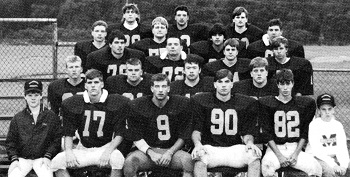 “A normal person would retire,” said Ken Buelow, Maskill’s assistant for all but three of the coach’s seasons at G-A and Sheridan. “But you have to remember, Bill is not a normal person. You’re talking about one hell of a human being here.”
“We don’t have size, we don’t have quickness and we don’t have speed,” Maskill said to Meinecke about this team that was perhaps the most satisfying of his career. “But we have a lot of heart.”
The Rams lost to MCC.
Changing landscapes
Maskill’s decision still took time. In August 1991, the G-A administration officially announced that the district would not field a varsity football team that coming fall.
“We do not have the numbers,” said athletic director Alex Forrester at the time. “It has nothing to do with money. … We do not have enough players.”
G-A chose to sponsor only a JV team that season. Instead of walking away, Maskill chose to stay on.
“I’ve never not coached a varsity,” he told Mark Bradley of the Enquirer. “I won’t know how to coach at the junior varsity level. But coaching is coaching, whether it be at the varsity or junior varsity level.”
He had retired from teaching following the 1980-81 school year and was one of 30 individuals inducted into the inaugural class of the Michigan High School Football Coaches Association’s Hall of Fame in April 1983. In October 1986, the school district honored him by naming the G-A football field in his honor. Without Maskill walking the halls and recruiting, fewer and fewer kids came out for football. After a year leading the JV, in July of 1992, he officially stepped aside from coaching. Forrester, one of his longtime assistants, took charge.
Maskill had purchased a tire company after he retired from teaching, and that became his focus.
In October 1994, over 12 years after Maskill had passed Johnson on the win list, Marysville’s Walt Braun passed Maskill in total wins. Leo “Smokey” Boyd of Saginaw Nouvel overtook Braun on the list in 1996. In turn, Fracassa topped Boyd in 2001, and Herrington bettered Fracassa’s total in 2017.
The “Ram Family”
The floor-to-ceiling mementos from his career that Maskill shared with Meinecke during their conversation were a feature of a party that Maskill would host annually.
“… It was not unusual to have 200-plus (former players, coaches, and new and old friends) there to celebrate the man they knew as ‘Coach’,” wrote Bill Broderick in a heartfelt article in the Enquirer, announcing Maskill’s passing.
Several years back, Buelow, his old assistant coach, had organized a group to create “a would-be Galesburg-Augusta football museum” in Maskill’s basement.
“… I was shocked when I heard,” said Bill Maskill, Jr., to Broderick concerning his Dad’s passing. Head football coach at Midwestern State University in Wichita Falls, Texas, since 2002, Bill Jr. had earned all-state honors at quarterback as a senior at G-A in 1966. "He went out and walked a mile on Monday. We all thought he would live forever."
 Ron Pesch has taken an active role in researching the history of MHSAA events since 1985 and began writing for MHSAA Finals programs in 1986, adding additional features and "flashbacks" in 1992. He inherited the title of MHSAA historian from the late Dick Kishpaugh following the 1993-94 school year, and resides in Muskegon. Contact him at [email protected] with ideas for historical articles.
PHOTOS: (Top) Bill Maskill Sr., here during the 1980-81 school year, was the state’s winningest high school football coach all-time after his final varsity season in 1991. (2) Maskill, shown here during the 1954-55 school year, played football and earned his bachelor’s degree from Michigan State. (3) The 1959 Galesburg-Augusta team finished 8-0. (4) The 1966 Galesburg-Augusta team was named a mythical state champion by media rankings. (5) Maskill took his team to the MHSAA Finals for the first time in 1990, when it finished Class C runner-up. (Photos gathered by Ron Pesch.)

Inside Selection Sunday: Mapnalysis '13
October 28, 2013
By Geoff Kimmerly
Second Half editor
At the end of the day – Sunday, in this case – the 2013 MHSAA football playoff field was determined based on a set of numbers we began working with long before the first kickoff of this season.
So to kick off our discussion of how some of the 2013 playoff-selection decisions were made, here are a few numbers that might boggle the mind – or at least surprise:
- A total of 3,111 high school results were used in determining this season’s field – 2,978 for 11-player and 133 for 8-player games.
- We inputted and then followed the schedules for 623 MHSAA teams.
- We also inputted and followed weekly the schedules for 50 teams from surrounding states and Ontario that played at least one game against one of our MHSAA schools.
- We worked through complicated maneuverings made necessary by seven teams playing a mix of 11 and 8-player games, plus two more teams that played a mix of varsity and junior varsity opponents.
- And by Sunday morning we ended up with a few more numeric rarities: only 225 automatic qualifiers, the fewest since the current playoff system was introduced in 1999, and also an uneven number of at-large bids from our four classes because only six Class D teams reached the number of victories needed to be considered. (This was balanced by taking more at-large qualifiers from Classes A, B and C.)
And that was just the start of one of our most exciting days of the school year.
Following are more details. First, I explain some of the history of the MHSAA playoffs – I’ve lifted this in part from our 2012 report, so skip ahead if you’ve already got that down. Next, I touch on five themes that emerged as we built the brackets for this season’s tournament.
The process
Our past: The MHSAA playoff structure – with 256 teams in eight divisions, and six wins equaling an automatic berth (or five wins for teams playing eight or fewer games) – debuted in 1999, as mentioned above. An 8-player tournament was added in 2011, resulting in nine champions total when November is done.
That’s a long way from our start. The first playoffs were conducted in 1975 with four champions. Four more football classes were added in 1990 for a total of eight champions each fall. Through 1998, only 128 teams made the postseason, based on their playoff point averages within regions (four for each class) that were drawn before the beginning of the season. The drawing of Districts and Regions after the end of the regular season did not begin until the most recent playoff expansion.
In early years of the current process (or until the middle of the last decade), lines were drawn by hand. Dots representing qualifying schools were pasted on maps, one map for each division, and those maps were then covered by plastic sheets. Districts and Regionals literally were drawn with dry-erase markers.
Our present: After a late Saturday night tracking scores, we file in as the sun rises Sunday morning for a final round of gathering results we may still need (which can include making a few early a.m. calls to athletic directors). Then comes re-checking and triple-checking of enrollments, what schools played in co-ops, some records and more before the numbers are crunched and the fields are set.
Those 256 11-player teams are then split into eight equal divisions based on enrollment, and their locations are marked on digital maps that are projected on wall-size screens and then discussed by nearly half of the MHSAA staff plus a representative from the Michigan High School Football Coaches Association. Only the locations themselves are marked (by yellow dots) – not records, playoff point averages or names of the schools or towns. In fact, mentions of those are strictly prohibited. Records and playoff points are not part of the criteria. Matchups, rivalries, previous playoff pairings, etc. also DO NOT come into play. The same process is followed for organizing the 8-player bracket.
Observations and answers: 2013
This doesn’t happen overnight: Preparation for selecting the MHSAA playoff field begins long before the first kickoff of fall, much less the first practice. We load schedules for all 600-plus varsity teams during the summer, and many schedules remain fluid right up until the first Friday of the season – and this fall, a few weren’t settled until Week 2 or 3.
This summer as in some past we also worked through schools closing (Inkster, Saginaw Buena Vista, Detroit Northwestern, Flint Northern), and others deciding in mid-July and early August they would not field teams because of a lack of players.
Sometimes we have to take odd paths to find scores for these games. The last 11-player score to be added to our data this regular season came in as a result of tweeting the sports anchor of a Wheeling, W.Va., television station. Our last 8-player score came in via email from a Wisconsin athletic director at 10:30 Saturday night. Thankfully, we get plenty of assistance from some of our friends in the field, who keep an eye on the data and alert us when something appears missing or incorrect.
Win and advance: This season’s list of 5-4 teams includes a number of heavy hitters that did not receive at-large bids – East Grand Rapids, Utica Eisenhower, Orchard Lake St. Mary’s and Flint Powers Catholic to name a few. All were solid teams and played strong competition. All missing the playoffs likely raised some eyebrows.
But we have to take a look at this from a statewide view. There admittedly can be some argument about what schools qualified for the 226-256 spots in the field – but the important part is that 225 qualified because they all met the minimum win requirement. A playoff is simply that – it decides a champion based on teams winning. For some it’s harder to pile wins, of course, because they play in tough leagues. But the winners of those leagues are in the field – and surely will credit that tough road with getting them prepared to now play the state’s best.
Geography rules: This long has been rule number one for drawing MHSAA brackets in any sport, and is a repeat as well for those who have read this report the last two Octobers. Travel distance and ease DO come into play. Jumping on a major highway clearly is easier than driving across county-wide back roads, and that’s taken into consideration.
Also, remember there’s only one Mackinac Bridge and hence only one way to cross between peninsulas – and boats are not considered a possible form of transportation. When opponents from both peninsulas will be in the same District, distance to the bridge is far more important than as the crow flies.
The best example of this comes this season in Division 5. Grayling clearly is east of both Kingsley and Kalkaska – but also sits on I-75, while those two do not. So while those more western teams are geographically closer to Houghton, Menominee and Kingsford from the Upper Peninsula, we instead paired the three U.P. teams with Grayling because being on a main highway made for a shorter trip. The trip to Grayling for any of those U.P. teams would be 36 miles shorter to Grayling than Kingsley and 13 miles shorter to Grayling than Kalkaska.
Sometimes it’s where the points aren’t: Sure, it would be best-case scenario to have perfect sets of eight dots split into four quadrants from Calumet to Bedford. But generally that doesn’t occur. “Dots determine the map” is a common phrase heard here during this selection process, but that works the other way as well. If there are no qualifiers in a division from a specific area of the state – see Division 1, with none south of Holland or west of the greater Lansing area – there’s no choice but to create the unusual Regional Final possibility of Traverse City West vs. Brighton. Brighton is simply closer to the west side of the state than our other options.
Border to border vs. coast to coast: Should Regions be grouped north to south or east to west? There isn't a right or wrong answer – it just depends on that set of dots.
Whenever we have Upper Peninsula teams in a division, they’ll be grouped with those from the northernmost points of the Lower Peninsula for a District. The next northernmost schools will be grouped into a District, and together those eight will form a Region.
But the tough decision comes with the other six Districts. Look at this season’s Division 5 map: Six Districts are grouped south of U.S. 10 with three near or west of U.S. 127 and three east of that highway, which runs through the center of the Lower Peninsula. We grouped the two southwestern Districts into a Region and the two southeastern Districts into a Region – leaving a final Region that stretches from Muskegon on Lake Michigan to Almont, about 35 miles west of Lake Huron.
That’s a haul. But it’s also the best of our possible compromises. We could’ve instead paired regions that would’ve stretched from Hopkins to Monroe – only 19 fewer miles in distance than Muskegon Oakridge to Almont, but a scenario that could’ve created travel increases for a number of additional teams. Another option included a possible trip from Detroit University Prep to Freeland, which also would take more than two hours.
Bottom line – it’s been written here before – we pour all we have into this process, asking questions often more than once until we come up with a consensus. We do appreciate the arguments that arise once brackets are released to the public: The discussions are proof of how much players, coaches and fans care – and often show us new ways we can look at a system that’s now 15 years old.
But we must remember that the good news is the tournament is still set up to reward nine champions over the next five weeks, and five schools – Auburn Hills Oakland Christian, Coldwater, Detroit Allen, Eaton Rapids and Muskegon Mona Shores – will be competing for those titles for the first time.
It’s not so much how the tournament starts as how it ends. And we’re preparing for nine more memorable conclusions.
PHOTO: Each collection of grouped dots is a District on this season's Division 3 playoff map.