

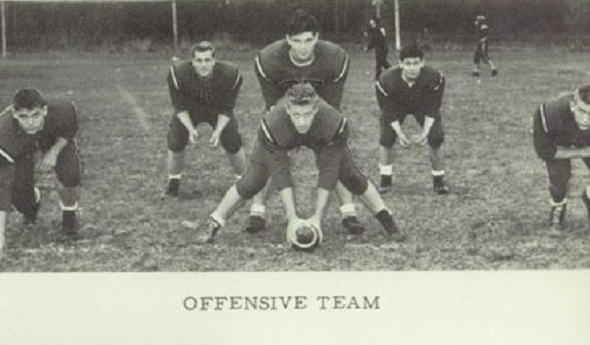
Epler's 6, 8-Player Game Lives On
November 10, 2017
By Ron Pesch
Special for Second Half
Is it a coincidence that the Stephen E. Epler Residence Hall on the campus of Portland State University is a six-story building?
Constructed in 2003 in the heart of downtown Portland, Oregon, the 130-unit structure is a belated tribute to Epler, “the founder of the Vanport Extension Center — the beginning of today's Portland State University.”
Following World War II, Epler moved to Portland with his wife Ferne to take a job counseling returning veterans on their educational opportunities. Once in the position, Epler quickly “realized that few colleges had the housing and jobs needed for the flood of veterans who wanted to take advantage of the GI Bill,” according to Bryce Henry, writing for The Oregon Encyclopedia, a project of the Oregon Historical Society.
To meet the needs of the area, he proposed “a two-year ‘feeder’ college. Established in March 1946 by the State Board of Higher Education, within 86 days, Epler had secured buildings at an old shipyard in Vanport and assembled a teaching staff into a college with housing. The Center allowed those veterans to begin work on achieving a college degree. For the next 10 years, Epler did all he could to nurse the Center he had helped create as it sought success and recognition.
 In 1952, after a series of physical moves around the Portland area, the Center was relocated to a site downtown and renamed Portland State Extension Center. Despite his work, Epler was passed over by the Oregon State Board as Dean. In 1955, with the announcement creating Portland State College by the Oregon state legislature, he was again passed over by the Board when they named a college president.
"’It was a blue day for me,’ Epler wrote in his diary,” wrote Charles White in a biography also written for the Encyclopedia. “With no administrative role in the new college, Epler accepted the presidency of Reedley College in California, where he served for five years. He then served as president of the prestigious College of Marin.
“Epler was fondly remembered by students who attended the Vanport and Portland Extension Centers, and in 1995, Portland State University honored him in a celebration of the school's origins,” continued White, a former professor at Portland State. “PSU feted its founder, dedicated the ‘Vanport Room,’ made him a PSU professor emeritus, and (later) named its new dormitory Stephen Epler Hall.”
The recognition for Epler, who passed away in 1997, was long overdue. Still, it wasn’t the first time Epler’s accomplishments had been celebrated. In what may have seemed a lifetime ago, he was honored on multiple occasions for an earlier creation.
~~~~~~~~~~~~~~~~~~
Born in 1909 in Brooklyn, Iowa, Epler was the son of a Disciples of Christ pastor and later played football at Cotner College in Lincoln, Nebraska. Following graduation, he taught for a year at Lincoln Teachers’ College High School. In 1934, he was working as a science and physical education instructor at Chester High School in Nebraska. On a rainy Saturday in the spring of 1934, an informal chat with Dean Moomey, the superintendent of Chester Public Schools, would alter the life path of both Epler and thousands of others.
The conversation was about football, or the lack of it at Chester, a school located on the Nebraska-Kansas border. “I was loyally defending football and giving reasons why every high school should play it,” recalled Epler, “but Mr. Moomey was reminding me of the actual situation in the small school and the sad experiences Chester and other small schools had … with the game in the past.”
Moomey identified two primary problems at play in Nebraska and beyond. Organizing a football team was a challenge because of expense, as outfitting “twenty-two or more players needed for a squad” was a burden for a small district, “when the gate receipts alone would hardly pay the official’s fee.” Funding was a major burden for small farming communities, compounded by a nation that was slowly working its way out of the Great Depression.
An even greater area of concern was for the safety of the players when a football team was formed. Squads from the smaller schools often included “lighter and weaker boys (competing) against players of vastly superior physical strength and stamina.” That, in turn, created worry and fear by parents about what might happen during a game, and certain disapproval if “their boy got hurt.”
In Nebraska at the time, more than 70 percent of the schools had enrollments of fewer than 100 pupils. Epler’s studies found that less than 19 percent could field a football team.
With Moomey’s encouragement and support, Epler settled on a goal of modifying the rules of the 11-man game he had played and loved to allow for “a safer, less expensive game, and one that required fewer players.”
 Later that year, Epler outlined the rules of six-man football, and on September 26, 1934, the first six-man football games were played at Hebron College. The contests featured a preliminary battle between Beatrice High and Hebron Academy that ended in a scoreless tie. A second match-up, staged between teams from Belvedere and Alexander High Schools and a squad representing Chester and Hardy schools, also ended in a deadlock, 19-19. “One of the officials at the (later) game was Mr. Epler himself, then coaching at Beatrice High School.”
A crowd of around 1,000 attended the matchup, in which every man, with the exception of the center, was eligible for a pass. Epler’s game was played on a shortened field, 80 yards long and 40 yards wide. Playing time was to consist of four quarters, each eight minutes long. All players were to wear basketball or tennis shoes. While coaches of the two teams could allow exception, the rule was in place “to cut down the cost of equipping the team.” Instead of 10 yards in four downs, six-man football required a team to gain 15 yards in four attempts “to balance the increased offensive power that comes with the smaller number of players.” Also in place was a rule that required the player who received the ball from center to make a pass behind the line of scrimmage of not less than two yards forward or backward to another player, before the ball could be advanced.
A field goal was worth four points, while a point after touchdown was worth two if kicked, but only one if passed or run into the end zone. Goal posts were set 25 feet apart instead of 18, with a cross-bar mounted lower to encourage field goals and kicked extra points.
The news of this new version of the game was carried by wire services in newspapers nationally. Suddenly, “the terms ‘football team’ and ‘the eleven’” were no longer synonymous in the world of sports.
~~~~~~~~~~~~~~~~~~
Epler’s first edition handbook on six-man football, numbering 64 pages, was published in 1935. In Michigan, the six-man game found immediate interest in the state’s northern-most region.
“As an answer to the curtailment of athletic funds and the question of attracting suitable material for a team, a drive is being made among smaller Upper Peninsula high schools to begin and to encourage ‘six-man’ football,” wrote the Bessemer Herald in May 1935. Channing High School coach A.J. Mautner approached Quinnesec, Felch, Amasa, Florence and Alpha about the possibility.
Knowledge continued to spread, aided by a September 1935 article by Epler in Scholastic Coach, mailed to nearly 100 percent of the nation’s high schools and colleges and aimed at coaches and athletic directors. The magazine was the first “to open its pages to six-man football.” Another Epler article, “A New Deal for Football” saw publication in October 1936 in Athletic Journal, another popular national publication targeting coaches. A September 1937 article in Detroit-based American Boy, the largest magazine for boys based on circulation, offered readers a copy of the official rule books for the game at a discount. Finally, in 1938, Epler’s book, Six-Man Football: The Streamlined Game, a 251-page book on the development of the game, its philosophy, fundamentals and style of play was published. It was dedicated “To the men and boys who organized and participated in the first game of six-man football played at Hebron, Nebraska, in 1934.”
~~~~~~~~~~~~~~~~~~
An alternative to both the 11-man and six-man games surfaced a couple months after the Hebron College contests. Little on the genealogy of the eight-man game has been documented, but, among the earliest records is one staged in Michigan between Morrice and Vernon High Schools.
Described in the Lansing State Journal as “a style of play designed to suit the smaller schools,” anyone interested in viewing the November 9, 1934, contest could attend free of an admittance fee. “Instead of the regulation 11,” wrote the State Journal, “each team will have but eight players. Two guards and one backfield will be eliminated from each team. The width of the field will be cut to 120 feet, the offensive team will be permitted but five men on the line of scrimmage and on kickoffs the receiving team must keep three men within five yards of the restraining line until the ball is kicked.”
 E.J. Hendershott, principal, coach and agriculture instructor at Morrice, was certainly one of the earliest proponents of an eight-man version. In May of 1935, he presented on the variations of the game at the annual University of Michigan football clinic at Yost Field House.
In early November of 1935, an eight-man contest between Kalamazoo-area schools Comstock and Schoolcraft was judged “a success.” Consideration of the eight-man game was kicked around among the Jackson County High School Coaches Association in January 1936. Upon his return from a trip through the Upper Peninsula in September 1937, MHSAA director Charles Forsythe said “he found smaller schools enthusiastic about ‘miniature’ teams which play with but six or eight men instead of the regulation eleven.”
“The purpose … is to make football available to a wider range of boys than is now the case,” added Forsythe. “It is not pass and touch football, nor is it soccer. … The injury hazards are not so great with the smaller number of players on the field. … However the game should not be undertaken unless proper equipment is made available and coaching facilities are up to standard.”
~~~~~~~~~~~~~~~~~~
After limited experimentation, it appears that Epler’s version of the game won out in Michigan.
Nationally, the first Six-Man Football Committee was formed in 1937 and the group made some alterations to the rules, including movement of kickoffs from the 20 yard line to the 30, the creation of a “clear pass” rule that eliminated the need to judge whether a pass behind the line of scrimmage had traveled at least two yards, and changes to the substitution of players.
Nationally, it was estimated that 586 schools were playing six-man ball. In Michigan, the number was around 12.
In 1938, the national Six-Man Football Committee again altered the rules, this time to make all players, including the center, eligible to receive a pass. That fall, three schools in the Battle Creek area – Augusta, W.K. Kellogg Agricultural in Gull Lake and Climax – adopted the six-man game. Each played the other two twice during the season, with Augusta emerging undefeated, outscoring its opponents 134 to 8 over the four games.
A national report noted increased popularity of the sport. A total of 1,082 high schools now played the six-man game, nearly twice the number estimated in 1937. Around 50 schools played the six-man game in Michigan in 1938, according to Forsythe.
 In 1939, the game again saw additional growth. In the Battle Creek area, Sherwood, Tekonsha, and Mendon joined Colon to form the St. Joseph Valley six-man football league. In addition, Climax, Schoolcraft, Richland, Scotts, Albion Starr Commonwealth, Sunfield, Martin and Marcellus took up the modified game. Reporting on the growing popularity, the Battle Creek Enquirer and News summed up the interest: “The scoring possibilities are numerous. … That’s what the fans like. Big Scores.”
Colon, coached by W.H. Judd, was awarded the Enquirer and News Trophy as St. Joseph Valley grid champion that season.
The “Tom Thumb League”, a subset of the Central Thumb League, also was formed in 1939. Comprised of Ubly, Port Hope, Kinde, Port Austin, Peck, Carsonville, Bay Port, Owendale and Gagetown, it was designed to provide a football program for small schools in the Thumb area of the state. Five of the nine had previously played either 11-man or six-man football in the past. No standings were kept that first year.
Statewide, 450 schools competed in traditional 11-man football in 1939, while six-man continued to grow rapidly. According to press reports, 100 or more now played the Epler version in Michigan.
In Fennville, coach Carson Niefert’s 1939 team notched an impressive 7-1 mark while jockeying between both versions of the game. Five wins came against six-man squads while the Blackhawks finished 2-1 in 11-man contests, downing both Hartford and Otsego. Their only loss came against Ravenna in the season opener. Due to a misunderstanding, Fennville was prepared to play a six-man game, but agreed to an 11-man game when the visitors arrived ready to play the standard version.
In the Lansing area, after a three-year lapse in which no football was played at Haslett High School, a six-man squad was assembled. Contests with other small schools including Bath, Morrice, Vernon, Byron, and Laingsburg were scheduled.
~~~~~~~~~~~~~~~~~~
In 1940, the MHSAA reported 150 schools across Michigan played six-man football. Schoolcraft and Climax were added to the St. Joseph Valley League. Colon emerged as the league’s sole champion. The conference title had been shared by Colon, Sherwood and Mendon in 1939.
The Central Thumb League and Thumb Tip League consolidated, and had shrunk to six schools playing football, as Port Austin dropped the sport, while Peck and Carsonville left the league. Ubly was honored as champion with a perfect 7-0 record.
Haslett, under the guidance of coach Paul Moyes, began its second year of six-man competition in 1940. In 1941 the Tri-County League was formed, comprised of Haslett, Bath, Morrice, Vernon, Byron, Laingsburg, DeWitt and the Michigan School for the Blind. Bath emerged as champions that season.
Augusta and Gull Lake W.K. Kellogg were added to the St. Joseph Valley in 1941, bringing that league total to eight teams.
Marenisco High School, coached by Joseph Poisson of Iron Mountain, claimed the “undisputed six-man football championship” of the Upper Peninsula in 1941. Undefeated in six games, his team averaged 51 points per contest.
Another successful six-man team from the era, according to the Detroit Free Press, was Roscommon, which had lost a single game from 1938 to 1941.
Travel restrictions and product rationing impacted high school sports around the state during the war years. Petersburg downed Britton in the final game of the 1942 season, wrestling away the Raisin Valley six-man football championship for the first time. Britton had won the league crown the previous two seasons. The teams would share the league crown in 1943.
 Climax grabbed its sixth straight St. Joseph Valley win, its fifth by the league’s maximum score limit, with a 50-0 victory over Tekonsha on October 29, 1943. League rules ended games when a team’s point total equaled or exceeded 45. A week later, Climax traveled to Colon for a conference showdown of unbeaten and untied squads. Like Climax, Colon had dominated conference opponents during the season.
Played under the lights before a crowd of 1,200, the largest in Colon history, the battle between the evenly-matched squads was a worthy finish to the season. A “safety by Ralph Slage of Colon, his second of the night, sent the invading Climax team into a two-point lead at 10 to 8, with four minutes of play remaining.” With eight seconds left on the clock, that two-point margin looked secure when Climax surrendered the ball on downs at the Colon 15-yard line.
“There was just time for one play. Climax arranged its defensive forces for an anticipated pass.” Instead, Colon back Elmer Saddison broke free from a mass of Climax defenders at the 15-yard line and raced 65 yards for the game-winning touchdown.
~~~~~~~~~~~~~~~~~~
In September 1945, the Lansing area Tri-County League reorganized to handle the three sports of baseball, basketball and six-man football. The circuit was now composed of Bath, Byron, Gaines, Haslett, Morrice and Laingsburg. The St. Joseph Valley reorganized, with Colon and W.K. Kellogg departing to play 11-man ball. Rechristened the Southwestern Michigan Six-Man League, Marcellus joined in 1946, Martin was added for two seasons, 1946 and 1947, Centrevillie was added in 1948 and Albion Starr Commonworth in 1949.
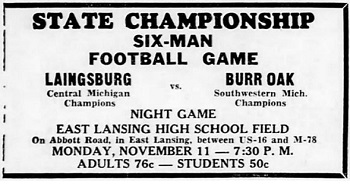
On Monday, November 11, 1946, Laingsburg, champion of the Tri-County league, represented Central Michigan against Burr Oak, winner of the Southwestern Michigan league, in what was billed as the state’s first “six-man state championship.” With the game staged on the lighted field at East Lansing High School, Dick Sparkes scored four times on runs of 30, 19, 18 and six yards to lead Laingsburg to a 33-26 win.
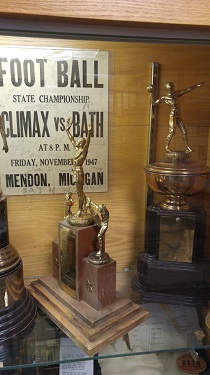
A year later a crowd of 700 at Mendon High School watched as Bath, the Tri-County champ coached by former Michigan State star halfback and captain, Walt Pawlowski, downed Climax, 36-20, in the second six-man championship game between the Central Michigan and Southwestern Michigan title winners.
Again the Bath squad won the Tri-County League title in 1948 and represented Central Michigan in the six-man championship series. The third title game was again hosted at East Lansing High School on Armistice Day. Victory came easily over Schoolcraft, the Southwestern League hopeful, 43-13. Bill Ballard and Forest Bass each scored three touchdowns in the rout.
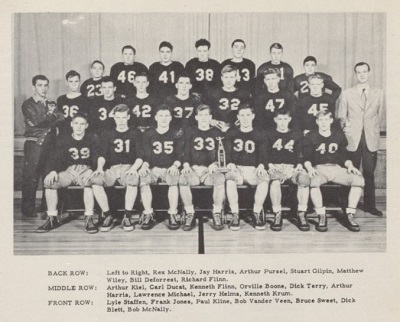
In spite of the loss to Bath, the season was richly celebrated by Schoolcraft. Runner-up medals were awarded following the game, and later a steak dinner with all the trimmings was hosted at a banquet in Kalamazoo. There, coach Kenneth Krum’s squad celebrated the school’s first-ever Southwestern Conference football championship.
~~~~~~~~~~~~~~~~~~
One month before on October 7, 1948, Epler, a naval officer during World War II, flew back to Chester, Nebraska from his current home in Vanport, Oregon. He was the guest of honor brought back to celebrate the 15th anniversary of the game he created. A crowd of more than 1,000 fans was on hand to applaud his achievement.
“To make the celebration perfect,” stated The Lincoln Star, “the home-town Chester six-man team bounced undefeated Sacred Heart of Norfolk by a resounding score of 26-2.”
According to rival Lincoln newspaper, the Nebraska State Journal, “It was the first defeat in 22 games for the invading Knights. … Between the halves, Epler received a trophy from the community of Chester. In turn, he presented plaques to the coaches of the two teams. …Governor (Val) Peterson, a former football coach himself, braved the weather to view the entire game.”
Earlier in the day, Governor Peterson greeted Epler, calling him a “man of vision” and “presented him an admiralty in the Nebraska ‘navy’.”
~~~~~~~~~~~~~~~~~~
“Is Eight-Man Football Preferable to the Six-Man Game?” asked an article in the Athletic Journal in 1942. Nationally, eight-man football had started to take hold, at the expense of six-man, especially in mid-sized schools during the late 1940s and early 1950s.
 Back in Michigan, the 1949 season saw a marked decrease in six-man ball, as around 50 schools in the state still played Epler’s version of the game.
Bath again finished 1949 undefeated and was now riding a 21-game win streak. Mendon ended the year unbeaten and untied in seven games, outscoring its opponents by a 262 to 112 margin. Plans for another “six-man championship” contest were made, but, as Bill Tucker, center for the Bath squad recalled in 2007, Bath’s coach Pawlowski sat the team down and announced no title game would be played.
“It was heartbreaking,” Tucker told Lansing State Journal reporter Chris Solari. “(Mendon’s coaches) said they were tired of playing football. I’ll tell you what – we’d have whomped them, anyway.”
The 1950 season saw the formation of the Cherryland Class D Conference, comprised of Leland, Suttons Bay, Lake Leelanau St. Mary, Empire, Williamsburg and Kingsley. New arrangements were made for a mythical six-man state title contest, pitting the Tri-County Class D champion against Lake Leelanau St Mary, the Northern Michigan champ. Laingsburg won the game, played at Clare High School, 34-12. Laingsburg and the rest of the Tri-County League moved to 11-man ball in 1951.
At Elk Rapids, Bellaire, Bergland, Ewen, Mercer, and Ironwood St. Ambrose, Epler’s game endured several more years. According to press reports, St. Ambrose scored four undefeated seasons of six-man ball between 1942 and 1947, before discontinuing the sport following the 1951 season. It was revived in 1954 for three additional campaigns before stopping again.
~~~~~~~~~~~~~~~~~~
In 1950, Freeport High School played its first-ever football game – the eight-man version. The season opener was a loss to Schoolcraft, 46-19, but the team managed a 3-6 record in games with the Hastings reserve team, Parnell, Rogers, Gaines and Sand Lake. (Freeport jumped to 11-man football in 1951). Schoolcraft, Mendon and the rest of the Southwestern Michigan league also played eight-man football in 1950, and then moved to the traditional 11-man game in 1955. In the Upper Peninsula, Bessemer and others districts experimented with eight-man ball at the junior high level.
The 1952 season saw six-man competition continue to drop off around the state. Still, in northern Michigan, the game remained. At Sault Ste. Marie Loretto, the Little Eight Conference six-man schedule called for six contests with the other Class D membership, as games were scheduled with Grand Marais, DeTour, Brimley, Cedarville, Rudyard and 1951 league champion Pickford. Loretto hoped to arrange an 11-man game against St. Ignace, also a member of the Little Eight, late in the season. According to Herb Levin of the Sault Ste. Marie Evening News, St. Ignace, with a Class C enrollment, was the first league member to attempt a move to the traditional game, scheduling a slate of opponents comprised of “reserve teams from Class C and Class B in Upper Peninsula and lower Michigan. If the venture into the ranks of 11-man ball is successful, several other conference schools may follow within the next few years.”
It appears most of the Little Eight moved to eight-man ball in 1959, then 11-man in 1961.
~~~~~~~~~~~~~~~~~~
Cheboygan Catholic earned at least a share of the Northern Michigan six-man football league crown in 1952 as well. The sole winner of the league in 1950, the team shared the league championship with Bellaire in 1951 and with Elk Rapids in 1952.
An attempt to move to six-man ball by Class D schools from Pentwater, Freesoil, Holton, Custer and Ludington St. Simon in western Michigan lost steam before the 1954 season.
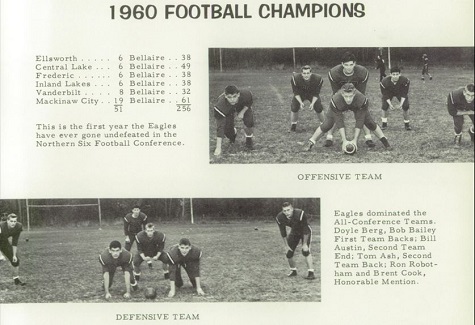
Thanks to the baby boom and increased enrollments, the resulting growth of the suburbs, and the expanding consolidation of smaller rural schools around the state, the coming years would see rapid decline in both six and eight-man squads. With the 1960 season, the Northern Six Football Conference operated as the last six-man league in the state. Bellaire won the conference, comprised of Central Lake, Ellsworth, Frederic, Indian River Inland Lakes, Mackinaw City and Vanderbilt, all Class D schools.
That lasted until 1964, when the league moved to eight-man ball, then to 11-man in 1968.
The Wolverine Conference, comprised of Rock, Carney, Bark River-Harris and Powers-Spalding, switched from regulation 11-man football to 8-man football in 1961, and was the last in the U.P. to play that style of ball. In 1962, Carney dropped from the league for financial reasons, as football was not paying for itself. It was replaced in the league by Pembine, “a Marinette County school in Wisconsin.” The league continued playing eight-man through the 1971 season.
~~~~~~~~~~~~~~~~~~
Like in Michigan, the six-man game had died out in Nebraska in the 1960s.
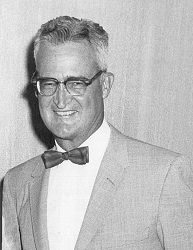 In October 1991, “as the last rays of sunlight disappeared across the plains, the mighty starting six of the Chester-Hubbell-Byron Consolidated High School Bulldogs squared off against the starting six of the hated visiting Campbell Cardinals,” penned Los Angeles Times staff writer Bob Sector. Describing the resurgence of the game, rediscovered thanks to dwindling enrollments across the country, he discussed its origins with Epler, who had returned at age 82 to be honored at a special halftime ceremony.
“The six-man game gave the high school students something to do,” said Epler to Sector, “and they could stay at their own schools and they could have all the bands and pep rallies just like the big schools.”
Chester junior Thad Mumm started the game with a highlight, returning “the opening kickoff for a 78-yard touchdown.” Mumm was the “grandson of Garald Van Winkle, who played in Epler’s groundbreaking six-man game,” back in 1934. Unfortunately, the home team fell this time, 26-20 in overtime.
Those dwindling enrollments have brought six-man to five states according to the National Federation of State High School Associations, including Texas, where it was first played in 1936 and has continued uninterrupted. More than 130 schools play Epler’s game in the Lone Star state today.
The 8-player game is now played in 18 states, including Michigan. It returned to the MHSAA-sponsored high school sports menu in 2010, with its first playoffs in 2011. Michigan 8-player football now is played by more than 60 schools, with the first two-division Finals scheduled for Nov. 18 at the Superior Dome at Northern Michigan University.
 Ron Pesch has taken an active role in researching the history of MHSAA events since 1985 and began writing for MHSAA Finals programs in 1986, adding additional features and "flashbacks" in 1992. He inherited the title of MHSAA historian from the late Dick Kishpaugh following the 1993-94 school year, and resides in Muskegon. Contact him at [email protected] with ideas for historical articles.
PHOTOS: (Top) Bellaire's six-man offense lines up for a photo in 1960. (Middle 1) Stephen Epler, from a 1935 newspaper report. (Middle 2) A poster announces the “first six-man football game in the U.S.A.” to be played in Nebraska. (Middle 3) The Lansing State Journal advertised a “state championship” game between Laingsburg and Burr Oak in 1946. (Middle 4) Bath High School displays its championship trophies won during the six-man heyday. (Middle 5) The Schoolcraft 1948 six-man team. (Middle 6) The Bellaire yearbook celebrated its 1960 Northern Six Football Conference championship team. (Below) Stephen Epler, from the Nebraska Hall of Fame. (Special thanks to Tom Townsend, Bath schools’ Denise Wahrer and library staff at Central Michigan University for providing background, photos and resources used in this piece.)
Millington Caps 1st Finals Trip with Decisive 'Forever' Championship
By
Paul Costanzo
Special for MHSAA.com
November 30, 2024
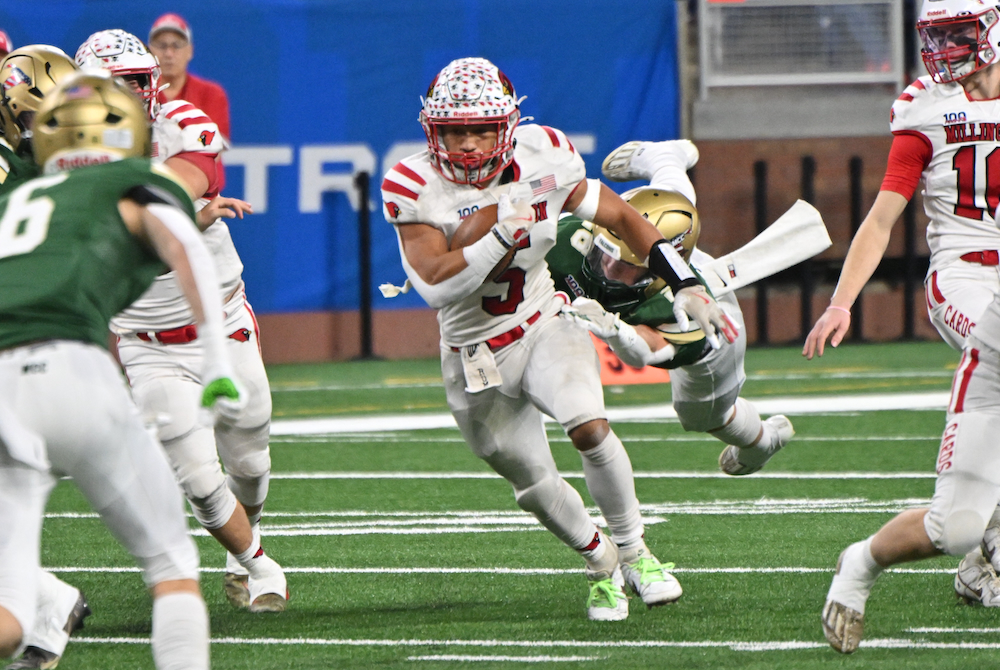
DETROIT – Dallas Walsh and his Millington teammates achieved a childhood dream Saturday at the Division 7 Football Final.
But for the sea of red in the Ford Field stands, and the few left watching at home, it was the fulfillment of a dream that started decades before the current Cardinals had taken a single snap.
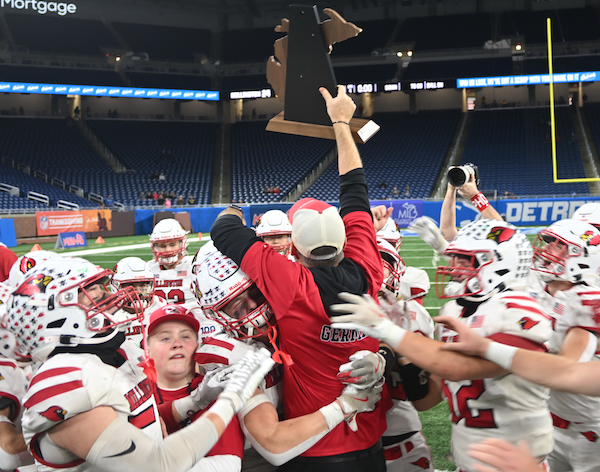
A suffocating defense combined with a big day on the ground from Walsh gave the Cardinals a 24-0 victory against Monroe St. Mary Catholic Central, bringing a first Finals trophy home to Millington.
“It’s definitely an amazing feeling,” Walsh said. “I’ve been playing with these guys since I was probably 8 years old. This is something we’ve all dreamt of, and it’s really an amazing experience. Our whole community backed us the whole way. I’m just so glad that we came out with the win.”
The Cardinals were making the first Finals appearance in program history, as they were 0-6 in Semifinal appearances prior to this season.
That just made getting over the hump that much more special.
 “It means the world to us,” Millington coach Jason Germain said. “We were 0-6 going into the Semifinals, and we heard about that. These kids knew that. They fulfilled my dreams, and they fulfilled a lot of people in the community’s dreams. If you couldn’t tell, you’d think that was a Division 1 game out there with that many people in the crowd. It is truly, in small towns like Millington and Frankenmuth, that’s what we cling to. We don’t have a lot in our community, but we have our Friday nights and we have our football program. That’s what it really, truly means. We told our guys, pain is temporary, championships are forever, and that’s what they really bought into. And it’s a true testament to our community. I’m telling you, it’s going to be a good night in Millington tonight.”
That fun night will no doubt include tales of a monstrous defensive effort from the Cardinals, which included three forced turnovers and allowing just 3.2 yards per play.
SMCC came into Saturday’s Final averaging 36.3 points and 240.5 rushing yards per game, but wasn’t able to get anything going against a stout Millington front. The Falcons were held to 131 yards of total offense and 68 yards on the ground.
“They did to us what we’ve been doing to teams for 13 games, so I think that’s a testament to them,” SMCC coach Adam Kipf said. “... They brought it on every single play. I don’t think they lost any energy throughout the game, and they were physical. We’d seen that on tape. We figured they’d wear down a little bit, and they did not wear down.”
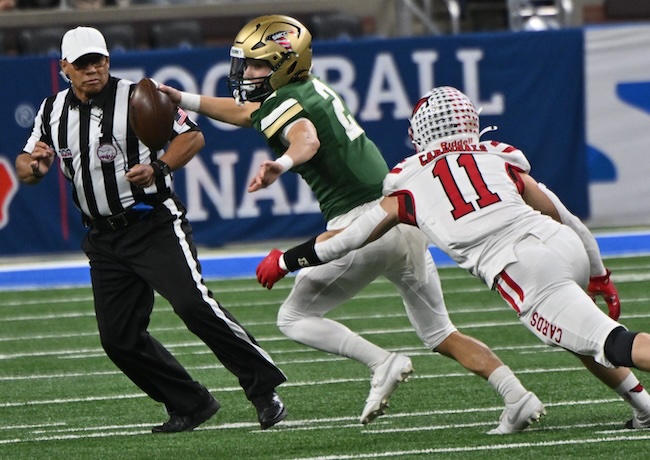
The Cardinals held SMCC to 2.3 yards per carry, and when quarterback Ian Jones did drop back to pass, he was often greeted with a defender in his face. Millington finished the game with four sacks, getting two apiece from Logan Myers and Brevin Hendricks, which resulted in 34 lost yards for the Falcons.
The Cardinals also forced three interceptions, with Truk Terbush picking off two and Owen Kreger snagging the other.
“We shut out (Pewamo-Westphalia); they’re a prolific offense. We held North Muskegon to 14 until the end of the game – our defense is outstanding, and that’s a credit to our defensive coordinator (Lenny Dantinne) and these guys buying in,” Germain said. “I can’t say enough about these guys and Coach Dantinne and all of our coaches for preparing these guys. You don’t just shut out a team like Monroe St. Mary Catholic Central unless you’re doing film study and working hard.”
Offensively, Walsh, who had a team-high eight tackles, rushed for 114 yards and a touchdown, while Landon Russell had 67 yards on two carries, including a 64-yard TD run. Terbush finished 7-of-12 for 58 yards and a touchdown, and one interception.
 Millington (13-0) had a significant field position advantage through most of the first half, and it was finally able to cash in on that late in the second quarter when Walsh opened the scoring with a 21-yard touchdown run.
The Cardinals put themselves right back into a dangerous position on the next play from scrimmage when Terbush intercepted a pass near midfield and returned it to the SMCC 15. The Falcons defense limited the damage, but Millington took a 10-0 lead with a 25-yard Larry Shoens field goal.
SMCC (13-1) was able to create a chance during the final seconds of the half, as Cole Reinhardt returned the ensuing kick 44 yards into Millington territory. But Kreger intercepted a pass in the endzone as time expired to preserve the Cardinals’ 10-point halftime lead.
That would have been enough, thanks to the outstanding effort of the Millington defense, but Landon Russell added a 64-yard TD run late in the third quarter on what was by far the game’s most explosive play. Russell’s run covered more ground than the SMCC offense had been able to gain up until that point (50 yards).
It’s a play that was supposed to go to Walsh, but he made the decision to switch with Russell after it was called.
“It was really, I told (Russell) I needed a breather, so I said, ‘Go get one,’” Walsh said.
That run capped a 95-yard drive for the Cardinals, as they started at their own 5-yard line, and opened the possession with a false start to fall back to the 2½.
“That was the turning point in the game for us,” Germain said. “They could have stopped us there, but our kids persevered and we just went old school football – flanker, double tight, and we just pounded the ball and scored on that. That was the huge part of the game for me, personally.”
The Cardinals tacked on a 13-yard touchdown pass from Terbush to Brevin Hendrick with 5:21 remaining in the fourth quarter.
SMCC was led by Lucas Linzell’s 12 tackles, while Brady Hines had eight, including 2.5 for loss. Jack Starner had one sack for the Falcons, and Drew Ferreira had an interception.
“I’m proud of our kids,” Kipf said. “They fought and they battled. I couldn’t be more proud of them.”
PHOTOS (Top) Millington’s Dallas Walsh (5) busts into a wide opening during Saturday’s Division 7 Final at Ford Field. (Middle) The Cardinals’ Brevin Hendricks (11) chases SMCC quarterback Ian Foster in the backfield. (Below) Millington coach Jason Germain holds up the championship trophy as he’s embraced by one of his players. (Photos by Hockey Weekly Action Photos.)