

Eriksen, Clarkston Finish 'Dream' Run
November 30, 2013
By Bill Khan
Special to Second Half
DETROIT — Ian Eriksen's senior season was slipping away.
And so was his lifelong dream.
Eriksen and his football-playing buddies in Clarkston talked about earning an MHSAA championship back when they were in elementary school and winning the Super Bowl of the Northern Youth Football League in Oakland County.
But after rushing for 2,167 yards and 33 touchdowns as a junior, Eriksen came into his senior year with Achilles and ankle injuries, then underwent arthroscopic surgery for a partially torn meniscus in his right knee on Sept. 19.
Four Friday nights passed with Eriksen in street clothes, unsure of when — or if — he'd ever rejoin his teammates in pursuit of their shared dream.
"That was really tough, because I've never been injured that seriously," Eriksen said. "It could've been a lot worse. I tried to be positive. All you can do is be positive rather than mope over it."
One positive out of the situation may be that Eriksen was fresh enough by the end of the playoffs to take on a heavy workload and help carry the Wolves to their first MHSAA football title.
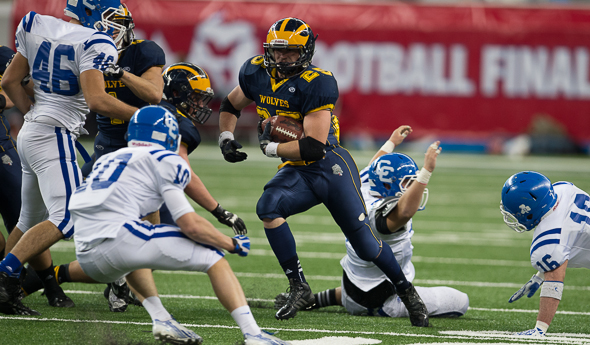
Eriksen ran 32 times for 237 yards and three touchdowns in Clarkston's 32-14 victory over perennial power Detroit Catholic Central in the MHSAA Division 1 championship game Saturday at Ford Field.
He also had a 30-yard catch to extend Clarkston's first touchdown drive, and a sack. In Clarkston's last two games, Eriksen ran 76 times for 592 yards and nine touchdowns.
"He gave us a lot of problems," said veteran Catholic Central coach Tom Mach, who has built a dynasty with the power-running game. "He was a very good running back. He would be a good running back in our program. We would've loved to have him. We had a lot of trouble tackling him. He got the extra yard and put in the extra effort.
“They kept the ball away from us, getting those first downs, getting those first downs, getting those first downs. That's frustrating on a team, especially when you do get the ball when you're a ball-control offense like us."
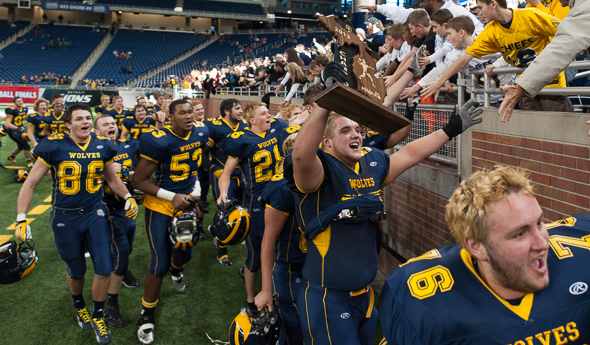
 Bringing Clarkston its first MHSAA championship was the fulfillment of a dream for Eriksen and his teammates after the program reached three Semifinals and made the postseason 16 times under 27-year coach Kurt Richardson.
"In Little League, there's a Super Bowl," Eriksen said. "We won the Super Bowl together in 2006 when we were in fourth and fifth grade. The next thing we started talking about was winning a high school championship if we could do it. We knew we could."
Eriksen and some of the players who delivered that championship were in the stands at Troy Athens four years ago when Clarkston lost by two points in a Semifinal to Sterling Heights Stevenson.
"I remember when that happened," Eriksen said. "Everyone in the community was just so upset about that. Me and the other guys were like, 'That's not going to happen to us when we get there.'"
Clarkston made Catholic Central settle for a third straight runner-up finish by stealing a page from the Shamrocks' script.
Led by Eriksen and an outstanding offensive line, the Wolves ground out 288 yards on 45 carries. They had a 27:58 to 20:02 advantage in time of possession.
"The offensive line doesn't get enough credit," Richardson said. "They deserve it for this one."
After a punt and interception ended Clarkston's first two drives, the Wolves scored touchdowns on their next five possessions.
Both teams had promising drives end with interceptions deep in the opponent's territory before Clarkston broke through for the game's first score with 13 seconds left in the first half.
Converting three times on third down and once on fourth, Clarkston moved 91 yards in 17 plays, taking 6:36 off the clock, before D.J. Zezula hit Shane Holler with a 15-yard touchdown pass on a post route. The extra point failed.
The key play on the drive was a 30-yard pass to Eriksen on third-and-12 from Clarkston's 15-yard line.
"We knew we had to score, because we got the ball to start the second half," Zezula said. "It was 0-0 and we knew we had to get up on CC. They brought in an extra (defensive back). The play-action with Ian helps me out a lot with time and the O-line helps me a lot with time. We knew the play-action would work."
Catholic Central's best drive of the first half came following the opening kickoff. The Shamrocks marched to the Clarkston 24 before Tim Cason intercepted a pass, only the second pick thrown by Catholic Central all season.
Jack Van Acker made two big plays to keep Clarkston out of the end zone on the Wolves' second possession. First, he made a touchdown-saving tackle on a 35-yard run by Eriksen to the Shamrocks' 10-yard line. Then, two plays later, he picked off a pass in the end zone after Clarkston moved to the 6.
A 63-yard punt by Zach Bock pinned Clarkston at its own 9-yard line with 6:49 left in the second quarter before the Wolves drove for the only touchdown of the first half. Clarkston's average starting field position on three first-half possessions was its own 10.
Armed with a lead and momentum, Clarkston took the opening kickoff of the second half and marched 80 yards in eight plays, taking a 12-0 lead on a 37-yard run by Eriksen with 8:18 left in the third quarter.
The lead reached 18-0 on a 1-yard run by Eriksen with 3:59 left in the third.
Catholic Central got on the board when Dylan Roney scored on a 2-yard run with 45 seconds left in the third quarter, cutting Clarkston's lead to 18-7.
The Wolves responded with a seven-play, 71-yard drive that ended on a 47-yard pass from Zezula to Caine Watlington with 8:35 left in the game.
The Shamrocks scored again on a 48-yard pass from Sean Birney to Alexander Bock with 5:46 left, but Clarkston again had an answer, with Eriksen scoring on a 12-yard run to cap the scoring with 4:06 left.
Zezula was 10 for 15 for 154 yards, two touchdowns and one interception. Birney was 13 for 23 for 166 yards, one touchdown and one interception.
Clarkston won its final 13 games after a season-opening loss to Rochester Adams, a loss the Wolves avenged in the playoffs.
"A lot of these kids have been playing together since fifth grade," Richardson said. "They've played Chiefs together, so they've come up through the junior ranks. We all felt this could be a special season. We had some issues at the start. We talked to the kids at the time about turning a negative into a positive. You're going to get slapped in the face in life. We got slapped in the face in the first game. They learned from it. It was a huge coming-together point for us as a team."
Catholic Central (11-3) became the third team to finish runner-up three straight years. Utica Eisenhower was the Division 1 runner-up from 1999-2001 and Crystal Falls Forest Park was the Division 8 runner-up from 2004-06.
The Shamrocks' 2012 runner-up team was led defensively by sophomore middle linebacker David Widzinski, who had a game-high 15 tackles. Less than two weeks later, he died in his sleep.
Tributes to Widzinski were visible at Ford Field. Catholic Central's uniforms had a patch with his No. 33 inside a shamrock. In the student section, some students wore white and formed a 33 within a field of blue shirts worn by the others. Widzinski's jersey hung on the wall on the Catholic Central sideline.
"We brought up David a lot," Mach said. "He was a force behind our team all year long. Every day after practice, we would say a prayer for him and the people in our community who are suffering. It was a real learning experience for our kids to put something bigger than themselves in place of winning and losing."
PHOTOS: (Top) Clarkston players trade high fives with fans as they march off the Ford Field turf with their first MHSAA championship trophy. (Middle) Clarkston running back Ian Eriksen runs through the reaching arms of Detroit Catholic Central defenders Saturday. (Click to see more from Terry McNamara Photography.)
Drive for Detroit: Week 1 in Review
September 3, 2013
By Geoff Kimmerly
Second Half editor
Let’s start our first weekly review of MHSAA football action with some of the results you won’t see among our list of most significant from opening weekend:
Kent City’s first opening night win over Ravenna in 15 tries and Beal City’s incredible 61-0 win over rival Mount Pleasant Sacred Heart. Kalamazoo Central’s 14-13 win over neighbor Loy Norrix and Kinde-North Huron’s 28-14 win over reigning MHSAA 8-player champion Deckerville.
All are big-time results, no doubt. But below I’ve tried to tell you about five more from each region of our state, organized by the winner in each game, that might have bigger impacts as we move immediately forward with most leagues schedules kicking off in three days.
West Michigan
Zeeland West 44, Detroit Country Day 28
Country Day came into this season with plenty of deserved hype returning most of its star power from last season’s run to the MHSAA Division 4 Final. But Zeeland West has plenty of championship experience too, and its tough running proved too much for the Yellowjackets. Click to read more from the Oakland Press.
Also noted:
East Grand Rapids 24, Grand Rapids Catholic Central 7 – The Pioneers began making up for last season’s first playoff miss since 2000 with a solid win over another perennial power.
Grand Rapids Christian 41, Grand Rapids South Christian 13 – New faces abound, but the reigning Division 3 champion won big over last season’s Division 4 title winner.
Muskegon Oakridge 31, Grand Rapids West Catholic 25 – The Eagles are soaring high to start this fall after finishing 2012 with a 13-6 District Final loss to West Catholic.
Rockford 23, Utica Eisenhower 6 – Given these teams’ histories, no one would be stunned if they met again in 13 weeks in the MHSAA Division 1 Final.
Greater Detroit
Oak Park 25, Orchard Lake St. Mary’s 20
Oak Park entered its opener with the opportunity to show last season’s historic run wasn’t over with 2012’s final horn. Four touchdowns during the second half against the reigning MHSAA Division 3 runner-up proved the Knights will be talked about plenty again in 2013. Read more in the Detroit Free Press.
Also noted:
Detroit Cass Tech 18, Southfield 14 – Two-time reigning Division 1 champion Cass Tech and quarterback Jayru Campbell edged an improved Bluejays team to start 1-0.
Clinton Township Chippewa Valley 27, Dearborn 20 (2 OT) – Chippewa Valley also beat Dearborn on opening night last season on the way to its first playoff berth in three seasons; this one could be prove just as important.
Rochester Adams 12, Clarkston 7 – Coming off its first playoff miss since 1996, Adams won for the first time in its last four tries against one of the biggest and best programs in the state.
Lake Orion 35, Oxford 30 – If this was an indication, these two should again be contenders in their respective divisions of the Oakland Activities Association. Lake Orion has held the Double "O" Pigskin Trophy three of four seasons since the series was restarted in 2010; the teams formerly played for the prize from 1962-83.
Southwest and Border
Battle Creek Harper Creek 27, Mattawan 7
Both of these teams should be contenders in their respective divisions of the Southwest Michigan Athletic Conference, and both will run their way to success again this fall. It will be interesting to see in eight weeks just how similar their paths finish after a game that would’ve been much closer if not for some untimely Mattawan turnovers. Click to read more from the Battle Creek Enquirer.
Also noted:
Battle Creek Central 15, Benton Harbor 0 – The Bearcats ended their 18-game winless streak with their first shutout since 2007.
Portage Central 55, Sturgis 0 – Sturgis has a Division 1 college prospect in quarterback Chance Stewart, which made this arguably the most impressive defensive performance statewide.
Watervliet 43, Gobles 14 – Simply put, this was a solid nonleague matchup between teams that each won eight games last season. Watervliet has the head start on repeating that feat.
Edwardsburg 34, Otsego 7 – Different teams, same story as above as both are playoff regulars that should again be in the mix by the end of the season.
Bay and Thumb
Saginaw Swan Valley 27, Saginaw Nouvel 20
Both might end this season at Ford Field after Swan Valley missed by one win a year ago and Nouvel missed by two after winning Division 7 in 2011. But as for the best in Saginaw, it looks like the Vikings at this point after running back Alex Grace ran for more than 200 yards in one of the state’s most intriguing openers. Click to read more from the Saginaw News.
Also noted:
New Lothrop 28, Traverse City St. Francis 7 – The Hornets traveled north for a tough opener and came back with plenty of momentum for the Genesee Area Conference Blue schedule.
Hemlock 19, Frankenmuth 12 – Hemlock, the 2012 Tri-Valley Conference Central champion, held on to beat the 2012 TVC East winner.
Montrose 38, Reese 8 – This looked to be a close game between 10-win teams from a year ago, but Montrose instead avenged last season’s 21-point loss to the Rockets in a bigger way.
Saginaw Arthur Hill 24, Goodrich 14 – Arthur Hill has struggled since it last playoff berth in 2008, but appears on the rebound with this reversal of a 41-6 loss to Goodrich in 2012.
Mid-Michigan
Ithaca 57, Williamston 13
This wasn’t really close, but was significant nonetheless. The win was Ithaca’s 43rd straight, tying the record for longest victory streak in MHSAA history in which all games were won during the playoff era. This week, the Yellowjackets face rival St. Charles with a chance to move up the list again. Click to read more from the Lansing State Journal.
Also noted:
Jackson Northwest 35, Hillsdale 20 – Only a record performance by Ithaca could trump what might be Northwest’s best football win since the mid-2000s. Hillsdale is coming off an 11-win season, and Northwest has won one game in each of the last three years.
Lansing Sexton 21, Chelsea 14 – Beating a team with 14 straight playoff berths will no doubt help the Big Reds return to the postseason after missing last season.
Pewamo-Westphalia 20, Lansing Catholic 7 – This reversed a 24-point loss to the Cougars last season as the Pirates began their quest for a third straight MHSAA Semifinals run.
Eaton Rapids 44, Leslie 0 – New Greyhounds coach Mike Smith, most known from his success at Holt, started his Eaton Rapids rebuilding effort with the team’s biggest win since 1996.
Upper Peninsula
Negaunee 36, Manistique 30
Negaunee had to be on its game for a tough Mid-Peninsula Conference opener against another playoff team from 2012. But the Miners held on through a late Manistique run and scored last to open league play and the season 1-0. Big plays were key, as Negaunee scored on an 80-yard kickoff return and 66-yard run. The Miners continued claim of the Oscar Wassberg Trophy, named for the former coach of both teams. Click to read more from the Marquette Mining Journal.
Also noted:
Cedarville 42, Posen 40 – The Trojans didn’t feel much of a challenge until Week 8 last season, but survived this one to kick off its 8-player season.
Ishpeming 36, Iron Mountain 0 – The reigning MHSAA Division 7 champion kept rolling with a win over another playoff team from last season.
Bessemer 28, Hancock 26 (OT) – The last three games between these two have been decided by a touchdown or less, but all in favor of the Bessemer-led co-op.
Marquette 31, Traverse City Central 23 – Marquette should get a solid boost at playoff selection time from this win as it goes for a fourth straight postseason berth.
Lower Up North
Reed City 39, Big Rapids 26
As stated earlier last week, this game eventually decided last season’s Central State Activities Association title in favor of Reed City. This was the fourth straight opening-night win for the Coyotes over rival Big Rapids. This game is played for the Pioneer Trophy. Click to read more from the Cadillac News.
Also noted:
Alpena 15, Escanaba 7 – Alpena has won only one game in each of the last two seasons and was outscored by Escanaba by a combined 72-0 over 2011 and 2012.
Hillman 55, Gaylord St. Mary 54 – These teams combined for only 41 points when they met to open 2012. This time, they qualified for the MHSAA record book.
Charlevoix 20, St. Ignace 0 – Coming off one win in 2012, and against a team that was 24-2 combined over the last two seasons, Charlevoix pulled off one of the biggest upsets statewide.
Maple City Glen Lake 27, Boyne City 13 – Glen Lake continued rolling off last season’s best finish in more than a decade by beating again the team it defeated to open the 2012 playoffs.
Trophy Games
Each week the MHSAA highlights trophy games played across the state. A few were mentioned above, with these the rest we knew about heading into the weekend.
- Bull Bowl – This is one of our newest trophies, established in 2011 for the opener between Fremont and Sparta. The Spartans gained a 2-1 advantage in the series last week. Final: Sparta 6, Fremont 0.
- Battle of 127 Trophy – Hudson and Addison have met for a number of years for this trophy sponsored by a local insurance company and local automotive group. Final: Hudson 46, Addison 0.
- Battle for The Paddle – Neighbors Sanford Meridian and Bullock Creek have met on opening night for the last dozen seasons. Bullock Creek owns a 7-5 advantage during that time. Final: Meridian 26, Bullock Creek 22.
- State Bank Traveling Trophy – Linden and Fenton have played for this prize dating to 1976, including on opening night the last two seasons. Final: Fenton 39, Linden 27.
- Little Brown Jug – Two games were played for these last week: Napoleon and Brooklyn Columbia Central continuing a series begun in 1967, and Manton and Mesick. Finals: Manton 29, Mesick 0; Columbia Central 26, Napoleon 18.
- Border Battle Cheese Trophy – Hurley (Wis.) made it eight straight opening-night wins over rival Ironwood. Final: Hurley 47, Ironwood 7.
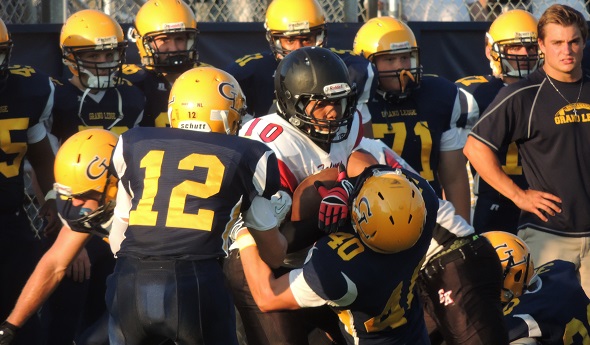
PHOTO: Grand Ledge made this stop, but fell a few short in a 16-14 opening-night loss at home against East Kentwood.