

Eriksen, Clarkston Finish 'Dream' Run
November 30, 2013
By Bill Khan
Special to Second Half
DETROIT — Ian Eriksen's senior season was slipping away.
And so was his lifelong dream.
Eriksen and his football-playing buddies in Clarkston talked about earning an MHSAA championship back when they were in elementary school and winning the Super Bowl of the Northern Youth Football League in Oakland County.
But after rushing for 2,167 yards and 33 touchdowns as a junior, Eriksen came into his senior year with Achilles and ankle injuries, then underwent arthroscopic surgery for a partially torn meniscus in his right knee on Sept. 19.
Four Friday nights passed with Eriksen in street clothes, unsure of when — or if — he'd ever rejoin his teammates in pursuit of their shared dream.
"That was really tough, because I've never been injured that seriously," Eriksen said. "It could've been a lot worse. I tried to be positive. All you can do is be positive rather than mope over it."
One positive out of the situation may be that Eriksen was fresh enough by the end of the playoffs to take on a heavy workload and help carry the Wolves to their first MHSAA football title.
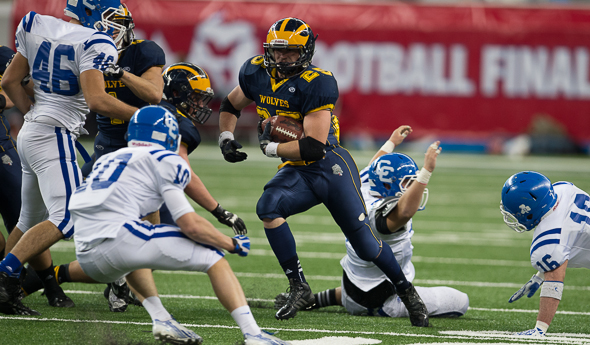
Eriksen ran 32 times for 237 yards and three touchdowns in Clarkston's 32-14 victory over perennial power Detroit Catholic Central in the MHSAA Division 1 championship game Saturday at Ford Field.
He also had a 30-yard catch to extend Clarkston's first touchdown drive, and a sack. In Clarkston's last two games, Eriksen ran 76 times for 592 yards and nine touchdowns.
"He gave us a lot of problems," said veteran Catholic Central coach Tom Mach, who has built a dynasty with the power-running game. "He was a very good running back. He would be a good running back in our program. We would've loved to have him. We had a lot of trouble tackling him. He got the extra yard and put in the extra effort.
“They kept the ball away from us, getting those first downs, getting those first downs, getting those first downs. That's frustrating on a team, especially when you do get the ball when you're a ball-control offense like us."
 Bringing Clarkston its first MHSAA championship was the fulfillment of a dream for Eriksen and his teammates after the program reached three Semifinals and made the postseason 16 times under 27-year coach Kurt Richardson.
"In Little League, there's a Super Bowl," Eriksen said. "We won the Super Bowl together in 2006 when we were in fourth and fifth grade. The next thing we started talking about was winning a high school championship if we could do it. We knew we could."
Eriksen and some of the players who delivered that championship were in the stands at Troy Athens four years ago when Clarkston lost by two points in a Semifinal to Sterling Heights Stevenson.
"I remember when that happened," Eriksen said. "Everyone in the community was just so upset about that. Me and the other guys were like, 'That's not going to happen to us when we get there.'"
Clarkston made Catholic Central settle for a third straight runner-up finish by stealing a page from the Shamrocks' script.
Led by Eriksen and an outstanding offensive line, the Wolves ground out 288 yards on 45 carries. They had a 27:58 to 20:02 advantage in time of possession.
"The offensive line doesn't get enough credit," Richardson said. "They deserve it for this one."
After a punt and interception ended Clarkston's first two drives, the Wolves scored touchdowns on their next five possessions.
Both teams had promising drives end with interceptions deep in the opponent's territory before Clarkston broke through for the game's first score with 13 seconds left in the first half.
Converting three times on third down and once on fourth, Clarkston moved 91 yards in 17 plays, taking 6:36 off the clock, before D.J. Zezula hit Shane Holler with a 15-yard touchdown pass on a post route. The extra point failed.
The key play on the drive was a 30-yard pass to Eriksen on third-and-12 from Clarkston's 15-yard line.
"We knew we had to score, because we got the ball to start the second half," Zezula said. "It was 0-0 and we knew we had to get up on CC. They brought in an extra (defensive back). The play-action with Ian helps me out a lot with time and the O-line helps me a lot with time. We knew the play-action would work."
Catholic Central's best drive of the first half came following the opening kickoff. The Shamrocks marched to the Clarkston 24 before Tim Cason intercepted a pass, only the second pick thrown by Catholic Central all season.
Jack Van Acker made two big plays to keep Clarkston out of the end zone on the Wolves' second possession. First, he made a touchdown-saving tackle on a 35-yard run by Eriksen to the Shamrocks' 10-yard line. Then, two plays later, he picked off a pass in the end zone after Clarkston moved to the 6.
A 63-yard punt by Zach Bock pinned Clarkston at its own 9-yard line with 6:49 left in the second quarter before the Wolves drove for the only touchdown of the first half. Clarkston's average starting field position on three first-half possessions was its own 10.
Armed with a lead and momentum, Clarkston took the opening kickoff of the second half and marched 80 yards in eight plays, taking a 12-0 lead on a 37-yard run by Eriksen with 8:18 left in the third quarter.
The lead reached 18-0 on a 1-yard run by Eriksen with 3:59 left in the third.
Catholic Central got on the board when Dylan Roney scored on a 2-yard run with 45 seconds left in the third quarter, cutting Clarkston's lead to 18-7.
The Wolves responded with a seven-play, 71-yard drive that ended on a 47-yard pass from Zezula to Caine Watlington with 8:35 left in the game.
The Shamrocks scored again on a 48-yard pass from Sean Birney to Alexander Bock with 5:46 left, but Clarkston again had an answer, with Eriksen scoring on a 12-yard run to cap the scoring with 4:06 left.
Zezula was 10 for 15 for 154 yards, two touchdowns and one interception. Birney was 13 for 23 for 166 yards, one touchdown and one interception.
Clarkston won its final 13 games after a season-opening loss to Rochester Adams, a loss the Wolves avenged in the playoffs.
"A lot of these kids have been playing together since fifth grade," Richardson said. "They've played Chiefs together, so they've come up through the junior ranks. We all felt this could be a special season. We had some issues at the start. We talked to the kids at the time about turning a negative into a positive. You're going to get slapped in the face in life. We got slapped in the face in the first game. They learned from it. It was a huge coming-together point for us as a team."
Catholic Central (11-3) became the third team to finish runner-up three straight years. Utica Eisenhower was the Division 1 runner-up from 1999-2001 and Crystal Falls Forest Park was the Division 8 runner-up from 2004-06.
The Shamrocks' 2012 runner-up team was led defensively by sophomore middle linebacker David Widzinski, who had a game-high 15 tackles. Less than two weeks later, he died in his sleep.
Tributes to Widzinski were visible at Ford Field. Catholic Central's uniforms had a patch with his No. 33 inside a shamrock. In the student section, some students wore white and formed a 33 within a field of blue shirts worn by the others. Widzinski's jersey hung on the wall on the Catholic Central sideline.
"We brought up David a lot," Mach said. "He was a force behind our team all year long. Every day after practice, we would say a prayer for him and the people in our community who are suffering. It was a real learning experience for our kids to put something bigger than themselves in place of winning and losing."
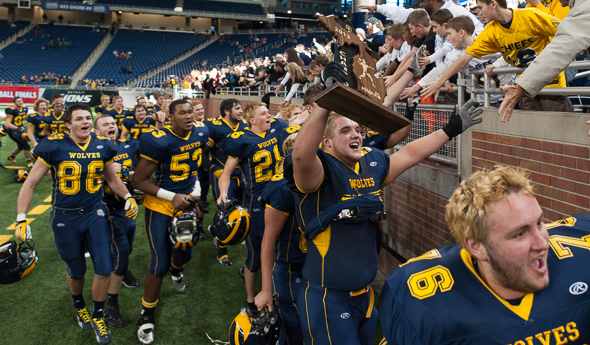
PHOTOS: (Top) Clarkston players trade high fives with fans as they march off the Ford Field turf with their first MHSAA championship trophy. (Middle) Clarkston running back Ian Eriksen runs through the reaching arms of Detroit Catholic Central defenders Saturday. (Click to see more from Terry McNamara Photography.)
Everett 'family' sticks together, wins together
October 19, 2012
By Geoff Kimmerly
Second Half editor
At the end of Thursday’s practice, another chance at history only 24 hours away, Lansing Everett’s football team met for a players-only “family meeting” in the shadow of Archie Ross Stadium’s high concrete bowl.
These brief night-before-game gatherings have become a staple of the Vikings’ best season in more than a quarter century.
With seniors Jaleel Canty and James Mills leading, the players discuss expectations for the team as a whole and each other individually.
This is what was missing two seasons ago when Everett, with 16 of these players on the roster, finished 0-9. The transformation began to take root last fall as the Vikings finished 4-5. Tonight, they can end the regular season 9-0.
“We knew what we could do. We knew our abilities. We’ve known each other since sixth or seventh grade,” Canty said. “We knew that all it took was a little hard work. Everyone dedicated themselves, and we stuck together.
“Honestly, I think it’s because we’re like brothers. We say ‘family’ when we break the huddle, and everyone on this team loves each other. We argue, we fight all the time, but we love each other. We always stick together.”
Everett gets a Second Half High 5 this week because it's one of the top football teams in the state, but also for pulling off a tremendous turnaround – and against a schedule this fall that included annual powerhouses Grand Ledge, Holt, Lansing Sexton, East Lansing and nonleague foe DeWitt.
The Vikings have outscored opponents by a combined 234-64, after being outscored 223-102 during that winless season of 2010. Four this year's seniors joined the varsity as freshmen in 2009, and 15 plus junior quarterback Lucas Barner played significant roles on that winless squad.
History, recent and ancient
Don’t try to stump the Vikings on their family history. They’ve already scoured the Internet to figure out the context of what they’ve accomplished so far – and the meanings behind two important dates:
1986 – The last season, before this fall, that the Vikings won a league championship. The clinched a share of the Capital Area Activities Conference Blue title by beating Sexton last week, and can win it outright tonight at Jackson.
1954 – The last season Everett finished the regular season without a loss, although Canty was quick to point out that team played only eight games. His can finish 9-0.
“They’re excited. They know they’re doing something – or they’re close to doing something,” coach Marcelle Carruthers said.
“We wanted to know if we could make history,” Canty added. “It’s really crazy, seeing where we came from.”
Carruthers said only a handful of players are familiar with the stars that led to Everett’s resurgence last decade – like quarterbacks Mike Canfield and Reggie Williams and receiver Michael Stevenson.
But none are old enough to remember what Carruthers tackled when he took over the struggling program in the spring of 2000.
The streak
From opening night 1995 until Sept. 17, 1999, Everett didn’t win a game. The streak reached 39 losses, and in eight of them the Vikings didn’t score.
Coach Fred Ford shepherded Everett as it finally won that September night and then the next week too before closing 1999 with four more losses. A mission accomplished, he stepped down after the fall – and was at the press conference to greet Carruthers, considered by many the best quarterback and perhaps best player ever from the Lansing area.
Three more losing seasons followed, running that streak to 16 in a row. But the Vikings were making visible strides. Finally, they broke through with a 6-4 finish in 2003 that included the first of four playoff appearances over six seasons before having to hit the restart button again with a 2-7 record in 2009.
As mentioned above, four of these seniors played on that team as freshmen. They were joined by 11 more classmates and Barner among underclassmen in 2010. The record turned ugly, but the experience resulted in 19 returning starters heading into 2011. Everett finished last season 4-5, but with two losses by a combined eight points. Those taught the players what was necessary to finish a winning effort.
“You're always aware of where you came from, and how good it feels now,” said Carruthers, a Lansing Eastern grad who then played and coached at Central Michigan. “But you also have to know the trials and tribulations too, which makes you humble. You appreciate it and you stay humble because you know how (difficult) it is to stay up; you can go right back down.
“So I think about it all the time. I do.”
More to accomplish
Carruthers told his players Thursday how proud of them he is for sticking together and sticking it out.
That often doesn’t happen when programs hit bumps in the road like Everett did the last three years. Players quit, or move to other schools, or keep playing but keep struggling.
But this team always had talent. Canty, a receiver and defensive back, will sign this winter to play next fall at the University of Cincinnati. He's just one of a large group of standouts with Mills, Barner and running back/linebacker Anthony White other names that have been written and said frequently this fall. Senior Alec Cambric has been a pleasant surprise in his first season with the team, emerging as one of the Lansing area’s top running backs.
Regardless of what happens tonight, Everett will make its sixth playoff appearance ever next week. The Vikings have won playoff games only twice, and have never advanced beyond the District Final.
So there are more goals to achieve. And be sure those will be discussed at the next family meeting, as a large group of players who grew up together look to make history one more time.
“We aren’t having any of that playing around, any of that joking. We’re taking it real seriously,” Canty said. “And that’s one of the things we didn’t have our sophomore year when we went 0-9, someone to push us and let us know what we needed to do. And we’ve been there before, as far as losing.
“But we haven’t been here before. This is a first.”
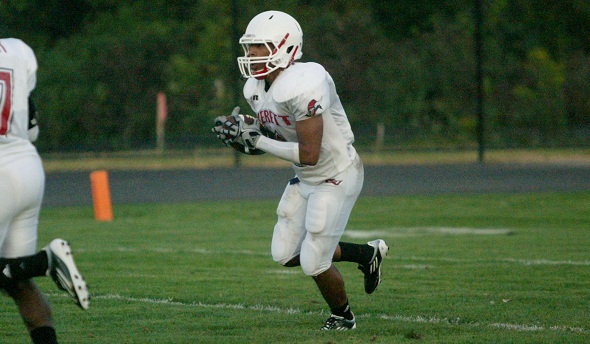
PHOTO: Lansing Everett's Jaleel Canty will sign this winter with the University of Cincinnati and is arguably the top player in the Lansing area this fall. (Click to see more from HighSchoolSportsScene.com).