


Fall 2012 Kicks Off Monday
July 31, 2012
The 2012-13 Fall sports season officially begins next week, when approximately 110,000 student-athletes begin practice in eight sports in which Michigan High School Athletic Association sponsors postseason tournaments.
Practice sessions begin Monday in football, followed by all other sports on Wednesday (Aug. 8). Practice in football must begin Monday for all schools wishing to begin regular-season games the weekend of Aug. 23-26. Schools must have 12 days of preseason practice at all levels before their first games, which may not occur before 16 calendar days. All football schools also must conduct at least three days of practice before beginning contact, and those sessions may not include any pads.
In golf and tennis, competition may commence no earlier than after three separate days of team practice, and not before seven calendar days. The first day competition may take place in golf and tennis is Aug. 15. In all other fall sports, contests can take place after seven days of practice for the team and not before nine calendar days. The first day competition may take place in cross country, soccer, swimming and diving, and volleyball this fall is Aug.17.
This year, two football dates precede Labor Day, and Thursday varsity games will take place both weeks. Subvarsity competition may begin on Wednesday, Aug. 22. In Week 1, 81 games will be played on Thursday, 222 contests will be played on Friday and 23 games will be played on Saturday. The following weekend, 239 games will be played on Thursday, 67 games will be played on Friday and five games will be played on Saturday.
There are several significant rules changes on football for 2012:
On passing plays, a receiver must first contact and establish control of the ball while inbounds – regardless of the opponent’s action. In other words, a catch cannot be ruled on plays where the receiver may have come down in bounds if not for the action of the defender.
If a player’s helmet comes off during a play, and did not occur as a result of a foul by the opponent, that player must leave the game for one play, unless it happens on the final play of a half or an overtime.
Hand contact by a blocker below the waist of a defender is now considered blocking below the waist.
The kicking team may not contact a member of receiving team on a kickoff until the ball has traveled 10 yards, or unless a member of the receiving team initiates the contact.
Jerseys of the visiting team must be white in color, and home jerseys are restricted in the use of white for varsity competition. This was a rule change made in 2007 for implementation this season.
In soccer, Michigan will not participate in a National Federation rules change this year involving the disqualification from a game when a player receives a second yellow card and the subsequent red card. In Michigan, the player will still be ejected from the contest, but that team will not continue the game a player down.
The penalty for a hand ball by a player other than the goalkeeper to prevent a score has been changed. If the goal is prevented, the penalty remains a disqualification of the player; however, if the goal is scored, the penalty will now be a caution to the player who deliberately handled the ball.
There are no substantial rules change in other fall sports.
The 2012 Fall campaign culminates with postseason tournaments beginning with the Upper Peninsula Girls Tennis Finals the week of Oct. 1, and wraps up with the Football Playoff Finals on Nov. 23-24. Here is a complete list of fall tournament dates:
Cross Country:
U.P. Finals -- Oct. 20
L.P. Regionals -- Oct. 26 or 27
L.P. Finals -- Nov. 3
11-Player Football:
Selection Sunday - Oct. 21
Pre-Districts – Oct. 26 or 27
District Finals -- Nov. 2 or 3
Regional Finals -- Nov. 9 or 10
Semifinals -- Nov. 17
Finals -- Nov. 23-24
8-Player Football:
Selection Sunday - Oct. 21
Regional Semifinals – Oct. 26 or 27
Regional Finals -- Nov. 3
Semifinals -- Nov. 10
Finals -- Nov. 16
L.P. Girls Golf:
Regionals -- Oct. 10 or 11 or 12 or 13
Finals -- Oct. 19-20
Soccer:
Boys L.P. Districts -- Oct. 15-20
Boys L.P. Regionals – Oct. 23-27
Boys L.P. Semifinals – Oct. 31
Boys L.P. Finals -- Nov. 3
L.P. Girls Swimming & Diving
Diving Quals -- Nov. 13
Swimming/Diving Finals-Nov. 16-17
Tennis:
U.P. Girls Finals –Oct. 3 or 4 or 5 or 6
L.P. Boys Regionals -- Oct. 11 or 12 or 13
L.P. Finals --Oct. 19-20
Girls Volleyball:
Districts –Oct 29-Nov. 3
Regionals – Nov. 6 & 8
Quarterfinals – Nov. 13
Semifinals – Nov. 15-16
Finals – Nov. 17
2016-17 Parade of Champions
By
Geoff Kimmerly
MHSAA.com senior editor
June 23, 2017
By Geoff Kimmerly
Second Half editor
Birch Run, Detroit Edison Public School Academy, Plymouth Christian Academy and Zeeland East celebrated their first Michigan High School Athletic Association team championships this school year, as 97 schools total won one or more of the 129 Finals titles awarded during 2016-17.
Teams earning the first MHSAA championship in any sport for their schools were Birch Run in girls bowling, Detroit Edison PSA in girls basketball, Plymouth Christian in girls volleyball and Zeeland East in boys track & field.
A total of 31 teams won first MHSAA titles in their respective sports. A total of 54 champions were repeat winners from 2015-16 – and 28 of those won for at least the third straight season, while 14 extended title streaks to at least four consecutive years.
The Birmingham Brother Rice boys lacrosse team has the longest title streak of 13 seasons, while the Petoskey boys skiing team and Marquette girls track & field team share the second-longest streak at seven straight championships.
Marquette claimed the most MHSAA team titles, five, winning in Division 1 boys skiing and Division 1 girls skiing, Upper Peninsula boys swimming & diving, and Upper Peninsula Division 1 boys track & field and girls track & field. All five were repeat championship wins. No other school won four or more titles, but six more schools won three: Birmingham Brother Rice, Bloomfield Hills Cranbrook Kingswood, East Grand Rapids, Midland Dow, Negaunee and Rockford.
Also claiming multiple championships were Detroit Catholic Central, Detroit Country Day, East Kentwood, Escanaba, Grand Rapids Catholic Central, Grand Rapids Forest Hills Central, Ishpeming, Ishpeming Westwood, Jackson Lumen Christi, Lowell, Munising, Pewamo-Westphalia, Powers North Central, Rochester, St. Ignace and Vandercook Lake.
Sixteen of the MHSAA's 28 championship tournaments are unified, involving teams from the Upper and Lower Peninsulas, while separate competition to determine titlists in both Peninsulas is conducted in remaining sports.
For a sport-by-sport listing of MHSAA champions for 2016-17: Click Here.
The MHSAA is a private, not-for-profit corporation of voluntary membership by more than 1,400 public and private senior high schools and junior high/middle schools which exists to develop common rules for athletic eligibility and competition. No government funds or tax dollars support the MHSAA, which was the first such association nationally to not accept membership dues or tournament entry fees from schools. Member schools which enforce these rules are permitted to participate in MHSAA tournaments, which attract more than 1.4 million spectators each year.
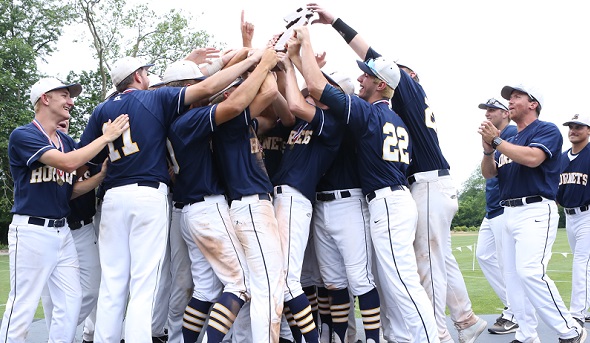
PHOTO: The Saline baseball team celebrates its first MHSAA championship Saturday at Michigan State University.