


Fall 2012 Kicks Off Monday
July 31, 2012
The 2012-13 Fall sports season officially begins next week, when approximately 110,000 student-athletes begin practice in eight sports in which Michigan High School Athletic Association sponsors postseason tournaments.
Practice sessions begin Monday in football, followed by all other sports on Wednesday (Aug. 8). Practice in football must begin Monday for all schools wishing to begin regular-season games the weekend of Aug. 23-26. Schools must have 12 days of preseason practice at all levels before their first games, which may not occur before 16 calendar days. All football schools also must conduct at least three days of practice before beginning contact, and those sessions may not include any pads.
In golf and tennis, competition may commence no earlier than after three separate days of team practice, and not before seven calendar days. The first day competition may take place in golf and tennis is Aug. 15. In all other fall sports, contests can take place after seven days of practice for the team and not before nine calendar days. The first day competition may take place in cross country, soccer, swimming and diving, and volleyball this fall is Aug.17.
This year, two football dates precede Labor Day, and Thursday varsity games will take place both weeks. Subvarsity competition may begin on Wednesday, Aug. 22. In Week 1, 81 games will be played on Thursday, 222 contests will be played on Friday and 23 games will be played on Saturday. The following weekend, 239 games will be played on Thursday, 67 games will be played on Friday and five games will be played on Saturday.
There are several significant rules changes on football for 2012:
On passing plays, a receiver must first contact and establish control of the ball while inbounds – regardless of the opponent’s action. In other words, a catch cannot be ruled on plays where the receiver may have come down in bounds if not for the action of the defender.
If a player’s helmet comes off during a play, and did not occur as a result of a foul by the opponent, that player must leave the game for one play, unless it happens on the final play of a half or an overtime.
Hand contact by a blocker below the waist of a defender is now considered blocking below the waist.
The kicking team may not contact a member of receiving team on a kickoff until the ball has traveled 10 yards, or unless a member of the receiving team initiates the contact.
Jerseys of the visiting team must be white in color, and home jerseys are restricted in the use of white for varsity competition. This was a rule change made in 2007 for implementation this season.
In soccer, Michigan will not participate in a National Federation rules change this year involving the disqualification from a game when a player receives a second yellow card and the subsequent red card. In Michigan, the player will still be ejected from the contest, but that team will not continue the game a player down.
The penalty for a hand ball by a player other than the goalkeeper to prevent a score has been changed. If the goal is prevented, the penalty remains a disqualification of the player; however, if the goal is scored, the penalty will now be a caution to the player who deliberately handled the ball.
There are no substantial rules change in other fall sports.
The 2012 Fall campaign culminates with postseason tournaments beginning with the Upper Peninsula Girls Tennis Finals the week of Oct. 1, and wraps up with the Football Playoff Finals on Nov. 23-24. Here is a complete list of fall tournament dates:
Cross Country:
U.P. Finals -- Oct. 20
L.P. Regionals -- Oct. 26 or 27
L.P. Finals -- Nov. 3
11-Player Football:
Selection Sunday - Oct. 21
Pre-Districts – Oct. 26 or 27
District Finals -- Nov. 2 or 3
Regional Finals -- Nov. 9 or 10
Semifinals -- Nov. 17
Finals -- Nov. 23-24
8-Player Football:
Selection Sunday - Oct. 21
Regional Semifinals – Oct. 26 or 27
Regional Finals -- Nov. 3
Semifinals -- Nov. 10
Finals -- Nov. 16
L.P. Girls Golf:
Regionals -- Oct. 10 or 11 or 12 or 13
Finals -- Oct. 19-20
Soccer:
Boys L.P. Districts -- Oct. 15-20
Boys L.P. Regionals – Oct. 23-27
Boys L.P. Semifinals – Oct. 31
Boys L.P. Finals -- Nov. 3
L.P. Girls Swimming & Diving
Diving Quals -- Nov. 13
Swimming/Diving Finals-Nov. 16-17
Tennis:
U.P. Girls Finals –Oct. 3 or 4 or 5 or 6
L.P. Boys Regionals -- Oct. 11 or 12 or 13
L.P. Finals --Oct. 19-20
Girls Volleyball:
Districts –Oct 29-Nov. 3
Regionals – Nov. 6 & 8
Quarterfinals – Nov. 13
Semifinals – Nov. 15-16
Finals – Nov. 17
Everett 'family' sticks together, wins together
October 19, 2012
By Geoff Kimmerly
Second Half editor
At the end of Thursday’s practice, another chance at history only 24 hours away, Lansing Everett’s football team met for a players-only “family meeting” in the shadow of Archie Ross Stadium’s high concrete bowl.
These brief night-before-game gatherings have become a staple of the Vikings’ best season in more than a quarter century.
With seniors Jaleel Canty and James Mills leading, the players discuss expectations for the team as a whole and each other individually.
This is what was missing two seasons ago when Everett, with 16 of these players on the roster, finished 0-9. The transformation began to take root last fall as the Vikings finished 4-5. Tonight, they can end the regular season 9-0.
“We knew what we could do. We knew our abilities. We’ve known each other since sixth or seventh grade,” Canty said. “We knew that all it took was a little hard work. Everyone dedicated themselves, and we stuck together.
“Honestly, I think it’s because we’re like brothers. We say ‘family’ when we break the huddle, and everyone on this team loves each other. We argue, we fight all the time, but we love each other. We always stick together.”
Everett gets a Second Half High 5 this week because it's one of the top football teams in the state, but also for pulling off a tremendous turnaround – and against a schedule this fall that included annual powerhouses Grand Ledge, Holt, Lansing Sexton, East Lansing and nonleague foe DeWitt.
The Vikings have outscored opponents by a combined 234-64, after being outscored 223-102 during that winless season of 2010. Four this year's seniors joined the varsity as freshmen in 2009, and 15 plus junior quarterback Lucas Barner played significant roles on that winless squad.
History, recent and ancient
Don’t try to stump the Vikings on their family history. They’ve already scoured the Internet to figure out the context of what they’ve accomplished so far – and the meanings behind two important dates:
1986 – The last season, before this fall, that the Vikings won a league championship. The clinched a share of the Capital Area Activities Conference Blue title by beating Sexton last week, and can win it outright tonight at Jackson.
1954 – The last season Everett finished the regular season without a loss, although Canty was quick to point out that team played only eight games. His can finish 9-0.
“They’re excited. They know they’re doing something – or they’re close to doing something,” coach Marcelle Carruthers said.
“We wanted to know if we could make history,” Canty added. “It’s really crazy, seeing where we came from.”
Carruthers said only a handful of players are familiar with the stars that led to Everett’s resurgence last decade – like quarterbacks Mike Canfield and Reggie Williams and receiver Michael Stevenson.
But none are old enough to remember what Carruthers tackled when he took over the struggling program in the spring of 2000.
The streak
From opening night 1995 until Sept. 17, 1999, Everett didn’t win a game. The streak reached 39 losses, and in eight of them the Vikings didn’t score.
Coach Fred Ford shepherded Everett as it finally won that September night and then the next week too before closing 1999 with four more losses. A mission accomplished, he stepped down after the fall – and was at the press conference to greet Carruthers, considered by many the best quarterback and perhaps best player ever from the Lansing area.
Three more losing seasons followed, running that streak to 16 in a row. But the Vikings were making visible strides. Finally, they broke through with a 6-4 finish in 2003 that included the first of four playoff appearances over six seasons before having to hit the restart button again with a 2-7 record in 2009.
As mentioned above, four of these seniors played on that team as freshmen. They were joined by 11 more classmates and Barner among underclassmen in 2010. The record turned ugly, but the experience resulted in 19 returning starters heading into 2011. Everett finished last season 4-5, but with two losses by a combined eight points. Those taught the players what was necessary to finish a winning effort.
“You're always aware of where you came from, and how good it feels now,” said Carruthers, a Lansing Eastern grad who then played and coached at Central Michigan. “But you also have to know the trials and tribulations too, which makes you humble. You appreciate it and you stay humble because you know how (difficult) it is to stay up; you can go right back down.
“So I think about it all the time. I do.”
More to accomplish
Carruthers told his players Thursday how proud of them he is for sticking together and sticking it out.
That often doesn’t happen when programs hit bumps in the road like Everett did the last three years. Players quit, or move to other schools, or keep playing but keep struggling.
But this team always had talent. Canty, a receiver and defensive back, will sign this winter to play next fall at the University of Cincinnati. He's just one of a large group of standouts with Mills, Barner and running back/linebacker Anthony White other names that have been written and said frequently this fall. Senior Alec Cambric has been a pleasant surprise in his first season with the team, emerging as one of the Lansing area’s top running backs.
Regardless of what happens tonight, Everett will make its sixth playoff appearance ever next week. The Vikings have won playoff games only twice, and have never advanced beyond the District Final.
So there are more goals to achieve. And be sure those will be discussed at the next family meeting, as a large group of players who grew up together look to make history one more time.
“We aren’t having any of that playing around, any of that joking. We’re taking it real seriously,” Canty said. “And that’s one of the things we didn’t have our sophomore year when we went 0-9, someone to push us and let us know what we needed to do. And we’ve been there before, as far as losing.
“But we haven’t been here before. This is a first.”
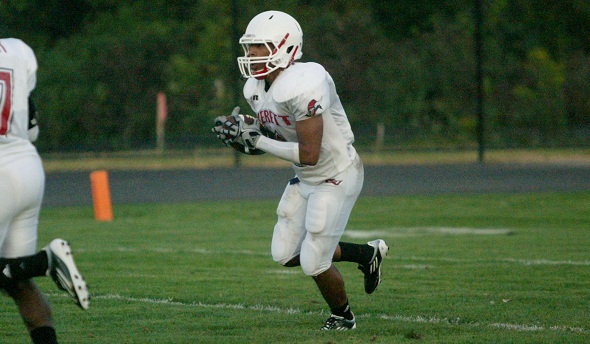
PHOTO: Lansing Everett's Jaleel Canty will sign this winter with the University of Cincinnati and is arguably the top player in the Lansing area this fall. (Click to see more from HighSchoolSportsScene.com).