


Fall 2012 Kicks Off Monday
July 31, 2012
The 2012-13 Fall sports season officially begins next week, when approximately 110,000 student-athletes begin practice in eight sports in which Michigan High School Athletic Association sponsors postseason tournaments.
Practice sessions begin Monday in football, followed by all other sports on Wednesday (Aug. 8). Practice in football must begin Monday for all schools wishing to begin regular-season games the weekend of Aug. 23-26. Schools must have 12 days of preseason practice at all levels before their first games, which may not occur before 16 calendar days. All football schools also must conduct at least three days of practice before beginning contact, and those sessions may not include any pads.
In golf and tennis, competition may commence no earlier than after three separate days of team practice, and not before seven calendar days. The first day competition may take place in golf and tennis is Aug. 15. In all other fall sports, contests can take place after seven days of practice for the team and not before nine calendar days. The first day competition may take place in cross country, soccer, swimming and diving, and volleyball this fall is Aug.17.
This year, two football dates precede Labor Day, and Thursday varsity games will take place both weeks. Subvarsity competition may begin on Wednesday, Aug. 22. In Week 1, 81 games will be played on Thursday, 222 contests will be played on Friday and 23 games will be played on Saturday. The following weekend, 239 games will be played on Thursday, 67 games will be played on Friday and five games will be played on Saturday.
There are several significant rules changes on football for 2012:
On passing plays, a receiver must first contact and establish control of the ball while inbounds – regardless of the opponent’s action. In other words, a catch cannot be ruled on plays where the receiver may have come down in bounds if not for the action of the defender.
If a player’s helmet comes off during a play, and did not occur as a result of a foul by the opponent, that player must leave the game for one play, unless it happens on the final play of a half or an overtime.
Hand contact by a blocker below the waist of a defender is now considered blocking below the waist.
The kicking team may not contact a member of receiving team on a kickoff until the ball has traveled 10 yards, or unless a member of the receiving team initiates the contact.
Jerseys of the visiting team must be white in color, and home jerseys are restricted in the use of white for varsity competition. This was a rule change made in 2007 for implementation this season.
In soccer, Michigan will not participate in a National Federation rules change this year involving the disqualification from a game when a player receives a second yellow card and the subsequent red card. In Michigan, the player will still be ejected from the contest, but that team will not continue the game a player down.
The penalty for a hand ball by a player other than the goalkeeper to prevent a score has been changed. If the goal is prevented, the penalty remains a disqualification of the player; however, if the goal is scored, the penalty will now be a caution to the player who deliberately handled the ball.
There are no substantial rules change in other fall sports.
The 2012 Fall campaign culminates with postseason tournaments beginning with the Upper Peninsula Girls Tennis Finals the week of Oct. 1, and wraps up with the Football Playoff Finals on Nov. 23-24. Here is a complete list of fall tournament dates:
Cross Country:
U.P. Finals -- Oct. 20
L.P. Regionals -- Oct. 26 or 27
L.P. Finals -- Nov. 3
11-Player Football:
Selection Sunday - Oct. 21
Pre-Districts – Oct. 26 or 27
District Finals -- Nov. 2 or 3
Regional Finals -- Nov. 9 or 10
Semifinals -- Nov. 17
Finals -- Nov. 23-24
8-Player Football:
Selection Sunday - Oct. 21
Regional Semifinals – Oct. 26 or 27
Regional Finals -- Nov. 3
Semifinals -- Nov. 10
Finals -- Nov. 16
L.P. Girls Golf:
Regionals -- Oct. 10 or 11 or 12 or 13
Finals -- Oct. 19-20
Soccer:
Boys L.P. Districts -- Oct. 15-20
Boys L.P. Regionals – Oct. 23-27
Boys L.P. Semifinals – Oct. 31
Boys L.P. Finals -- Nov. 3
L.P. Girls Swimming & Diving
Diving Quals -- Nov. 13
Swimming/Diving Finals-Nov. 16-17
Tennis:
U.P. Girls Finals –Oct. 3 or 4 or 5 or 6
L.P. Boys Regionals -- Oct. 11 or 12 or 13
L.P. Finals --Oct. 19-20
Girls Volleyball:
Districts –Oct 29-Nov. 3
Regionals – Nov. 6 & 8
Quarterfinals – Nov. 13
Semifinals – Nov. 15-16
Finals – Nov. 17
A Game for Every Fan: Week 9
October 18, 2012
By Geoff Kimmerly
Second Half editor
Most of this weekend is about numbers for hopeful MHSAA football teams.
There are still a few league titles to award. Some are listed below. But much of the focus is on the 256-team playoff field that will be determined Sunday. As of this morning, 178 teams have achieved automatic berths.
Some other numbers of note:
- Only five games this weekend feature 5-3 teams facing each other. That means at least five more teams will be added to the automatic qualifier list.
- Six 5-3 teams face undefeated opponents, and 16 5-3 teams face opponents that have only one loss.
- A total of 31 teams face opponents with six or more losses, including eight that face teams that haven't won this fall.
See below for some of the most significant games being played in every corner of the state. Visit the MHSAA Score Center all weekend for updated scores and standings, and tune in to Fox Sports Detroit at 6 p.m. Sunday for the Selection Sunday Show.
(All games below are tonight unless noted. Go to Score Center for additional dates and kickoff times.)
Greater Detroit
Detroit Catholic Central (5-3) vs. Orchard Lake St. Mary (6-2), Saturday at Ford Field
The Detroit Catholic League Central title had seemed all but sown up by the Eaglets before DCC’s stunning 35-13 win last week that pushed Brother Rice out of this Prep Bowl game and set up this rematch instead. But two of DCC’s losses were to Ohio powers and it’s fast becoming the expectation for three Catholic League Central teams to make runs at MHSAA Finals.
Others that caught my eye: Detroit Martin Luther King (5-3) vs. Detroit East English (7-1) at Ford Field, Clarkston (8-0) at Oak Park (7-1), Allen Park Cabrini (6-2) vs. Detroit Loyola (8-0), Saturday at Ford Field; Ann Arbor Gabriel Richard (7-1) vs. Pontiac Notre Dame (8-0), Saturday at Ford Field.
Upper Peninsula
Kingsford (7-1) at Escanaba (4-4)
The Flivvers have secured a share of the Great Northern Upper Peninsula Conference title, but can win it outright with one more victory tonight. That would appear likely as Kingsford has beaten Escanaba in 12 straight. But the Eskymos are holding onto a faint hope of making the playoffs at 5-4, and winning this one would go a long way beyond the obvious toward making that happen.
Others that caught my eye: Lake Linden-Hubbell (4-4) at Crystal Falls Forest Park (6-2), Bellaire (5-3) at Rapid River (7-1), Cheboygan (6-2) at St. Ignace La Salle (8-0), Powers North Central (5-3) at Stephenson (6-2).
Mid-Michigan
Holt (5-3) at Grand Ledge (6-2)
This may be the best rivalry in the Lansing area. These are the only regular Division 1 teams, and they’ve split their last 10 meetings. With it unlikely that Lansing Everett will lose to winless Jackson tonight, Grand Ledge probably won’t gain a share of the Capital Area Activities Conference Blue title. But the Comets can continue to improve their playoff point average – and possibly keep Holt from qualifying at all.
Others that caught my eye: Portland (7-1) at Charlotte (6-2), Fruitport (8-0) at DeWitt (6-2), Grass Lake (7-1) at Leslie (8-0), Mendon (8-0) at Pewamo-Westphalia (6-2).
Thumb and Bay
Midland Dow (5-3) at Midland (8-0)
The Chemics secured a share of the Saginaw Valley Association North title by defeating Bay City Western last week, but easily could end up sharing the championship. Western plays Bay City Central, a tough foe, but perhaps not as tough as the Chemics run against in Dow – which must win to secure a playoff berth. Midland has won nine of the last 10 against the Chargers.
Others that caught my eye: Vassar (7-1) at Frankenmuth (8-0), Montrose (7-1) at Lake Fenton (7-1), Linden (7-1) at Swartz Creek (7-1), Lapeer West (6-2) at Fenton (7-1).
West Michigan
Muskegon (8-0) at Zeeland East (8-0)
Muskegon might’ve left a more competitive conference top to bottom when it moved from the O-K Red to Black after last season. But it still has to face a similarly tough foe for the title in the Chix. Zeeland East is seeking its second league title in three seasons; Muskegon its first since 2008, plus the possibility of home playoff games through Regionals.
Others that caught my eye: Lowell (7-1) at Grand Rapids Christian (7-1), Hastings (6-2) at Grand Rapids South Christian (5-3), Grand Rapids Northview (7-1) at Grand Rapids West Catholic (5-3), Hamilton (5-3) at Hudsonville Unity Christian (4-4).
Lower Up North
Boyne City (8-0) at Grayling (8-0)
These teams have succeeded in avoiding all obstacles on the way to this deciding game in the Lake Michigan Conference, which was dominated lately by Traverse City St. Francis before the Gladiators left the league after this spring. Grayling has won their last three meetings by at least 27 points and is going for its first perfect season since at least 1950 (the 1970 team didn’t lose, but had a tie). Boyne City is hoping for its first perfect regular season since 2001.
Others that caught my eye: Elk Rapids (4-4) at Kalkaska (6-2), Menominee (7-1) at Petoskey (5-3), Muskegon Catholic Central (5-3) at Traverse City St. Francis (4-4), Mayville (5-3) at Big Rapids Crossroads (0-8).
Southwest and Border
Lawton (7-1) at Watervliet (8-0)
Watervliet can claim the Southwestern Athletic Conference South championship for the second straight season and is averaging 50 points per game in league play. Lawton would love to get the title back after winning in 2010 but falling to Watervliet in the deciding game last season.
Others that caught my eye: Otsego (6-2) at Dowagiac (8-0), Paw Paw (8-0) at Edwardsburg (6-2), Portage Northern (7-1) at Mattawan (7-1), Portland St. Patrick (8-0) at Waldron (6-2).
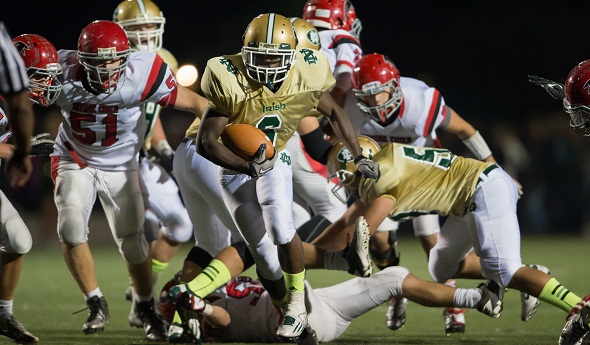
PHOTO: Pontiac Notre Dame, here against Dearborn Divine Child, will face Ann Arbor Gabriel Richard in a Prep Bowl game Saturday at Ford Field. (Click to see more at Terry McNamara Photography.)